
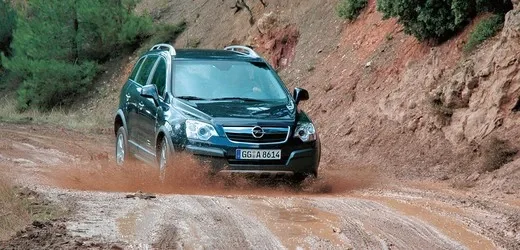
Lightning to the face
You can't call the Antara faceless, although you wouldn't call it super original either. Stylish headlights, clearly inspired by the GTC concept, striking "gills" at the junction of the front fenders and doors, a broken hood line, and rear lights that don't let you get bored — all this comes together into a cohesive and harmonious image. The chrome strip on the faux radiator grille, topped with the signature "lightning bolt," looks very fitting.Round inside
The Antara's interior, frankly, brings on melancholy. Perhaps we were just unlucky — we got a version with dreary light gray on dark gray. But personally, the interior design didn't bring me joy. True, the official disc showed a variant with beige inserts on the panel and the same upholstery on seats and doors — that's a completely different matter! As for shapes, only the three round ventilation deflectors stand out from the overall modest picture. But the steering wheel is excellent — sporty, plump like a bagel, with sensibly placed column-mounted and column-top switches for climate control, cruise control, and audio system. The seating position is quite comfortable. The seats, unlike the dashboard and round deflectors, are not sporty and not even too firm, which is untypical for Germans, but they are comfortable. And what more do you need? All controls are intuitive and lie exactly where they should be. Unlike the Captiva, the new Opel is a five-seater. Inside, it's not more spacious than the Chevy, but at least there's a trunk. There's also an intriguing option — the FlexFix mounting system. This mechanism, hidden under the cargo floor and sliding out from the rear bumper, strongly resembles a bicycle carrier platform that attaches to a tow hitch. But instead of bikes, you can load a hefty chest with supplies for a month onto it or roll up to Oktoberfest with your own refrigerator.Dust of roads, mists of mountains
The Antara test took place in the mountains of Greece. First, the sun was shining, and we had plenty of driving on the narrow roads of the Greek province, while also kicking up dust on the dirt tracks of the local reserve. There was no serious off-roading there, and the Antara isn't really inclined toward it anyway. But there were plenty of mountain serpentines. Especially since part of the turns and "mother-in-law's tongues" fell on roads with worn-out surfaces, or even without any surface at all. The Antara responds beautifully to the steering wheel, which can't be said for the suspension — it could use a fair share of stiffness. Ride comfort is decent, and trajectory stability is better than directional stability: on a broken road, especially where longitudinal irregularities are interspersed with transverse ones, the Opel doesn't want to go straight and requires constant, albeit slight, steering correction. But in a corner, the Antara allows you to hold the trajectory very precisely. True, it does so with noticeable body roll and pitching, but the wheels follow the imaginary arc like on rails! Moreover, the steering response makes you want to turn it even faster and sharper. On the second day, the mountains along the route were shrouded in thick fog. Speeds dropped, and I went looking for off-road. In Greece, that turned out to be no easy task: all exits from the asphalt are either blocked by barriers or dug up. Still, I managed to get the wheels hanging and feel out the geometric clearance. The Antara's all-wheel drive engages automatically, following the most fashionable scheme: the front axle is the drive axle, and the rear is connected via a multi-disc clutch with electric drive, hidden in the rear differential housing. Torque is distributed equally between the axles, and during diagonal wheel hanging, the traction control system kicks in. There's also a hill descent assistant and a stability control system for asphalt. In real conditions, it turned out that the traction control system has a kind of fuse that prevents exceeding the permissible load on the transmission and running gear. Simply put, as soon as the force on the half-axle becomes critical, the wheels start to slip. And given that the low-end torque of the diesel we got isn't impressive, I wouldn't compete in a trial in the Antara. Nor would I go crawling over large rocks. Besides, its underbody protection is plastic. But everything that could be tucked away is tucked away — nothing hangs down.The Opel Antara has plenty of rivals. The same Captiva, for one. It's hard to say exactly what this car should use to hook its future owner. The top modification with a 3.2-liter V6 gasoline engine will cost around 30,000 euros, and for that money, quite serious Korean and American SUVs are already offered. Take the same Rexton or Sorento. They're not crossovers, of course, but the price tag is comparable... In short, a product created almost by genetic engineering methods has a decent set of advantages, but it raised more questions in me than it gave ready answers.