
The base version of the Antara with a four-cylinder engine has already taken part in a crossover comparison. Back then, it lost to the Toyota RAV4 and Nissan X-Trail, but the question of how the top version with the V6 behaves remained open. "Check it," I was told. Well, let's check.
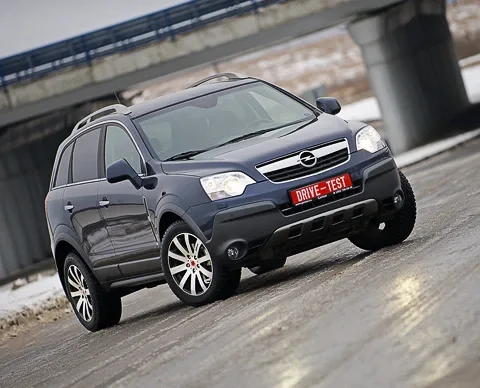
The Antara is stuck somewhere between segments: it's larger than the Toyota RAV4 or Honda CR-V, but it doesn't quite reach the level of crossovers like the Mazda CX-7, Hyundai Santa Fe, and Mitsubishi Outlander XL.
Externally, the version with the 3.2 engine is indistinguishable from the base one. So I immediately dive inside — to the already familiar excellent seats and proper driving position. Settling behind the wheel, I again catch myself thinking: there's absolutely nowhere to put my phone, and I'll have to get used to the onboard computer controls again.
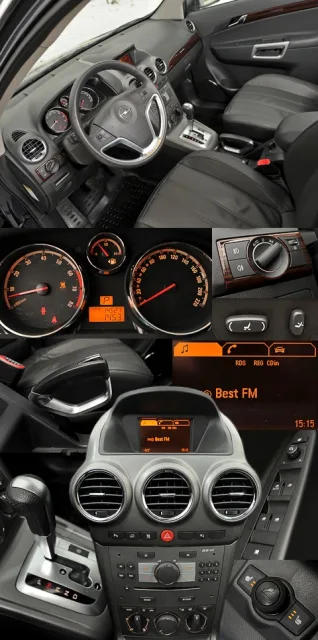
In terms of trim material quality, only European cars can beat the Antara. The "Japanese" and other "Koreans" are no competition. On the other hand, the Corsa, which costs half as much, has an interior that's not much worse.
- The onboard computer controls are simpler but still require getting used to.
- The steering column switches are finally fixed.
- The seat heating buttons are inconveniently located.
- Only the driver's seat has power adjustments.
- The handbrake is exactly like the one on the Antara's "brother," the Chevrolet Captiva crossover.
We've already come to terms with the fact that Koreans can make decent cars. Although we still look at Hyundai Genesis (or even Grandeur) owners with surprise, if not a smirk. And the phrase "expensive Korean car" no longer sounds like an oxymoron. And it goes further: we're getting used to branded products from Korea, which, by the way, are sold at quite adult prices, without dumping. Like the Antara, for example.
The build quality is top-notch: in that comparative test, the Toyota RAV4 and Nissan X-Trail seemed to regret not being from Korea themselves. Among inexpensive crossovers, it's hard to recall a car with such a solid interior. Except maybe the Tiguan or Kuga.
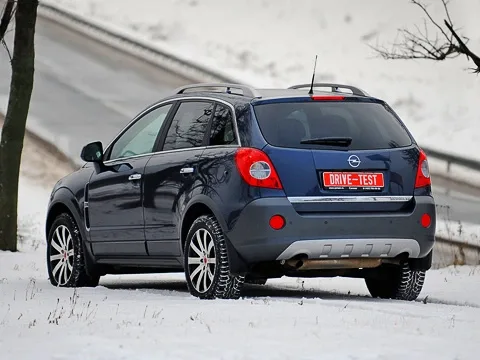
The top version of the Antara can be distinguished only by the badges and two exhaust pipes.
The assembly — first Korean, then Russian (our example was finished at the St. Petersburg "Arsenal" plant) — raises almost no complaints. Does the center panel creak? I heard the same sound in the luxurious Lexus LS 600h. Is the steering wheel slightly off-center? My Golf GTI had the same issue. The only thing that surprises me: on a car worth a million with just 1,500 kilometers on the odometer, I noticed rust marks on the tailgate.
Of course, you can't win a battle against competitors with just the interior. Last time, I got the version with the ancient Holden 2.4 engine — not very torquey (140 hp and 220 N•m), but noisy and vibration-heavy. It was paired with a frankly lazy five-speed automatic.
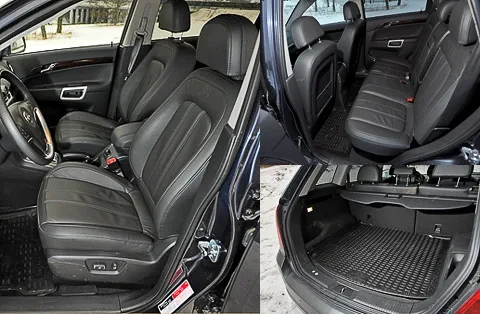
The front seats are purely German: firm, with a good profile and decent side support. Five points. There's also enough room in the back, but the trunk is small and has a very high loading height.
The new aluminum V6 3.2, as expected, sounds velvety and drives noticeably more briskly, especially after four thousand rpm. But the gearbox, it seems, didn't notice the change of partner and continues to work on the old principle: "Wait to execute — they might cancel." When overtaking, you press the gas pedal and wait, wait, wait... By the time the gearbox deigns to wake up, the desire to overtake has already faded. Okay, I exaggerated. But why, at three thousand rpm, does the "automatic" stubbornly refuse to downshift, even if you floor the pedal?
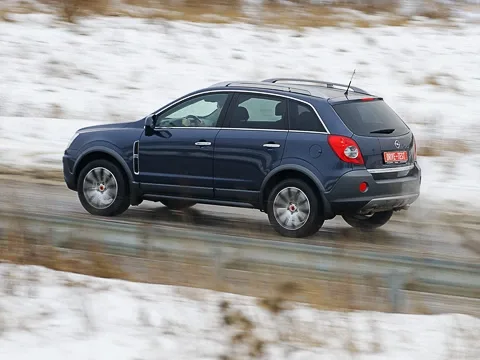
On the highway, the Antara drives confidently, but small trajectory deviations and sensitivity to ruts prevent it from earning the title of a high-speed liner.
The result is paradoxical: there's power, but you don't want to use it. The car simply doesn't encourage fast driving. I didn't push it on the highway — the Antara's directional stability, while decent, isn't brilliant: you constantly have to correct the steering, fight ruts and crosswinds. On average, I drove about 20 km/h slower than in a regular car. Yet fuel consumption still came to 17 liters per 100 km. But the brakes — no complaints at all: informative and grippy.
What about comfort? In a calm rhythm, the "automatic" starts smoothly and doesn't jerk on shifts, and the sound insulation is pleasing too. Driving the Antara at a measured pace is a pleasure! But the suspension... It swallows large bumps confidently, but on small joints and seams it falters — every asphalt defect is felt in the seat.
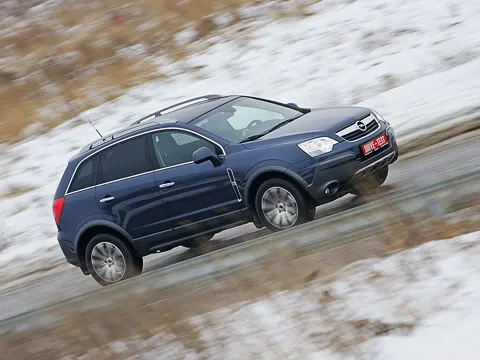
And handling? None at all! There's effort on the steering wheel (the Antara, unlike the related Captiva, has a variable-assist hydraulic power steering), and the road feel is decent. Corners — a "C minus": even with more advanced dampers than the Captiva, body roll is still too much, and responses to steering inputs lag. On slippery surfaces, the all-wheel-drive Antara behaves almost like a two-wheel-drive one — it's practically impossible to kick the tail out with the throttle. Only understeer, and nothing but understeer! And it's clear why: the electromagnetic clutch that engages the rear axle has a delay of up to two seconds.
This is most problematic off-road: while the rear engages, the front wheels manage to spin. Get stuck in mud — and you're done for. Although there are worse transmissions; I've seen them. But the main thing is that for most owners, this is enough for the dacha: they care more about ground clearance and suspension energy capacity than clutch algorithms. And here the Antara is fine: short overhangs, and a decent 200 millimeters of ground clearance. You fly over broken dirt roads at full speed — and nothing happens. The stability control is also good: it gently brings the car back on track and doesn't strangle the engine more than necessary.
Practicality is in perfect order: the cabin is neither cramped nor spacious; the trunk is average. Total mediocrity — and that's already about the car itself. It's normal. Normal, but nothing special. Yes, it drives. But without enthusiasm. It corners decently. But not excellently. It can get you somewhere, but getting out isn't always possible. This verdict is most often given to Korean cars. And if we were to do a comparative test of the Antara and the Captiva, the conclusion would be simple: the former has better trim and sound insulation, while the latter is a seven-seater. And that's essentially all the differences of the "German"!
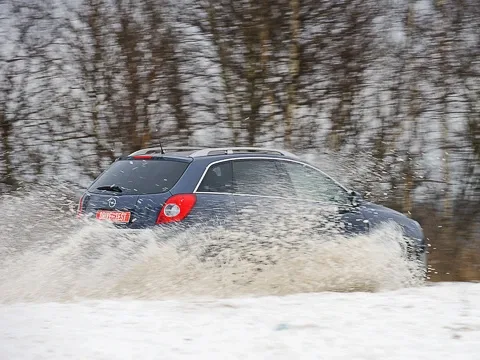
The electromagnetic clutch on the Antara engages the rear wheels with a significant delay — up to two seconds. On hard ground, that's tolerable, but on slippery surfaces and in corners, such behavior doesn't add confidence.
And you'll have to get used to this. Following General Motors, the Renault-Nissan alliance has started mastering such tricks — look at the Renault Koleos or Nissan Almera Classic. And the GM folks themselves are going further: they want to entrust the Korean division with the development of almost all of the concern's compact models. It's profitable, and the car turns out quite competitive. After all, Japanese LCD TVs use Samsung panels, and Japanese anime is drawn on order in Korea.
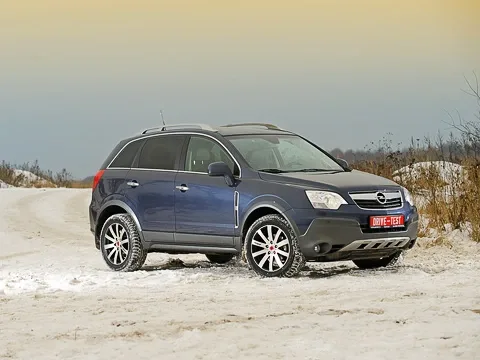
There's nothing to praise the Antara for, and nothing to scold it for either! Or is it the other way around? Ask anyone who's been to South Korea: whether it's a washing machine or a regular car, the attitude is the same. And Koreans choose colors — all shades of gray. Of course, the Antara is just a mid-size crossover, and expecting a miracle from it would be naive. But if the car's creators aren't infected with the virus of car enthusiasm, then the result of their work will be tempting to call, in marketing terms, a product. I can consume it without difficulty. But enjoy it — hardly.
I studied the technical specifications of the Opel Antara 3.2 from the table, and I will describe my impressions from the drive below.
**Body and dimensions**
This is a five-door crossover for five seats. The body length is 4575 mm, width is 1850 mm, height is 1704 mm. The wheelbase is 2707 mm, the track front and rear is 1578 and 1574 mm respectively. The curb weight is 1865 kg, and the gross weight varies from 2272 to 2505 kg. The trunk holds from 370 to 1420 liters depending on the position of the rear seats.
**Engine and transmission**
Under the hood is a gasoline V6 engine with a displacement of 3.2 liters with distributed injection. The engine is located transversely at the front, has 24 valves and produces 227 horsepower at 6600 rpm. The torque is 297 N·m, available at 3200 rpm. The engine works in conjunction with a five-speed automatic transmission, and the drive is all-wheel drive.
**Chassis and off-road capability**
At the front is an independent spring suspension of the MacPherson type, at the rear is an independent multi-link suspension. The brakes are disc brakes, ventilated on both axles. The ground clearance is 200 mm. The approach and departure angles are 24 and 23 degrees, the ramp angle is 18.2 degrees. The vehicle can ford water up to 450 mm deep.
**Operational indicators**
The maximum speed is 203 km/h, acceleration to 100 km/h takes 9.3 seconds. Fuel consumption in the urban cycle is 16.4 liters per 100 km, outside the city is 8.9 liters, in combined mode is 11.6 liters. The tank holds 65 liters, fuel is AI-95. The environmental standard is Euro-4.
**Equipment**
The base version includes front and side airbags, inflatable curtains, fog lights, a stability control system with trailer stabilization function, a light sensor, heated front seats, climate control, fabric upholstery, a CD audio system with MP3, electric adjustments for the driver's seat, and leather trim on the steering wheel and gear lever.
The Cosmo version additionally offers leather interior trim, metallic paint, front and rear parking sensors, electric adjustment of the driver's seat, a DVD100 Navi navigation system, an onboard computer, Bluetooth support, cruise control, and a rear suspension with automatic ground clearance support.
The price of the base configuration is 1,159,900 rubles, the tested car cost 1,172,900 rubles.
Technical 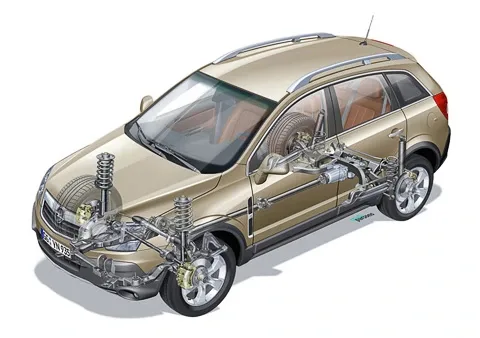
Opel Antara and its twin Chevrolet Captiva are built on the Theta platform (also used for Chevrolet Equinox, Pontiac Torrent, and Saturn Vue). At the front are MacPherson struts, at the rear is a multi-link suspension. In Europe and the USA (where Antara is sold as Saturn Vue), front-wheel-drive versions are also available.
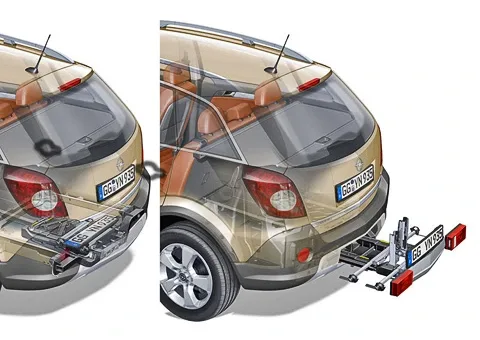
As an option for Antara, a retractable bicycle carrier is offered, like on the Corsa hatchback.
Design 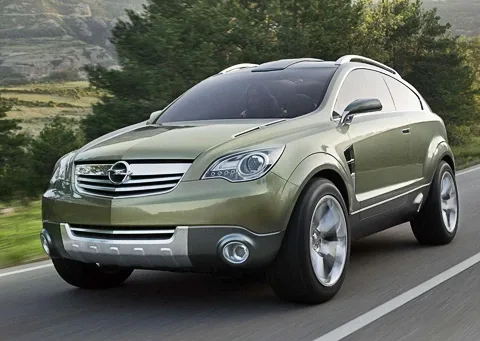
The Opel Antara GTC concept with a three-door body was shown in 2005 at the Frankfurt auto show. The production car, which appeared two years later, retained the main design features, but, alas, lost the energy of the show car. By the way, it is interesting that the Antara GTC concept was also shown in the States, initially changing the emblem to Saturn.
Behind the scenes 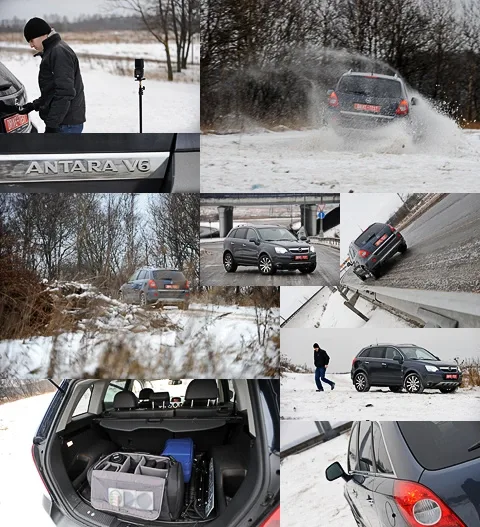
This time we were lucky with the weather. Right before the test, snowfall began, and there was plenty of slippery surface. However, while driving through fields and forests, we got so carried away that we accidentally almost drove onto the territory of some military base. Seeing a couple of "green men" with machine guns, we quickly turned around and went on our way. Otherwise, who knows, they might have taken us for German spies. Or Korean ones?