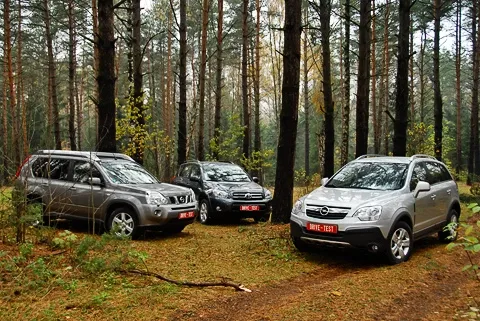
By the way, this is not a joke at all. We were joking about SUVs, of course, but crossovers really do suit the city well. You sit high, the view is excellent. You can easily drive onto a curb, and in winter park in a snowdrift where no sedan would dare to go. Their fuel consumption is not much higher, and dynamics with handling are not much worse. And you can also get to the dacha on a broken road if needed.
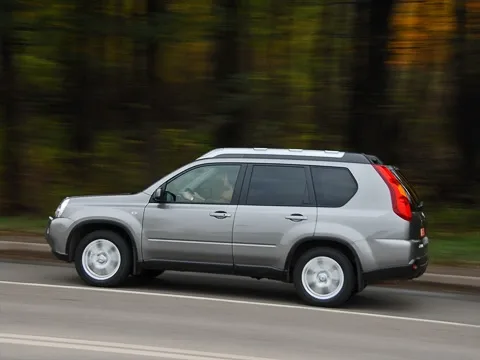
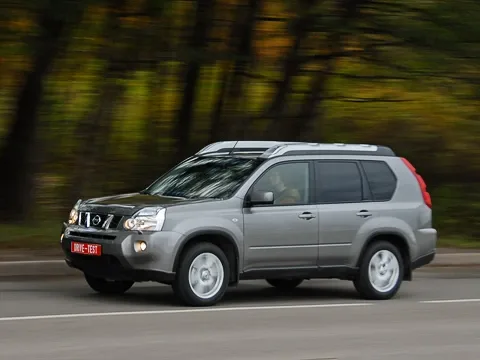
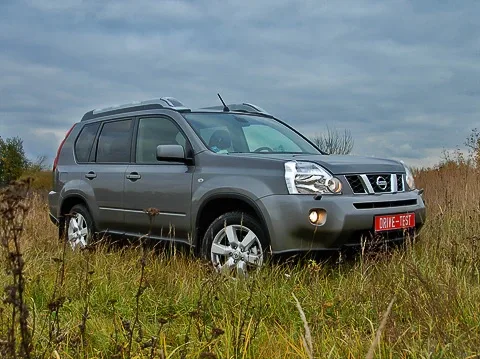
But for many, what matters more is that a crossover is "almost a jeep," only costing significantly less. And in this sense, our compatriots clearly favor the Nissan X-Trail. Rough and angular, it really looks like a true conqueror of mud. By the way, according to statistics, in our country the X-Trail is more often bought by men.
Here it is, the most heroically looking crossover for $40,000. What more could you want?
The X-Trail also impresses inside. In a Nissan, you feel like if not a Dakar conqueror, then definitely a participant in some trophy raid. You sit high in a square, somewhat rough interior. Before you stretches a huge field, and just as you want to drive onto it, you realize that this field is the hood. In general, everything is very masculine and even slightly heroic.
It's also great that the instrument cluster on the new X-Trail has finally stopped being nonconformist and understood that it's better for it to stick out not in the center of the panel, but in the usual place behind the steering column. The Nissan interior has started to look much better, although a certain feeling of ruggedness remains. Neither soft plastic nor quality leather helps—it's more about the design.
Mismatched plastic spoils the feel of the interior. But with practicality and equipment—zero problems.
There are no problems with equipment. Our test X-Trail turned out to be with a 2.0-liter 141-horsepower engine, a CVT, and in maximum trim: with a huge sunroof, leather interior, power seats, climate control, CD changer, stability control, and Bluetooth. They ask $40,980 for such a car.
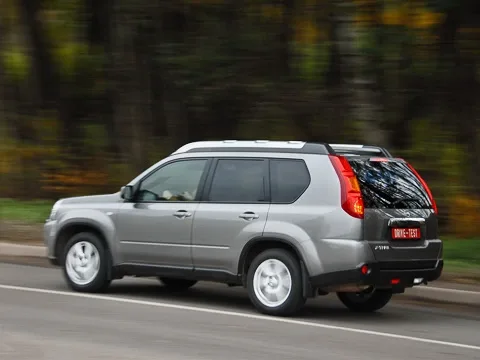
Distinguishing the new X-Trail from the old one at first glance is a task for an expert.
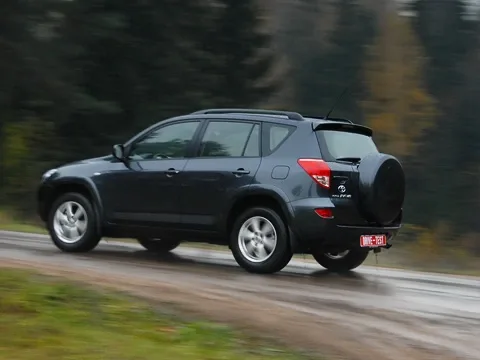
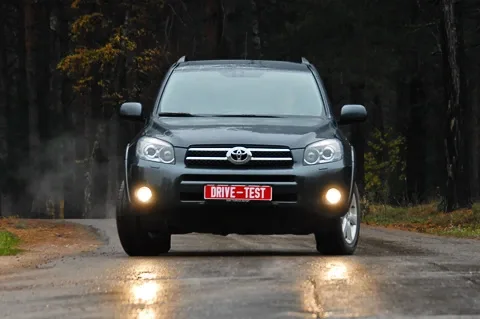
But behind the wheel of the RAV4, imagining yourself as Crocodile Dundee doesn't work. If only because of the appearance—the Toyota looks more like a powder compact than a conqueror of off-road. But hardly anyone can reproach the car for this. On the contrary, it's precisely for this that the fair sex loves it.
Of course, next to the others, the RAV4 doesn't look too masculine. But is it needed?
Inside—complete harmony with the exterior. The intricate design of the "two-story" front panel and door handles, a bunch of shelves, buttons, and compartments for small items. But "overboard" there's no hint of the hood, and the seating position is rather minivan-like.
By the way, the quality of the Toyota's finish didn't blow our minds—quite ordinary plastic that doesn't try to seem more expensive than it really is. But the design saves the situation—the RAV4 has a feeling of coziness. And there are small pleasant touches, like a shelf above the glove box that opens and closes with a button press. A funny thing.
The RAV4 probably has the simplest trim materials, but everything is very civilized and solid. And in the various drawers and shelves for small items, it's easy to get lost. The engine starts with a button.
Our RAV4 turned out to be in the most loaded version—with a 2.4-liter engine producing 170 hp, a four-speed automatic, leather interior, power driver's seat, dual-zone climate control, and keyless entry system. For all of this—$45,430. An audio system with a CD changer is present, but there's no xenon, just like in the X-Trail.
The spare tire hangs at the back—which means a heavy fifth door and the lowest trunk floor.
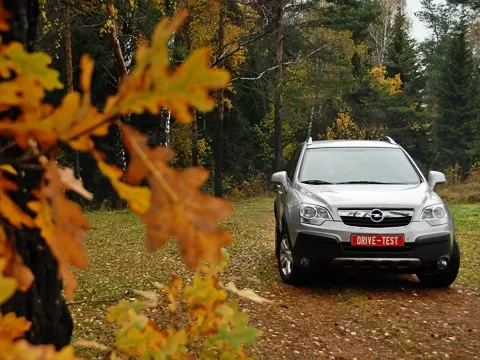
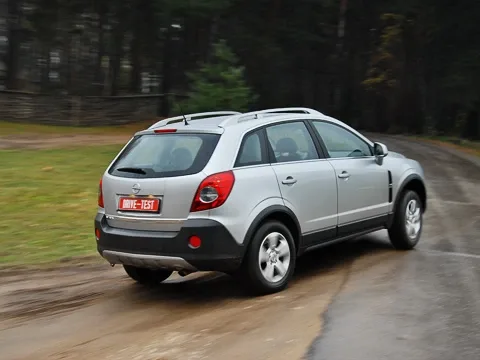
And what about the new one? The Opel Antara against such different competitors is something in between, though it leans more toward the RAV4. From some angles it looks very cute, from others—sporty, but the "face," in our opinion, still lacks expressiveness. And what a beautiful concept the Antara GTC was…
Opel is a newcomer in crossover building. Will the first pancake be lumpy?
But the interior pleases with both design and quality. The seating position is also wonderful—in a stiff, purely German seat with decent lateral support, you sit as if glued. And although all three cars have steering columns adjustable for height and reach, the best seating position is in the Opel. Typically car-like, we like it. But what we don't like is that in the Antara, like in many other Opels, there's practically nowhere to put small items. Phones, cigarettes, and other necessary and useful (and harmful) things have to be stuffed into pockets.
The "ordinary Opel" interior in the Antara is diluted with round air vents and a slightly different architecture. But the materials are undeniably a cut above both the Nissan and the Toyota. Only the steering wheel stands out from the ensemble, which someone for some reason decided not to wrap in leather. And overall, the trim isn't great: fabric interior, manual seat adjustments. Although climate control, "music," and other mandatory things for a car costing $39,900 are present. Among the pleasant things, there are two parking sensors—front and rear. The RAV4 has none.
Inside it's very high quality, but you'll have to get used to everything—to the audio system controls, the lack of places for small items. But the steering column switches, which on all other Opels are non-latching, are regular in the Antara.
The Antara's gearbox is a five-speed automatic, and the engine is 2.4 liters. But it develops only 140 "horses." After all, this engine is from Chevrolet, and the Antara itself is built on a common platform with the Captiva and is produced at the same plant in Korea.
So, it's no surprise that the Antara loses in dynamics to the RAV4. The Opel's dynamics are generally sufficient, but there's no desire to race. Moreover, the automatic doesn't hurry either and does its job with feeling, with deliberation. Probably, the Antara with a 3.2-liter V6 producing 227 hp would be more interesting. But for now, we have what we have.
Of all the test participants, the Antara looks the most dynamic. It's a pity that it only looks that way.
The handling also doesn't cause delight. The Antara steers easily and understandably, but dives into corners with a slight laziness. So the excellent seats, in which we saw a clear hint of sportiness, actually didn't hint at anything. The Opel doesn't stand out in comfort either—the suspension is moderately stiff, and that's it.
But the more you drive the Antara, the clearer it becomes that it drives fine. Yes, the steering is vague, but on a straight line the car stands confidently, and in the cabin there's dead silence compared to competitors. In this regard, the Antara is a real "coffin on wheels." And the suspension, although it thumps over bumps, is quite energy-intensive.
The Antara's suspension pleases with energy intensity but disappoints with sluggish reactions.
But the RAV4 is much more fun. The 170-horsepower engine invigorates during acceleration, already allowing hooliganism. And what surprised most was the gearbox—the Toyota's automatic has only four speeds, but how much more agile it works! As a result, managing dynamics is very convenient—the car precisely follows the pedal, and driving in the city is pure pleasure.
The advantage of three dozen "horses" allows the RAV4 to easily pull away from competitors. Including—in price.
The Toyota also handles better than everyone. The RAV4 has the fastest and most precise steering responses, the most natural effort. And although it's still far from the level of a normal car—the large suspension travel and high center of mass take their toll—for the city, the "feel of the car" is more than enough.
In terms of comfort, the RAV4 is hardly worse than the Opel. Except perhaps a bit noisier. The suspension is about the same stiffness. The only thing—it slightly lacks energy intensity.
And what about Nissan? It had a hard time from the very beginning—in engine displacement, it yields to rivals. However, the CVT installed here turned out to be surprisingly responsive, and the X-Trail is quite capable of competing in dynamics with the Antara. And if you turn on sport mode, everything becomes even better. Moreover, what's especially pleasant, the Nissan CVT doesn't suffer from that very "vacuum cleaner disease" characteristic of some similar units.
Of our trio, the Nissan is the undisputed leader in comfort and ride smoothness. On a road with mediocre surface, the X-Trail feels excellent: the suspension masterfully smooths out asphalt defects, only slightly rocking the body on long waves. True, on sharp joints and potholes, the car still noticeably shakes. With sound insulation, not everything is ideal either, although you can't call the car noisy.
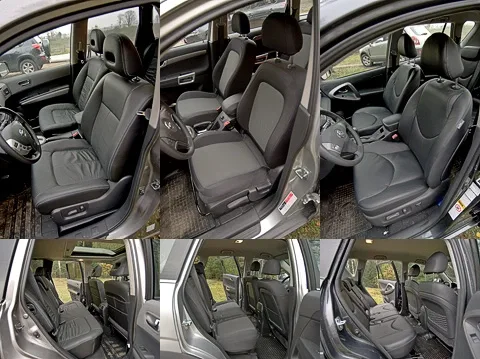
The front seats in the Opel Antara are stiff and grippy, like in a decent passenger car. In the Nissan, the situation is the opposite—you sit high, the seats are soft and spacious, like a home sofa. The Toyota is somewhere in between. In the back, it's spacious in all three cars, but you give the greatest preference to the X-Trail.
Of course, we expected the Nissan to lean into corners like the Leaning Tower of Pisa. But no! Somehow miraculously, the X-Trail, despite all its softness, demonstrates quite decent handling. Yes, it reacts to all actions with a slight delay, but it does react! And even though it still has a long way to go to reach the RAV4, the overall impression is very good.
But the X-Trail wins with its practicality. Its trunk is so huge that... No, the "Rafik" and Antara probably won't fit in there, but it feels like it holds more than their compartments combined. And on top of that, it's incredibly well thought out. The floor is covered not with delicate carpet but with durable hard plastic, onto which you can throw anything, even the dirtiest item — it's easy to wash off later. Under the floor are a couple of pull-out drawers with dividers into compartments. And if you fold the rear seats, the X-Trail holds 1,773 liters of something non-liquid. You look at all this splendor — and you want to buy the X-Trail just for the trunk. It's mesmerizing!
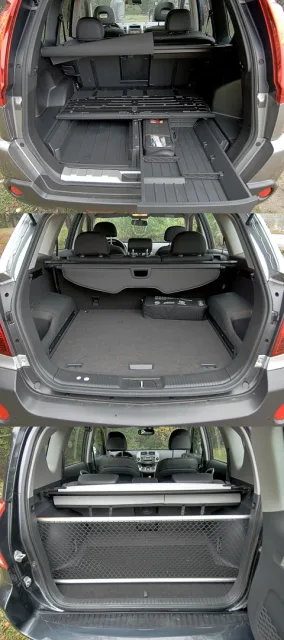
The X-Trail's cargo area is unrivaled. There's plenty of space, and you can organize it as you wish. The RAV4 can boast a small but convenient trunk. And the Opel disappointed — the rear compartment is tall and quite compact.
The RAV4 looks more modest. The trunk itself is not large, and access to it is through a heavy rear door hinged in the Japanese manner — with hinges on the left. True, there are some nice touches — nets and hooks. And if you look more carefully, you can find a couple of hidden niches. The rear seat folding mechanism is well thought out. Pull the hook — the backrest folds, and the cushion simultaneously moves down and forward. Also, the RAV4 has the lowest loading height — the spare tire hangs on the door.
In the Antara, it's hidden under the floor, which makes the trunk floor itself very high. And the compartment itself is not much bigger than a glove box — you can't load much good stuff in there. No nets or hooks are visible — just a couple of pockets on the sides. So in terms of cargo hauling, the Antara surrenders without a fight. But Opel passengers will be pleased that, even though their luggage couldn't be taken along, they themselves are quite comfortable. In the back, the Antara has plenty of room, almost like the X-Trail, and more than the RAV4.
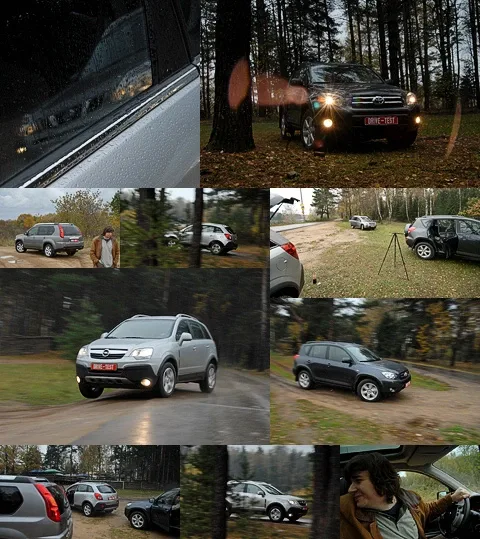
But since our subjects are positioned as pseudo-crossovers, it would be a sin not to test them on mild off-road. First, let's send the RAV4. Its all-wheel-drive system is classic — the rear is engaged by a clutch on command from the electronics. Although Toyota has some tricks — for example, the stability control can redistribute torque between wheels and change steering effort. But that has nothing to do with off-road, and the RAV4 hopelessly gets stuck on the first diagonal wheel hang, unable to move an inch.
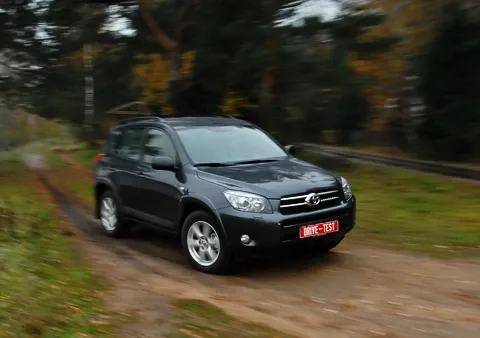
From Toyota, you usually expect smooth and comfortable manners. But the RAV4 is a very lively car to drive. At least for a crossover.
The Nissan X-Trail gets further. Its All-Mode 4×4-I transmission is basically similar to Toyota's. It also works in conjunction with the stability control but has three modes. The first is front-wheel drive — for the highway and fuel economy, that's clear. The second is automatic. And the third simulates a locking center differential, but only at speeds up to 40 km/h. So we engage that. And the X-Trail moves! However, as soon as the surface becomes more slippery, it gives up. Helpless wheelspin... We've arrived!
But the Antara truly surprised. Nowhere else, but in it, there are no tricks in the all-wheel-drive system — just a regular "plug-in". But the Opel climbs where the Nissan is already stuck! What's the secret? Maybe the tires? No, they're no more "toothy" than the others. Just fantastic.
But, alas, off-road talents alone are not enough for victory. The Opel certainly has an excellent interior and decent ergonomics, but the sluggish engine and imperfect handling don't add points in the fight. And the trim level is the poorest among the test cars. The Antara could be an excellent choice for long trips — good sound insulation and excellent directional stability. But then why is the trunk so small?..
We confidently recommend the Toyota for the role of a city car. It's nimble and agile, handles well, and comfort is at a decent level. Its modest off-road capabilities will be quite sufficient in a metropolis. It's just that such a "Rafik" costs a lot. $45,000 is already serious. In this price category, cars like the turbocharged Mazda CX-7 and the three-liter Mitsubishi Outlander XL are already eyeing it. And they're playing in a different, higher league.
Well, for those who love long trips with a few hundredweight of useful cargo, the X-Trail is perfect. A real man's car — rugged, spacious, incredibly practical, and quite "off-road". And also, with equal trim levels, the most affordable! In excellent equipment, unattainable for competitors, it costs $41,000. And even if it's far from the RAV4 in agility — there's no need to race around the city. And there's nowhere to. And besides, the X-Trail has such a hu-u-uge trunk!
Technical Specifications
| Specifications | Nissan X-Trail | Opel Antara | Toyota RAV4 |
| Body |
| Number of doors/seats | 5/5 | 5/5 | 5/5 |
| Length, mm | 4630 | 4576 | 4395 |
| Width, mm | 1770 | 1850 | 1815 |
| Height, mm | 1630 | 1704 | 1685 |
| Curb weight, kg | 1514 | 1805 | 1590 |
| Gross weight, kg | 2050 | 2225 | 2110 |
| Trunk volume, l | 479/1773 | 420/1420 | 586/1469 |
| Engine |
| Type | Petrol, with distributed injection | Petrol, with distributed injection | Petrol, with distributed injection |
| Location | Front, transverse | Front, transverse | Front, transverse |
| Number and arrangement of cylinders | 4, in-line | 4, in-line | 4, in-line |
| Number of valves | 16 | 16 | 16 |
| Displacement, cm3 | 1997 | 2405 | 2362 |
| Max. power, hp/rpm-1 | 141/6000 | 140/5200 | 170/6000 |
| Max. torque, Nm/rpm-1 | 196/4800 | 220/2400 | 224/4000 |
| Transmission |
| Gearbox | Continuously variable transmission | Automatic, five-speed | Automatic, four-speed |
| Drive | All-wheel drive | All-wheel drive | All-wheel drive |
| Chassis |
| Front suspension | Independent, McPherson | Independent, McPherson | Independent, McPherson |
| Rear suspension | Independent, multi-link | Independent, multi-link | Independent, multi-link |
| Front brakes | Disc, ventilated | Disc, ventilated | Disc, ventilated |
| Rear brakes | Disc | Disc, ventilated | Disc |
| Ground clearance, mm | 200 | 200 | 191 |
| Performance characteristics |
| Maximum speed, km/h | 172 | 170 | 180 |
| Acceleration time 0-100 km/h, s | 11.9 | 12.7 | 10.6 |
| Fuel consumption, l/100 km |
| urban cycle | 10.8 | 14.1 | 12.6 |
| extra-urban cycle | 7.2 | 7.1 | 7.9 |
| combined cycle | 8.5 | 10.1 | 9.6 |
| Emission standard | Euro-4 | Euro-4 | Euro-4 |
| Fuel tank capacity, l | 65 | 65 | 60 |
| Fuel | AI-95 | AI-95 | AI-95 |
Trim levels of tested vehicles
| Trim level | Nissan X-Trail | Opel Antara | Toyota RAV4 |
| Base trim price, rubles ($) | 914,909 (37,350) | 937,000 (38,250) | 1,102,500 (45,000) |
| Front airbags | + | + | + |
| Side airbags | + | + | + |
| Side curtain airbags | + | + | + |
| ABS | + | + | + |
| Stability control | + | + | + |
| Xenon headlights | - | - | - |
| Power-adjustable heated side mirrors | + | + | + |
| CD player | + | + | + |
| MP3 playback | - | + | + |
| CD changer | + | - | + |
| Front fog lights | + | + | + |
| Climate control | + | + | - |
| Dual-zone climate control | - | - | + |
| Rain sensor | + | - | + |
| Light sensor | + | + | + |
| Headlight washer | + | - | + |
| Steering wheel controls | + | + | + |
| Alloy wheels | + | + | + |
| Hill descent control | O | + | + |
| Heated front seats | + | + | + |
| Power-adjustable driver's seat | O | - | + |
| Power-adjustable front seats | O | - | - |
| Leather interior | O | - | + |
| On-board computer | + | O | + |
| Cruise control | + | O | + |
| Rear parking assist | - | O | - |
| Front parking assist | - | O | - |
| Power sunroof | O | - | - |
| Metallic paint | O | O | O |
| Price of tested car, rubles ($) | 1,003,984 (40,980) | 977,500 (39,900) | 1,113,000 (45,430) |
Key:
+ included in base trim;
- not available;
o option installed on the tested car.
Safety
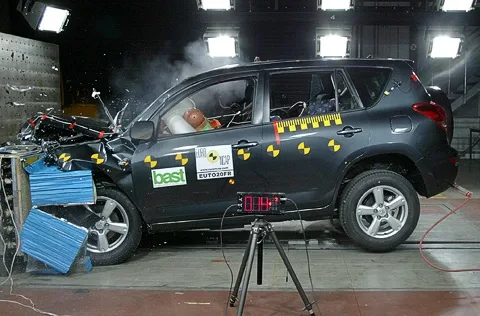
The 2006 Toyota RAV4 scored four stars in EuroNCAP crash tests. The rating didn't go higher due to the frontal impact — the car earned only 12 points out of 18 possible. Even the separate driver's knee airbag didn't help. However, the RAV4 passed the side impact brilliantly, scoring 16 points. Including the bonus for seatbelt reminder, the total was 32 points. As for child passengers, Toyota protects them quite decently, and pedestrians suffer not too severely in a collision.
The Opel Antara and the fresh Nissan X-Trail have not yet participated in EuroNCAP tests. However, the Antara has a twin brother, the Saturn Vue, which was crashed by Americans from NHTSA. It performed well: four stars for driver protection in frontal impact and five for the passenger. The Vue also passed the side test successfully.
Behind the scenes
Initially, the idea was different. When selecting cars for comparison, we planned to put the Opel Antara, Toyota RAV4, and Mitsubishi Outlander XL with a two-liter engine (actually 2.4 liters, as specified in the characteristics) side by side. We booked all three cars, but Mitsubishi let us down at the last moment — it didn't arrive on time. We had to urgently find a replacement, and Nissan became it. However, versions with the 2.5-liter engine, which would have been more logical in this company, were already taken, so we took the two-liter one.