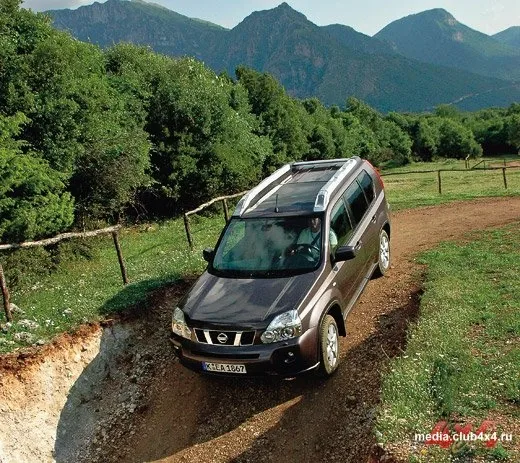
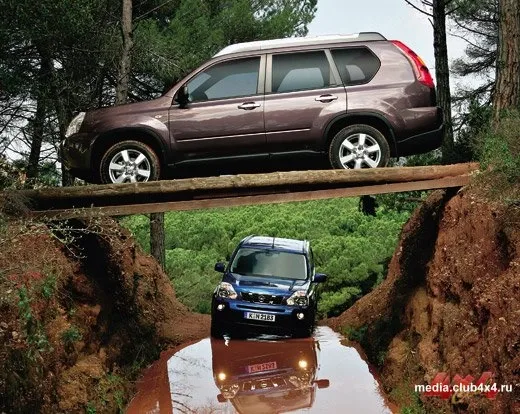
Every year automakers make crossovers more and more asphalt-oriented, sacrificing their off-road talents. But Nissan, fortunately, has not turned onto this well-trodden and, frankly, dubious path. The updated X-Trail feels much more confident on country roads, and on rocky trails it simply shines. Neither Mitsubishi Outlander, nor Chevrolet Captiva, nor Jeep Compass, nor Hyundai Tucson, nor Honda CR-V with Toyota RAV4 are capable of rushing along forest and rural routes so quickly, comfortably, and without damage to the suspension.
On bumps, the body does not sway excessively, maneuvers remain under control, and the driver and passengers on cobblestones and rocky ground feel the most careful treatment. The suspension of the new X-Trail is a carefully calibrated balance created for off-road driving. How did the Japanese (or the French?) manage to combine the incompatible: comfort, durability, and maneuverability? There are few successful examples of such a synthesis, not counting air suspension.
THE SECRET OF THE SAMURAI
The Japanese managers did not elaborate on their secrets. At the presentation at the foot of the Greek mountains, they only mentioned the increased angle of the rear shock absorbers, explaining this by the desire to expand the trunk. Among the changes directly affecting the car's behavior, they named a new massive anti-roll bar and a noticeably increased body rigidity. Just like that, with a couple of strokes, Nissan engineers radically changed the character of the X-Trail 2007. This is no longer the previous model with its roll and breakdowns. The new X-Trail is practically not afraid of potholes, and it has every chance to seriously boost sales in Russia.
A COSMETOLOGIST WITH A SCALPEL
The old X-Trail looked somewhat amusing, with pioneer enthusiasm: they say, when I grow up, I will become a jeep. The new one is even funnier, resembling a young newt curiously sticking its head out of the water. Surprisingly, it is precisely this appearance that Nissan's regular customers have always been satisfied with. The Japanese, making changes to the design, acted carefully so as not to scare off the loyal audience. Therefore, everything new in the X-Trail appeared not because of fashion, but at the requests of "old" buyers, most of whom live west of our borders. By the way, over the entire history of the model, about 800 thousand units have been sold worldwide, of which 300 thousand in Europe. Every year, Europeans buy about 55 thousand such Nissan crossovers, and in Russia in 2006, 10 thousand units were sold.
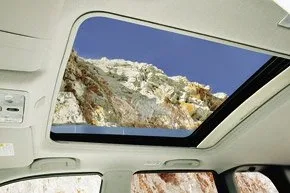
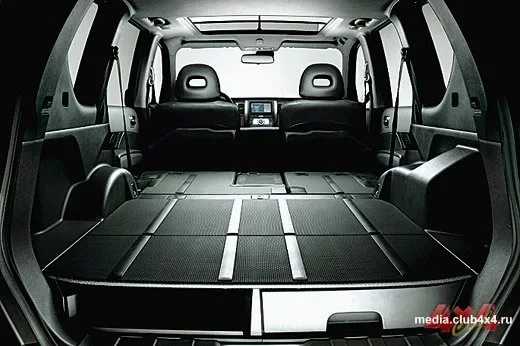
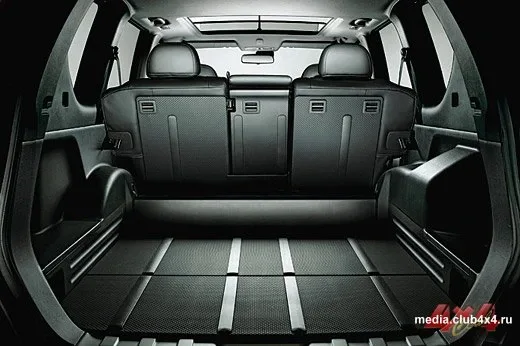
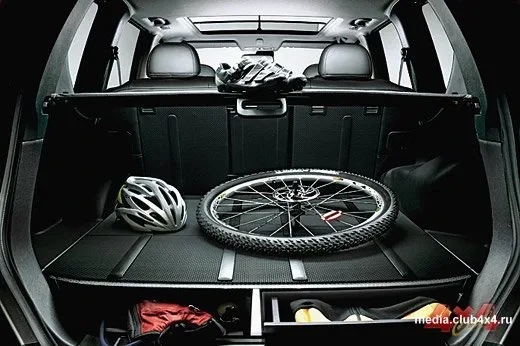
Nissan research showed that many X-Trail buyers see it primarily as a spacious station wagon. That is why the new generation has an increased opening of the fifth door — everything for the home, everything for the family.
Because of this loyalty to traditions, the Nissan crossover resembles a thorough restyling rather than a full-fledged new product. But if you delve into the list of changes, you understand: there are so many refinements that, in fact, nothing remains of the old car. All changes can be called cosmetic, but, as in the case of the suspension, the effect is surgical.
The previous X-Trail was based on the Almera platform, while the current one is built on the new intercontinental "C" platform, which has already given the world the Nissan Qashqai, Renault Megan, and Renault Scenic. The designers did not ignore any component: optics, interior and trunk trim, transmission control, engines.
ONLY AUTOMATIC
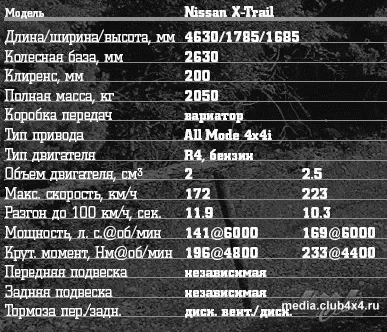
The topic of engines for Russia, as usual, is painful. We are not promised a diesel. In Europe, there will be two of them — with a power of 173 and 150 hp, both with a volume of two liters. Moreover, there is a configuration excellent for loose soils: a diesel paired with a six-speed automatic. Alas, we will be offered two gasoline options without alternatives. The main one will be a modern two-liter — an engine familiar from the Qashqai with 141 hp. It is equipped with a variable valve timing system (on intake and exhaust), two balance shafts, and piezo injectors that provide fuel injection up to five times per stroke. The second engine is less progressive — a modernized 2.5-liter with 169 hp. Instead of an automatic transmission, the gasoline version assumes a CVT.
Still, I will say a couple of words about the diesel. On the mountain serpentines of Greece, it is indispensable, especially if you are a fan of the manual gearbox. In third gear, the two-liter 173-horsepower engine pulls without complaints. You shift down rarely — only on a very steep climb or after a 90-degree arc. But fans of "mechanics" are becoming fewer. And I am no longer among them. As glorious as it is to overtake old Japanese pickups and A and B class small cars, which form the basis of the Greek car fleet, on a manual, it is just as shameful to stall and burn the clutch on an off-road climb. The Greek test site with rocky drops showed the complete advantage of the automatic over the manual, even when the latter worked in tandem with a powerful diesel. The automatic transmission is much more rational. Especially the CVT: it transmits torque more smoothly and thinks faster than the automatic. Therefore, the Russian configuration of gasoline-CVT is in some sense universal.
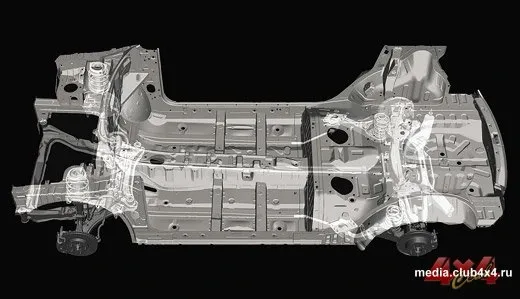
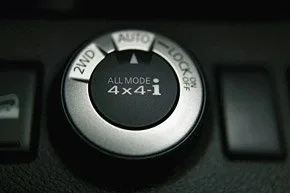
On the previous model, the transmission was "brainless," now it "thinks." It reads data from the ESP sensors, steering wheel angle, lateral and longitudinal accelerations, and the accelerator pedal position. The torque between the axles is distributed for an optimal trajectory in corners and to prevent wheel spin.
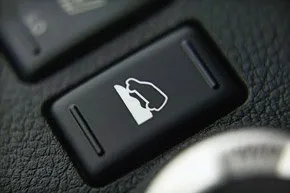
Two functions have been added: hill start assist, which activates automatically on slopes from 10 degrees, and hill descent control, which is activated by a button and works only in the Lock transmission mode, that is, with the inter-axle clutch locked.
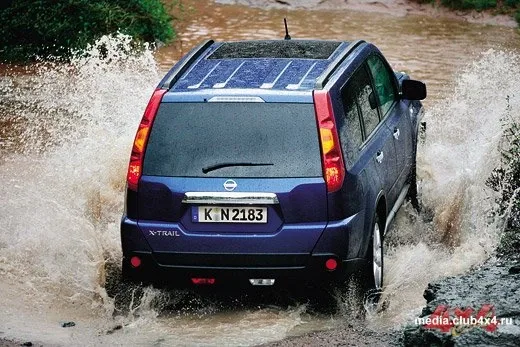
I had an excellent opportunity to test all these innovations. Although there is nothing revolutionary in Nissan's off-road electronics. On dry ground, the crossover is excellent, but as soon as a wheel hangs, the brains of the "intelligent" all-wheel drive are no longer enough. It was, of course, created to improve handling. One should not attribute off-road functions to it (bearing in mind Russian demands).
THE FLEECE IS ALREADY BETTER
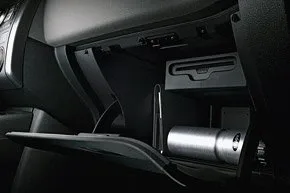
Having driven along serpentines and the off-road test site, I finally paid attention to the interior trim. The quality of materials has become better by about 30 percent. The large "fleece" on the ceiling looks pleasant, although the trim still does not reach the level of the best representatives of the class. But now you can place 37 cans of Pepsi with a volume of 0.33 liters in the standard places in the cabin. Of these, four, as before, will be cooled by the air conditioner.
The Japanese made mistakes only twice. They were too lazy to make navigation for Russia (the monitor on the panel serves only the rear-view camera). And also, for the sake of a larger trunk, they pressed down the knees of rear passengers, although they simply needed to make the second-row seats with longitudinal adjustment — say, like on the twice cheaper Nissan Note...
Technical characteristics of Nissan X-Trail