Nissan Tiida
TIIDA - the dawn of tomorrow
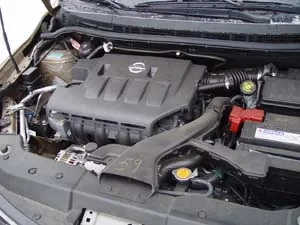
Engine: 1,598 cc.
Max power: 110 hp/6000 rpm.
Max torque: 153 Nm/4400 rpm.
Max speed: 170 km/h
Acceleration 0-100 km/h: 12.6 sec.
Transmission: 4-speed automatic
Fuel consumption:
city - 10 l
highway - 5.9 l
combined - 7.4 l
Dimensions:
length 4303 mm
width 1695 mm
height 1525 mm
ground clearance 175 mm
tires 185/65 R15
Curb weight: 1281 kg
Gross weight: 1715 kg
Equipment: ABS+EBD+Nissan Break Assist+ESP+ASR, electric power steering,
climate control, Bluetooth, rain and light sensors, Intelligent Key
The history of Nissan begins with the opening of the automobile plant Kwaishinsha Co., founded in 1911 by the pioneer of the Japanese automotive industry, Mr. Masujiro Hashimoto, in the Azabu-Hiroo district of Tokyo.
Later, a small, box-like passenger car of their own design was produced, which debuted on the market a year later under the name Dat Car. Its maximum speed was 32 km/h. The name Dat is an abbreviation of the first letters of the surnames of Mr. Hashimoto's three main patrons: Kenjiro Den, Rokuro Aoyama, and Meitaro Takeuchi. In addition, the name Dat in Japanese means "lively, nimble."
The official date of the creation of Nissan is December 26, 1933, when the predecessor company Jidosha Seizo Co., Ltd. was formed with an authorized capital of 10,000,000 yen. Mr. Yoshisuke Aikawa was appointed president of the company.
On June 1, 1934, the company name was changed to Nissan Motor Co., Ltd. The export of the first Datsun cars to Asia, Central and South America began, totaling 44 cars. The construction of Nissan's first plant, Yokohama Plant, was completed.
The first Datsun passenger car rolled off the assembly line of the Yokohama plant in April 1935. At that time, Nissan switched to using only Japanese-made components and installed presses for producing body panels, thereby ending the manual processing of metal sheets. The first corporate logo was adopted: a red circle symbolized the rising sun, and blue symbolized the sky.
The slogan of that time was "Sincerity brings success."
After restoring production after the end of World War II, Nissan created several legendary models. In 1947, production of Datsun passenger cars was resumed. The company began to increase production volumes after the forced shutdown of its plants. Nissan used its experience in producing military vehicles, which was significantly deepened during World War II, and released the legendary SUV Patrol. The all-wheel-drive model with an 85-horsepower 6-cylinder engine surpassed the American Willis Jeep in engine power and payload capacity.
In 1958, Nissan Motor Co. began exporting passenger cars to the USA. In September of the same year, two Datsun 210 cars took part in the Australian Mobil Gas Trial Rally, one of the most challenging rallies in the world, and won the championship title in their class. In 1958, Nissan rolled out the high-class Datsun Bluebird, created for personal use. At that time, Japanese cars were considered less practical than imported ones, as they required more effort from the driver when braking.
One notable feature of the Bluebird was the first use of power-assisted front brakes, which allowed even fragile women to brake with a light press on the pedal. The first generation Bluebird embodied the features of a reliable, attractive, and durable car. Two years after the first sales of its cars in the USA, Nissan opened an official branch, Nissan Motor Corporation USA (NMC), in California.

Vitaly, personal car Renault Megane
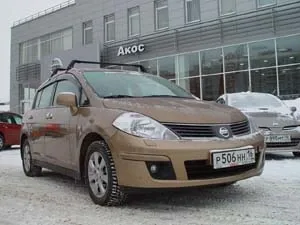
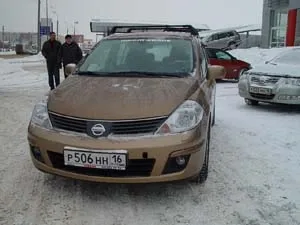
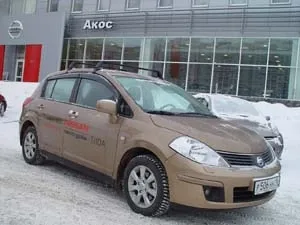
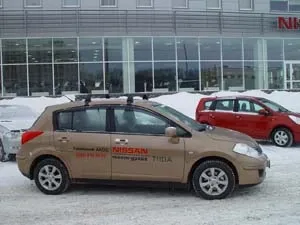
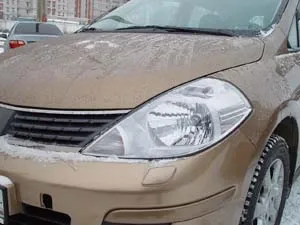
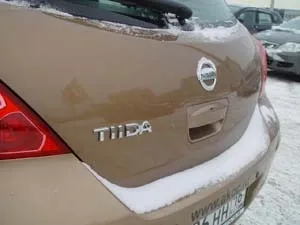
Externally, the design of the Tiida did not impress me. The car can easily be confused with Chinese cars.
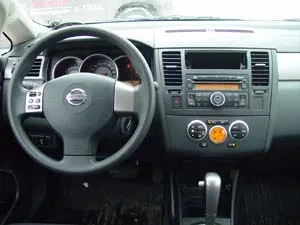
The interior of the car is quite modern, but nothing more.
The seating position in the Nissan Tiida is high, which distinguishes it from competitors in its class. The exception, perhaps, is only the Renault Megane. I couldn't get comfortable behind the wheel; I think the reason was the lack of adjustment of the steering column for reach: it only adjusts for height. While driving, the instrument panel is quite informative, and the driver should not have any difficulties with the readings.
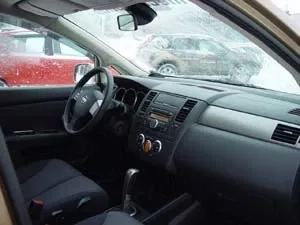
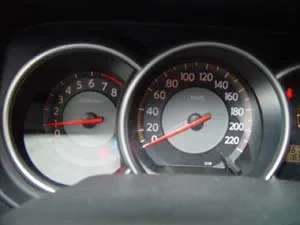
The creators of the car focused on comfort. The suspension turned out to be elastic, but there was no discomfort while driving. The car handles uneven surfaces confidently, with no breakdowns on large bumps. The sound insulation of the Tiida is acceptable for the C-class, and I have no particular complaints.
The tested car had an automatic transmission that works smoothly with the engine. After pressing the accelerator, the car "thinks" a little, and then very briskly picks up speed.
A drawback of the Tiida in any configuration is the lack of a traction control system. This is felt on slippery roads.
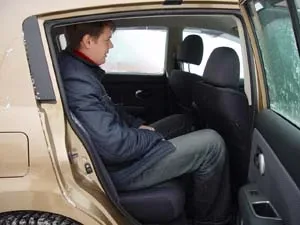
When I moved to the rear seat, I noted that only two adults can sit there comfortably. The distance between the front and rear seats is impressive; moreover, it can be adjusted. With my height of over 1.90 meters, I fit there easily. The rear seat backrest angle is also adjustable.
Overall, the car turned out to be decent. It has its pros and cons, but when choosing a vehicle, everyone is guided by their own tastes and buys a car according to their ideas of convenience and comfort. Undoubtedly, the Tiida will find its buyer.

Vadim, driving experience 10 years.
"New York is a city of contrasts," I repeatedly recalled this phrase from the film "The Diamond Arm" while trying to fit the Tiida into existing schemes. But this car constantly surprised me with its "non-standardness."
I find it difficult to say which class, B or C, the Tiida belongs to. In length, it's spacious; the knees of rear passengers don't touch the front seatback. But in width, it's cramped; sitting three in the back will be difficult. The external width is 1695 mm (a bit small for C), and the engines are 1.6 and 1.8 (a bit much for B). The interior design is quite bland, and that's a plus, because nothing catches the eye or irritates. What surprised me here? Cars of class C (small family) imply seating for the whole family, with 3 seats in the back and some knee room constraints. But with the Tiida, it's the opposite: spacious in length and narrow in width. Also, 1.8 engines are practically not offered for class C. Although there are exceptions - Opel Astra and Honda Civic.
I went to the official Nissan website, to the "Car Advantages" section. There are only three, in the manufacturer's view: comfortable seats, sound insulation, and a comfortable suspension. The driver's seat is indeed comfortable. But in the back, no matter how I changed the backrest angle, I couldn't sit completely comfortably. Perhaps the most comfortable position is reclining. The sound insulation pleased me; usually in classes B and C, they save on this. Here, the car had Nokian HKPL2 tires, excellent in all respects, but too noisy. However, it was quite quiet in the cabin, a huge plus for the Tiida. And the "comfortable suspension" deserves a closer look. The manufacturer emphasizes: "Stabilizers and springs of increased diameter effectively absorb road irregularities at any speed." The effect is indeed amazing: potholes/bumps/rails are passed very softly. True, I wouldn't advise doing this at any speed, because a soft suspension at high speed (or a large pothole) usually "breaks through." But during normal driving, the ride smoothness is excellent, quite comparable to some comfortable cars of class D or E. As expected, paired with the comfortable suspension are tires 195/65R15 (although almost everywhere else, other manufacturers install interchangeable with them, but stiffer 205/55R16). Their increased profile suits the car's character perfectly, adding softness and warning against overly aggressive maneuvers. What surprised me here? Cars of class C (small family) usually have good handling (at the expense of comfort, naturally). However, if you compare the car with the other two "soft" representatives of class C, the Tiida is stiffer than the Renault Megane (and handling is worse), and softer than the Toyota Corolla in the previous body (surprisingly, handling is better).
May the automotive gods forgive me, but I can't stand 4-speed automatic transmissions. A 4-speed automatic (compared to 5-, 6-, 7-speed automatics) is a sign of backwardness: it consumes a lot of fuel and works poorly. But if you properly match the gear ratios of a 4-speed automatic to a specific engine, you can get a decent tandem. For example, take the new Hyundai Elantra 2.0 (the engine is ancient and only good at high revs), where the 4-speed automatic quickly downshifts whenever possible, providing high revs and, as a result, decent dynamics. True, the price for this is increased fuel consumption. The Tiida has a similar situation: the engine with variable valve timing has good low-end torque, so the 4-speed automatic almost always keeps low revs, emphasizing the advantages of this particular engine. Naturally, the "birthmarks" of the 4-speed automatic are present here too: sluggishness when shifting, inadequacy (compared to 5-, 6-, 7-speed automatics) of the selected gear. But, to give credit, here the 4-speed automatic will look almost perfect for an inexperienced driver. What surprised me here? Cars of classes B and C are almost universally abandoning the 4-speed automatic in favor of a "robot" on engines up to 2.0 inclusive. And on engines from 2.0 to 2.5, a CVT is increasingly being installed. Despite the general fashion, Nissan is doing serious work (and successful, it must be admitted) with the outdated and unpromising 4-speed automatic.
So who is this car created for? For a small family that values above all comfort of movement and is absolutely undemanding to the exterior or interior appearance. Let's put it another way: for those who value inner content much more than outer shine.

Alfred. Driving experience - 12 years
After the Almera faded into oblivion, it needed a worthy replacement. To ignore the best-selling golf-class segment would have been madness on Nissan's part, and so the Tiida appeared on the Russian market.
The name, frankly, doesn't quite roll off the tongue in Russian (as does Qashqai). In Japanese, it means something like "dawn of a new day." I believe that cars should be approached from the point of view of their direct purpose.
It's clear that this Nissan Tiida is a purely urban car, but excuse me, in the city live young people and not so young, rich and poor, former pioneers and current pensioners, so who is this car intended for? The Note, which became the donor for the Tiida's "cart," is a completely clear and understandable car - a purely family micro-van. At least the Tiida looks more mature than the Note, which resembles the "girly" Micra, but the Tiida's look is not very expressive. It seems to be created for those who are tired of rushing about in choosing a car in pursuit of constantly changing fashion and who need a "workhorse" for everyday driving.
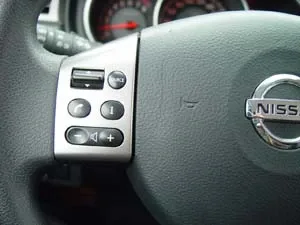
By the way, already in the base trim you get ABS, EBD, Nissan Brake Assist, electric power steering, air conditioning, CD player, 15-inch steel wheels, front and side airbags, steering wheel audio controls, 4 power windows, that is, the essentials are in place.
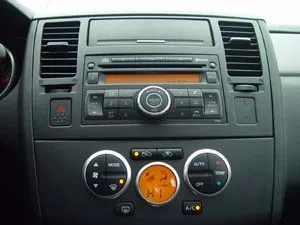
Our car, which has an automatic transmission, has climate control and a keyless entry. The latter gadget turned out to be very convenient; you don't need to constantly take out the keys that lie at the bottom of your jeans pocket.
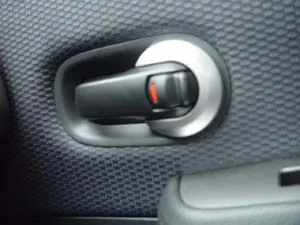
The driver's seat is very comfortable, visibility (even despite the rather massive front pillars) is good. Instruments, handles, pedals - all without questions, and the whole car is calm both outside and inside, nothing protrudes and nothing irritates. The already painfully familiar Nissan "bagel" with shift paddles haunts us in this model too. Once again I catch myself thinking that the manufacturer did not cheat, but did everything as cheaply as possible, but solidly. An honest decision! From the Note remains a characteristic feature - the height of the ceilings, thanks to this and the shifted wide front seats closer to the doors, sufficient living space is formed between the front passengers. In the hatchback, the rear seats have the property of sliding back, freeing up knee room, and I'll tell you, there's as much space here as in a good D-class sedan, but in width, three people will be cramped in the shoulders. It seems that Nissan decided not to reinvent the wheel, but to create a workhorse, playing on maximum unification and taking ready-made solutions from its other models.
That the 4-speed automatic is very well tuned, I think Vadim has already told you, and Vitaly probably noticed that the traction control system is missing, so I fully agree with this opinion, and also, perhaps, I'll add: I understood what the salt, the zest, if you will, of this Nissan creation is. It doesn't stress you out! It rolls easily, equally protecting the peace of rear and front passengers (as evidenced by driving on a "washboard" and crossing tram tracks), holds the straight well, it has all the necessary options, it is unsightly, but solidly and neatly made. Most likely, this will be the choice of pragmatists, not romantics, the choice of the mind, not the heart.
(c) "Autoclub-Kazan"
Maintenance interval - 15,000 km or 1 year
Maintenance 1 - $119 (946 UAH)
Maintenance 2 - $203 (1,620 UAH)
Maintenance 3 - $119 (946 UAH)
Maintenance 4 - $203 (1,620 UAH)