
An inconspicuous turnoff from a forest road that wound away from busy highways near St. Petersburg led us to a wide sandy strip, cut by deep ruts from heavy machinery. A sign warned of ongoing gas pipeline work and strongly advised against venturing there. In a normal situation, we would probably have heeded the warning and not driven onto the sand in a heavy vehicle, even if there was no serious obstacle in the form of security guards.
But now we had at hand not an SUV, but a business-class sedan with all-wheel drive and a ground clearance of 150 millimeters — quite impressive for such a car. That's only 50 mm less than the Nissan X-Trail crossover (though the Russian Toyota Camry still has 10 mm more ground clearance). So, having estimated where the nearest village with a tractor was, we confidently steer the all-wheel-drive Teana onto the sandy road.
where other sedans would never go
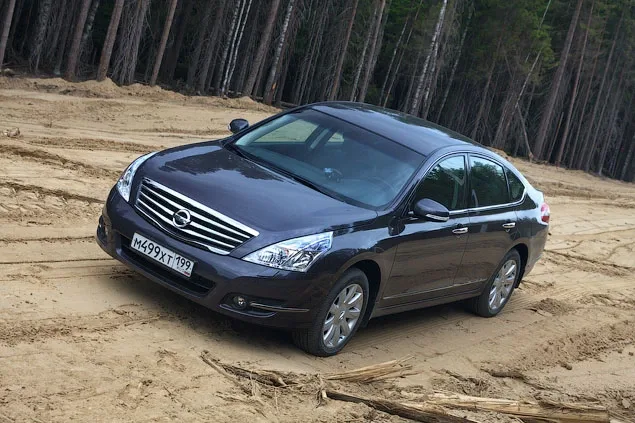
The all-wheel-drive transmission for the sedan came from the X-Trail. It's the same electronically controlled electromagnetic clutch that can not only be engaged automatically when the front wheels slip but also locked manually, like on real off-roaders. The only difference is that on the crossover, the lock disengages at 40 km/h, while on the sedan, it's already after 10 km/h. We certainly didn't storm sand dunes, but on loose sand with the "center" locked, the Teana moved confidently, not scraping the underside on stones and branches that came our way.
To increase ground clearance, Nissan engineers tried various "lift" options for Russian roads. In the end, they settled on modifying the suspension: at the rear, they removed the anti-roll bar, replacing it with stiffer shock absorbers, and at the front, they slightly raised the lower spring seats while simultaneously shortening the springs.
only by the "Four" badge
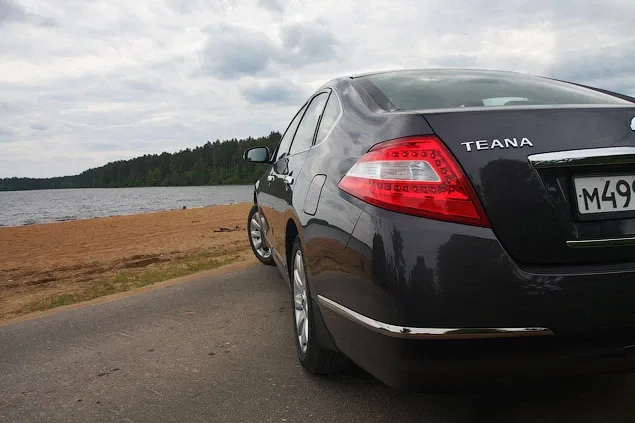
on the trunk lid
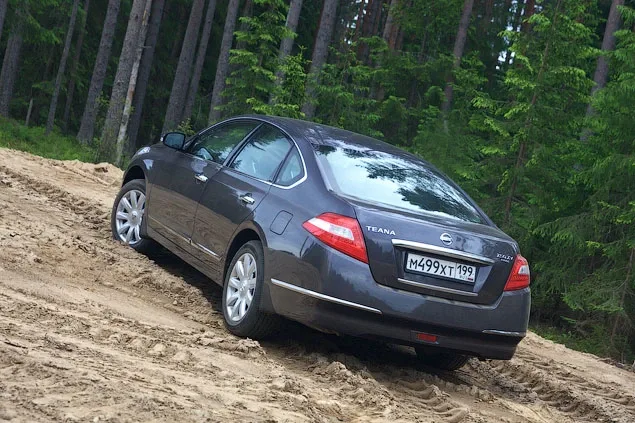
Our little off-road test showed that even this set of modifications, along with the all-wheel-drive transmission, was enough to turn the Teana into a city "off-roader" that holds the road more confidently on wet surfaces, isn't afraid of snowy shoulders, and can get you to a vacation spot where owners of other large sedans would have to walk.
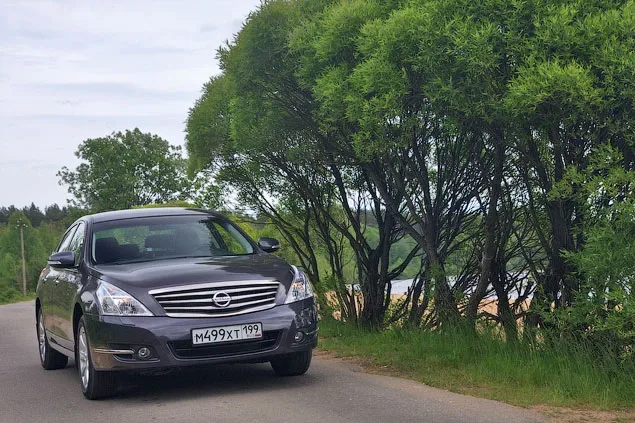
From the sand, we returned to asphalt, where the all-wheel-drive Teana, like its front-wheel-drive sibling, literally floats over the road, barely noticing bumps — and this despite the stiffer shock absorbers. The suspension is very energy-intensive; it seems impossible to break through it.
In a calm rhythm, the sedan relaxes. The cabin is quiet and cozy: soft leather seats with ventilation, whose backrests press against the door armrests, excellent visibility, dimmed lighting on the center console and door handles, navigation, a rearview camera, and a glass roof. And in the passenger seat, you can completely melt into the "ottoman chair": you extend the footrest, recline the backrest — and sleep comes instantly.
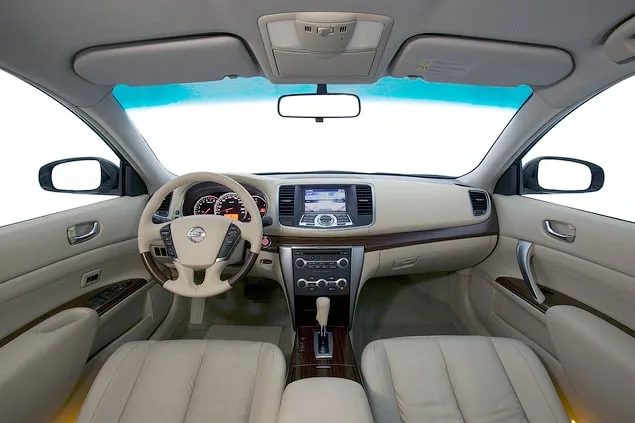
But despite all this luxury, the Teana strangely lacks steering wheel reach adjustment, automatic window mode (only the driver's has it), a folding rear seat backrest, a rain sensor, and the air vent deflectors don't close completely. This looks like incomprehensible penny-pinching on small details.
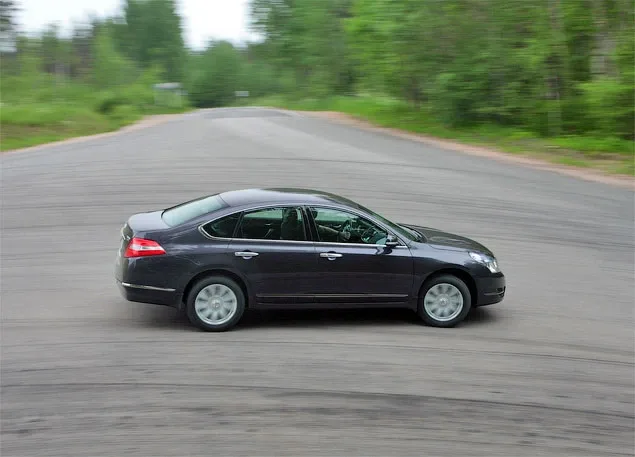
Driving impressions are also mixed. On one hand, the all-wheel-drive Teana handles well — only the stiff response in the near-zero zone disappoints. On a high-speed curve, the car holds confidently and doesn't require steering corrections, although body roll in corners is noticeable. On a straight, speed is almost imperceptible, and only a glance at the speedometer makes you take your foot off the gas when you realize all limits have long been exceeded.
On the other hand, the almost perfect silence in the cabin is disturbed by the engine's voice — it's a bit noisy, and due to the CVT, it hangs on one note during acceleration, which is annoying.
150 millimeters
The engine in the all-wheel-drive Teana is also new — a four-cylinder gasoline unit with a displacement of 2.5 liters and 167 horsepower. It moved over from the X-Trail almost unchanged. Compared to the 182-horsepower V6 of the same displacement that sits in front-wheel-drive sedans, the new engine produces more torque — 240 Nm (12 Nm more than the V6 and 7 Nm more than the X-Trail), but loses 15 horsepower. No other engines are available for the Teana 4x4.
During intense acceleration, this engine isn't enough for the one-and-a-half-ton sedan — the car simply gains speed smoothly and calmly. According to the specs, acceleration to 100 km/h takes 9.8 seconds — two-tenths of a second slower than the front-wheel-drive version with the 2.5-liter "six." Therefore, on the highway, you can safely overtake only slow-moving vehicles without worrying about completing the maneuver, and in the city, the engine is only enough to keep up with traffic.
but body roll in corners is quite noticeable
A more powerful engine would be nice here — for example, the 249-horsepower 3.5-liter "six." But Nissan engineers say it's difficult to combine it with all-wheel drive: the components simply don't fit in the engine bay. And even if the problem were solved, the car's price would rise to an uncompetitive level.
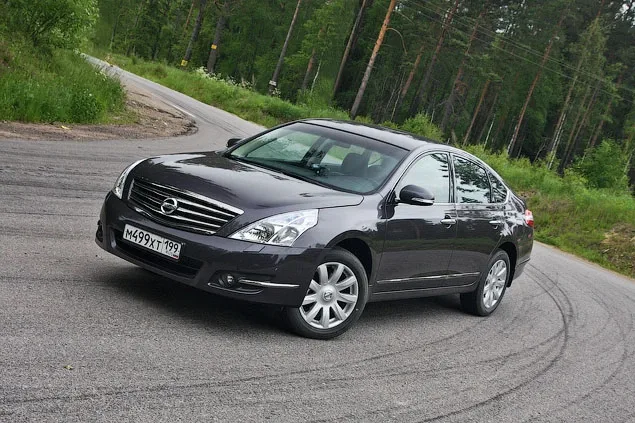
For now, the Nissan Teana Four, which is sold only in Russia and Japan, will become the most affordable all-wheel-drive car in its class. The price of the new model starts at 1 million 75 thousand rubles: for this money, the buyer gets leather upholstery, a stability control system, front seats with power adjustment, an audio system with six speakers, climate control, and 17-inch alloy wheels.
in Russia and Japan
For the same money, the only all-wheel-drive option currently offered is the Opel Insignia with a 220-horsepower two-liter turbo engine and a manual gearbox — it costs 1 million 70 thousand 300 rubles. But the Insignia with an "automatic" will cost more than 1.5 million rubles, and the automatic transmission is only available paired with the 260-horsepower 2.8-liter "six."
Another all-wheel-drive competitor is the Skoda Superb. Its all-wheel drive is only available in the version with a 3.6-liter V6 and a dual-clutch preselective gearbox, and such a car costs 1 million 449 thousand rubles.
all-wheel-drive car in
its class
In the end, even in the top trim, the Teana turns out to be 206 thousand rubles cheaper than the Skoda, and the Japanese car also has a DVD player, an "ottoman chair," a rearview camera, and a Bose audio system with 11 speakers. It seems that Nissan is betting on this relative affordability of its all-wheel-drive new model.
This year, the company plans to sell 10 thousand Teanas, of which 2.5 thousand should be all-wheel-drive. Affordable all-wheel drive is indeed a good way to boost sales, but catching up with the Russian-favorite Toyota Camry will be tough for the Teana.
Technical specifications of the Nissan Teana Four
| Length, mm | 4850 |
| Width, mm | 1795 |
| Height, mm | 1515 |
| Wheelbase, mm | 2775 |
| Curb weight, kg | 1563 |
| Engine displacement, cm3 | 2488 |
| Power, hp/rpm | 167/5600 |
| Torque, Nm/rpm | 240/4000 |
| Acceleration time from 0 to 100 km/h, s | 9.8 |
| Maximum speed, km/h | 180 |
| Fuel consumption in urban/extra-urban/combined cycle, l/100 km | 12.5/7.5/9.4 |