
Nissan Teana. Exceeding Expectations
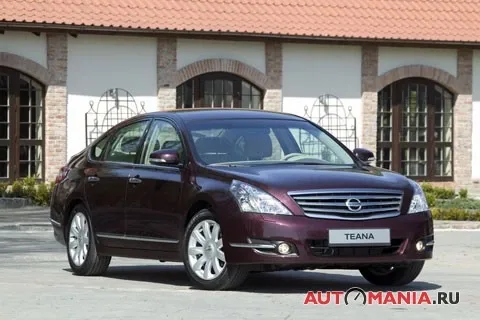
For many Ukrainian drivers, the Nissan Teana is no longer a novelty — over two years on the market, it has managed to attract the attention of potential buyers. Nevertheless, this model is actually still younger than most of its competitors. But the Japanese were not deterred, and they introduced a new generation. Such a step is quite logical, since the previous version debuted back in 2002.
By the way, it was the age that was considered almost the main drawback of the Teana, which negatively affected its sales. Over the past couple of years, the sedan has not only actively joined the fight for customers but has also left behind some strong rivals. Among the losers are the Mitsubishi Galant, the old Skoda Superb, the Volvo S80, as well as nominal opponents from Audi, BMW, and Mercedes. True, it should not be forgotten that the latter, like the Swede, have long belonged to the not-so-mass-market premium segment.
The main rival of the Teana, like its predecessor Maxima QX, remains the class record holder — the Toyota Camry, which was overtaken last year only by the Nizhny Novgorod "Volga," and even then thanks to a huge government order. The Japanese cannot count on such a "freebie," so the competition will be exclusively fair. And Nissan is ready for this.
The first trump card is the appearance. Although the body formally remains the same, the designers, as usual, took the path of least resistance. There was no classic minor change here. Simply, when changing generations, the exterior hardly changed. New architecture, different bumpers, more massive headlights, an elegant body kit, and, of course, a huge chrome radiator grille, very reminiscent of the one adorning the Infiniti M, — these are, perhaps, all the updates. As a result, the Teana began to look much more solid. True, it has not gotten rid of the Asian "slanted eyes." But this advantageously distinguishes it from the completely neutral Camry. But the rear is still somewhat heavy. Although the designers clearly tried...
There are even more changes in the interior. The architecture is familiar, but the level of execution is completely different, more characteristic of premium models of the Japanese brand. In short, the resemblance to the Infiniti M is clearly not accidental. Now the Nissan has the same warm light-brown "wood" dividing the cockpit into two tiers, and a large central monitor with a very recognizable control panel in front of it. But the hypertrophied visor on the front panel is gone — it has shrunk to normal sizes. All these elements look appropriate and timely, although they have already been tested on the "M."
Passengers are provided with optimal comfort here. The Teana's interior is the most spacious in its class and features thoughtful ergonomics. By the way, the car's dimensions, although changed, are not radical: the width has increased by 30 mm, the length by only 5 mm, while the height and wheelbase remain the same. Where does the extra volume come from? The secret lies in the design solutions. First, the engineers lowered the floor, making the seating position more correct (the seats are now 15 mm lower); second, they increased the front door openings; and third, they expanded the legroom for rear passengers.
Naturally, it was not without rich equipment. For the base price of 838,500 rubles, buyers get a full set of safety systems, four airbags, a light sensor, a "smart" key with a start button, dual-zone climate control, a decent audio system, an onboard computer, cruise control, power mirrors and windows, leather trim on the steering wheel and gear shift knob. As for the list of additional equipment — rain sensor, color rear-view camera, advanced Bose audio system, power seats, leather interior, and many other electronic "gadgets" — it is better to study it yourself: listing all the items would take too much time.
Let's just say that the most "loaded" version for 1,233,400 rubles has literally everything: from ventilation of the front and rear seats and a footrest for the front passenger to Nissan's main innovation — Russified navigation. By the way, it is fully adapted: voice, road names, and names of populated areas — just like in the Audi A6 or Mercedes-Benz E-Class. Its only drawback is the small coverage area (the same applies to the similar system in the updated Infiniti M35). Both capitals and their surroundings are, of course, mapped, as are the main highways. But as soon as you drive 30 km away, the electronics stop noticing not only country roads but also major district roads used by public transport. However, company representatives promise to fix this shortcoming: the map is constantly updated, and the next version will appear by autumn.
Now about the most "delicious" part. The first Teana, unlike its competitors, had a good set of powertrains. This largely predetermined its victory over the American Maxima in the battle for our market. The "American" was equipped only with a 3.5-liter 245-horsepower V6, while the Asian sedan also had engines of 2 and 2.3 liters. Alas, the new model cannot boast such variety — only two V6 engines are offered for it.
The first is the same top engine from the VQ series with a volume of 3.5 liters, whose power has increased to 249 hp. It is still paired only with the proprietary X-tronic CVT-M6 variator, naturally with a manual mode. This unit creates 80% of the maximum torque already at 1600 rpm. The engineers also worked on both the response speed and the smoothness of acceleration. In short, it has become even better.
However, the second engine is far more interesting — a newcomer to the lineup, a 2.5-liter V6 producing 182 hp and developing maximum torque of 228 Nm at 4400 rpm. It was specially developed for the latest Teana and optimized to work with the same variator. Unlike the previous tandem (2.3-liter V6 with a four-speed automatic), there are no complaints about this one. It pulls smoothly and quite dynamically. Fuel consumption is within reasonable limits. It is a bit noisy, of course, but overall it strains passengers' ears less than the same 2.4-liter engine in the Camry. It is worth noting that the variator does not operate in sequential mode. But, as is known, few drivers switch to it even once a month, so the loss is not too great.
In terms of handling, no significant changes have occurred. The Teana received a stiffer body, which a priori improved its behavior on the road. True, the suspension remains primarily comfortable. On the one hand, noticeable body rolls and longitudinal pitching during fast driving on wavy asphalt have not disappeared. On the other hand, this car is "tuned" for maximum care of passengers in any situation. At low and medium speeds, the suspension literally swallows most irregularities, transmitting minimal vibrations to the body. It is reliable, obedient, and predictable. The steering is also adequate. However, there were no particular complaints about it when testing the previous generation either.
In general, the new Nissan has truly stepped forward. And quite confidently. Which, of course, is very good, because it will easily satisfy the demands of those for whom this car is intended, thereby surely attracting new fans.
Technical Specifications
| Dimensions: | Nissan Teana |
| Length (mm) | 4850 |
| Width (mm) | 1795 |
| Height (mm) | 1475 |
| Wheelbase (mm) | 2775 |
| Weight (kg) | 1513 |
| Trunk volume (l) | 488 |
| Engine displacement (cm³) | 2496 |
| Max. power (hp) | 182 at 6000 rpm |
| Max. torque (Nm) | 228 at 4400 rpm |
| Max. speed | 200 |
| Acceleration 0–100 km/h (s) | 9.6 |
| Average fuel consumption (l) | 9.5 |
| Price (rub.) | From 838,500 |
Magazine "Autoguide" August 1, 2008 No. 76
Source – AUTOMANIA.RU