
Nissan Teana 2.5. The Strongest Link, but Only in Its Niche
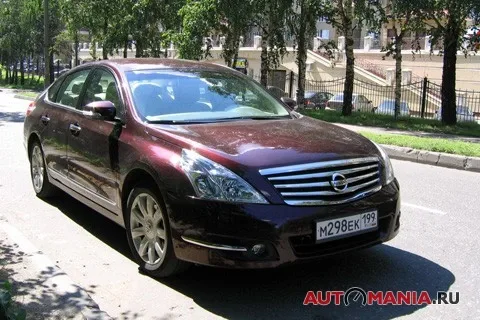
Back in 2006, the Maxima QX quietly left the stage. At that time, Nissan decided that the vacant spot in the business class would be taken by the 2003 Teana, which was to take on the Toyota Camry. But the moment was missed: the competitor was not asleep, and by then the Camry had managed to freshen up and prettify itself noticeably.
So there was no full-fledged battle. Over a couple of years, the Teana sold in a run of 10,238 units — almost five times more modest than the Camry's results. Buyers were put off not only by the controversial design (especially the optics), but also by the fact that the car was, in essence, a rebadged Korean Samsung SM7. If anyone thinks Samsung only makes TVs and phones, they should look online and see otherwise. Suffice it to recall the Samsung SM4 and Nissan Almera Classic — they are the same car under different names for different markets. In Moscow, not to mention the Far East, you can also find the "real" Japanese Teana of the previous generation, but exclusively with right-hand drive.
Now — Only Japan
Two years later, the new Teana made a second attempt to conquer the Russian market. They approached the matter seriously: the Japanese newcomer reached Russia even earlier than its home market. Plus, the car underwent adaptation to our realities. Specifically to ours, because, like its predecessor, it will not be sold in Europe. Nissan folks are not eager to break into the oversaturated European venues — Russia with its vast expanses is far more interesting to them. It should become the third most important market after China and Japan. The car is assembled in China, Taiwan, and at the Japanese plant in Kyushu. Only Japanese-assembled cars will be shipped to Russia.
Now about the heroine herself (I hope the name is still feminine). The appearance has become far more attractive — that is evident at once. All five days I spent behind the wheel of the Teana, the car drew interested glances, looked solid and expensive. Drivers approached me more than once and asked what had changed in the car with the old name. Many were interested in the price, but more on that later. From the front, the "Eastern guest" is simply a beauty, clearly reminiscent of the luxury Infiniti. It even seemed to me that the hood had moved here unchanged from the Infiniti G35. The body has grown 5 mm in length and 30 mm in width (though the Camry is still wider). The rear passenger knee room has increased by 17 mm, headroom by 9 mm. The height remains the same — 1475 mm, and the trunk has grown from 476 to 488 liters.
The car has begun to look richer. The standard mud flaps have disappeared, and the plastic sill trim has given way to polished gloss. There is more chrome — including in the form of trim at the bottom of the doors, resembling a katana sword in shape.
New Platform
The Teana is a fresh model on the D platform, which replaced the FF-L. The body is completely new, and according to Nissan folks, it shares not a single part with the previous one. The share of high-strength steels has grown from 15% to 33%. Torsional rigidity is up 40%, bending rigidity by a full 85%. The suspension geometry has been changed, and the shock absorber mounts have moved from the lower arms to the bearing support. Inside the shock absorbers, a compensating spring has appeared that prevents the unloaded side from hanging out in corners. The suspension is almost a "five plus": the Teana simply does not notice most bumps, including speed bumps and bridge joints. There is almost no longitudinal pitching, and at speed there is no need to correct the steering. Sharp turns, of course, make themselves known, but the "businessman" is not made for racing on serpentines. For that, there is, say, the Infiniti G37.
The fact that they did not skimp on metal is a fact. Take, for example, the v-e-r-y heavy hood lid. But upon opening it, I noticed that in some places the designers still had to yield to the accountants. Apparently, under their pressure, the hood is held not by a hydraulic strut, but by a metal rod, as in the most budget models. The second trace of economy is in the cabin: the steering column is adjusted manually and only vertically.
Goodbye, 2 Liters
So what is under the hood? Our heroine has a 2.5-liter engine with 249 hp (we will tell about the 3.5-liter next time). It replaced the old 2.3-liter with 173 hp. The two-liter Teana has disappeared completely. Along with it, the 4-speed automatic has gone — replaced by the Xtronic CVT. The new engine is more economical than the previous 2.3-liter: that one consumed from 8.3 to 13.7 liters of 95-octane, the current one — from 8.1 to 12.1 liters, and, importantly, 92-octane. Over 800 km of testing, the average city consumption was 10.9 l/100 km, maximum — 13.7 l. Not bad for a brisk and heavy car: acceleration to 100 km/h is 9.6 seconds.
Where to Put a Water Bottle?
Now — the cabin. Ours is the premium trim (about other options — below). The interior has changed radically and again reminds of kinship with Infiniti. It is simply luxurious. Light cream leather creates a feeling of home comfort. The "wood-look" plastic no longer looks garish. Perfect fit of parts, soft plastic, door handles made of matte aluminum, a huge (as much as 10 liters!) glove box. You can hide not only gloves in this glove box, but a bunch of all sorts of things. But at the same time, it is strange that there was no place in the cabin for an ordinary half-liter bottle of water. In the glove box it rattles around, and getting it out on the go is unrealistic; in the central cup holders, the bottle does not hold. The pockets in the doors are so small that even a pack of cigarettes accidentally thrown there had to be dug out for a long time. To the left of the seat, you also cannot put a bottle — you might hit the seat adjustments.
Pay Attention to the Rear Headrests
But the seats themselves are simply fantastic. Soft, with good lateral support, sitting in them is very comfortable. Moreover, which is rare, in the back it is perhaps even more comfortable than in the front. The main expert on family cars — my wife, who prefers to ride in the back — especially appreciated the rear headrests, 350 mm wide. They have an unusual shape — a kind of crescent with adjustable edges, reminiscent of inflatable travel pillows for flights. The seats perfectly support the torso, and the headrests support the head. Comfortable dozing on a long journey is guaranteed.
In the rear armrest in the premium trim, there is a keyboard for controlling the heating and ventilation of the seats, the BOSE stereo system with 11 speakers, and only the right half of the climate control. The buttons for heating and cooling the front seats are hidden in the central box so as not to overload the console (honestly, I did not find them right away). Not entirely convenient, but on the other hand, you do not have to use them often.
You Cannot Fully Rely on Navigation
In the center of the console is a 7-inch color display with a rear-view camera and navigation. Setting a route by touching the screen with the displayed keyboard is much more convenient than with a joystick, like in Audi. But it is less convenient that the entire proposed route is not visible at once. The navigation works quite correctly, all prompts and menus are in Russian. But it is still far from Audi's. The navigation does not recognize some streets, makes mistakes when one street transitions into another and changes its name — the screen still shows the old one. It constantly seems that it lags slightly, works sluggishly.
Movies — Only When Parked
A DVD player is hidden in the vast glove box. But since there are no monitors for rear passengers, you cannot watch a movie on the go — the front passenger is also deprived of such an opportunity. To enjoy the picture and the very high-quality 5.1 sound, you need to do the following: start the engine, insert the disc, press the hand (in this case rather "foot", in the American manner) brake — and only then will the menu and image appear. As soon as the "foot brake" is released, the picture disappears.
A Magic Little Button
The Japanese also came up with another trick. When you press the "Clean" button (with a blue light and an image of berries resembling grapes on the display), an intelligent air conditioning system with ionization and air purification, Plasma Cluster Air Conditioning, is activated, which in a few seconds cleans the air of tobacco smoke by 95 percent. Tested: in the car, not a single passenger guessed that someone had smoked in the cabin. And when harmful impurities are detected, the system turns on automatically.
A very convenient function, I tell you. I would apply such a system at home too — my wife constantly runs to the stairwell for cigarettes.
At this point, perhaps, we can wrap up the story. If I missed something, we will return to the topic in the next Teana test, but with the 3.5-liter engine. I assure you, there is also something to be interested in there.
You Won't Be Able to Build Your Own Configuration
Now about money and equipment. For the 2.5-liter engine, three trim levels are available — Elegance, Luxury, and Premium, as well as five equipment variants (for the 3.5-liter version there are only three). You can't assemble the car from individual options like with Volvo, Audi, or BMW. That is, you can't order a DVD player on the base version or add rear window shades from another trim. A well-equipped car costs 938,500 rubles (including a rear-view camera) — today this is the best option for personal use in terms of price and capabilities. For comparison: the Camry with a 2.4-liter engine (167 hp) is priced at 922,000 rubles, but it lacks most of the options that the Teana has. None of the main rivals offer this much equipment for such money. For 1,033,100 rubles you get even more — already 11 speakers, ventilation for all four seats, and other bonuses. And for 1,086,800 — the maximum set of pleasures (including a phone). Compare with competitors! Even the Hyundai Grandeur from the same business class, without many of the mentioned "features," will cost 200 thousand more. But can you even compare a slightly outdated Korean with a modern Japanese?
The base Teana costs only 832,500 rubles. Naturally, there is no leather interior, no ESP system, and a monochrome display. But even in the initial version, the car is very well equipped.
By the way, the previous Teana is still on sale. Prices have hardly changed. For the version with a 2.0-liter engine, they ask 812,000, and for 2.3 liters — 993,000 rubles. It's unlikely anyone needs it now. It's time to have a sale and lower prices.
Dmitry Shavyrin
We express gratitude to Nissan Motor Rus for the car provided for the test.
Technical specifications
| Dimensions (mm) | 4850 x 1795 x 1475 |
| Wheelbase (mm) | 2775 |
| Curb weight (kg) | 1513 |
| Gross weight (kg) | 2060 |
| Tires | 205/65 R16 |
| Trunk volume (l) | 488 |
| Engine displacement (cm3) | 2496 |
| Max power (hp) | 182 |
| Max torque (Nm/rpm) | 228/4400 |
| Max speed (km/h) | 200 |
| Acceleration 0-100 km/h (s) | 9.6 |
| Fuel consumption (avg l/100 km) | 8.1-12.1 |
| Tank capacity (l) | 70 |
| Turning diameter (m) | 5.7 |
| Price (rub.) | 838,500 |
| Price of tested car (rub.) | 1,086,800 |
Source – AUTOMANIA.RU