
Normal logic
In our time, when marketing rules the world, any, even the most insignificant change in a car's design can stimulate sales. Has the Qashqai changed much, adding +2 to its name?
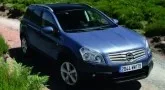
The success of the Qashqai is primarily a triumph of marketing thought. Having caught the widespread craze for crossovers, the creators were not afraid to release a model that is difficult to classify into any single segment. The idea was born from scratch and fully justified itself: in a year and a half, 250 thousand units were sold. But no one was going to stop there, and just a year and a half after the premiere, Nissan presents a new modification of the bestseller. If you look at the situation through the eyes of marketers, the Qashqai +2 occupies a free niche between the short-wheelbase version and large minivans. And for buyers, it's a chance to get a slightly larger trunk and a third row of seats, which was so lacking.
From the outside, it's not so easy to recognize the new model. From a distance, you're unlikely to immediately say which Qashqai is in front of you — the regular or the extended one. But place them side by side, and the difference becomes obvious. The wheelbase of the "plus two" has grown by 135 mm, the rear overhang by 75 mm, and the height has increased by 38 mm. The numbers seem small, but they forced a rework of almost the entire body. The Qashqai+2 is not just a stretched version. It has different roof and doors, especially the elongated rear door and enlarged window openings. The rear is also completely new: its own side panels, bumper, and glass. The work done is serious, but was it worth it?
The driver's seat and front passenger seat are the same as in the regular Qashqai. The 10 mm increase in headroom is unlikely to be noticed by anyone. The dashboard, steering wheel, seats, and trim materials remain unchanged. But the rear door is truly huge — the entire increase in wheelbase went into it. The only inconvenience is that on a tight parking lot, it's hard to open it fully. But in the back, the "plus two" has nothing but pluses. The wide opening allows you not to squeeze into the second row as in the regular Qashqai, risking dirtying your trousers, but almost to step in. And there's noticeably more space: in the short version, either your knees would hit or your head would press, but here you can sit comfortably. Moreover, the middle row is now sliding, with a 240 mm adjustment range.
If you slide it all the way back — it's spacious. But slide it forward, and it becomes tighter than in the standard Qashqai, but space appears for those very "plus two." Nissan says the additional seats are designed for people up to 165 cm tall. Good thing I'm 180 — the way there is barred for me. But the profession obliges me to climb in at least once. I tried to shrink by 20 cm and remember my childhood. Perhaps I'm hopelessly adult and no miracle happened, but it seemed to me that kids would have a hard time there. The narrow gap between the seat back and the door opening is frightening at first glance. Suppose you overcome this fear and settle on one of the benches. You want to get out immediately. You sit almost on the floor, uncomfortable, cramped, and you want to return at least to the middle row.
But getting out is quite a task. A trap. If you go headfirst, you might trip and fall face-first into the dirt. If feet-first, you'll either get dirty or have to literally jump out. I concluded that the third row is made for the offspring of ninjas or kamikazes. Better to fold these "plus two" into the floor and inspect the trunk. If the second row is in the most comfortable position, the volume is not much larger than that of the regular Qashqai. But we keep in mind the possibility of increasing it, and the niche for the curtain is convenient.
I won't go into detail about the driving characteristics — the engines and gearboxes haven't changed. To compensate for the extra 100 kg of mass of the extended version, the suspension was slightly refined. As a result, the "plus two" drives almost like its younger brother — confidently, calmly, without spark. It met the French serpentines without much enthusiasm, but didn't resist either — it passed the test with dignity.
So, are these "plus two" a lot or a little? That's the trick of marketing: presenting minor changes as something grand and luring another trusting buyer. Although formally, everything is honest. Did the dimensions increase? Yes. Is the car seven-seater? Yes. Did the trunk become bigger? Yes. Maybe I attacked the marketers in vain? After all, a lot has been done. And it's quite possible that someone needed exactly such a Qashqai. And the fact that they ask two thousand conventional units more for it seems quite humane. Queues for this niche model are unlikely to be long, if any at all. To sum up, the "plus two" is neither a lot nor a little, but normal and logical.
**FOR YOUR INFORMATION**
**Engines and transmissions**
A modern 1.6-liter 16-valve engine with an aluminum cylinder block, head, and plastic intake manifold. Equipped with multipoint injection and variable valve timing. For the Qashqai+2, its power was increased by 5 hp, and torque by 7 Nm compared to the "short" Qashqai, Tiida, and Note, on which it is also installed. It is paired only with a 5-speed manual and front-wheel drive.
Despite the larger displacement, this engine is as compact as the 1.6-liter one. The block and head are also aluminum. It features low internal friction and low weight. More than 90% of maximum torque is available from 2000 rpm. The Qashqai+2 with this engine can be either front- or all-wheel drive. In addition to the 6-speed manual, a CVT is offered for the all-wheel-drive version.
**Suspension**
Front — McPherson on a subframe with lower L-shaped arms. The anti-roll bar is attached directly to the struts for better roll resistance. Rear — a compact multi-link, also on a subframe. Its design is thought out to maximize trunk volume. The upper arms are made of aluminum — this reduces unsprung masses.
Test drive photos
Comments
No comments yet. Say the first word.