
The name of the model Qashqai (pronounced "Kashkai") comes from the name of a nomadic tribe living in the desert areas near the Zagros Mountains in southwestern Iran. It is worth admitting: those who come up with such names are unlikely to imagine how hard the life of real nomads is. For them, a nomad is a kind of fashionable traveler who has been to places they themselves have not yet reached. But by next summer they will definitely get together, only first they will submit a report, finish building the veranda, and save up money. They would not want to end up in the conditions of real nomadic life, at most urban. Flew to Los Angeles - already a traveler. Got to Goa - a wanderer, the Tuareg are resting! It is for the world of such contrasts and illusions that our today's test subject was created - the new compact crossover Nissan Qashqai. Such that the soul sings, and the body does not ache.
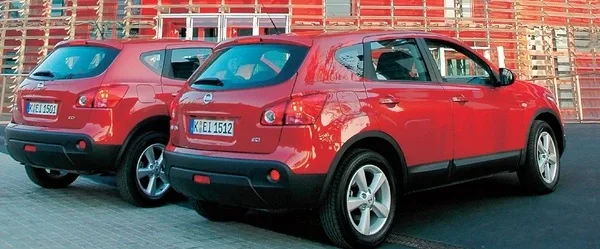
When creating the appearance of the Nissan Qashqai, the designers abandoned the deliberate futurism inherent in some new Nissan models and took functionality as a basis
FRENCH CUISINE
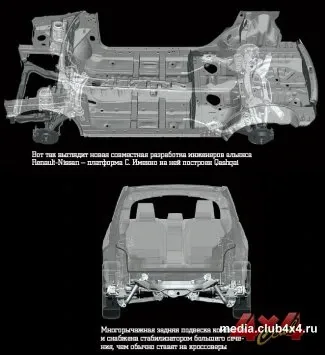
The Nissan Qashqai is based on a platform developed jointly by Renault and Nissan, with the index C - according to the class of cars for which it is intended. By the way, the Qashqai became the first-born of this platform.
The cooperation of Japanese and French engineers, designers, and technologists turned out to be surprisingly productive. The new products of the Renault-Nissan alliance have been delighting us for several seasons. Now it has come to the joint development of engines and common platforms. Globalization bears fruit: the cost of design and production preparation decreases, quality grows, prices fall, profits stabilize, the French flight of thought complements Japanese pedantry - everyone is satisfied. Anti-globalists are indignant: where is the soul? And individuality? Perhaps in national cuisine and folk songs, individuality and soul are important, but in TVs and cars, I value thorough assembly, pleasant appearance, and ergonomics understandable not only to aliens.
When creating the appearance of the Nissan Qashqai, the designers abandoned the deliberate futurism inherent in some new Nissan models and took functionality as a basis
FROM GORILLAZ TO SWAROVSKI
As the director of the design studio told, inspiration for creating the car's appearance was drawn from the works of the Swarovski company and the creativity of the virtual group Gorillaz. The essence of both projects is eclecticism, a mixture of styles and images. For example, Swarovski has a series of chandeliers that resemble natural materials in shape but are made entirely of artificial crystals. They are both strict and airy, similar to Renaissance stained glass and children's mosaics. And with Gorillaz music, everything is even simpler - one of the project's authors himself called the group's style "synthetic folk." There is country, neo-punk, hip-hop, trip-hop, rap, and even a semblance of J-hop. And it sounds great! Very talented and fresh, although, between us, it is obvious pop. In the Nissan Qashqai, the mixture of styles manifested in the vertical division of the car's image. Simply put, the top is light, airy, sporty, the bottom is powerful, masculine, jeep-like. The shape of the glazing - windshield and side windows - resembles the visor of a racing motorcycle helmet, the roof slope - sports coupes, the long hood and decent overhang - American muscle cars. Although we do not see anything revolutionary in the appearance of the Qashqai, the overall impression is decidedly positive. The body proportions, the size of the wheel arches and wheels, the high waistline, moderately large and aggressive light blocks - everything is perfectly executed. Only the protruding "lower lip" of the front bumper looks funny, hinting at a character from "Tom and Jerry." Remember the bulldog that lived in the yard? Well, and this touching little window behind the rear door, which no one will ever look out of.
All instruments and main controls are concentrated around the steering wheel
HUSTLE AND BUSTLE OUTSIDE THE WINDOW
The Qashqai's interior, contrary to fashion, is five-seater. Not surprising, because the creators classified the crossover as C-class - yes, the passenger category called golf class. The interior concept is also with a twist. The cabin is divided into two unequal functional zones - concentration and relaxation. The first surrounds the driver, the second - passengers. It is clear that all controls and instruments are with the pilot, but what about the navigator? Look at the photo: in front of him is a flat, rough panel. Even the glove box is hidden under it and almost invisible. You can, like Bodhidharma, meditate in front of an empty wall and fall into relaxation, or, conversely, concentrate on the bustle outside the window. Second-row passengers got a sunroof in half the roof, decent space to it, and a little less - to the backs of the front seats. I myself (height 186 cm) can sit behind myself, but my knees touch the backs. Surprisingly, with such a swift silhouette of the car, there is plenty of space above the heads of second-row passengers. The "Nissan people" did not have to save on the trunk either, the volume of which varies from 400 to 1300 liters depending on whether the second-row seats are folded.
When folding the second-row seats, a one-and-a-half-cubic-meter space with a completely flat floor is obtained
GASOLINE IN MIND
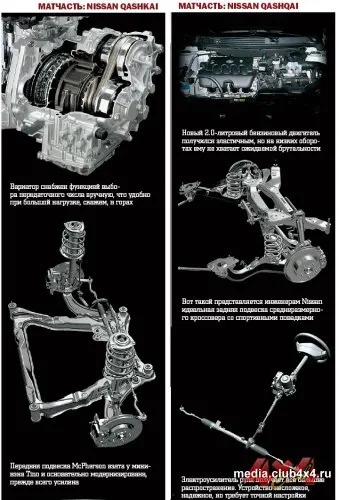
The crossover body is load-bearing. The suspension is fully independent. In front, as usual, McPherson, but in the rear they decided not to skimp and installed a compact multi-link with a large inclination of shock absorbers. Time will tell how durable it is, but this scheme adds a hundred liters of volume to the cargo compartment. The Qashqai's engine range has four power units, two of them new, two diesel. Only gasoline engines will be supplied to Russia: 1.6-liter 115-horsepower and 2.0-liter 140-horsepower. Both are four-cylinder and inline. The weaker engine is also installed on the Note model and the sporty version of the Micra. The larger engine is known only on the domestic Japanese market. It can be paired with a continuously variable transmission or a 6-speed manual. The CVT has a function that allows you to fix "gears" manually, using a servo drive. The less powerful engine is equipped with a 6-speed "automatic" or 5-speed manual. In Europe, Nissans with diesels will also appear: 1.5-liter and new 2.0-liter, the more powerful version of which is installed on the new Renault Scenic. Diesels are paired with 5- and 6-speed manuals and a CVT. In general, in terms of the number of transmission-engine options, the Qashqai has surpassed some passenger cars! And if you consider that there will be two drive versions, you can simply get confused when choosing. For the test, we were given the opportunity not to choose: there were cars in two versions - 2.0-liter diesel all-wheel drive with 6MT and 2.0-liter gasoline front-wheel drive also with 6MT. The former will not be supplied to us, the latter are not quite interesting due to "under-drive." Especially since in Russia 95% of Qashqais will be all-wheel drive. Well, for now we have to act according to the known scheme: all-wheel drive "write down," gasoline "in mind." And I took the diesel.
LIGHT MY MIRROR
Excellent seats, comfortable steering wheel, gear shift lever in place, all instruments readable, visibility is gorgeous, mirrors are extensive, all superlatives. The hood is practically invisible, the sunroof ate a couple of centimeters from the ceiling, and I don't want to raise the height-adjustable seat. Navigating when leaving the parking lot is helped by professional intuition, as well as the protruding longitudinal profiles of the hood and fender joint, reminiscent of the Corvette. I found out that in the lower left corner of the central console there is a "soft airflow" switch. If you don't like the air flow in your face and the noise of the heater, press it, and you won't have to remember the brilliant line from the song of a famous group about lips and a breeze that sways them with something. Ba! There is even a camera that turns on when selecting reverse gear. How damn convenient, I should install one on my "UAZ" too! And it even comes standard - true, in the most expensive trim. And six airbags.
WRITING IN BLACK