
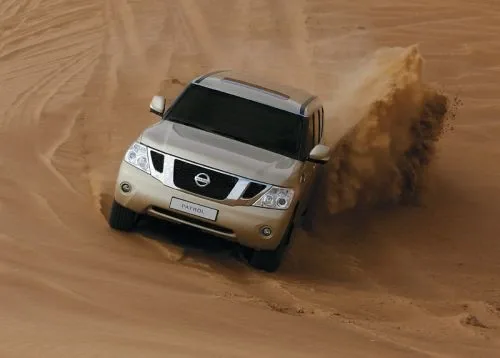
The first encounter with the new generation Nissan Patrol took place in Oman — a country where, thanks to the efforts of the local ruler, roads are covered with first-class asphalt and excellently lit. However, we still managed to find a stretch of off-road to at least roughly gauge how the newcomer will behave in Russian conditions.
Civilized countries where one can truly unleash the talents of a serious SUV are becoming fewer each year. As a result, such vehicles themselves are becoming fewer. They are dying out like dinosaurs, but not due to cold or hunger, but due to overly hothouse conditions. And Oman, which Nissan chose for the first encounter with the new Patrol, was clearly unsuitable for testing the legendary off-roader.
In the Middle East, the distant ancestors of the current Patrol appeared half a century ago. Back then, those regions knew no more about asphalt than about Coca-Cola. Now everything has changed. Thanks to the efforts of the esteemed Sultan, local highways can easily give a head start to the world's best motorways. A traveler is unlikely to find even one unlit stretch. And on the roadsides, imagine, flowers grow. However, that's lyricism. And we are in for direct contact with the Japanese newcomer.
Let's be honest: the new Patrol turned out to be very "suitcase-like." I don't mean to say that's a minus, because often a brutal appearance becomes rather a plus. Like, a man should remain a man in any situation.
2010 Nissan Patrol
© Photo: Nissan
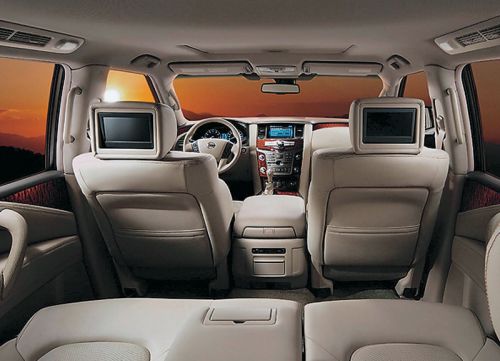
The flip side, and a very pleasant one, of the 7-seat "suitcase" is the truly enormous interior space. It feels like a symphony orchestra, three teenage elephants, and even that guy I saw at McDonald's last week could all fit in the cabin.
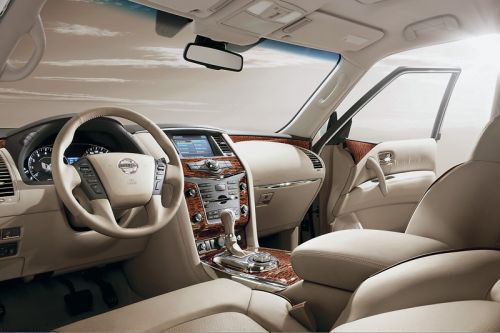
As for the interior, it can only be called luxurious. The light upholstery was especially pleasing, although in Russia darker tones are more often preferred. Leather, wood, and aluminum are used throughout the trim, combining quite harmoniously. The multimedia center at the top of the central console impresses with its capabilities: a DVD player, a multi-format audio system, navigation, and even a video surveillance system around the body.
It's rare for a car manufacturer to openly name its main competitor. In this case, the Nissan folks, without any embarrassment, point to the Toyota Land Cruiser. Here it is — the opponent, rival, and "sworn friend." Poison starts dripping from the pages of the official press kit when it comes to the trunk (this is a large square compartment that is 25% more spacious than the LC200's). Or again: a cooler bag can be placed even with the third row of seats folded out (which is impossible in the LC200). Well, competition is a cruel business. By the way, a couple more words about the rear seats: their backrests also adjust in angle. Everything is done properly.
2010 Nissan Patrol
© Photo: Nissan
While driving, you quickly realize that Japanese engineers tried their best to teach the Patrol to move easily and quickly on good roads. Just imagine: an almost three-ton giant with a 5.6-liter engine producing 400 horsepower can reach the first hundred in under seven seconds. Bravo! Of course, such agility comes at the cost of increased appetite. In the city, the SUV consumes 20.6 liters; in the combined cycle, according to the developers, 14.5.
When maneuvering, the Patrol doesn't sin with disobedience. Excessive body rolls are effectively countered by the Hydraulic Body Motion Control system, which keeps the body from lateral swaying. This, in turn, has a good effect on high-speed maneuvering. To ensure the suspension works optimally, the driver independently selects one of four modes: highway, sand-mud, snow, rocks. The control joystick is located in the tunnel between the front seats.
Of course, as befits a modern SUV claiming leadership in its class, the Patrol is equipped with useful assistants. In particular, the hill start assist (HSA) and hill descent control (HDC) systems seem quite useful. If you stop on a hill and take your foot off the gas, the car will obediently stand still awaiting further commands. When descending, the automatic system maintains a speed of 7 km/h in 4H mode and 4 km/h in 4L mode. The main thing is not to be afraid and not to try to brake on your own. By the way, they are activated by pressing a single button.
2010 Nissan Patrol
© Photo: Nissan
Having retained decent off-road characteristics, the new generation Nissan Patrol is much better adapted to city life. I don't know about Europe or Japan, but in our country such vehicles will be in demand for a long time.
Likes and dislikes
The unimaginably spacious trunk is quite suitable for transporting not only cargo but also large journalists. Spacious
Using the "washer" next to the automatic transmission selector, you can change transmission settings depending on the road surface. Convenient
Driving
The creators of the model found the ideal balance between an off-roader and a city car.
Interior
With the modernized body and suspension, the Patrol has gotten rid of rolls during sharp maneuvers.
2010 Nissan Patrol
© Photo: Nissan
Comfort
Thoughtful ergonomics plus high-class finishing materials deserve the highest praise.
Safety
Few doubt that the Nissan Patrol will receive top scores in Euro NCAP crash tests.
Price
It is known that in Arab markets, the Patrol will cost about $75,000.
Advantages and disadvantages
+ Good off-road qualities, confident behavior on high-speed highways.
- Appearance "for an amateur."
Technical specifications
Make and model - Nissan Patrol
Dimensions - 5140x1955x1938 mm
Engine - petrol, 5552 cm3, 400 hp/5800 rpm
Transmission - automatic, 7-speed
Dynamics - max 210 km/h; 6.6 s to 100 km/h
Competitors - Toyota Land Cruiser 200
Our opinion
The new Nissan Patrol is better adapted to city and highway use than its predecessors. While retaining its off-road potential, the SUV effectively counteracts body rolls, maneuvers excellently, and stops quickly. And it also offers first-class comfort.