
Nissan Navara and Nissan Pathfinder - A bicycle that didn't fit
Do you love nature, travel, kayak, bike, and other snowboards? You need an SUV! Or a pickup... Or maybe an SUV is better - somehow you feel calmer about the luggage. No, still a pickup - it will fit more. Wait a moment, let's figure it out!
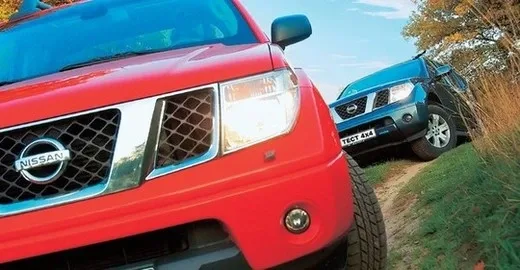
In recent years, pickups have become a real hit on the Russian market. Unlike the US, where such vehicles are purely workhorses, here they are perceived as a more budget-friendly replacement for the usual SUV. Before the Nissan Navara came out, the choice was scarce: either the Mitsubishi L200, or the Ford Ranger with the Mazda B-Series, or outright exotic options like the Great Wall Deer G3. But the Japanese at Nissan decided otherwise: they made a light truck that, in terms of equipment, is no worse than a serious SUV, drives quite briskly, and easily takes half a ton of cargo in the bed. True, the question arises: what exactly to carry? The Navara doesn't target hard workers but people with an active lifestyle—those who love sports, nature outings, fishing, or mushroom picking. It's a vehicle for those who don't want to be like everyone else and prefer to stand out. Although, to be honest, calling the Pathfinder boring wouldn't be fair—it's considered the base for the Navara and gives the owner almost the same capabilities as the pickup. Or not quite? So it's interesting what to choose for someone who, a couple of times a year, goes with friends, tents, and kayaks to a lake for a week, and every weekend just heads to the forest or fishing. They don't plan to ford mountain rivers or conquer peaks on a bike worth half a pickup. An ordinary guy, not an extreme sports enthusiast, though we should also think about the latter. In short, we packed our gear, jumped into the Navara and Pathfinder, and headed to the autumn forest—to have the last picnic of the season.
AND MY FRIEND THE TRUCK
Now a few words about the vehicles. The Navara, which came out a couple of years ago, is a classic mid-size SUV from the beginning of the century. Our example was equipped with a 4.0-liter gasoline V6 producing 270 horsepower, a five-speed automatic, all-wheel drive, a seven-seat cabin, and an Infinity audio system. We agreed in advance that, according to the scenario, four people would ride in each vehicle, so we didn't use the third row and didn't fold the second—at most partially. In the Pathfinder, the rear seat folds in a 40:20:40 split, and if you lower the center section, you get two separate seats on the sides. In the Navara, the proportions are different—40:60, but the mechanism is also different: the seat cushions lift up, revealing compartments under a net. This is convenient if you need to put something not too clean inside the cabin, but not something rough enough to throw in the bed. For example, I stuffed two kayaks there when I stopped to pick up meat for the barbecue. And only because our pickup didn't have a roof over the cargo area. Otherwise, the Navara is a typical representative of the new generation of comfortable pickups. Under the hood is an excellent 2.5-liter turbodiesel paired with a four-speed automatic and a proper part-time system. The equipment included air conditioning and a rear differential lock. Comfort, dynamics, and handling—all in the base. In terms of dynamics, the vehicles were almost identical, but fuel consumption was a different story. The gasoline Pathfinder, over 300-plus kilometers, consumed more than half a tank—about 17 liters per 100 km. The diesel Navara, without lagging a second, was content with just a quarter tank and 11 liters per 100 km. A pleasant difference, especially given the prices: on the test day, 95-octane gasoline cost 20.2 UAH per liter, while diesel was 18.1 UAH.
HEAVE HO! LOWER AWAY!
Now about the gear and loading. According to the scenario, we're heading out of town, about a hundred kilometers away, for the whole weekend—to relax in comfort, but also not forgetting about activity. So, to the mandatory list, we added a few optional items. In the end, we took: two three-person tents, camping furniture—three chairs and a table, a full set of dishes, sleeping bags, self-inflating mats, two "Vyun-K" kayaks, fishing rods and spinning rods, a grill, charcoal, an axe, a machete, a chainsaw, warm clothes, a blanket, and a bunch of small stuff. And after some thought—also a bicycle: in case someone wants to dash to the village for kefir? When we dumped all this in front of the vehicles, it made a decent pile that clearly didn't promise easy loading. According to the test plan, we needed to load everything first into one vehicle, then into the other, and see what wouldn't fit.
INTO THE FOG
The road to the campsite was typical for such outings, with a Moscow twist. First—short hops around the city, then traffic jams on the way out, fifty kilometers of narrow highway with trucks and villages, a kilometer of dirt road, and the same amount of forest tracks, a bit of off-roading—and we're there. The city, highway, and even dirt road didn't reveal an obvious leader. The SUV goes uphill a bit easier, overtakes more confidently outside the city, and is quicker on the ring road. In traffic, all its advantages in power and dynamics come to naught. In the forest, the longer Navara—which differs from the SUV only in length—squeezes between trees with difficulty. And another point: when driving fast over bumps, the front suspension of the loaded vehicles no longer holds the impact as confidently. With the Navara, this happened less often, but the Pathfinder annoyed more often—the arms hit the bump stops roughly and, not finding understanding, thumped indignantly against the travel limiters. The rear suspensions, especially the leaf springs on the pickup, looked at this fuss with silent superiority. But off-road, it's better to drive slowly anyway. The ground clearance is almost the same: 238 mm for the SUV and 236 mm for the pickup. Under the front suspension, both have 254 mm; under the rear, the Pathfinder has 235 mm, and the Navara has 230 mm. The difference is insignificant, but it's important to remember: in the SUV, the rear clearance decreases under load, while in the pickup, it doesn't. But the truck has a longer rear overhang. And how can you call such beauty a truck?
TEA WITH BAGELS
Without adventures and without low range—which, by the way, is serious in both, 1:2.596—we reach the bank of a Moscow-region river. We quickly set up camp, drink coffee with bagels, and get to work on the kayak. If you want to kill a couple of hours before guests arrive—buy a kayak and try to assemble it. Don't forget the band-aids and the instructions, read three times. They say experienced people, even girls, manage in 20 minutes. But for a beginner, it's fascinating...
Most of the gear was carried by the pickup. In the bed went the kayaks, camping furniture, two 75-liter backpacks, a 100-liter duffel, small items like a tarp and hammock, something else—and the bicycle with the front wheel removed. As it turned out later, the wheel could have been left on, but I was afraid of scratching the bed and banging the bike against the sides. We measured the Navara's cargo platform ourselves: 1510 mm wide and 1560 mm long on the floor, 1488 and 1496 mm along the inner edge of the side. The side height is 475 mm. The width between the wheel arches is 1130 mm, and the width of the tailgate opening is 1430 mm. By the way, that tailgate turns into a convenient table and easily supports 200 kg—tested. The kayak package fits in the bed both lengthwise and crosswise. The bicycle goes diagonally, but the wheels have to be pushed under the lip. All this stuff is covered on top with a net that attaches to the standard tie-down points. These tie-downs are a huge plus for the Navara, not only over the SUV but also over other pickups. The cargo securing system is called C-Channel: it's rails along which double hooks slide, laid along the floor, along the side, and front walls.
When we started loading things into the Pathfinder, it turned out the kayaks fit only crosswise. The pile of cargo rose to the very ceiling, completely blocking the rear view, and the bicycle remained standing outside—it clearly belonged on the roof. We didn't have special roof rack attachments with us, so the bike simply didn't fit.
We had to unload everything we had so painstakingly stuffed inside, fold down the center section of the second-row backrest, and place the poor bike between the seats. But even here there was a snag: it didn't fit in height, so the front wheel had to be removed. Some light but bulky items we just tossed on top of this pile of gear. And there was nothing to secure the net to—the tie-down loops, hidden below the window line, reliably concealed the backpacks and sleeping bags.
Going home was the last thing we wanted. The autumn day fades quickly: the shashlik turned out great, the flask of "contraband" Georgian cognac emptied after three toasts, the tea cooled—time to hit the road. But how reluctant we were to leave! Okay, let's shake it off.
This little test showed that a pickup, in terms of capacity, really gives a head start to a classic SUV. You'll say—who doubted it. But if you're not planning to load three kayaks or something similar in size, and for bicycles and bulky but light items you have separate roof boxes, then the pickup's advantage comes to naught. Especially since a pickup with a hard bed cover and without it are two completely different vehicles. Without a cover, you can't leave it unattended even for a minute, especially in the countryside. And that already borders on a full-fledged expedition, where it's better not to go without special preparation. But that's a topic for another conversation. Our picnic was a success, and we didn't abandon the bicycle—we managed to fit it into the pickup after all!
Test drive photos
Comments
No comments yet. Say the first word.