
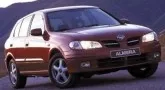
Nissan spent 200 million pounds sterling on organizing the production of the new Almera hatchback at its plant in Sunderland, England. It seems the Japanese are serious: they not only want to establish themselves in the golf class but intend to compete for a place in the most competitive segment of the European market.
To understand what class of car we are dealing with, one glance at the new Almera is enough. Especially in profile, it strongly resembles a well-known European model. High beltline, massive rear pillars, expressive roofline silhouette. Remove the slightly different headlights, remove the Nissan emblem from the hood, simplify the taillights — and the picture becomes quite obvious. Technology centers in Japan and England, several European studios, and a design studio from Germany worked on the new model's appearance.
It is curious whether anything from the previous model remains in the new Almera, and most importantly — is the noticeable price increase of around two thousand dollars justified?
In my hands is a hefty key with a built-in antihijack system and remote door opening buttons. I insert it into the ignition, turn it — and the transponder built into the key sends an encrypted request to the engine immobilizer to start. The electronics, recognizing the new code (which changes each time), gives permission — and the engine comes to life. Previously, such a system was only on the Nissan Primera, and that model was considered one of the most theft-protected.
I settle into the driver's seat, adjust the seat, and use the joystick to set the mirrors. A feeling arises that I have done all this somewhere before. The deja vu is explained simply: all buttons and controls are in familiar places. The only exception is the backrest tilt adjustment with a "thumbwheel" that can only be reached with the door open. That is a purely European approach.
The interior rearview mirror initially seems small. But after adjusting it, you understand: it is not about the mirror itself. The too-wide rear pillars, three headrests in the second row, and a small rear window — that is what limits visibility.
The clutch pedal is almost weightless, and the gearshift lever has a short throw. I engage first of five gears, and we move off.
The Almera confidently picks up speed, not even requiring much revving of the engine. The 1.5-liter engine with 90 horsepower is quite enough not to feel deprived in city traffic. And if you need to punish someone, you can push the tachometer needle into the 4000 rpm zone and take off spectacularly, allowing the 15-inch wheels to spin.
The body of the new Almera has become 30% stiffer, while dimensions have grown: length increased by 64 mm, width by 16 mm, height by 55 mm. For the first time, the concept of a "two-zone body" is applied here: deformation zones are clearly separated from the ultra-strong "cocoon" of the cabin. The passive safety list now includes active headrests and side airbags for head and chest.
While stuck in a traffic jam, we do not feel the heat: a powerful air conditioner works in tandem with special glass that reduces the penetration of ultraviolet and heat into the cabin. At the same time, there is time to inspect the car more closely.
The European origin is felt. There are so many shelves, pockets, boxes, and cupholders that you wonder what to fill them all with. Later, in the trunk, in the niche under the spare wheel, we found a hidden compartment — small, perhaps for a camera. In the rear part of the front seat armrest, we also found a 12-volt outlet. A small thing, but pleasant: you can charge your phone and connect a laptop.
The traffic jam is not clearing, so we decide to make our way to the suburban highway through the backstreets. Maneuvering in tight spaces allows us to appreciate the power steering — it is moderately responsive — and the small turning radius: only 5.2 meters.
On the highway, the driver can finally let loose. Acceleration to 100 km/h in 13.8 seconds is quite decent, and it holds up to fourth gear. But as soon as you engage fifth, the car "goes flat." It seems the dynamics are provided by the selection of gear ratios in the gearbox, not by engine power. Let me explain: the new Almera is equipped with a QS15DE engine with a displacement of 1497 cubic centimeters. This newcomer has no variable valve timing system; it is tuned for efficiency and reduced emissions. It is the first engine in Europe with a built-in diagnostic system that meets Euro 4 standards, which will come into force in 2005.
The Russian driver is concerned about ecology rather abstractly, so he can only rejoice in the moderate appetite: 6.6 liters of 95-octane gasoline in the combined cycle. And even with its "sluggishness," this engine can accelerate the car to 173 km/h. And for those who want something livelier, it is worth looking at the 114-horsepower 1.8-liter unit with variable valve timing, which is also available for the new Almera.
A road with sharp turns and a speed of about 120 km/h clearly demonstrated the strengths of both suspensions. The front one came here from the previous Almera almost unchanged, only becoming stiffer. But the rear multi-link is the same as on the Maxima QX and Primera. Its essence is that during any maneuver — braking, turning, or accelerating — the rear wheels remain strictly perpendicular to the road. And this does not depend on load; the gross vehicle weight reaches 1710 kg. The only drawback is the peculiar operation of the front suspension on rebound: when hitting a pothole, the front wheels tend to ride along its bottom.
Fortunately, in normal driving, I did not have to test emergency braking. So we chose a quiet place and provoked the ABS to activate along with the Brake assist system, which allows braking on the verge of anti-lock activation. The technique is simple: we reduce the pedal effort needed for effective braking. The Almera's brakes work exceptionally. At the same time, feedback is not lost, and it is quite easy to modulate the pedal effort.
An unevenness on the road that the driver and front passenger barely noticed took its toll on the rear passengers — they tested the softness of the headliner. It turned out that there is not enough space above the heads of rear passengers. The "gallery" immediately expressed a wish — hypothetical, of course — to add a couple of centimeters for the legs. And there was no question of seating a third passenger in the back row: you would have to say goodbye to the relaxed seating.
The trunk volume of 355 liters is quite sufficient for a reasonable amount of luggage. If you need to transport something larger, the rear seats fold down.
I systematize my impressions. The new Almera has undoubtedly taken a big step forward compared to its predecessor, which was popular with us primarily because of its price. So, 200 million British pounds were not spent in vain. But whether it can compete with its classmates is an open question. In the basic Comfort trim, the new Almera costs 16 thousand dollars at dealers. About the same is asked for a Golf IV in the simplest configuration. But since the founder of the class is a purebred "European" from a good "family," the advantage will most likely remain with it. Over time, the emphasis may shift: the Almera could sell better than a Golf of the same age if the Japanese again achieve a special price for the Russian market, as was the case with the old Almera. But these are nothing more than assumptions.
Technical specifications of Nissan Almera 1.5
Body – 5-door hatchback
Number of seats, persons – 5
Curb weight, kg – 1200
Dimensions (length/width/height), mm – 4184/1706/1442
Wheelbase, mm – 2535
Maximum speed, km/h – 173
Acceleration time to 100 km/h, s – 13.8
Fuel consumption, l/100 km:
- city cycle – 8.6
- highway cycle – 5.5
- combined cycle – 6.6
Engine:
- type – 4-cylinder, in-line
- displacement, cm3 – 1497
- power, hp at rpm – 90/5600
- torque, N·m at rpm – 128/2800
- fuel system – multi-point injection
Transmission – manual, 5-speed
Tire size – 185/65R15
Suspension:
- front – independent, McPherson
- rear – multi-link
Brakes:
- front – disc, ventilated
- rear – disc
Steering – rack and pinion, power-assisted
Price, $ – 16000.