
Nissan Almera: new classic
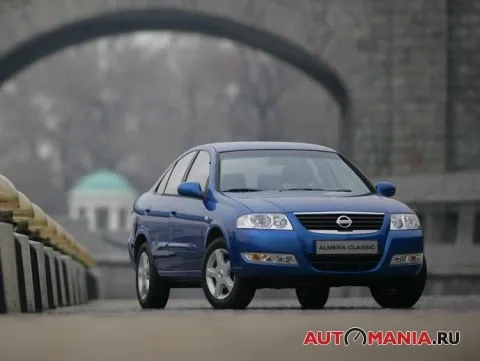
The first and perhaps most important difference from its predecessor is its quite democratic price, which allowed the newcomer to seamlessly join the rapidly growing international squad of "killers of the domestic auto industry." All together against the Kalina and each for himself: Franco-Romanian Renault Logan, Chinese Chery Amulet, pseudo-American Chevrolet Lanos, almost Russian Kia Spectra… The latter, by the way, should be considered the main rival of Classic in the fight for the buyer.
The second significant difference of the newcomer from the old Almera is its appearance. The Japanese preferred a more avant-garde but less original execution to the almost textbook exterior. The author of these lines was clearly reminded of the once super-popular VW Passat B5. The V-shaped radiator grille, the shape of the front optics, the hood, the pillars, and indeed the overall body silhouette are strongly associated with the "original source"…
But I do not at all consider this a drawback: as the Japanese say, car design is akin to music, where there are only seven notes, so if something repeats somewhere, it is not so scary. The main thing is that despite a radical revision of styling, the appearance of Almera Classic gravitates towards proven classic forms that remain in demand.
The interior design is the same self-sufficient classic. Inside, compared to the exterior, everything is simpler and more democratic, but quite modern. There is neither blatant imitation nor pretensions to luxury. The materials used in the interior trim, thanks to their characteristic texture, imitating if not leather, then decent-looking polyurethane, look much more presentable than they actually are, which favorably distinguishes Classic from the mass of budget sedans. Otherwise, however, there is less enthusiasm. The archaic ventilation control unit on the center console is clearly overkill. The horizontal "sliders" "a la VAZ 'nine'" seemed like a terrible anachronism back in the early 90s; today they look like a misunderstanding. Although, I won't hide it, using this setup is still quite convenient. By the way, this also applies to all other equipment – there are no special complaints about ergonomics.
Alas, the same cannot be said about comfort. Firstly, despite quite decent dimensions, in practice the Classic's interior turned out to be rather cramped; at least, the rear seats of many of its "classmates" are much more spacious. It would seem that such limitations should indirectly indicate that up front, anyone can sit freely and comfortably, even if they are far from "Korean" height and build. But no – the range of adjustments is designed for an average driver up to 1.80 meters. A taller individual, if they squeeze behind the wheel, will perceive the trip as a veritable execution – the too-short cushion and backrest of the driver's seat will provide "unforgettable" sensations in the legs and back after a couple of hours. I don't know if it's worth strictly judging the newcomer for these shortcomings – unfortunately, they are typical of most modern Korean cars, even family sedans and business-class cars.
If we turn to the advantages of Almera Classic, among them are a quite spacious trunk, the presence of a full-size spare wheel (which, by the way, the predecessor did not have), and quite decent driving characteristics, largely provided by a power unit that is more than worthy for such a car. The 1.6-liter engine with 107 hp is inherited from the Nissan Primera. The engine is characterized by decent traction at low revs and good fuel economy (both provided, among other things, by the continuous variable valve timing system CVTC); in addition, it is specially adapted for 92-octane gasoline for the Classic. From the point of view of dynamics, there is no fundamental difference between the 5-speed manual and the standard 4-speed automatic. In both variants, the power unit provides quite brisk and smooth acceleration, which is usually not typical for such cars.
But the engine's shortcomings, on the contrary, are more than typical. The most significant is the unmelodious "voice." At idle and low revs, it is noticeable but not intrusive. However, starting from medium revs, its high-frequency whine begins to noticeably strain. And this is despite the fact that the car has far from the worst noise insulation.
The suspension and steering are also tuned at an average level. The former provides decent ride smoothness, good stability when driving straight, but also allows significant body roll. After 150 km/h, rocking is very noticeable – the car literally floats in the lane, requiring constant steering correction.
The "steering wheel" itself is characterized by high performance (only three turns from lock to lock), and this partly compensates for the slight lack of feedback. When accelerating, it should be taken into account that the car has a pronounced tendency to understeer.
The efficiency and informativeness of the brakes cause no complaints at all. The moderately stiff pedal allows quite precise dosing of effort; the electronics engage softly and unobtrusively, easily correcting possible driver errors.
The price list provides for five fixed configurations of the Classic. The base version with the PE index will cost $14,090 – that's for a car with a driver's airbag, power steering, central locking, and front electric windows. The next option – with air conditioning – is $1,000 more expensive. The PE+ version is also presented in two successive modifications costing $15,690 ($16,840 with automatic transmission) and $16,490 ($17,640 with automatic transmission), respectively. In the first case, the car will be additionally equipped with a passenger airbag, belt pretensioners, Isofix mounts, and heated seats, and in the second – ABS, EBD, Brake Assist, and an audio system with four speakers. The most "loaded" version SE assumes the presence of a full set of possible options, however, you will have to pay at least $17,590 ($18,740 with automatic transmission) for it.
That, in fact, is all the more or less noticeable features of the Nissan Almera Classic. Overall, despite a certain set of shortcomings, the car makes a very pleasant impression, which, in fact, is confirmed by sales results. And for such a mass model, this is the best recommendation.
Technical specifications:
Nissan Almera Classic
Dimensions:
Length (mm) 4510
Width (mm) 1710
Height (mm) 1440
Wheelbase (mm) 2535
Weight (kg) 1160
Trunk volume (l) 460
Engine displacement (cm3) 1596
Max. power (hp) 107 at 6000 rpm
Max. torque (Nm) 146 at 3600 rpm
Max. speed (km/h) 184
Acceleration 0-100 km/h (s) 12.1
Average fuel consumption (l) 6.8
Price ($) from 14,090
Source – www.automania.ru