Nissan Almera. Korean city dweller
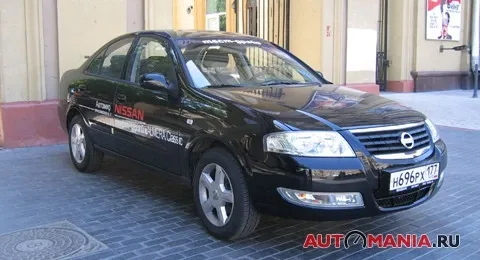
Choosing the Nissan Almera Classic for a test today may seem strange — the car is no longer a new model, sells well, and is often seen on the roads. But we were interested in something else: why people are willing to pay half a million rubles for it and what exactly attracts them.
Perhaps many are lured by the loud Japanese name, associated with Murano, 350Z, or Pathfinder. But here fans will be disappointed: the Almera Classic, like the Teana, comes from Korea, and only for Russia were they renamed to Nissan. On the plate at the driver's door, it says "Renault Samsung MotorCo," and under the hood — "Made in Korea." Nissan's marketers, who own both Renault and Korean Samsung, resorted to this trick to sell these models more easily in our market. After all, for Russians, Samsung is firmly associated with TVs and phones, not cars, and proving otherwise would take too long. It was simpler to use an already well-known brand.
By the way, if you've watched Korean action movies, you've probably noticed: mafia bosses there drive Samsung SM7 (that's our Teana), and their henchmen drive Samsung SM3 (for us, the Almera Classic). A European, to buy such a car under its native name, would have to go to Russia or Korea. The Teana can still be found in Japan, but there it will be right-hand drive.
In addition to the SM3 and SM7, there is also an intermediate model, the SM5, based on the Nissan Maxima — since late 2003, it was sold in Ukraine for 15,900 euros in the version with a 2.5-liter engine (1.8 and 2.0 engines were cheaper). By the way, Ukraine is almost the only country in Europe where Samsung is sold under its own name, not as Nissan.
Enough history, let's get down to business. Externally, the Almera Classic looks pleasant — cute, even elegant. From the front and side, it can easily be mistaken for a VW Passat. The narrow fog lights fit organically into the design, and the rear doesn't irritate. The trunk opens with the key fob or a button in the cabin. It looks big, but in reality, it's not that spacious. The rear seat backs don't fold down — a serious drawback. The suspension is also far from ideal: all joints, bumps, and speed bumps are transmitted, which doesn't add comfort. And the sound insulation leaves much to be desired — both the engine and the Kumho tires are clearly audible.
The interior is without frills: no onboard computer, only two airbags, a plastic steering wheel, and hard dashboard plastic. There is seat heating, but the buttons are poorly placed — they are easy to hit when shifting gears. And the temperature adjustment is with sliders, like in a "Zhiguli" or cheap Chinese cars. That's such a "retro touch" in a modern car.
The driver's seating position is also disappointing. Dimensions are felt poorly, and when parking in reverse, it's a real problem. The mirrors are too small, and the shelf behind the rear seats blocks the view, so even with your head turned, you see little. Parking sensors are absolutely necessary here! A similar problem exists in the Fiat Albea, but it's more forgivable — it's almost 150 thousand cheaper and its suspension is decent.
Competitors for the Almera Classic in the "C" class are plentiful, especially since the "Korean with a Japanese name" is offered with only one engine — 1.6 liters with 107 hp. The Ford Focus 1.6 (100 hp) costs 476 thousand, the KIA Cerato 1.6 (105 hp) — 469 thousand, the Mitsubishi Lancer X 1.5 (109 hp) — 482 thousand, the Renault Megane 1.6 (115 hp) — 472 thousand. Almost all of them are better in driving qualities, equipped with onboard computers, more spacious in the back, and more economical in the city. And the Almera is the most expensive — 499 thousand, and at the same time, it can't boast obvious advantages that would justify such a price.
Technical specifications:
Dimensions (mm)
|
4510 x 1710 x 1440 (1450) |
Curb weight (kg)
|
1215 |
Gross weight (kg)
|
1700 |
Maximum power (hp)
|
107 |
Max. torque (Nm/rpm)
|
146/3600 |
| Maximum speed (km/h) |
184 |
Acceleration (0-100 km/h) (s)
|
12.1 |
Engine displacement (cm3)
|
1596 |
| Fuel consumption (l/100km) |
9.5-10.7 |
Wheelbase (mm)
|
2535 |
| Tires |
175/70 R14 |
Minimum turning diameter (m)
|
10.6 |
Trunk volume (l)
|
460 |
Tank volume (l)
|
55 |
| Fuel |
AI-95 |
Price of the tested model (rub.)
|
499,000 |
Dmitry Shavyrin
We thank the "Avtomir" dealership on Yaroslavka for providing the car for the test.
Source – AUTOMANIA.RU
