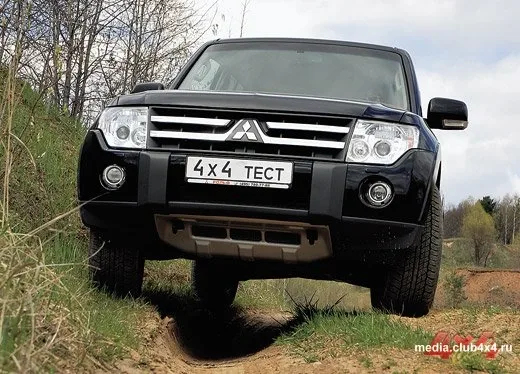
The debate over whether the fourth-generation Mitsubishi Pajero is a completely new model or a restyling of the previous one has not yet subsided. Nevertheless, only a quarter of the parts were inherited, the rest are its own.
2,617,139 views
Let fans of this model throw tomatoes at me, but the Pajero IV, like its predecessor, is not designed for regular off-road conquering. There is no frame here, the suspension is fully independent, and the transmission is literally packed with electronics. In essence, it is a comfortable family SUV with enhanced all-wheel-drive capabilities. And what about the third generation's victories at the Dakar rallies? Let's not delude ourselves—everyone knows that racing cars have little in common with production vehicles.
Plenty of new parts, updated design—all of this is wonderful. Personally, I am genuinely glad that those awful muscular front fenders are a thing of the past.
FIND TEN DIFFERENCES
But in what ways has the Pajero IV truly advanced compared to the third generation? The body has become noticeably stiffer in torsion, which should have improved handling on asphalt. That's a pleasant fact, but the Pajero III was also in perfect order in this regard. It's practically impossible to notice the difference. However, the aluminum hood is tangible: now you can lift it and prop it up with the stick without much effort. True, for a car of this price level, there should be no sticks at all—the hood should have hydraulic struts... Another plus is improved rear visibility: the spare wheel has been lowered by 50 mm.
Our test vehicle was equipped with a new 3.8-liter gasoline V6 (250 hp) with the proprietary MIVEC system and variable-length intake manifold. And thank goodness it replaced the previous GDI V6 3.5 L (202 hp)—that one often suffered from failures of the high-pressure fuel pump and injectors due to poor fuel quality.
The new gasoline engine works exclusively in conjunction with the adaptive five-speed automatic transmission INVECS-II Sports Mode. This version is called Ultimate and costs $60,990. Besides the engine and gearbox, it differs from the base Intense trim (3.2 L diesel, 165 hp, manual transmission, $49,990) with a leather interior, advanced audio system, and DVD player. There is also an intermediate Instyle version—it already has leather, but the audio is simpler and there is no DVD. Everything else is included in the standard equipment: climate control, CD receiver, alloy wheels, xenon headlights, rear air conditioning with manual control, and cruise control.
A SENSE OF BEAUTY?
The interior has undergone serious reworking. It is comfortable, no argument there. New instrument panel, soft plastic everywhere. However, the "wood" and "metal" inserts do not get along with each other—you want certainty about what this is: high-tech or classic? And the dark blue backlighting of the instruments and onboard computer completely stands out from the overall picture. It reminded me somewhat of Chinese SUVs. Good thing there are other trim options...
The first and second row seats are comfortable without any reservations. The driver's seat with electric drive has five adjustments, including lumbar support firmness. The steering column adjusts only by tilt angle—in principle, this is not critical; it's unlikely anyone will have ergonomic issues. But a car of this class should satisfy the owner's maximum whims... By the way, I noticed that the onboard computer does not understand Russian.
The Pajero IV is a seven-seat SUV. More precisely, conditionally seven-seat, like most of its classmates. The third-row bench is just too small, and it hides in the underfloor of the trunk when folded. The trunk itself, with the third-row seats folded, is simply huge. However, the plastic on the side panels is too delicate—scratches appear as if by themselves.
The chassis has remained virtually unchanged, at least visually I noticed no differences from the old Pajero hanging on the neighboring lift. The suspension is independent with springs: double wishbones at the front, multi-link at the rear.
The proprietary SuperSelect transmission is now called Advanced SuperSelect 4WD (SS4-II). It still offers four modes: rear-wheel drive, all-wheel drive, all-wheel drive with locked center differential on high range, and the same on low range.
BUSINESS COMFORT
Well, we've sorted out the technical part. Let's ride? On asphalt, the Pajero is good. Only excellent visibility and high seating position remind you that it's not a passenger car. And, of course, the more than respectful attitude of other drivers. At first, I was surprised by the excellent sound insulation, but then that feeling passed. When the speedometer needle goes past a hundred, aerodynamic noises gradually seep into the cabin. As for the lights—the low beam is simply excellent, and the high beam is "die, all living things."
The suspension is comfortable, and body roll in corners is quite small. Minor complaints arose about the steering—it's too light, somewhat "American-style."
During calm driving, the "automatic" shifts smoothly and timely. But during overtaking, kick-down engages with a noticeable delay. Manual mode doesn't save the situation. It seems the gears have already clicked down a couple of steps, but the gearbox's brain is in a brief state of thoughtfulness.
AND WHERE ARE THOSE HORSES?
What about the engine? I can't say it disappointed me. Yes, it accelerates the Pajero to 100 km/h in 10.8 seconds, but still, from 250 "horses" you expect more. True, don't forget that they have to haul 2,110 kg of curb weight. So it's no surprise that these "horses" have an excellent appetite. According to our rough calculations and the onboard computer data, fuel consumption was about 18–20 liters per 100 km. With an 88-liter tank, the range is not great. By the way, far from big cities, the owner might face a surprise: at the next gas station, the nozzle might simply not fit into the narrow filler neck—it's made to the European standard.
REMEMBER THE RAMP
How are things off-road? Well, it depends on what kind. As long as there is a solid base under a layer of sand or mud, everything is fine. The ground clearance is quite decent, and the transmission allows a lot. The vehicle climbed over rough terrain quite well. The travel of the independent suspension is, of course, small, but the full rear differential lock (optional) came to the rescue. The main thing is not to forget that the car has a long wheelbase. Hanging on the belly on a crest is as easy as pie. The complex of active safety and off-road capability systems can be turned off with a button, but not completely. The electronics stay vigilant to the last, and the degree of its intervention depends on the position of the transfer case selector.
What are the results of our acquaintance? It's not entirely clear who needs such a serious off-road transmission combined with a car-like chassis. After all, in their right mind, owners of the Mitsubishi Pajero IV are unlikely to venture into the difficult domestic off-road. Scratches on the sides are half the trouble. There is a risk of damaging the suspension or puncturing the unprotected fuel tank. And mud baths are clearly not beneficial for the numerous electronics. Nevertheless, overall impressions remained quite positive. The new Pajero is a comfortable and safe family all-rounder for multi-purpose use. It seems it has finally settled down.
Test drive photos
13 photos
Comments
No comments yet. Say the first word.
Write a comment
No sign-up needed - just your name.
Write