
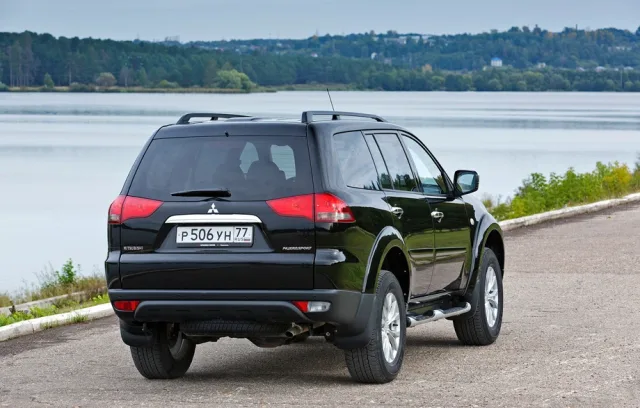
Imagine the scene. A meeting is held, attended by specialists of various profiles from Mitsubishi. The agenda is the restyling of the Pajero Sport SUV. What to change? What to leave unchanged? After a short discussion, a simple decision is unanimously made — to slightly touch up the exterior (just a little), revise the equipment, and leave the mechanics as they have been since 2008. And looking at the updated Mitsubishi Pajero Sport, such a situation is easy to imagine, because most likely, that's exactly how it was. The new model received a different front bumper, a modified radiator grille and rear lights, as well as an improved multimedia system. That's it.
According to Mitsubishi's calculations, from January to August 2013, the Pajero Sport sold 5,630 units on the Russian market (+41% compared to the first eight months of 2012). Among similar-sized opponents, the Pajero Sport is second only to the five-door Toyota Land Cruiser Prado, which showed a result of 9,835 cars.
Mitsubishi representatives explain that the appearance of the "sporty" Pajero is already modern and moderately brutal (as befits a real SUV), and the mechanics are time-tested and do not need modernization at all. I talked to owners of second-generation Pajero Sport five-doors, scanned thematic forums... Cases of failures of main components and units are isolated and not systematic, but on many other aspects people have enough complaints. They complain about weak paintwork (easily scratched) and corrosion, which sometimes appears on almost new cars.
It's good that the Pajero Sport SUV has advantages that allow you to turn a blind eye to the cheap interior trim and not the highest build quality. But you constantly think about the missing onboard computer.
After the update, the car received a multimedia system with an improved display (higher resolution). It also includes navigation and a 420-watt audio system. All this is the prerogative of the most expensive Ultimate trims (1,579,990–1,599,990 rubles depending on the engine).
In addition, according to owners, it would be good to refine the design of the steering rack and its supports, which constantly make extraneous sounds. Some are unhappy with the weak front suspension, which sags at low mileages even on relatively smooth roads, while others lack quality interior trim and proper sound insulation. They also complain that the fuel tank has no drain plug, and about the frequent malfunction of the spare wheel mounting mechanism (the fact that it is under the floor is a separate problem). Even the 2.5 turbodiesel got its share: not everyone is satisfied with the somewhat high fuel consumption on the highway, which differs significantly from the stated figures.
The driver sits uncomfortably due to one but very important detail: the steering column has no reach adjustment. You either move closer to the wheel but endure leg discomfort (you have to press the pedals, your knees constantly touch the bottom of the panel), or you sit "by legs" but reach for the wheel. However, there are no questions about the seats themselves — they perform their purpose well. Rear passengers, in addition to space, get a central armrest with cup holders and a backrest with angle adjustment.
The trunk volume is from 714 to 1813 liters. The rear seat backrest is split in a 60:40 ratio, but when folded, it forms a high step. This can be avoided if the seat is removed.
But specialists at the Russian office of Mitsubishi just shrug their shoulders — no modifications to the design or technical content were made. Much that needs modernization awaits its time — the arrival of the third-generation model, which should hit the market in a couple of years. In the meantime, you have to make do with what you have: uncomfortable driving position due to the non-adjustable steering column reach, strong vibrations of the transfer case lever, and rough manners on asphalt. With a steering wheel that makes as many as 4.2 turns from lock to lock, you simply indicate the direction — there is no question of precise control. Add to this strong body rolls, excessive suspension stiffness, shocks transmitted to the steering wheel, and deviation from the trajectory on a straight road with bumps. Pleasure is below average.
On a smooth straight road, the Pajero Sport holds up well. Unfortunately, when potholes start flying under the wheels, directional stability noticeably worsens. The suspension cannot be called soft — passengers are always aware of everything happening under the wheels regardless of the size of irregularities. But there were no bottoming out even on the largest potholes and ruts.
The engines have been familiar for years. These are a four-cylinder 2.5 turbodiesel (178 hp, 350–400 N•m depending on the gearbox) and a gasoline "six" 3.0 (222 hp and 281 N•m). With the V6, the SUV is slightly faster and more convenient in throttle control, but this is not worth its gluttony, higher transport tax, and noticeably less torque compared to the diesel. This is especially noticeable off-road, where the Pajero Sport is in its element. Ladder frame construction, part-time four-wheel drive with locking center and rear differentials, and a low-range gear. And this tank plows through mud so that it takes your breath away! You want to drive further and further, choose more difficult routes. Even if you are not an off-road fan, the Pajero Sport will give you that specific pleasure.
The approach angle is 36 degrees, the departure angle is 25. The wading depth is 600 mm. Mud lovers will be pleased to know that the powertrain and fuel tank are protected from below by steel guards.
However, according to the survey, only 18% of owners chose the Pajero Sport for its advanced four-wheel-drive transmission. Another 13% bought it for reliability. But the main reason for purchase is that the Pajero Sport is ideal for Russian roads, as 63% of respondents answered. And since the situation with our roads is unlikely to change dramatically in the coming decades, the Japanese can count on high demand from Russians in the future. Especially since the modernized Pajero Sport is priced at 1,319,000–1,599,900 rubles (at the beginning of this summer, prices were 20–30 thousand rubles higher). This, for example, is noticeably lower than the price of the main competitor — the five-door Chevrolet Trailblazer 2.8 (180 hp, 440–470 N•m), which costs from 1,444,000 to 1,650,000 rubles in Russia.
Specifications
| Mitsubishi Pajero Sport | 2.5 |
|---|---|
| Body | |
| Body type | wagon |
| Number of doors/seats | 5/5 |
| Length, mm | 4695 |
| Width, mm | 1815 |
| Height, mm | 1800 |
| Wheelbase, mm | 2800 |
| Front/rear track, mm | 1520/1515 |
| Curb weight, kg | 2040 (2050)* |
| Gross weight, kg | 2710 |
| Trunk volume, l | 714–1813 |
| Engine | |
| Type | turbodiesel |
| Location | front, longitudinal |
| Number and arrangement of cylinders | 4, in-line |
| Number of valves | 16 |
| Displacement, cm | |