“What are you even talking about? This is sheer nonsense, it doesn’t go at all,” Savva fumed. “It only reacts to kick-down with the exhaust. The numbers on the badge are clearly mixed up: it’s not 3.2, but 2.3. And the gears in the gearbox are like macaroni, endless. I drove to the store and back – I don’t want it anymore.” As it turned out, the adaptive automatic transmission was to blame. My colleague got the car at the very beginning of the tests, after some “nerd” from another publication, and I got it after Ivan Evdokimov, who pressed the gas so hard that the “automatic” simply went crazy. In a good sense of the word.
A pothole as a personal insult
You, dear readers, simply flooded us with calls and letters: when, oh when will the Pajero Sport test appear. And that’s understandable – for a long time this car remained the most affordable of decent universal SUVs. A people’s favorite, a true “Japanese” for $30,000, while competitors cost one and a half times more. Now the new Pajero Sport is also cheaper than many – depending on the trim, the price ranges from 1,259,000 to $46,879 (375,030 UAH). The latter figure includes, for example, leather and climate control. But this is no longer the democratic price tag it used to be. Especially since the “Koreans” have now caught up, who formally can quite compete with Mitsubishi. And, by the way, in terms of comfort, the same Kia Sorento and SsangYong Rexton surpass the new Pajero Sport. That’s not surprising – it, like its predecessor, is built on a pickup truck base, for which the pinnacle of ergonomics is considered the ability to turn on the lights on the overhead console with your knee.
On a flat road, the Mitsubishi Pajero Sport might seem tolerable to some, but it has one nasty trait – it doesn’t forgive road defects for their existence and constantly snaps back. It clearly lacks refinement. It should treat surface irregularities more leniently, otherwise the impacts and vibrations from the wheels unpleasantly transmit to the body.
And the steering here is downright truck-like. Four turns of the wheel from lock to lock allow you to precisely align the rear to the warehouse loading dock, but we’re not going to haul frozen chickens, are we? Three turns would be quite enough. And instead of the fourth, it would be better to add feedback to the steering. Or at least a force that returns the wheels to the straight-ahead position.
To haul, drink, and sleep
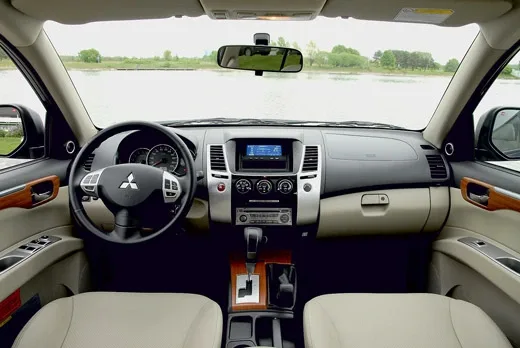
A couple of years ago I sat behind the wheel of the old Pajero Sport and even then was amazed at the hopelessly outdated dashboard. Now, looking at the new Mitsubishi, I experience completely different emotions. The plastic seems simple, but through the play with shape, color, and texture, a rather attractive picture has resulted. Cheap – yes, but not dreary. Much has carried over from the L200, though there are also plenty of small differences. The main plus, as with its relative, is the large round climate knobs, which even a nearly blind driver with impaired coordination can use. Such things need to be cherished and protected from the encroachments of unconventional designers. As is the very design of this classic SUV with a frame, rear solid axle, and a transfer case with low range. By the way, the new generation is equipped exclusively with the SuperSelect 4WD transmission. And that, I remind you, is the ability to drive both in permanent all-wheel drive and rear-wheel drive – as desired. The previous model didn’t offer SuperSelect even for an extra charge – it’s a good thing, but expensive. However, the Mitsubishi L200 also wasn’t previously equipped with such a transmission, but now – here you go.
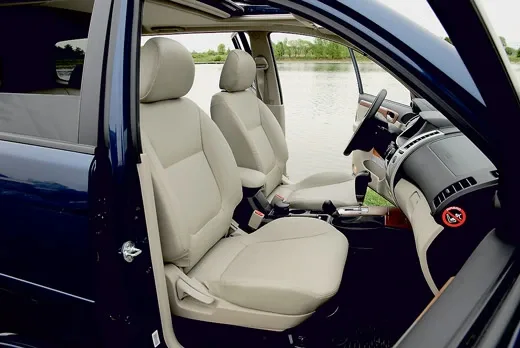
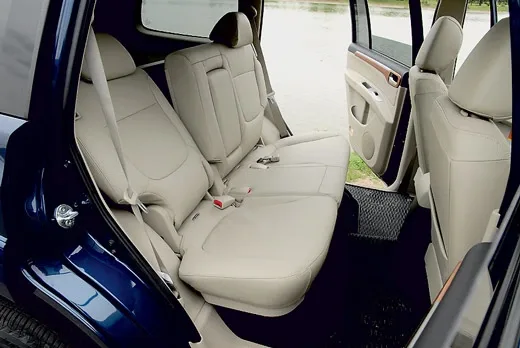
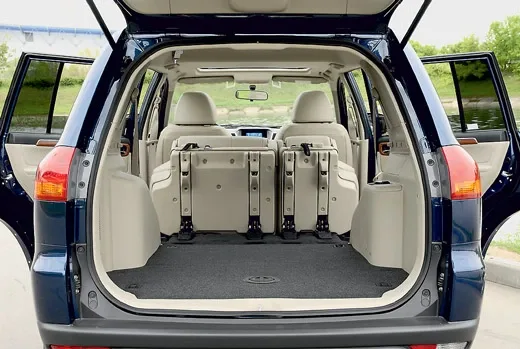
What else valuable is there in the Pajero Sport? Legroom for rear passengers – not like in a pickup. A huge trunk with cupholders inherited from the three-row version: you can carry a large wardrobe in it, or you can sleep or drink from cups.
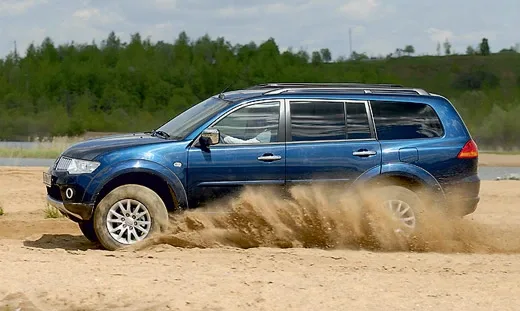
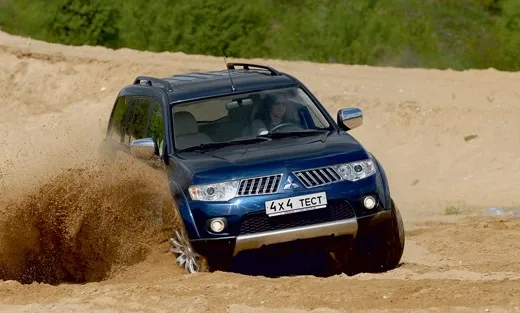
However, there was no time to sleep and drink, because we, tired of rocks and mud, were looking for a place resembling the Sahara. A hundred kilometers from the city we found it, and the Pajero Sport, joyfully chattering with its diesel, ran between the dunes. True, on the highway it also wasn’t bored. The “Japanese” powertrain pleased with a quick response to the pedal without a noticeable dip on kick-down. One of our regular readers asked that during tests of diesel cars we pay special attention to noise and vibrations from the engine on “black” fuel. Therefore, most of the road I tried to track them. Now I can confidently state: the engine vibration doesn’t annoy, since it’s completely covered by the vibrations of unsprung masses coming from the wheels to the body. And the diesel noise is even pleasant, because it drowns out the awful audio system tuned to the sound of a diving mosquito. The Pajero Sport, by the way, is supplied to our market only in a diesel configuration; petrol engines are unavailable.
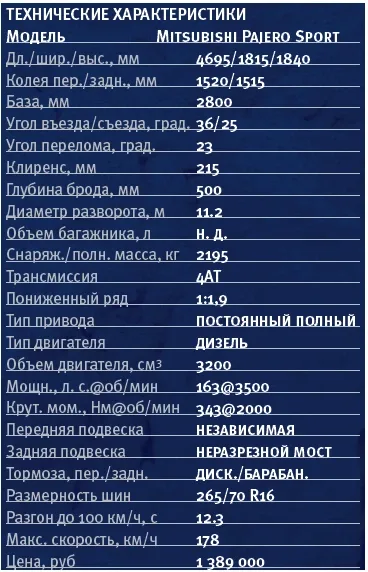
SPECS: MITSUBISHI PAJERO SPORT
Where does the driver live?
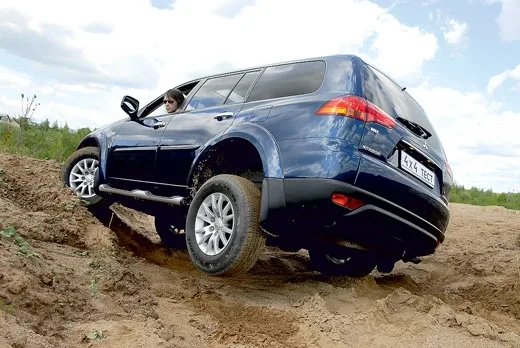
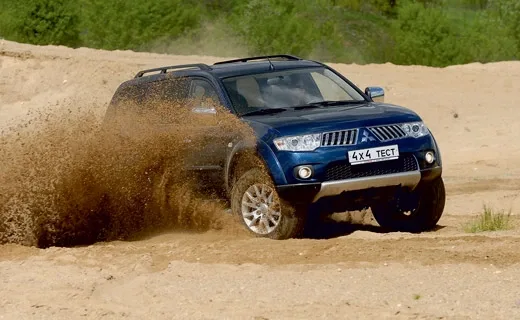
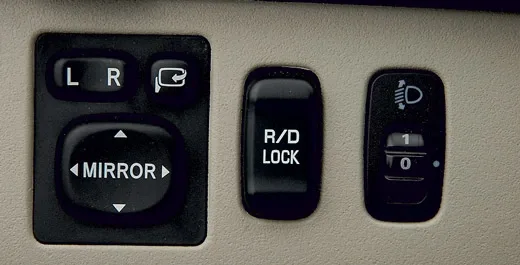
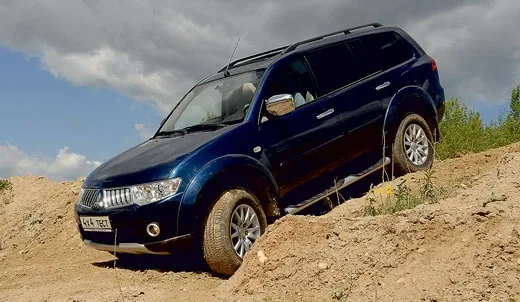
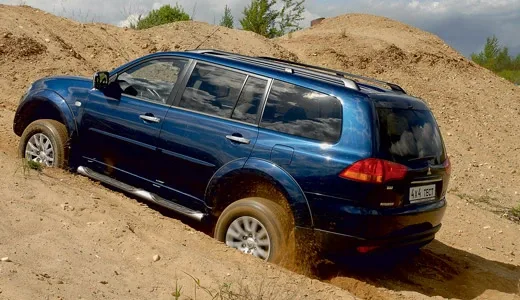
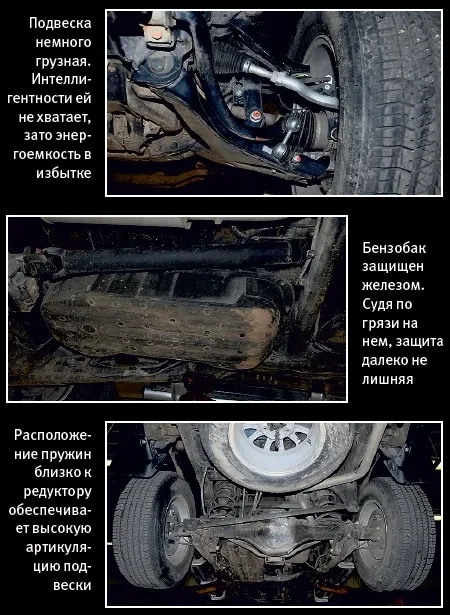
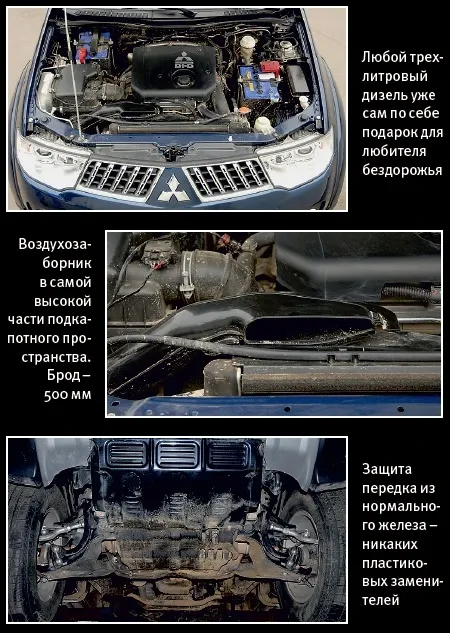
Another reader wanted us to rigorously test off-road capability. But is a trophy route needed when a simple sandy hill clarifies a lot? The climb that the Lexus LX570 struggled to conquer was taken by the Mitsubishi significantly faster, easier, and on the first attempt. The hollow in the sand, where the Range Rover spent a long time pondering with its electronic brains what to do with the wheels, engine, and air suspension, was passed by the “Japanese” simply and without hesitation. This is the most ordinary old-school SUV; it has nothing to think about. But it has good geometric off-road capability, sufficient torque at the wheels, and permanent all-wheel drive. Want to – go with momentum, or want to – go in a crawl. If needed – lock the rear differential with a separate button. I preferred driving slowly, although the suspension is energy-intensive and one could have staged a small rally raid. The Pajero Sport remained what it was before. A true SUV. The changes to the exterior and interior haven’t spoiled it. It’s even pleasant to sit in traffic jams in it: the configuration with diesel and automatic transmission promotes relaxation not only off-road but also in the city. Combine this with the huge trunk and we get an almost universal car, suitable for trips of any distance. Especially for people with long arms and short shins. No matter how you look at it, the driver’s workplace of the Pajero Sport strongly resembles a doghouse.