
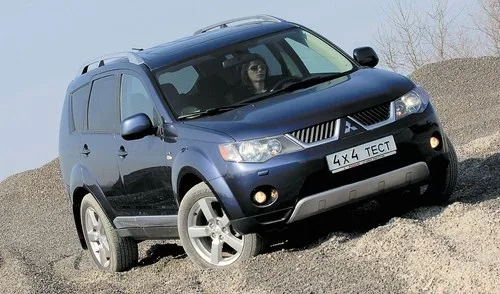
The meaning of the XL prefix in the name of this crossover is clear without extra explanation — the dimensions have indeed grown. The body has become 100 mm longer and 50 mm wider. However, it's not just about size. The engineers, working on the XL, set themselves a dual goal: to increase comfort and at the same time make the car more driver-oriented. And, apparently, they succeeded: in Japan, the model has been sold since 2005 and consistently enjoys demand.
RECOGNIZABLE SILHOUETTE
From the front, the enlarged Outlander is distinguished by the radiator grille, stylized after the corporate theme of "Mount Fuji." From the rear — unusual LED taillights. The model is based on a new global platform that Mitsubishi developed jointly with DaimlerChrysler.
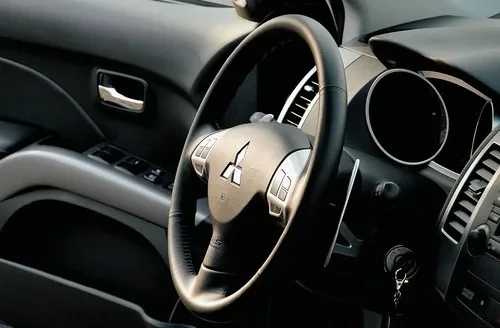
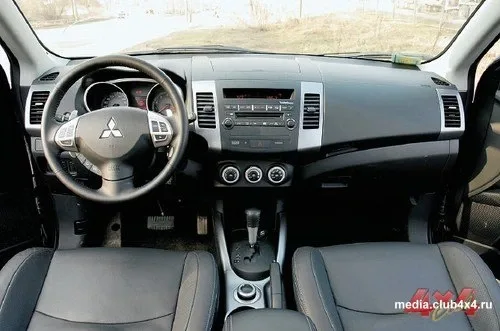
In the interior, which was completely redesigned, the instrument panel, styled after motorcycles, immediately catches the eye. The company's marketers found that among potential buyers of the Outlander XL there are many enthusiasts of classic motorcycles, and this design solution should appeal to them. At the same time, the readability of the indicators has not suffered at all.
The front seats compared to the regular Outlander have become slightly wider and deeper. They are quite comfortable, but more oriented towards a sporty seating position. Thanks to pronounced lateral support, you don't slide off in corners, and the perforated leather prevents slipping. True, it's worth noting: we tested the top version Inspire for $44,900. In more affordable trims (the base Intense is priced at $39,490), the interior is upholstered in velour, and there are fewer options. However, even the base version is well equipped: six airbags, automatic transmission, a wide electric package with heated windshield in the wiper area, climate control, and many adjustments for the driver's seat.
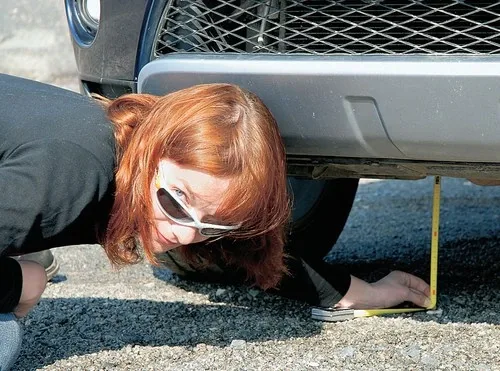
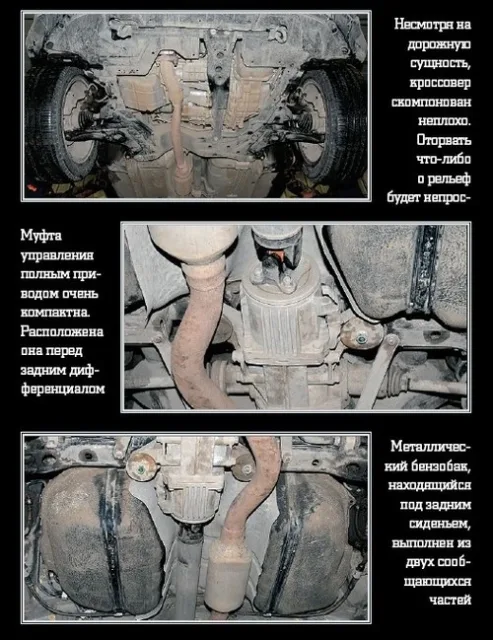
We measured the ground clearance: it turned out to be 230 mm to the engine crankcase. But this is not the lowest point — the longitudinal beam at the front is located 15 mm lower
FIVE SECONDS — AND DONE
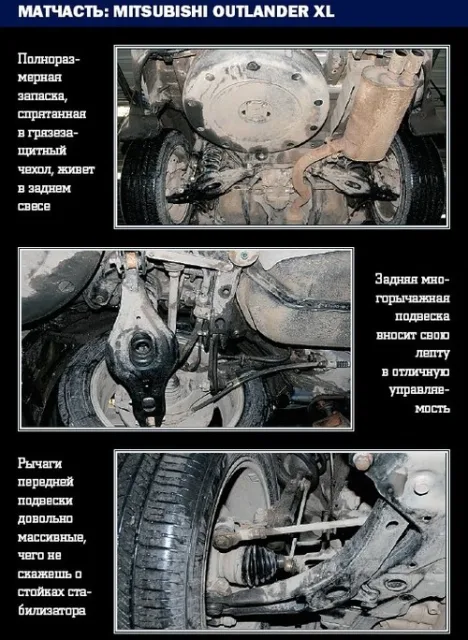
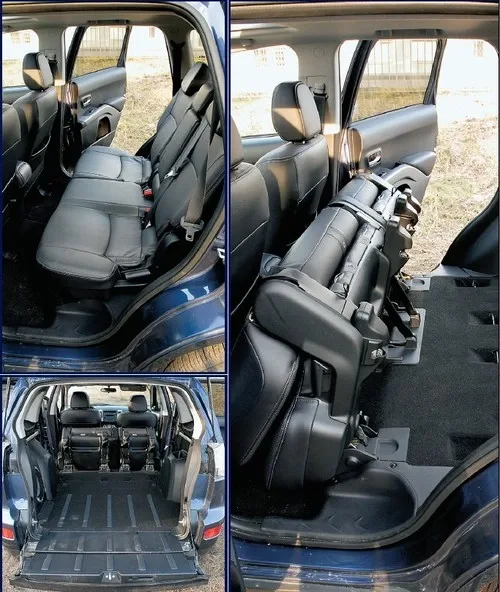
Although the distance between the first and second rows of seats is visually small, passengers in the back will have plenty of space. Legs fit freely under the raised front seats. The rear seats are separate, they move on their own rails by 80 mm, and the backrests can be slightly reclined. The main feature is the automatic folding of the rear row. Just press the lever in the trunk, and the seats, like gymnasts, perform something like a one-and-a-half toe loop, locking in the folded position. A flat "sleeping" area after folding is a rarity for modern crossovers, but here it is! By the way, for some markets, the XL is offered in a seven-seat configuration. But for Russia, the third row was abandoned in favor of a full-size spare tire (by the way, 18-inch). A "doughnut" would have scared off buyers given our roads and distances.
The regular Outlander had a not very spacious trunk. In the XL, it has increased and received a folding tailgate, which reduces the loading height and can withstand up to 200 kg.
A COUPLE OF NITPICKS
The interior is good, but there is one nuance that is a bit annoying. On a sunny day, the front panel with air intake slots and the upper glove box reflects on the windshield. However, the problem is easily solved with polarized glasses — the reflections disappear completely. Also, in bright light, the audio system display is hard to read, even if you set the maximum brightness. Shall we continue the criticism? The hood is held up by a regular prop — somehow not solid. The headlight washers work more for show. The right mirror leaves a significant blind spot: if a car in the adjacent lane is at the level of the middle pillar, it is not visible in the mirror. Surprisingly, the problem could have been solved with a spherical segment. The seat heating buttons are hidden in a narrow gap between the center console and the seat — they are inconvenient to use. And one more personal observation. Never before on cars with an automatic transmission has my foot gotten stuck between the pedals. But here, even a size 48 shoe or motorcycle boots will fit in easily.
ONLY V6 FOR NOW
On the Russian market, only one engine is currently available — a 3-liter V-shaped "six" with 220 hp, tuned to the Euro-3 standard. Based on the ratio of displacement and power, one might assume that there will be a lack of torque at low revs. But no — the proprietary MIVEC system, which controls valve timing and lift, provides good traction both at the bottom and at the top. The acceleration dynamics of the big Outlander are excellent. The only thing you need to get used to is the somewhat sharp response to the gas pedal. You can start smoothly only with a very light press.
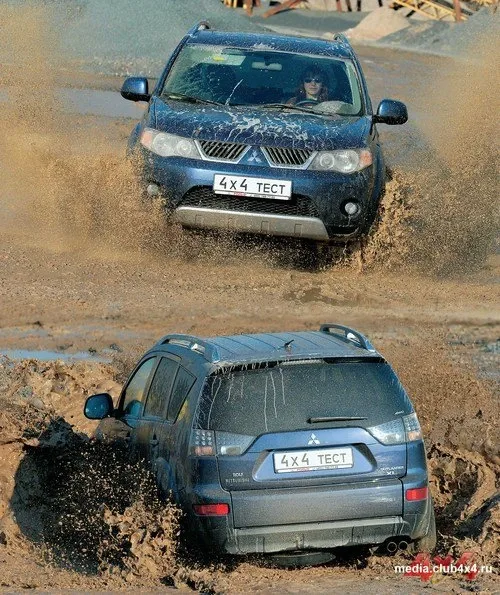
On light off-road, the new Outlander feels confident. After all, it has a clutch lock (Lock mode) that distributes torque between the axles equally
The combination of this "six" with a 6-speed adaptive automatic transmission (and there is no choice yet) turned out to be successful. Truly a marriage of both love and convenience. In automatic mode, gears shift smoothly and timely both up and down. In sequential mode, the "automatic" becomes truly manual. You can select a gear either with the selector or with paddle shifters (optional). Moreover, the shifts are firm: the engine revs to the limiter, but the next gear does not engage. This is rare. Plus, in manual mode, there is excellent engine braking. You involuntarily think that manual transmissions will soon become the lot of retrograde people.
CHOOSE TO YOUR TASTE
The regular Outlander did not have all-wheel drive control. The XL has a mode switch for the electronically controlled clutch. In the 2WD position, torque goes to the front wheels; in 4WD Auto mode, torque is distributed between the axles by the "brains," which process data from many sensors. Switch to 4WD Lock — and about one and a half times more torque is sent to the rear wheels than in 4WD Auto. You can switch modes on the go, without any restrictions. During the test, the XL never surprised us with sudden torque transfer between axles. Even in extreme corners, no inadequacy was observed.
RALLY HERITAGE
The suspension here is completely car-like: McPherson at the front and multi-link at the rear. It's no wonder that in press releases the XL is compared to the iconic Lancer Evo. The handling of the new crossover is excellent. But you have to pay for it with suspension breakdowns on our roads, which can only conditionally be called asphalt. Low-profile tires also contribute. You drive over "speed bumps" harshly, with a noticeable impact. But on good asphalt, the ride smoothness is quite decent. As speed increases, small irregularities cease to be felt — the old saying "more gas — fewer potholes" works. As for the suspension's lifespan, concerns are raised by the thin, chicken-bone-like stabilizer links — both front and rear.
The steering here is, perhaps, an acquired taste. The steering wheel is quite heavy, becomes even stiffer at speed, and during sharp lane changes it starts to slightly 'bite'. At the same time, calling the wheel simply heavy doesn't feel right — it is both elastic and sharp. However, few would find fault with the ABS operation — both novices and seasoned drivers will praise it. It's rare to come across such a correctly tuned anti-lock braking system these days. Even on a rough gravel road where the wheels constantly bounce over washboard bumps, and on asphalt sprinkled with sand, the ABS worked flawlessly. OFF-ROAD Ground clearance is quite respectable by today's standards. Under the transverse beam of the engine compartment — 215 mm, and to the oil pan, which is unprotected, — 20 mm more. But the exhaust system, on the contrary, hangs 20 mm below that same beam. Overall, a quite good figure for a crossover. The air intake design also pleased. It seems that to get a hydro-lock while fording a deep puddle with a wave washing over the hood, you'd have to try very hard. Of course, the Outlander's all-wheel drive is designed for asphalt and smooth dirt roads. Nevertheless, in 4WD Lock mode on standard highway tires, the crossover drove quite confidently on a muddy country road. True, for this, the stability control system had to be turned off — otherwise, its brains, boiling from not understanding what was happening, either cut fuel supply or panic-braked. Overall, the new Outlander has stepped up a level in the crossover hierarchy. And even considering the price increase, there is simply no alternative in this price segment in terms of overall qualities yet.