How does this car differ from the only recently available Outlander XL with a three-liter engine and automatic transmission for a hefty $45,000? Practically nothing. The same impressions of excellent handling, a significant share of which is provided by excellent torsional rigidity of the body, a "racing" strut under the hood, and a lowered center of gravity achieved thanks to the lightweight aluminum roof.
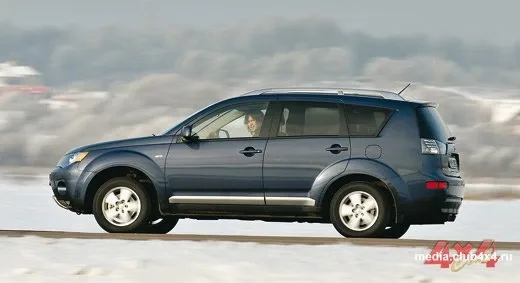
WHERE ARE THE WHEELS LOOKING?
Fans of the brand are already accustomed to the sporty nature of the crossover, but others will probably have to keep their ears open, especially those who switched from American cars. On the Outlander XL, you can't just turn the steering wheel in the right direction and press the gas, watching the SUV enter an approximately desired arc. Here, if you press the pedal, you will quickly end up exactly where the wheels are pointed. The Mitsubishi crossover does not forgive mistakes or hesitation behind the wheel.
But there is minimal longitudinal and lateral pitching, no body oscillations. Holding the steering wheel, you feel that the entire car obeys you with maximum precision, not just the steering rack.
"WORLD ENGINE"
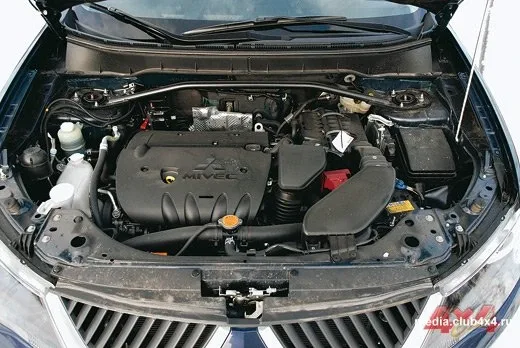
I admit, the XL is one of my favorite cars in this segment. Once I had the chance to drive it for three days straight on rough terrain, and the pleasant memories of that trip are still fresh. True, that was a three-liter Outlander. And today, as a reminder, we have a 2.4-liter gasoline unit — the fruit of the joint work "World Engine" of Mitsubishi Motors Corporation, DaimlerChrysler, and Hyundai Motor Company. Its characteristic design features are a die-cast aluminum cylinder block, electronic control of valve timing and valve lift (MIVEC), as well as an exhaust manifold located at the rear.
The developers are especially proud of the compactness and low weight of the power unit. The dimensions were reduced thanks to the use of a chain instead of a belt in the camshaft drive and the abandonment of rocker arms in favor of direct valve mechanism drive.
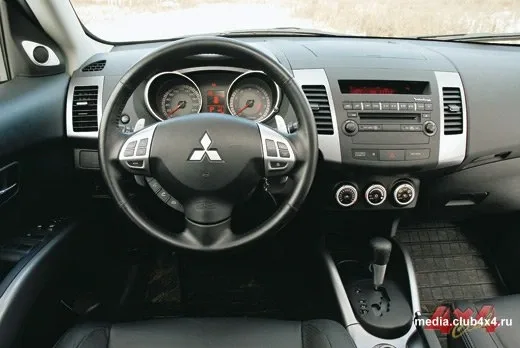
In practice, the 2.4-liter engine together with the CVT allows you to drive the Outlander very comfortably at a speed of 160–170 km/h, keeping 3000–3500 rpm. When overtaking, the manual mode helps — there are "racing" paddle shifters on the steering wheel. The CVT works quickly, but, as usual, screams in tandem with the engine at maximum rpm.
THE CLUTCH COULDN'T HANDLE IT
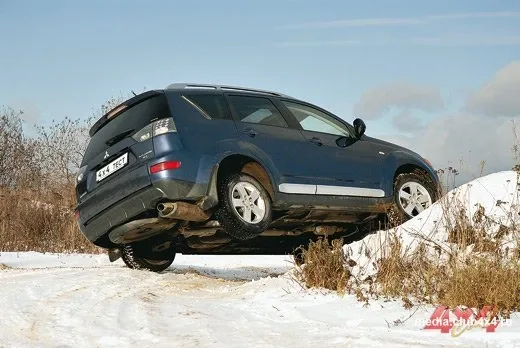
Remembering how the XL confidently handled dirty dirt roads in the summer, I decided to tackle a 30-degree snowy incline, and right in the middle of the hill, the "Japanese" suddenly triggered a built-in fuse against such loads. When the load on the transmission exceeded the threshold (known, however, only to the manufacturer and not specified in official data), the electronics itself disconnected the rear axle, after which all that remained was to engage reverse gear.
After two more attempts, smoke poured from under the rear wheel arches. The clutch finally gave up. In less than five minutes of operation. This is far from a rigid lock! The discs inside the clutch slip and overheat, which is also a sin of other crossovers. The spare wheel, which limited the rear overhang, also greatly hindered off-road movement. If light off-roading is planned, it is better to remove it.
Answering the question of whether the cheaper XL is good compared to the three-liter version, I will say: it overtakes "KAMAZ" trucks less briskly. But overall, it is a 100% Mitsu, and it pleased me again. I even almost forgot about its ergonomic miscalculations: the too-distant CVT selector and the lack of seat cushion tilt adjustment. And yet, it has a pleasant interior finish in all respects, exemplary handling, and, of course, the aesthetics of the body.
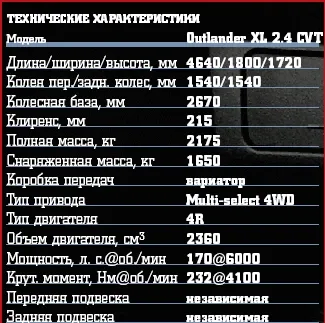
Technical characteristics of Outlander XL 2.4 CVT