
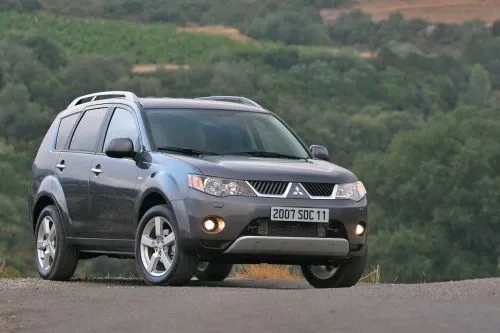
The automotive world had barely had time to get a good look at the unusual Mitsubishi Outlander crossover when another new model hits the stage, bearing the same name but essentially being a completely different car. Moreover, in different countries this vehicle will be called differently: Shogun or Montero. So what kind of beast is this?
Price: from $38,490 • On sale: January 2007
Mitsubishi Outlander XL
© Photo: Mitsubishi
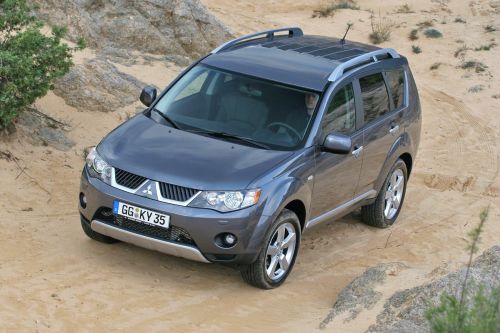
Essentially, we are looking at the next generation of the Outlander model, which debuted in Japan a couple of years ago. There, the predecessor is known as the Airtrek or Outlander Sports Gear. However, the new Outlander XL is not just another model in the lineup. It became the first development made in collaboration with the Germans from DaimlerChrysler on a shared global Mitsubishi platform. This means that over the next few years, about ten more related vehicles will appear on this same base. Moreover, the Peugeot-Citroen concern has already eyed the Outlander as a donor for a pair of its SUVs, which are expected to be released this year.
Mitsubishi Outlander XL
© Photo: Mitsubishi
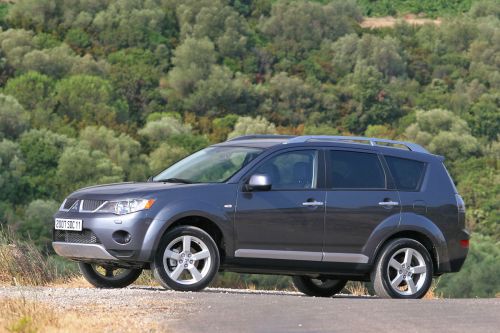
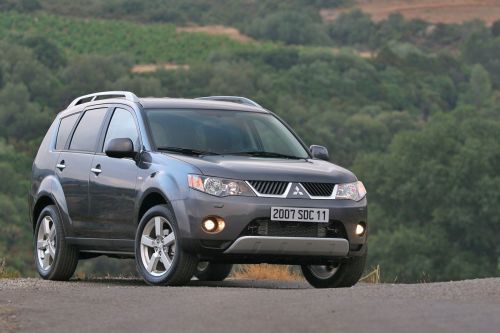
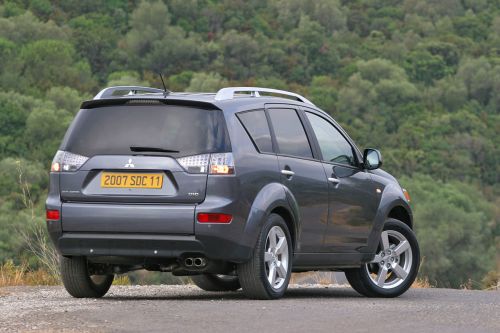
The first Outlander was remembered for its excessive simplicity, and the new XL is designed to correct this flaw — both externally and internally. The XL suffix in the name unambiguously hints at the growth in size: the new model has gained 10 cm in length and now reaches 4.64 m. The exterior design is inspired by the Pajero Evo 2+2 concept shown in 2002. For Europeans, a distinctive Mount Fuji radiator grille was specially developed, already familiar from the Lancer, Evolution VIII, Colt, and Grandis models. Massive fenders with widened wheel arches are meant to emphasize dynamics. The rising window line, narrowed headlights, and 18-inch alloy wheels create a sense of constant motion. The rear lights extending onto the sides visually soften the vertical of the tailgate and add swiftness to the silhouette.
Mitsubishi Outlander XL
© Photo: Mitsubishi
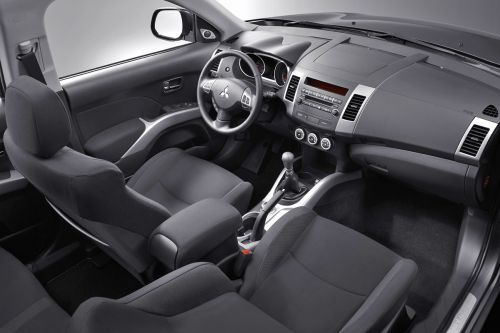
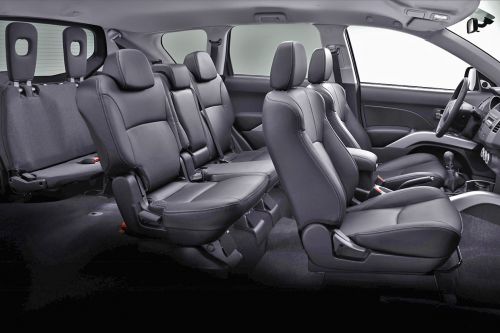
The interior is finished in steel color, which pairs well with the black upholstery. There is nothing superfluous inside. The leather three-spoke steering wheel is painted in the same light silver tone as the instrument panel, and the metal hub dampens vibration. The front seats are bucket-shaped with pronounced side bolsters, hinting at the Outlander's sporty character. At the same time, the profile of the cushion and backrest is designed so that getting in and out of the car is hassle-free.
Mitsubishi Outlander XL
© Photo: Mitsubishi
The Japanese crossover also has room for other interesting solutions that are sure to appeal to drivers. For example, the tailgate is split into two parts, which is convenient when loading and unloading items — especially given that the upper section is light and compact. There are also automatically folding second-row seats. The cabin also features a built-in Bluetooth module and a Hands Free system with control buttons on the steering wheel.
Behind the wheel, the Outlander behaves like the most ordinary passenger car — thanks to independent suspension on all wheels, effective brakes, and a low center of gravity. The latter became possible thanks to the aluminum roof and technologies honed on the Lancer Evolution IX.
Mitsubishi Outlander XL
© Photo: Mitsubishi
As Toshiyuki Matsumi from the testing department explained, engineers spent thousands of hours developing the new platform for high handling. And the results are impressive: the SUV boasts excellent stability. You can sharply throw the steering wheel from side to side, but dangerous rolls do not occur. This is largely thanks to the front track widened by 45 mm. The standard equipment includes the ASC stability control system. It works like this: sensors detect a discrepancy between the driver's intentions and the car's actual behavior. If ASC detects an approaching skid or understeer, it selectively brakes the wheels and redistributes torque. Simultaneously, a signal goes to the CVT and the 4WD all-wheel drive system, which also participate in stabilization. ASC also includes a traction control system that behaves like a mechanical limited-slip differential lock.
The anti-roll bar mounted on the struts noticeably improved the car's behavior. The new exhaust system layout allowed the front crossmember to be eliminated, which positively affected steering precision.
As for serious off-roading, the Outlander is not a hero here — the developers themselves admit this, calling the new model an all-weather touring vehicle. The electronically controlled all-wheel drive system allows confident driving on snowy or muddy roads. But it's better not to venture where the asphalt ends. On good surfaces, for fuel economy, it's worth selecting 2WD mode, while all-wheel drive will come in handy in other situations.
Mitsubishi Outlander XL
© Photo: Mitsubishi
The new model will be offered in three trim levels, with prices ranging from $39,490 to $44,990. However, for now, only the version with a three-liter gasoline engine producing 220 hp, paired with a 6-speed automatic, is available. A more affordable and economical modification with a new 2.4-liter engine (170 hp) will appear in autumn 2007. The crossover received a multi-mode Multi-Select 4WD transmission with electronic control, which automatically engages the rear drive when the front wheels slip. The third row of seats, available for example in the US, was decided to be dropped in favor of a full-size spare tire.
Sales of the new Mitsubishi Outlander XL started in early 2007. Vehicles in cold-climate specification will be supplied to Russia. This means the crossover is equipped with a high-output generator and battery, heated seats, mirrors, and windshield wipers.
Alongside the new model, the previous generation will remain on sale. This coexistence will last about a year. There is practically no competition between them — externally and internally, the cars are too different.
| Dimensions, mm | 4640x2670x1800 |
| Engine | gasoline, 2986 cm3, 220 hp/6000 rpm |
| Transmission | automatic, 6-speed |
| Competitors | Hyundai Santa Fe, Suzuki Grand Vitara |
Advantages/Disadvantages:
+ Excellent stability during maneuvers.
– Weak off-road capabilities.
Conclusions:
- Precise handling is complemented by a perfectly tuned suspension.
- Increased dimensions noticeably expanded the interior space.
- The cabin is spacious — on a long journey, every passenger can settle in comfortably, and the lateral support of the front seats reliably holds the body.
- The ASC system is responsible for safety.
- Prices have risen, but the car itself has become different.
Our Opinion
The new Outlander has every chance to outperform its predecessor — in Russia, size matters. In addition to external solidity, the new model has shed its former simplicity. It is quite possible that shortly after the premiere, the model will undergo a facelift — at least, there were hints of this from Mitsubishi managers. We'll see.
© 5 Koleso