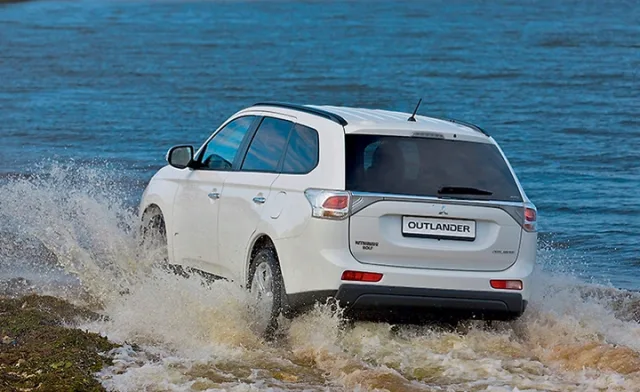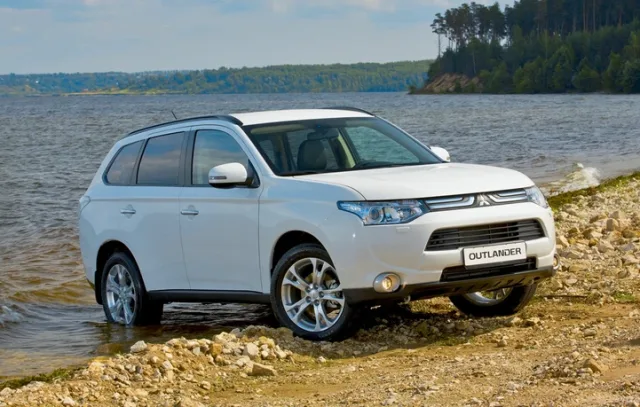
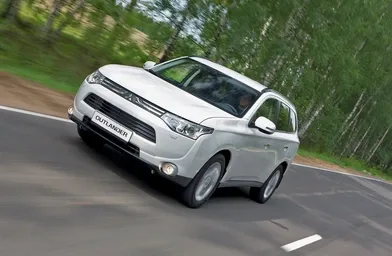
 Mitsubishi Outlander On sale: since August 2012 Photo: Mitsubishi | Sales of the new SUV (now it is officially designated as such) Mitsubishi Outlander have started in Russia — one of the most popular mid-size crossovers in our country. Let's see how it differs from its predecessor. |
| The third-generation Mitsubishi Outlander was presented in March this year at the Geneva Motor Show. But sales started in Russia and the CIS: in Europe and even in Japan and the USA, the car will appear only in late autumn — the Russian market is one of the most successful for the Outlander. Specifically for us, the Japanese changed the approach angles by literally half a degree and passed the vehicle type approval as an SUV.
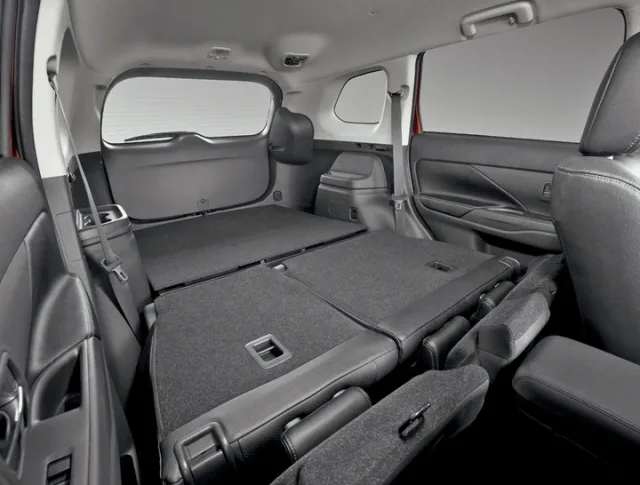
P2012 Mitsubishi Outlander However, this is not the only and far from the most noticeable change. Outside and inside, the new Outlander is completely different from the previous one. The interior trim now uses softer plastic. I can't say I felt a significant difference, but it has become a bit better. The rear seats now fold differently, forming a flat floor and increasing the trunk space by as much as 32 cm — this is really noticeable! The exterior dimensions remain the same as the previous Outlander XL, but inside it has become more spacious. And, of course, the car's appearance has changed dramatically. The design, though, is debatable, but it's unlikely that practical Russians choosing this car give primary importance to exterior looks.
2012 Mitsubishi Outlander The greatest number of innovations is hidden inside. One of the most important is the time-tested petrol engine 2.0 L (146 hp) or 2.4 L (167 hp) now consumes 92-octane petrol instead of 95-octane and has generally become more economical. This was facilitated by improved aerodynamics (by 7%) and reduced weight (by 5%, about 85 kg) compared to the previous generation.
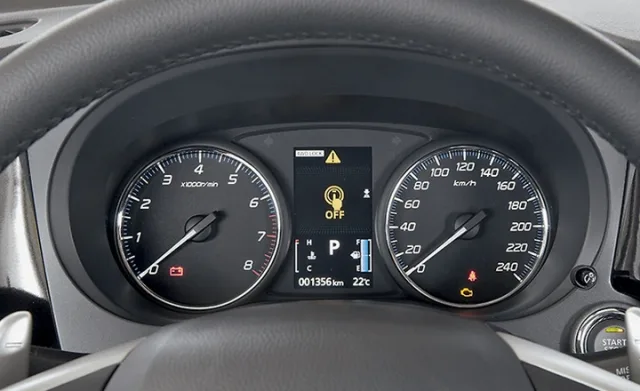
The instrument panel has changed slightly Interestingly, now the all-wheel-drive version has no option to drive in pure front-wheel-drive mode: the rear drive engages automatically depending on driving conditions. Many sensors are responsible for its operation (the entire system was taken from the Mitsubishi Evolution). There are three transmission modes: Eco — front-wheel drive, like on the Outlander XL, but the rear engages when slipping; Auto — the rear drive is more involved: sensors determine that the car is driving on slippery surfaces, at full throttle, or uphill, and engage the rear drive; Lock — the rear drive is constantly engaged, but not rigidly, because the Outlander, despite the official document, is still not a real SUV, so it works as needed (during over-revving, in corners, on poor surfaces), disengaging as soon as the need disappears.
The trunk depth has increased by 32 cm thanks to the new seat-folding system! As if on order, before the second day of the test, when we had to drive several dozen kilometers through the forest, a heavy downpour passed. The road was washed out, puddles formed up to the wheel arches, some with a clay bottom. It was on them that we managed to test all transmission modes. On a regular forest sandy road, the Outlander easily coped even on front-wheel drive alone, when the rear practically didn't engage. In clay mud baths, of course, the car was pulled and drifted, but that was more due to the road tires, as all obstacles were overcome without much difficulty. During the test, despite our efforts, the organizers', and the weather's, we failed to reach the car's limits, which means it will easily handle 90% of Russian roads, unless, of course, you venture onto the infamous "Lena" highway...
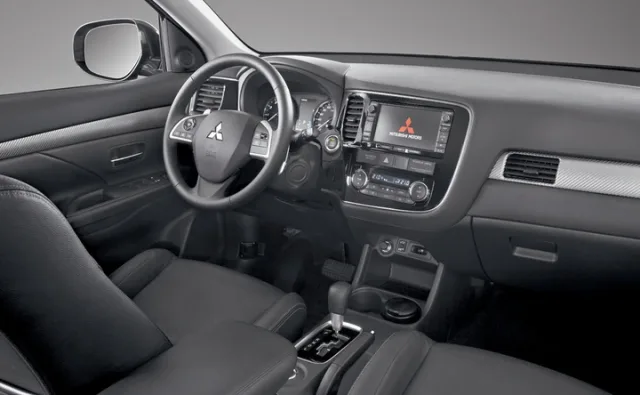
The center console was fashionably turned toward the driver and more buttons were added Instead of hydraulic power steering, there is now an electric power steering. In my opinion, Mitsubishi hasn't quite perfected it yet: both on the updated Pajero IV and on the new Outlander, I don't like how it works. It's unclear what position the steering wheel is in and where the wheels are — too weak feedback. Driving on asphalt is fine, but off-road or during tight maneuvers, you need to get used to it. OUR VERDICT
ADVANTAGES AND DISADVANTAGES Poor interior trim, controversial design, lack of emotion. Driving Interior Comfort Safety Price
TECHNICAL SPECIFICATIONS LIKE/DISLIKE Convenient P Debatable
|