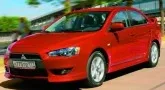
Never before have I had to catch so many glances while driving a car that costs just over twenty thousand dollars! At first I even got nervous — what if something happened to the Lancer? Maybe a tire went flat? For the test, we were given the most expensive version — with a stylish aerodynamic body kit that comes only with the Intense trim, and a two-liter engine paired with a CVT. I don't know how the car will behave in more modest trims, without the side skirts, the fancy rear spoiler, and simpler wheels, but in this form, and in red, the tenth Lancer looks stunning.
The stretched body shape is all about sporty aggression, which most classmates lack. Perhaps only the Civic can compete with the new Lancer in this regard. The "shark" nose with a huge trapezoidal grille protruding far forward, and a massive but not bulky rear (the taillights frankly hint at the Alfa 156 and 159) — very bold solutions. The beltline, emphasized by a stamping along the side, sweeps upward, adding dynamism to the silhouette. It turned out to be a striking car; the Japanese hit the bull's-eye with their tenth Lancer — no pun intended. It seems this is how the entire Mitsubishi passenger lineup will now look. The ninth model was a real "gray mouse," nothing memorable. But the new Lancer is a dandy with a masculine, aggressive face and a sporty figure. The whole image is spoiled only by the 16-inch wheels with high-profile tires (205/60), which don't match the sporty character at all, plus the ground clearance increased by 15 mm for Russia.
As a result, the clearance is 165 mm, and because of this, the rear of the car looks excessively raised. But inside, the new Lancer is much calmer. It feels like the interior was designed without any regard for the exterior. Individual sporty touches like "kevlar-look" inserts don't save the situation. The front panel and steering wheel have moved here from the Mitsubishi Outlander XL. But if there are no complaints about the leather steering wheel with music control buttons (both the cross-section and shape are comfortable), then there are questions about the quality of the panel trim and the upper part of the doors. The shiny hard plastic responds with a hollow sound when tapped.
Ergonomics — no surprises. You can get comfortable, but you want to lower the seat and move the steering column closer. However, reach adjustment still hasn't appeared in the tenth generation — Mitsubishi stubbornly ignores tall drivers. The seating position resembles the Outlander. The seat is nothing special — ordinary, neither hard nor soft, with a hint of lateral support. There's enough room in the back — thanks to the increased wheelbase (plus 35 mm) and overall body dimensions. But the view in the rearview mirror was sacrificed for the original appearance — the beautiful rear spoiler cuts the panorama exactly in half.
The steering column stalks are convenient, and the three climate control knobs, in my opinion, are an ideal solution for ease of use. The CVT selector in Sport Mode, although wrapped in leather of not the best quality, feels pleasant in the palm.
Maybe the Lancer will delight on the road as much as it delights the eye? It didn't... Don't think the car is slow — for its class, it's quite peppy. The MIVEC engine produces 150 horsepower, which, you'll agree, is decent. But it's not a lot for a curb weight of 1400 kg. Nevertheless, the sedan accelerates briskly, the adaptive CVT delivers torque to the wheels without delays or jerks. Floor the pedal — and few neighbors in traffic will start off from the light as quickly. But there's no sporting excitement in the acceleration. However, a car with a CVT rarely delivers driving thrills. And the dry roar of the engine, which hangs at high revs during intense acceleration, won't please anyone.
Controlling acceleration is inconvenient. The CVT often revs the engine to the limit without much need. Sometimes it's easier to ease off the pedal a bit so it "shifts to the next gear." The paddle shifters help a little, but you won't constantly click them, and why have a smart Sport Mode then? Oh, a proper manual would be nice here! And at around 180 km/h, the CVT delivered an unpleasant surprise. A slight press on the gas caused it to instantly "downshift." The engine howled, I eased off the pedal — and immediately there was an "upshift." Very nervous behavior, especially since we're talking about a light press on the pedal.
I note that at speeds near 200 km/h, the Lancer provides decent comfort. The driver doesn't have to strain, and sound insulation is good. Only after 140–150 km/h do air vortices around the front mirrors start to make noticeable noise. There's no sport in the handling of the "tenth," but there is confidence and reliability. And some simplicity. In other words, the Lancer on the road is as dry as the sound of its engine. The car drives like an average classmate, without spark. It enters corners with noticeable body roll (though you could blame the high-profile tires and increased clearance). When lifting off the throttle, it behaves as expected — smoothly transitioning to oversteer. There is feedback from the steering, but it seems somewhat artificial. The strong point of the new Lancer is high-speed straight-line driving. The energy-intensive suspension "gathers itself," and the steering wheel holds clearly at center.
The new Mitsubishi Lancer left mixed impressions. On one side of the scale — perhaps the most interesting exterior in its class and a powerful engine; on the other — a plain interior, a strange CVT algorithm, and bland handling. And will the Lancer be as good without the body kit? Will it be as dynamic with the 1.5L engine? And prices now start at $18,000. There's something to think about...
**Prices and Trims**
At dealers, the Mitsubishi Lancer is available with two petrol MIVEC engines: 1.5L (109 hp) and 2.0L (150 hp). Both units work with a 5-speed manual. For the 1.5L engine, a five-speed automatic is offered, and for the two-liter — a CVT with manual shifting capability. There are three trims — Invite, Invite "plus," and Intense. The simplest Invite 1.5 with a manual costs $17,990. In the Invite "plus" version, a CD receiver with mp3, leather steering wheel with audio controls, front fog lights, and alloy wheels appear. In Intense, instead of air conditioning — climate control, plus a 6-disc changer, aerodynamic body kit in body color, rear spoiler, side airbags, and a driver's knee airbag. The car we tested (Intense trim, two-liter engine, CVT) costs $24,300.
**History of the Mitsubishi Lancer**
The Lancer model ("ulan" in translation from English) appeared in 1973. With it, Mitsubishi filled the niche between the Minica and Galant on the domestic Japanese market. The model's internal index is LA. If this Lancer existed today, it would be classified in the lower-medium segment. On different markets, the car bore different names: in Australia — Chrysler Valiant Lancer, in the USA — Dodge Colt. There were three body styles: coupe, sedan, and wagon, with the latter already called Station Wagon then — a designation that has survived to this day. There were 12 trims in total — from the base 1.2-liter to the top 1.6-liter GSR. In 1975, the lineup was joined by the three-door hatchback Mitsubishi Lancer Celeste (on some markets — Mitsubishi Celeste, Colt Celeste, Chrysler Lancer Coupe, or Plymouth Arrow). Initially, it came with 1.4 and 1.6L engines, later a two-liter unit was added. Then the Lancer underwent a facelift, and the factory index changed to LB.
The second generation debuted in 1979 and was known on the Japanese market as the Lancer EX. The new "ulan" became noticeably more angular compared to its predecessor and was offered exclusively as a four-door sedan. In 1980, a version with a turbocharged 1.8L engine appeared.
The third generation came out in 1982 — in Japan it was called the Lancer Fiore. It was based on the Mitsubishi Mirage, intended for the domestic market. For export, a five-door hatchback (simply Lancer) and a sedan (Mirage Sedan) were supplied. In Australia, the model was sold as the Mitsubishi Colt Sedan. Thus, at that time, Mitsubishi had two almost identical models in the same class — Mirage and Lancer.
In 1983, both cars were updated, and this event is considered the appearance of the fourth generation. The Mirage sedan disappeared — only the Lancer remained. The engine lineup gained fuel-injected and turbocharged units. In 1985, the fourth generation was supplemented by the Station Wagon, which could also be equipped with all-wheel drive. Since then, the name Mirage (or Colt) was used only for the three-door hatchback, while all other body versions became Lancers. This generation served as the basis for the first Malaysian car — the Proton Saga.
The fifth generation Lancer came out in 1987 and, like the senior Galant model, received a streamlined body. The names Mirage and Lancer were retained. In Australia, all body variants were sold as the Mitsubishi Lancer, the Japanese sedan was called the Mirage Aspire, and in the USA — the Dodge Lancer.
The "sixth" Lancer of 1992 no longer shared a platform with the Mirage. In America, the Mirage sedan was sold under the name Eagle Summit. A year later, a wagon appeared (Libero on the Japanese market). At the same time, the Lancer received a V6 of just 1.6L — at that time the smallest V6. In September 1993, the GSR modification came out with a 4G93 turbo engine of 1.8L and all-wheel drive from the Galant VR-4 — the direct predecessor of the famous Evolution. The two-door coupe was called the Mirage Asti Coupe in Japan, and the Lancer Coupe on external markets.
The seventh generation of 1995 was essentially a deep modernization of the sixth and was built on the same platform. Only 1.5- and 1.8-liter engines remained in the engine lineup. From 1996 to 2004, on a number of markets, the Lancer was replaced by the Mitsubishi Carisma model.
In 2000, sales of what was essentially the eighth generation started in Japan — the Cedia model (which stands for CEntury DIAmond), although on most external markets, the seventh-generation Lancer and Carisma continued to be sold. Cedia was offered in two body styles: sedan and Station Wagon. By that time, Mirage had become a standalone model. In 2002, Cedia reached the USA and Australia.
The ninth generation of Lancer is considered to be the result of the Cedia facelift carried out in 2003. At the same time, Lancer returned to the European market. And the car we most often see on the streets today was replaced by the Lancer, the test of which is published in this issue of MOTOR.