
TO2 — 10 165
TO3 — 9 065
TO4 — 21 195
TO5 — 7 315
TO6 — 19 316
Vadim Sadykov, «Avtoclub-Kazan»
When my acquaintance said that the CVT on the ASX is «sluggish», I didn't believe her. At worst, I attributed it to Euro 5, where the «brake» at low revs is really felt. Imagine my surprise when during the test I saw for myself – it is «sluggish», and even understood why this happens. But first, to avoid accusations of subjective assessment, let's look at the technical characteristics of cars with CVT.
Here's the Audi A4, acceleration to 100 on a manual and CVT is the same, and fuel consumption in the city with CVT is 0.1L less. Agreed, the A4 is a front-wheel-drive sedan, not a crossover. Comparing it directly with the ASX is not entirely correct. Then another example. Toyota RAV4, acceleration to 100 on a manual is half a second faster than on CVT. The same figure (0.5 sec difference between manual and CVT) is also present in the ASX. With one huge difference: 1.6 (!!!) on manual accelerates faster than 2.0 on CVT. I'm afraid to even guess how much faster the same 2.0 would be on manual. After stating the fact of not the best acceleration with CVT, it's time to explain why this happens. The mechanical device of the CVT (usually two cones connected by a chain) cannot explain the huge difference in the behavior of the «automatic» on different cars. But besides the «hardware», the CVT also includes «brains», a control program for changing the gear ratio. All «slow» CVTs have 2 features: hanging at 6000 rpm (sometimes at 4000 rpm) when sharply pressing the gas; and second - acceleration can be faster if you switch virtual gears in manual mode. Strange, at first glance, situation: the maximum power of the engine is at 6000 rpm, and the acceleration of the car when hanging at the same 6000 rpm is not the best. Alas, that's how it is. In short, the torque created by the engine still needs to be transmitted to the wheels. Either we (as on manual, robot, automatic) fix the torque value, and achieve an increase in vehicle speed (wheel rotation) by increasing engine revs. Or we hang at 6000 rpm of the engine, and acceleration is achieved by reducing the torque transmitted to the wheels. Less torque – means it's harder and harder for the engine to spin the wheels quickly. This feature of the CVT on the ASX is not very annoying in the city, but on the highway overtaking will have to be done much more carefully.
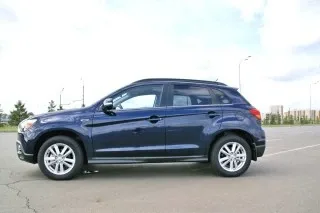
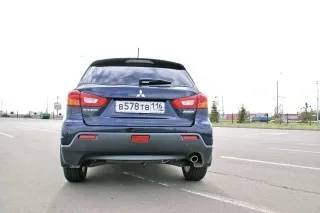
This car is a real crossover. It's not worth going off-road in it. But it's worth checking on bad roads. First test: we climb a fairly gentle hill with a narrow track and large bumps in the middle of the «road». Surprisingly, the car passes this obstacle easily, just swaying from side to side. Alfred decided to storm a steep climb where there was wet ground and overgrown grass. It goes! Not every car managed to climb from the first attempt here. I noticed the small overhangs, this is an additional plus for «off-road».
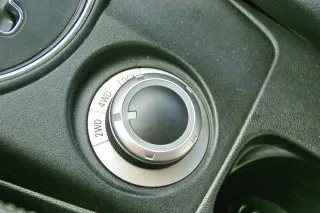
On the site we only tested behavior on the «snake». I managed to reach a speed of 70, both with 2WD and 4WD. The behavior always remains «front-wheel drive». With 2WD the car is more interesting, but on public roads it's of course better to use the automatically connected all-wheel drive. The car holds its trajectory well, the rolls are small, I liked it. Alfred drove faster (71 or 72), and he also tried disabling ESP. I should have done that too: when accelerating on dry asphalt, the traction control constantly activated. Probably, it will also interfere with the «racer» during a sharp start from an intersection.
This time we drove very little in the city, devoting most of the time to the highway and «off-road». Probably in vain, because the ASX is specially created for the city. About our roads, with potholes/bumps/cracks, we can not say much. The behavior of the ASX on these artificial (or already natural?) obstacles is worthy of praise: irregularities are worked out elastically, but also quite comfortably. True, rear passengers will be less lucky. Not only is their seat short, but also resonant motion sickness sometimes happens (if the «obstacles» are not single, but repeat at close intervals). Visibility (which is very important for the city) here is very good: narrow pillars, huge «burdocks» of rear-view mirrors.
The only direct competitor of the ASX is the Nissan Qashqai. Which of these cars is better? I think they are just different. And at the same time similar in their ideology. And both will be very popular.
Alfred Mardanov, «Avtoclub-Kazan»
«...Brighter style, cooler temper» - says the TV ad of the sales leader in its class, where in general there are no competitors, or rather there were none, on the Russian market until August 2010. The ranks have increased, and I think this is not the last coming to the division of the pie in the class of urban crossovers, and other automakers will try to grab a tasty piece. It was from this month that sales of the new Mitsubishi ASX started, which is ready to create serious competition in the class created by Qashqai and plowed the virgin soil, preparing fertile ground for other players. So we waited....
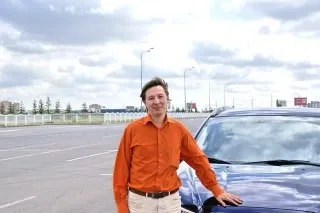
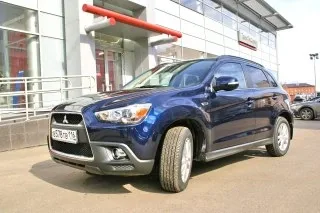
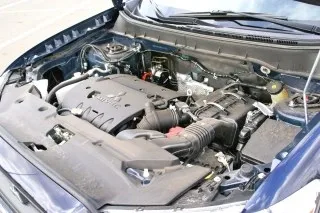
I could not understand the logic of the name ASX: why not some sonorous name, and specifically asked the dealer manager, who deciphered ASX for me as Active Sport (x) Crossover. Well, the word «sport» in any interpretation regarding this car sounds somewhat provocative. Initial configurations start with a 117-horsepower engine with a volume of 1.6 liters. There is also a 1.8-liter 140-horsepower and the most powerful 2-liter with a whole 150 horses. Well, it doesn't smell like «sport» here, honestly. Maybe it was meant that you can go out into nature and do sports there, because all-wheel-drive versions are available only in the most powerful configuration. But what is really aggressive and sportily tightly packed in this car is its appearance. I looked at it more closely and came to the conclusion that such a predatory look and the whole assembled appearance of the ASX suits it very well. And it looks much better than the more adult Outlander - compact and pumped up. It feels like the Lancer overate hormones and sat down in the gym.
Pumped up muscles and torso, dressed in chrome - and got the ASX. Be that as it may, the concept from which the characteristic «face» came, nevertheless got a start in life. The corporate style of Mitsubishi is emerging before our eyes. Grandis, Galant and heavy SUVs stand apart, perhaps they will also be touched by restyling changes in this direction (Colt has already acquired a similar appearance). I did not want to miss the ASX past the test site with a snake and turned out to be right. The car turned out to be well balanced and perfectly performs the exercises. With the ESP system disabled, the ASX can be sent into a lateral drift, but it quickly catches and willingly corrects the trajectory. I tried the same on the snake in front-wheel and all-wheel drive modes. The difference in acceleration dynamics is noticeable, of course. On front-wheel drive it runs more fun, but on all-wheel drive it steers more confidently. Also, in addition to this, taking advantage of the space, I tested braking at a speed of 80 km/h.
I liked the correct operation of the ABS, which activates just when the wheels are about to lock up. During such emergency braking, according to modern passive safety standards, the hazard lights come on, as if saying "thank you" to the vehicle behind for managing not to rear-end us during such braking. That's a joke!!! The energy-intensive suspension never bottomed out during the test. It copes very well with both minor vibrations and large potholes. The road, ruined at the end of summer, to our makeshift off-road test site turned out to be just a warm-up for the ASX. Unexpectedly! The settings are rather shifted towards comfort, and it is noticeably softer than the Outlander. On a dirt road, you can go a bit faster than it seems, and it can go where you wouldn't want to venture. During diagonal articulation, I was a bit worried about the front overhang, but the ground clearance was enough, and I didn't hit anything. When engaging the "Lock" mode, it quite briskly conquers the incline when articulated and just the hill.
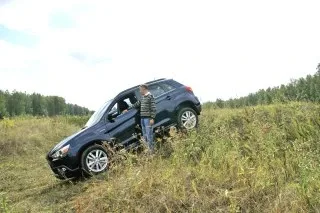
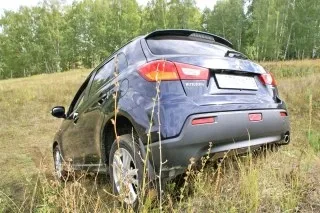
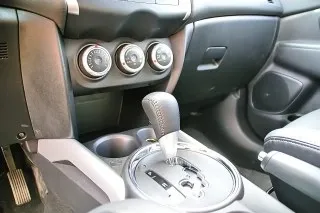
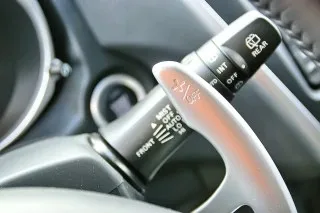
That hill Vadim mentioned has an unpleasant feature: at the very top there is an additional bump, and at the bottom there is a pothole. Roughly speaking, you can't build up speed, and the car can pass the test only thanks to its characteristics. I engage "Lock", turn off ESP, manually engage first gear - and forward ("alga" as we say), I thought we'd hesitate at the top, but no, we passed without any adventures. Well, a crossover is a crossover. As Vadim already said, we spent a lot of time on the highway, and to the above I want to add the noise level of the CVT itself, and I also played around with the cruise control. The activation algorithm is clear, but how to set the speed itself, you don't immediately understand, there's no familiar "SET" indicator, I figured it out using the old Russian method - trial and error. Returning to the CVT, I note the presence of paddle shifters, which definitely makes life easier when performing overtaking maneuvers and quick acceleration. Otherwise, the process promises to be lengthy. Double-pressing the pedal doesn't help either, but with a steady press, the car accelerates adequately, and fuel consumption is normal. By the way, we almost met the claimed 10.5 liters, exceeding it by only 0.1 liters. The conclusion is this: for calm and measured driving, everything suits, everything is fine, if you want to accelerate faster, then use either the paddle shifters or the manual mode on the lever itself. The interior is done in a calm style and is very similar to the interiors of its siblings.
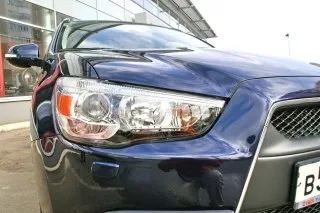
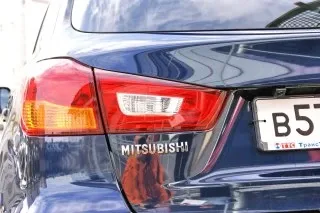
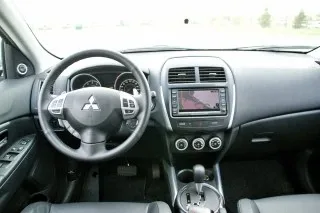
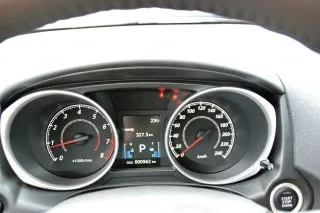
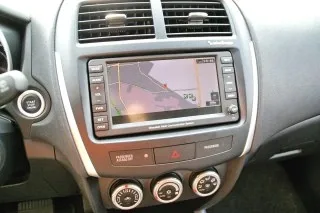
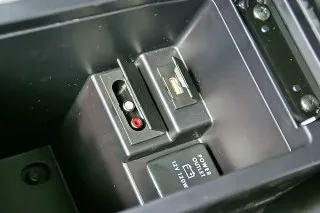
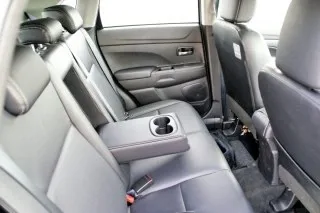
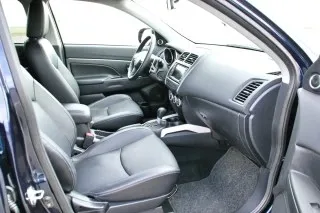
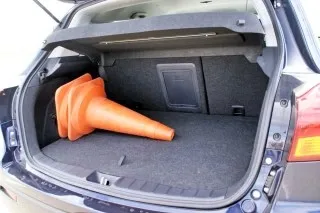
The same three dials of the climate system, the CVT lever framed in a circle, exactly like on the previous Lancer. The instrument panel with two wells and beautiful indicators between them is the same as on the Outlander. A convenient multifunctional monitor with Touch Screen technology, which replaces a bunch of buttons for various systems (DVD video, navigation, sound control, FM radio, trip computer, etc.). The material feels soft, and the leather seats are perforated, the driver's seat is equipped with electric adjustments. The steering column has reach and tilt adjustment. Our test version is the pre-top trim, which differs from the most expensive one only by the panoramic roof and a price difference of 50,000 rubles. If you save another 100,000, you lose xenon headlights and headlight washers, a premium system with a subwoofer, a rear-view camera, and the aforementioned display with navigation and CD/DVD system. In the trunk, a full-size alloy wheel was found, which is very useful. It is characteristic that the base version lacks the ESP system. So, what do we get? Externally, many will probably agree that the car is attractive. On the move, it is dense, not stiff, with an energy-intensive suspension, and responds perfectly to the steering. Economical, with a CVT, and well-equipped even in non-top trims. I'll also add that, subjectively, like many Japanese cars, it is very friendly, get in and go. Personally, if I literally try it on for myself, I liked it, especially in the new exclusive brand color "Kawasemi".