In those days, men did not consider it shameful to carry this blade alongside a full-size katana. On top of that, the wakizashi was, for obvious reasons, the favorite weapon of female samurai. The logic is ironclad, isn't it? Especially since Mitsubishi was preparing its new car for real combat against a hostile clan.
Remember the furor the Nissan Qashqai once caused? Yet its success rested on just two trump cards – compact dimensions and a hypnotic price tag. I know many young women who dream of a car with increased off-road capability but categorically refuse a mid-size crossover. Their argument is simple, irrational, and therefore not up for discussion. It goes like this: "This car is too big for me." From a logical standpoint, this is nonsense – this isn't a case where an extra thirty centimeters could actually be a hindrance. But the best thing a man can do in an argument with a woman is agree. At Mitsubishi, that's exactly what they did. Assessing the triumph of the Qashqai, they took the Outlander XL platform and mounted a new, shortened body on it. The new model, named ASX, inherited even the wheelbase from the older model, not to mention all key components and units. This means the company saved significantly on development and ultimately reduced production costs. The only question is what came out in the end. That's exactly what we set out to find out, covering 9,000 kilometers.
As is usually the case at international presentations, calling this a full-fledged test is a stretch. A four-lane asphalt track shaped like a trough, a short profiled section simulating a mountain serpentine – conditions are as greenhouse as can be. Just like in that joke: "And where would it go out of the rut!"
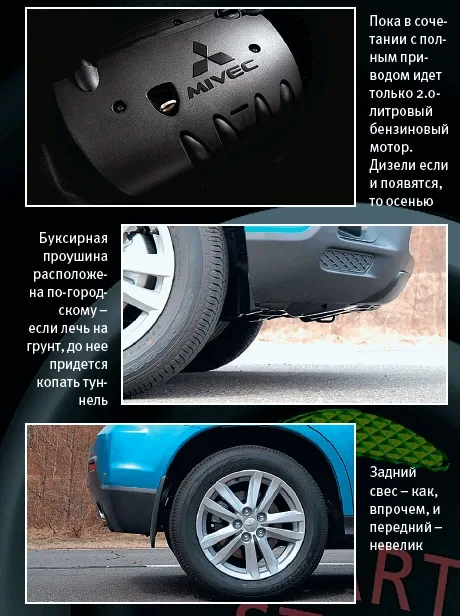
In all-wheel-drive trim, the new model gets a two-liter gasoline engine and a CVT. Maybe that's not bad, but the CVT whines during hard acceleration like a washing machine on spin cycle. Especially when you switch it to sport mode to rev the engine to the limit. And how else, if the unit is frankly car-like, with peak torque at over four thousand rpm? However, you can do it differently – start without fanaticism, drive steadily, not trying to instantly reach the maximum allowed 150 kilometers per hour on the track. In this mode, the cabin is quite quiet – ASX's sound insulation is clearly better than that of its closest competitor. At least even at 160 km/h, you can talk without raising your voice. The dynamics, by the way, are acceptable, but not outstanding: despite the Jet Fighter-style grille, this is clearly not a jet fighter.
QUESTIONS OF FAITH
The question of diesel engines remains unclear. For the European market, the ASX will have a 1.8-liter compression-ignition engine – not counting the French 1.6-liter unit intended for the platform-sharing Citroën. The prospects of these engines on the Russian market are foggy, as they are designed for high-quality fuel. As far as I understood, the Japanese themselves are pondering over their engine: whether to adapt it, or to believe that the northern barbarians' diesel meets civilized standards, or to give up and not bother. However, at Rolf Import – the Russian distributor of Mitsubishi Motors – they are confident that by autumn the issue will be resolved positively.
As for handling, the ASX doesn't claim sportiness here either. However, the steering wheel is rather elastic than empty, and reactions to its turns are precise. Body rolls are minimal, the suspension doesn't make unnecessary movements. Although it doesn't stand out for comfort – it meticulously reads small irregularities. In other words, in road behavior, the ASX is close to an average hatchback. And this is no accident – as a rule, consumers switch to a compact crossover from the golf class. Yes, and one more thing: the brakes on the new model are excellent – both informative and effective.
DUTY FIRST
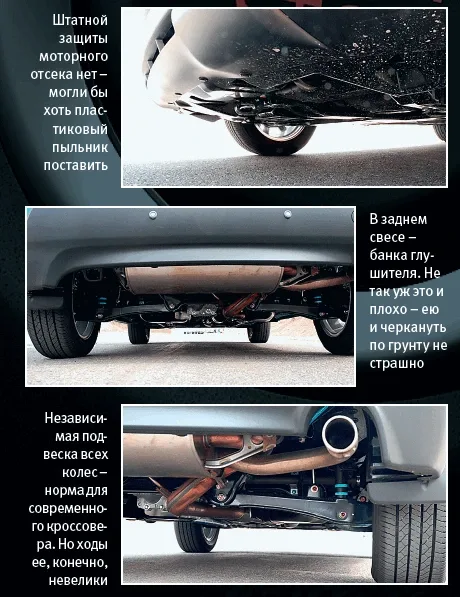
As is known, for a Japanese, duty to the company is above all. Therefore, upon hearing that off-road was not at all included in our driving menu, I acted simply: I declared that if I weren't given the opportunity to test the ASX on dirt, I would be fired from the magazine. For sons of the Land of the Rising Sun, this means loss of face and, consequently, immediate suicide (you wouldn't believe it, but such things still happen to them). So, after long telephone consultations with Tokyo, a semblance of off-road was provided to me. It was a dirt ring about five hundred meters in diameter. To be honest, a crossover with a ground clearance of 195 mm deserves more rugged terrain. But still – it's not asphalt, so we can check the operation of all-wheel drive. But first, sorry, a bit of theory – so everyone understands what we're talking about.
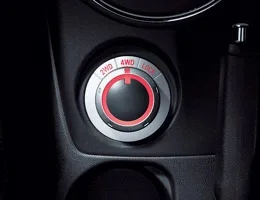
As on the Outlander model, the drive control lever here has three positions – 2WD, 4WD, and Lock. The first is clear, the second is an automatic mode of the clutch operation, the third is supposedly a lock. But in reality, in Lock mode, there's no rigid distribution of power flow. Approximately 60 percent goes to the front wheels, the rest to the rear, but this ratio can change depending on the degree of wheel slip. Deep inside the transmission, everything is as simple as possible: a clutch is attached to the rear inter-wheel differential – a pack of friction discs immersed in oil, pressed when necessary by an electromagnetic device. It, of course, receives signals from the control electronics.
How does it feel? Let's say this: in 4WD mode, distinct front-wheel-drive behavior is maintained, but in Lock position, the ASX gets a bracing response to accelerator pedal input: the rear axle begins to show a slight tendency to oversteer. The car does this shyly, remaining fully under driver control. If you turn off ESP, it gets more fun. However, the stability system doesn't turn off completely – in critical situations, in its opinion, it still strangles the engine. And here an important question arises: what about imitation of locks, off-road ESP mode? Alas, there's none here. If a rear wheel is hanging, it will spin idle, giving power flow to emptiness. All hope rests on the fact that for the front axle, the ASX has an electronic imitation of the differential lock. But usually, it's the rear wheel that hangs. And it does so easily, since suspension travel is quite small. So for off-asphalt cases, you have to rely on inertia and relatively light weight, passing difficult sections with momentum.
Yes, by the way, getting stuck in the ASX is not recommended – the tow hook is located under the front overhang and, if anything, will hit the ground first. But at the rear, it seems, there are two hooks – one screws into the bumper, the other is hidden under it, on the left.
In general, despite the excellent ground clearance for a city crossover, the ASX can conquer exactly as much off-road as most potential consumers need: make a dizzying climb onto a curb, ford a puddle, heroically ram a snow bank about twenty centimeters high.
LUXURY CLOSER TO THE CENTER
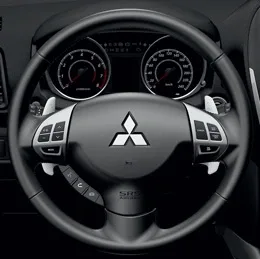
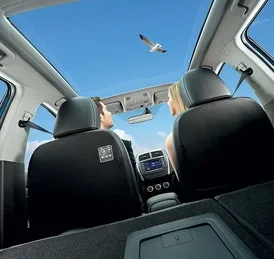
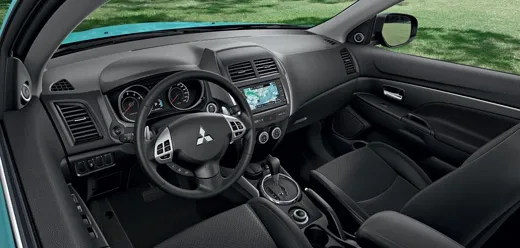
As you've already understood, our today's hero primarily claims accessibility, and secondarily, external originality. Fortunately, it was originally designed for the new grille and looks quite harmonious. And what about the inner world? First, its steering column adjusts not only for tilt but also for reach. This is the first Mitsubishi on the Russian market to offer this. It seems not quite budget, but time dictates its laws: as the General Secretary would say, ergonomics must be ergonomic. And so it is – behind the wheel of the ASX, a person of any height is comfortable. But only if the car isn't equipped with a panoramic roof. With it, the ceiling height noticeably decreases.
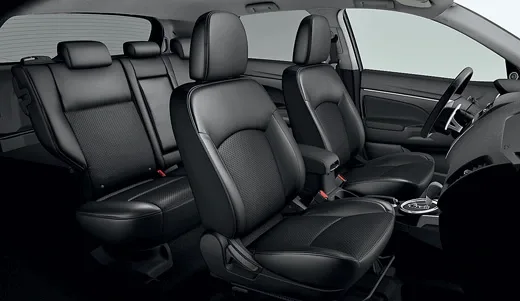
The driver's seat is adjustable in height as well, and the backrest angle changes according to the "Zhiguli" algorithm: pull the lever – and you recline as much as needed. There is, of course, also a version with electric adjustment. Can you sit in the back behind a pilot of a not-so-delicate build? Easily, at 186 cm tall I sat behind myself. I won't say I'd want to drive like that from Moscow to St. Petersburg, but a hundred kilometers – it's possible.
The interior trim has a funny story. The parts of the front panel that you can reach first are made of soft plastic. There's something familiar about it: closer to the steering wheel – premium, on the periphery – hard plastic. The center console layout is far from ideal, with the air vents in the spotlight, climate control at the very bottom, and the rotary knobs likely have been sitting in warehouses since the end of the last century.
The upholstery is available either in leather or fabric, and the latter has several versions – for example, a 3D effect option with a deep micro-relief. In this version, the seats look quite modern. True, you shouldn't count on lateral support. And I'll repeat again: despite its bold appearance, the ASX is a purely practical car, without any sporty pretensions.
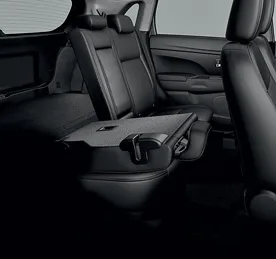
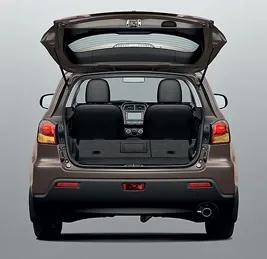
And finally, the trunk. For our market, it had to be reduced because a full-size spare wheel is hidden under the floor. But even so, it's not small – bigger than competitors'. Again, because of that spare wheel, you won't get a flat floor when the rear seats are folded. But hardly anyone in Russia will think that's a big loss.
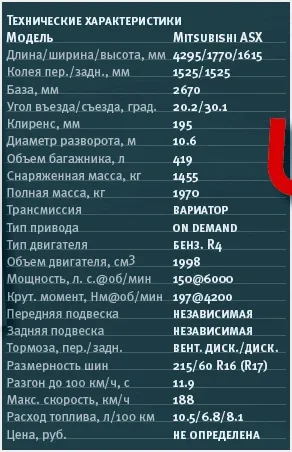
SPECS: MITSUBISHI ASX
EVERYONE GETS A BLADEWell, it seems it's time to end our song about the wakizashi. An inexpensive compact crossover with a bright appearance sounds good, doesn't it? Perhaps I would have treated the noisy CVT, the strange front panel, and everything else differently if I didn't know that the ASX would be cheaper than the Nissan Qashqai, while also surpassing it in sound insulation and interior build quality. Yes, we need such wakizashi – and not only for women. In post-crisis times, not every samurai can afford a katana, and being without a weapon – that is, without all-wheel drive – is somehow undignified for a man.