
 Comments (10)
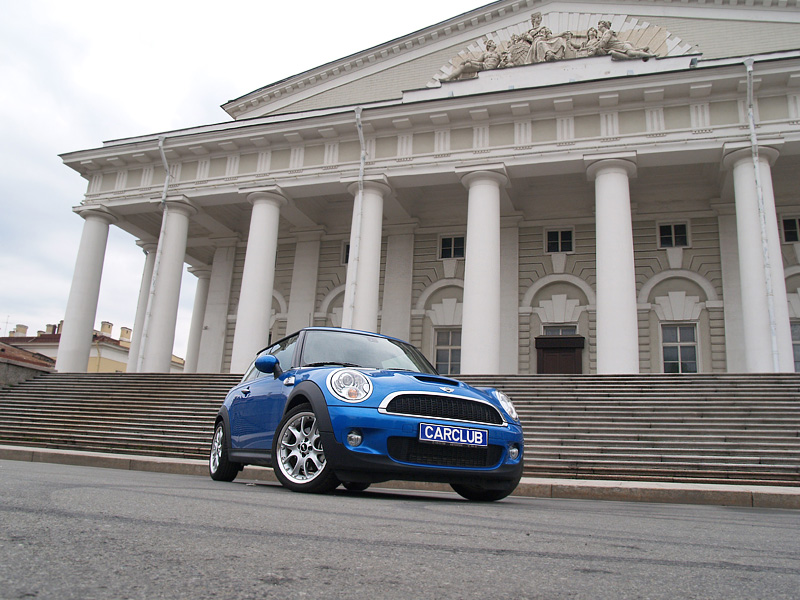
About three years ago, when I first had the chance to drive a MINI Cooper S of the previous generation with a supercharged engine, the car amazed me. How can such a small body hide a car that is simultaneously extremely sporty and yet suitable for daily trips, albeit without much comfort: the cabin is completely devoid of sound insulation, and the wheel alignment angles are such that the car simply cannot drive straight – you have to constantly correct the steering. But the sensations behind the wheel are incomparable to any road car: dynamics, handling, brakes – everything is taken to the highest degree! 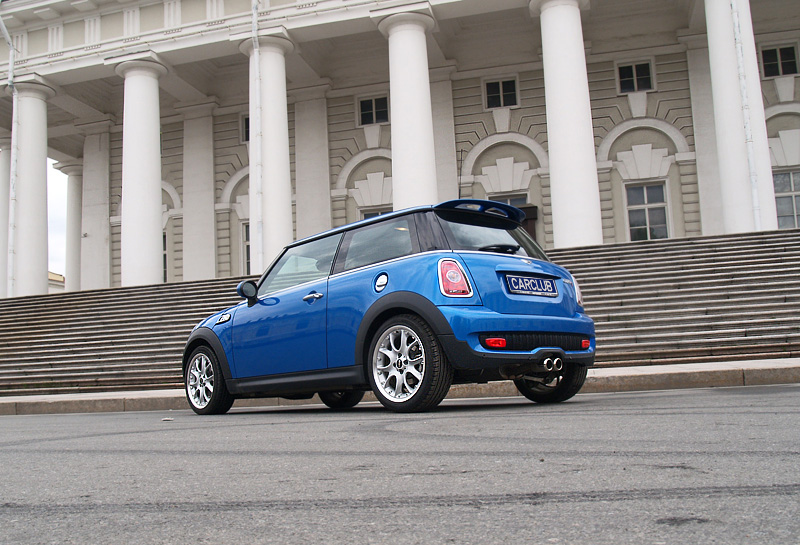 So, the previous MINI impressed with its combination of relative comfort and sportiness, albeit with a clear predominance of the latter. For the new car, we decided to set an even more interesting and challenging task than simple city driving – we set off in a MINI Cooper S on a long journey, or to be more precise – to Saint Petersburg.
Most colleagues twirled their fingers at their temples, saying, Mini is exclusively a city car and completely unsuitable for long trips. But after the war, the British used the first MINI as their only family car and went on trips in it. And why are we worse?
In a word, ignoring all the warnings about the quality of our roads and their compatibility with 18-inch low-profile tires and the sporty suspension of the "S", I set off to the city on the Neva. Fortunately, the Russianized navigation system of the MINI found this city and showed me the route. So, a full tank of 95-octane, fingerless leather gloves to grip the small sporty steering wheel tighter, and off we go. At the same time, on the way out of Moscow, I reset the onboard computer. I wonder how the MINI Cooper S will behave on a long journey.
Of course, thanks to the sporty suspension and 18-inch stiff Run-on-flat tires, the driver and their hands are duly informed of all road surface defects. But looking ahead, it can be said that along the way the suspension did not allow a single breakdown, although on the BMW 3 Series, which I drove to St. Petersburg last year, hard impacts were the norm. Surprisingly, the Cooper also reacts not particularly sharply to ruts, and during acceleration the powerful front-wheel-drive car does not tear the steering wheel out of your hands at all. While moving, the MINI is perceived as an absolutely rigid car, but not in terms of suspension, but in terms of the body. The Cooper S responds without delay to any driver action, whether it be turning the steering wheel or pressing the gas. The car bounces elastically, like a ball, over any bumps, but never loses contact with the road for a second.
After the first hundred kilometers, the doubt about the correctness of choosing this car for a long journey completely dissipated. When you are behind the wheel of the "S", the feeling of a small car gradually evaporates. It holds the set trajectory perfectly, whether it is a straight line or an arc, and reactions follow immediately, as if the Cooper S has no mass, which creates a resemblance to extremely lightweight racing cars.
The stiff tires faithfully transmit a monotonous hum into the cabin; it is audible already at 80 km/h, but does not increase further, at least up to 160 km/h you can talk on the phone almost without raising your voice.
The new 1.6-liter turbo engine, which BMW engineers built in collaboration with the French from the PSA Peugeot-Citroen group, initially raised doubts. If the previous supercharged engine had perfectly smooth torque across the entire rev range, then turbochargers are prone to lag. But anticipating the concerns of potential buyers, the developers created a very elastic engine. Locomotive-like torque begins already after 1500 rpm, and around 3000 there is a significant surge that persists all the way to the red zone. There is an abundance of torque, so you don't really want to rev the engine to the limit. It is more enjoyable to shift in the range from 4000 to 5000 rpm and always stay in the turbo boost zone. Fortunately, the gears are closely spaced and there are six of them. Although the need for such a number remains a mystery to me. During the entire test, I never once engaged fifth gear – there is no need for it. Usually, a brisk acceleration in third gear up to 5500 rpm, which corresponds to 120 km/h, is enough, and then you can confidently switch to sixth – the tachometer will show exactly 3000. Sometimes you use fourth, but fifth is completely unnecessary. Rather, the 6-speed gearbox is a tribute to fashion and marketing, because almost all hot hatches have six gears, so engineers are forced to invent new gears even if they are not needed by anyone. Perhaps multi-speed gearboxes can help forced turbo diesels, which have a narrow operating range, but when torque, as on the Cooper S, is present almost throughout the entire tachometer, an excess of gears is rather annoying. You have to turn to the gearbox more often than usual or skip "extra" gears.
However, the tall lever fits perfectly in the hand, and the gears themselves, although requiring considerable effort, engage with excellent precision – it is almost impossible to make a mistake, except maybe to put fourth instead of sixth, but that, by and large, does not matter.
The standard mode of highway driving turned out to be quite intense: the speed quickly rises to 160-180 km/h, and sometimes exceeds 200. Moreover, for quite dynamic acceleration, the last, 6th gear is quite enough. Sometimes, without shifting, I managed to drive more than a hundred kilometers. An excellent engine. But even more, the Cooper S impressed with fuel consumption. Under conditions of very active driving, when the average speed exceeded 110 km/h, the onboard computer showed a result of 8.3 liters per "hundred".
At first, the MINI's instrument panel is somewhat puzzling. The tachometer is in front of your eyes, while the speedometer is moved to the center of the front panel, and its size exceeds all reasonable limits. And given that the center of the scale is occupied by the navigation system display, the speedometer needle moves around the circumference of the scale and is quite poorly visible, and in the dark you can only guess the speed or display its digital value on the tachometer screen. Also, the MINI's speed can be accurately determined by the tachometer – in top gear, every thousand rpm corresponds to 40 km/h.
Otherwise, the interior, as before, leaves a very optimistic impression – it is a true kingdom of circles and ovals. It seems that if the designers were given free rein, they would make the windshield round, just as they made all the mirrors oval, including those in the sun visors, the pedal covers, and the door inserts. There are simply no right angles in the Mini's cabin. Perhaps for fans of classic cars, such shapes may seem blasphemous, but I really like the design of the MINI, both exterior and interior. Approaching the car, you always want to smile, and you won't be able to stay in the cabin with a sad face for long: the Cooper S will definitely make you smile, either from its unique style or from its dynamics.
Perhaps, based on the results of the test, I managed to find only one drawback of the MINI – its price. The tested "S" with the navigation system and other options is priced at 33,900 euros (more than 45,000 dollars). With all due respect and love for the MINI Cooper S, I could not pay such a large amount of money for such a small car. Unless as a second car, when price no longer matters, but then it is worth preferring the open-top version of the Cooper S Cabrio – to achieve a complete blowing… of the head. For a similar price, I would give preference to the Alfa Romeo 159 2.2. It, of course, loses to the MINI in dynamics, but the difference is not so great, and in terms of handling feel these cars are close, but the Alfa's cabin is still more adapted for life.
Text and photos: Leonid Pavlov