
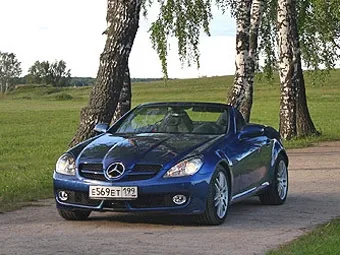
Russian Product
The Mercedes-Benz SLK appeared in 1996 and instantly won over its audience: in the first year, 55,000 units were sold — one and a half times more than the factory had expected. Four years later, the compact roadster-coupe (SLK stands for Sportlich, Leicht und Kurz, meaning "sporty, light, and short") with a rigid folding hardtop underwent a facelift, gaining standard stability control, side airbags, and climate control. The lineup added a 3.2-liter V6 with 218 horsepower — an engine then used in the E-, M-, and S-Class models, as well as the CLK coupe and SL roadster. Before that, the SLK only had supercharged engines of 2.0 and 2.3 liters.
Over eight years of production at the Bremen plant, which also assembles other folding-top models like the SL and CLK, nearly 309,000 first-generation roadsters were built. The car was especially well received in Germany, Italy, the UK, and the US.
The second generation arrived at dealerships in March 2004. And again, success: 190,000 cars sold, 60,000 of them in Germany. The body stretched by 72 millimeters to 4.03 meters, became 65 millimeters wider, and the wheelbase grew by three centimeters. Inside, it became noticeably more spacious.
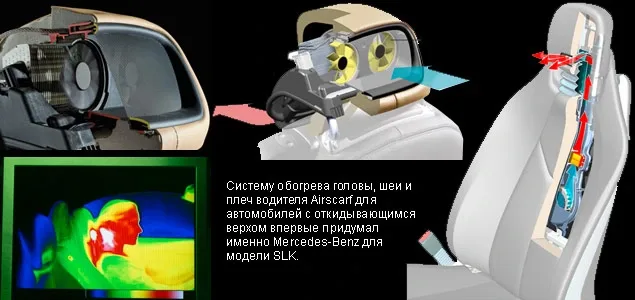
The old 3.2-liter V6 was replaced by a new 3.5-liter unit: paired with the seven-speed 7G-Tronic automatic, it produced 272 horsepower. And for the first time, an AMG version featured a V8 with 360 horsepower. The second-generation SLK also debuted the Airscarf system, which heats the head, neck, and shoulders.
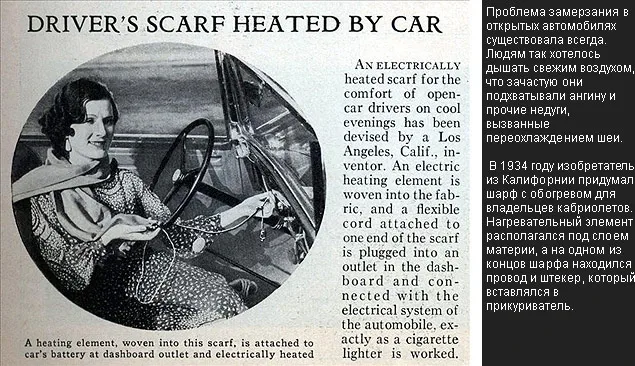
From the Airscarf vents built into the headrests, hot air blows — it is heated in a radiator located right next to them (!). A button on the center console activates the fans in the headrests, and they blow warm air, so you don't freeze in cool weather with the top down.
The airflow has three intensity modes — from low to maximum. The electronics automatically regulate the air temperature based on speed and outside weather. The name "air scarf" immediately conjures an image of a racer from the early last century wrapping a scarf around their neck to avoid catching a cold. However, this feature will soon no longer be exclusive to Mercedes: the Peugeot 308 CC coupe-cabriolet is in the works, where a similar system will be called Airwave and will also be available for rear passengers.
We once experimented: can you drive a convertible in winter? Yes, if you set the climate to maximum and turn the airflow to full power. On the SLK, it's even easier. Hot air on the neck and back of the head really makes you forget the cold outside. But if you lean to the side — for example, to reach for something in the glovebox — the wind immediately reminds you of the bad weather. Which is healthier: constant cold or sharp temperature changes? I don't know; I'm not a doctor.
 |
The updated roadster, built on the C-Class W203 platform shortened by 285 millimeters, was shown in Detroit in January 2008, with global sales starting three months later. Almost always, the most sought-after modification was the SLK 200 Kompressor — it accounts for more than half of all orders. A quarter of buyers choose the SLK 280, and the remaining quarter is split between the SLK 350 and SLK 55 AMG. For the Lenta.ru test, we got a car with the updated 3.5-liter engine.
After the facelift, more than 650 changes were made to the design. Some are immediately visible. The new front bumper is complemented by an expressive V-shaped grille with a large Mercedes-Benz emblem, and the fog lights have chrome trim. At the rear — a fresh bumper and darkened taillights, a feature borrowed from the SLK 55 AMG.
The side mirrors became wider to accommodate arrow-shaped LED turn signal repeaters. The engineers also thought of those who wash their car at an automatic car wash (such owners in Russia are probably hard to find): the external antenna was shortened so it wouldn't need to be unscrewed. And the retuned exhaust system with new trapezoidal tips now sounds even better.
 |
The interior was also refreshed: a new three-spoke steering wheel, different window switch buttons, an instrument cluster with three-dimensional dials, red needles, and chrome trim. Chrome appeared on the center console around the audio system's "head," as well as on the gear lever and handbrake.
In the options list — the NTG 2.5 multimedia system with Linguatronic voice control, a new feature for the SLK. However, it only works with foreign languages. Bluetooth became standard, and for an extra charge, an iPod connector and an SD card slot are offered.
For navigation — a 6.5-inch monitor, for audio files — four gigabytes of memory. The sound is delivered by a 500-watt Harman Kardon audio system, which is 120 watts more powerful than before.
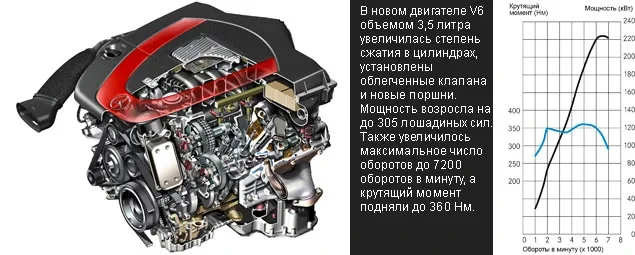
But the SLK didn't stop at cosmetics. Engineers from Stuttgart refined the 3.5-liter V6: the compression ratio increased from 10.7:1 to 11.7:1, the valves became lighter, and the pistons are new. Now the engine produces 305 horsepower — 33 more than before. The maximum rpm rose to 7200, and torque increased by 10 Nm to 360 Nm at 4900 rpm.
The seven-speed automatic 7G-TRONIC received a Sport mode, reminded by paddle shifters. The 7G-TRONIC Sport shifts faster, and when downshifting, it can rev-match. With a sharp press on the gas, the gearbox first engages neutral, then a lower gear — at that moment, the crankshaft and transmission speeds align, making the downshift smooth.
 |
All this allowed the official 0-100 km/h time of the SLK 350 to be reduced by a tenth of a second. The automatic doesn't yield to the manual: both versions reach 100 km/h in 5.4 seconds. Shifts are almost imperceptible, and the speedometer needle runs so quickly toward the coveted number that you remember cameras and traffic police posts only after exceeding all city limits. The increased power didn't hurt efficiency: fuel consumption in the combined cycle dropped by 0.9 liters to 9.2 liters per 100 km. With the manual, the appetite is 0.3 liters more.
For an extra charge, a fully mechanical "direct-steering" system is offered, which is standard on the AMG version. Its feature is a steering rack with a variable ratio. In the "near-zero" position, the steering wheel barely reacts to small movements, which helps maintain a straight line at speed and on uneven surfaces. But turn the wheel five degrees or more — and the ratio changes from 15.8:1 to 11.5:1. As a result, from lock to lock — only 2.16 turns. This is very convenient in parking lots, and as speed increases, the steering wheel fills with pleasant heaviness, which saves from a ditch during a sharp maneuver.
The SLK 350 has no shortage of comfort: the roadster proved to be a true Mercedes-Benz. The ride smoothness of Stuttgart cars can be set as an example for all other production cars, including our test subject. It handles speed bumps like a full-size SUV with independent suspension, and pays no attention to potholes and cracks — unless they are really huge.
The SLK 350 roadster can well be considered one of the most suitable sports cars for Russian roads. It handles bumps well, doesn't disappoint in dynamics, boasts rich equipment, and is built so well that it justifies its price. And it starts at almost 2.2 million rubles, not including the 7G-Tronic automatic and additional options, which increase the final cost even further.
Technical specifications of Mercedes-Benz SLK350
| Length, mm | 4030 |
| Width, mm | 1720 |
| Height, mm | 1472 |
| Wheelbase, mm | 2540 |
| Curb weight, kg | 1220 |
| Engine displacement, cm³ | 3498 |
| Power, hp/rpm | 305/6500 |
| Torque, Nm/rpm | 360/4900 |
| Acceleration 0-100 km/h, s | 5.4 |
| Top speed, km/h | 250 (limited) |
 Great-grandfather of the SLK
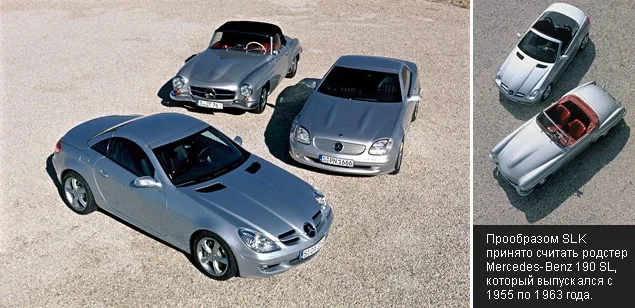
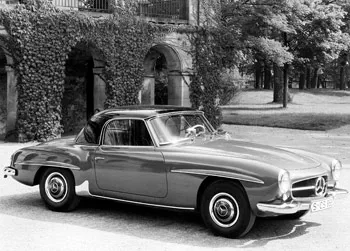
In Mercedes-Benz itself, the 190SL roadster, shown to the public at the New York Auto Show in 1954, is called the ancestor of the SLK. Series production started in May of the following year.
The car was built on the tubular frame of the 300SL roadster, which had appeared three years earlier. The more powerful version, by the way, was nicknamed "Widowmaker" — that's how unruly that car was. The 190SL was not affected by such dubious fame — perhaps because its engine was much more modest than the 212-horsepower unit of the 300SL. Under the hood of the SLK's ancestor was a 1.9-liter inline engine (as clear from the model name) with 104 horsepower, and fuel was supplied by two Solex carburetors. The roadster was offered in two versions: with a removable hardtop that could be taken off manually, and with a fabric folding top. For the 190SL, there was a fun option — a third seat. It could be placed between the two main ones, and even an adult could fit there. In 1963, the Mercedes-Benz 190SL and 300SL were replaced by a new model with the index 230SL. |