
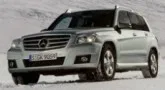
Having landed in Munich, we quickly made our way to Innsbruck, where all-wheel-drive Mercedes were already waiting for the trip. From there, the route lay to Hochgurgl, a place situated at an altitude of about two kilometers. The mountain air and the desire to quickly forget the Moscow hustle prompted me to choose the luxurious and unhurried CL 500 4MATIC for this climb into the mountains. As soon as the massive frameless door closed behind me, I immediately realized: that's it, Moscow was left behind, and all around were only the Austrian Alps. A true paradise, and not just for ski enthusiasts.
I have nothing against the CL and was ready to drive it for the entire vacation, but two things intervened: this car was already well known to me, and I hadn't come here for rest. The GLK was shown to us the next day, after a packed press conference held in the evening. At that event, I managed to exchange a few words with representatives from Mercedes headquarters and, of course, asked them about their plans for all-wheel-drive models. Would the Germans implement any active schemes? The first answer left me somewhat puzzled—a confident "no." But why?
It turns out that for most brand customers, issues of sharp handling and constant drifting are simply not on the agenda. Often, Mercedes owners have other cars for such not-quite-everyday entertainment. In civilian vehicles, the company's engineers prioritize predictability and reliable handling. That means you know in advance how the car will behave in any given situation, without intending to "fly sideways" through interchanges. In all other cases, electronics are more than sufficient. Such is the philosophy of "firmatics."
Let's, for example, compare an abstract active all-wheel-drive system with computer-controlled center and rear differentials to the latest, fourth, version of 4MATIC. How does the first option work? The electronics are constantly on edge: thinking, analyzing, calculating, and actively working the clutches like a weightlifter with dumbbells, shifting torque. Such a system can be tuned for any oversteer or understeer, but one thing is clear: traction on the wheels never remains constant. Even simple systems with an uncontrolled differential like Torsen imply changing torque between axles, but 4MATIC takes a completely different approach.
Here, torque is distributed between the wheels in a fixed 45/55 ratio favoring the rear axle, and all the remaining work is taken over by electronics, simulating the operation of locks both off-road and on slippery surfaces. Modern high-speed ESP allows this. That's why all all-wheel-drive Mercedes behave the same. Moreover, mechanically preset torque distribution means that torque reaches the wheels faster than in adjustable systems, which need time for the computer to "think" and the mechanics to react.
To test these words in practice, the next day we were given a closed section of a mountain serpentine, completely covered with creaking snow. It was -15°C outside—more than invigorating, the road was narrow, unfamiliar, and treacherously winding. Beyond the barriers—at least a kilometer of drop. Studded tires are banned in Austria. In short, only a truly crazy rally driver would dare to race here. We drove in a column, periodically hitting specially created obstacles. Some, of course, tried to hustle in the first three gears, but that was more like fooling around.
Let me put it this way: the Mercedes folks created conditions where journalists turned out to be the most ordinary users. We had to drive mostly calmly. And here, all the statements from the press conference were confirmed one hundred percent. The understeer is constant—the front slides outward, and that's it. If you provoke with the steering wheel and throttle... it still goes outward, but it starts to throw the rear out a bit. Understand? Yes. But it's too straightforward. However, I already spoke about driving in slides above.
And how will the GLK handle obstacles? First—diagonal wheel hanging. The car climbs, wheels hang in turn, and those with traction, after a couple of rotations, push the car forward. Let's say on hard and slippery surfaces this is not fatal, but what if there's, say, sand under the wheels?
However, the Mercedes folks themselves in no way consider the GLK an off-roader. It's a typical city car. I think in a metropolis it will look very organic. Like for the ML, an off-road pack can be ordered for the GLK, but you shouldn't expect any special miracles after its installation, because, unlike the older model, it doesn't affect the mechanics. Only the appearance.
The imitation of locks could be tested by starting on a mixed surface. Under the pair of wheels on the right—ice, on the left—packed snow. The 4ETS traction control really works quickly. The car doesn't have time to slide slightly to the side before the trajectory immediately straightens out. Well, for an ordinary user, this should indeed be enough.
Unfortunately, having more or less figured out driving on slippery roads, I found the answer to only one question. And there are still many left, and they all concern driving on public roads typical of Russia. Of course, after leaving the track, I drove a bit around the outskirts of Hochgurgl, but that experience is too little for any conclusions. One thing can be said—the GLK drives as a modern Mercedes should: quietly, softly, very comfortably. At the same time, the driver is not detached from the driving process. The car is not exciting, but it handles well. And the engine-transmission tandem is good. However, this has been known for a long time. Well, let's wait for a test on our native expanses.
Returning to the hotel, we handed over the GLK keys, and I faced the choice of a car for the way back to Innsbruck. Given that the test hero is largely inspired by the legendary Gelandewagen, I took the keys to the G 500 and dedicated the last 100 km of the journey to it. An interesting car, charismatic. Driving this SUV is quite amusing. But better not in the mountains, but on the autobahn. How many more four-wheeled constructions can you find that have been produced since the 70s, constantly improving? It's a cocktail of automotive eras! But I would rather have gone down in the white GLK 350, which remained waiting for new journalists. Then, perhaps, there would have been far fewer questions about it. And maybe I wouldn't have had to test it in Moscow. But now I'll have to. Could this have been a subtle calculation by the company's PR people?