
The GLK makes an impression of a powerful car. A controversial decision, but a powerful one. And most importantly, it's immediately clear why the car was named GLK and not MLK. Buyers are tired of streamlined shapes, and designers, who could be called miniaturists or cubists, have created a reduced copy of the Gelandewagen. The interior, assembled somewhat roughly, unlike the C-Class, looks organic here. And the quality has improved: there is almost no cheap plastic.
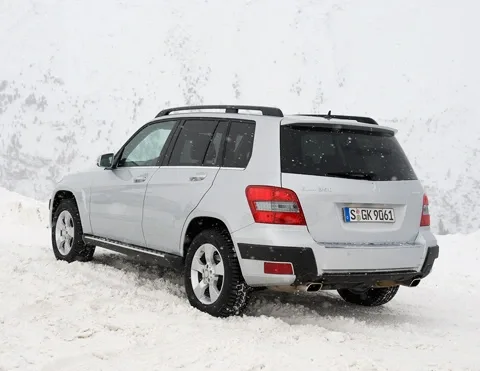
The cube-shaped body is also practical. Visibility is excellent, and there is plenty of space in the rear seat. The only thing is that the 450-liter trunk is not the most spacious in its class. Ergonomics, of course, are top-notch: both adjustment ranges and controls are well executed. Passengers of the big Gelandewagen can only dream of such space and comfort.
However, the GLK's image is deceptive. The ground clearance is the standard "two hundred" millimeters, but the approach and departure angles of the GLK are smaller than those of the Audi Q5, which looks more "car-like." Do you think this is a small but real premium SUV? Alas, no.
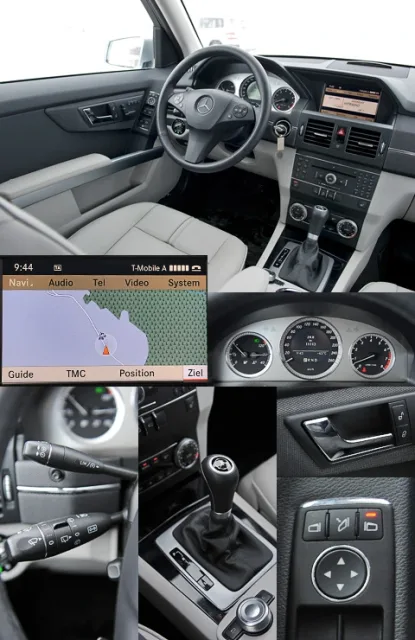
The steering wheel, instrument panel, climate control and audio system units — all of this is from the regular C-Class. But a different architecture and more pleasant materials finally give a feeling of a quality item. Even if in a tech style.
But the technology is quite real — and no revolutions. Technically, the GLK crossover is heavily unified with the C-Class, on whose platform it is built. Naturally, it has different suspensions with larger but not impressive travel. Engines — gasoline "sixes" with 3 and 3.5 liters (231 and 272 hp respectively), as well as a three-liter turbodiesel with 224 hp. A little later, the GLK 220 BlueEfficiency version with a "urea" diesel of 2.1 liters will appear. Any of these engines is paired with a gearbox — our good old friend 7G-Tronic. Well, as for the gearbox itself...
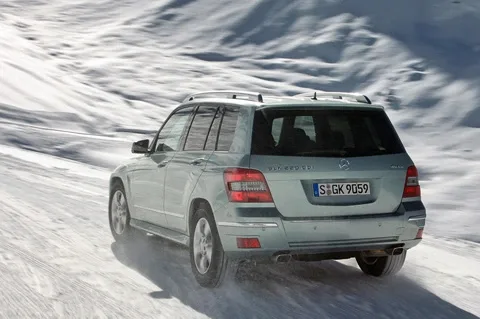
The GLK 220 BlueEfficiency version with a 170-horsepower Bluetec diesel is not for Russia: the engine is too demanding on fuel quality. But the version with a regular three-liter diesel will be available here — it will appear early next year.
And here we come to the most interesting part. To what many people buy a crossover for — all-wheel drive. His Majesty All-Wheel Drive — this is confidence on any surface and full control over the car in any situation, as advertising will tell you with the persistence of a hypnotist. Forgetting to add a mere trifle: in fact, all-wheel-drive cars are the most complex and ambiguous to drive. You release the throttle in a corner — what will happen? Understeer or oversteer? And if you press the throttle at the limit? Where will you fly off?
Merker does not argue. But he says: the main goal was to create a car that is easy to drive. Not for rally drivers — for realists. For ordinary people.
That's why the 4Matic all-wheel-drive transmission, familiar to us from the S, CL, and C-Class models, looks so simple? The center differential with an overrunning clutch, distributing torque between the front and rear wheels in a 45:55 ratio — pure mechanics. The rest is electronics: the 4ETS system takes over the task of distributing traction, selectively braking wheels and simulating the locking of cross-axle differentials. Off-road modes have been added: on dirt, ABS allows a quarter-second wheel lock, and a corresponding program will help you descend a hill.
The Mercedes transmission is compact and light, the weight increase is about 60 kilos. On passenger cars, the 4Matic badge doesn't even require "replanning" of the body floor. But there are no "self-locking" or active differentials, like in the BMW X6 or Audi S4. "Yes, competitors are doing this, and we are also conducting research in this direction," says Merker, "but I don't see any real benefit for the average driver. And such systems are usually expensive and heavy!"
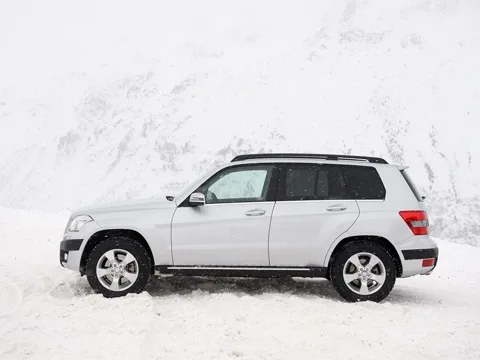
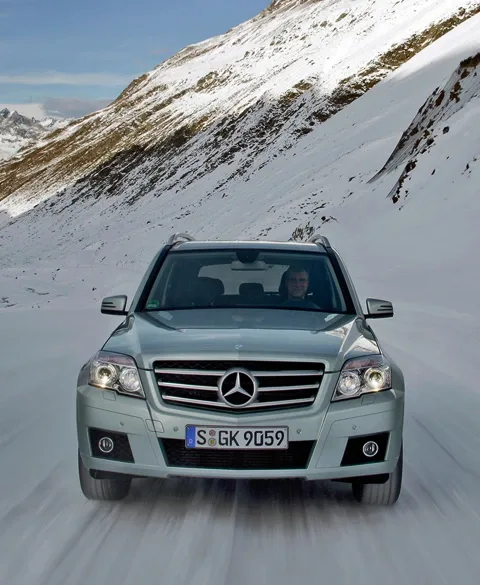
Okay, let's play "average driver"! Mountain road. Snow, ice. On the right — a rock, on the left — a small snowdrift, and behind it — a cliff. If you fall there, it will definitely be Hollywood-style, with a couple of flips and an explosion. It's scary, but I'm fooling around: either flooring the throttle before the apex, or an untimely release. But the GLK doesn't give in to provocations. Safe! I won't claim that the 4Matic system is more reliable than competitors' (for that, we'd need to arrange a comparison), but the impression of ease remained.
And what if I, a complete fool, turn off the stability control? "You can't turn it off completely," says Thomas Merker, "the ESP off button deactivates it only partially and is needed for driving on certain types of surfaces, for example — virgin snow. Where you can't get through without a little wheel spin." I press it. Now I can fool around — send the GLK into a slight drift or pull the car out with throttle.
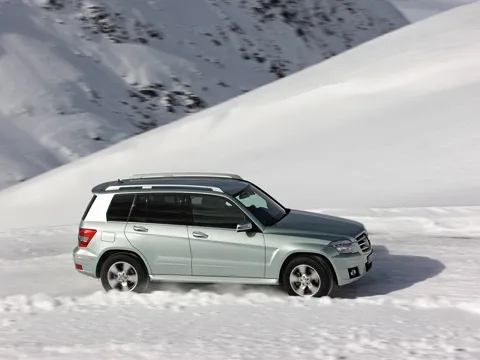
But there are a couple of nuances. The half-disabled ESP does not prevent a slight drift on a high-speed arc (fortunately, easily controllable), but you press the throttle on the exit of a hairpin on asphalt — and wait a second for acceleration. "The lateral acceleration was too high," Merker comments on my actions, "but this risks tipping over. According to our internal standards, the car must perform any maneuvers with a maximum load of 100 kg on the roof, and this shifts the GLK's center of gravity even higher! That's why the electronics strangle the engine. But on snow, even if you're flying at nearly a hundred, the lateral acceleration is low and the system doesn't interfere — you control the car yourself: with the steering wheel, throttle, however you like."
To drive the GLK fast, you need to use your head, working the pedals and steering wheel extremely delicately, so as not to wake up the ESP. Otherwise, if you overdo it, the electronics will immediately cut off the fuel supply, and — goodbye, acceleration. Mercedes says: "Be a realist: if you can't drive fast, I'll decide everything for you." But if you know how, it doesn't interfere.
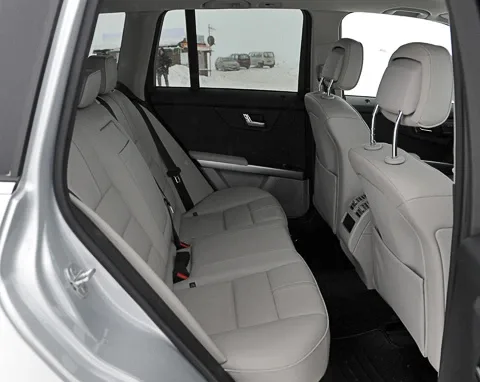
There's no reason to complain about the lack of space in the back. It's a pity only that the backrests don't adjust for recline. But for an extra charge, the GLK can be equipped with three-zone climate control.
Playing the "newbie," I never got into any trouble. Moreover, the Mercedes is comfortable: it pleases with smooth throttle responses, a dense but not too stiff suspension. And the gearbox — with soft shifts.
So, on the road (slippery and not so), the GLK is good. And what about off-road capabilities? We couldn't test them within this test, but the Mercedes people say everything is okay. Do they really think that ESP-based differential lock simulations will work more effectively than honest mechanics? "Come on," says Merker, "most customers won't even use the existing capabilities! If the buyer really needed it, we would have done it."
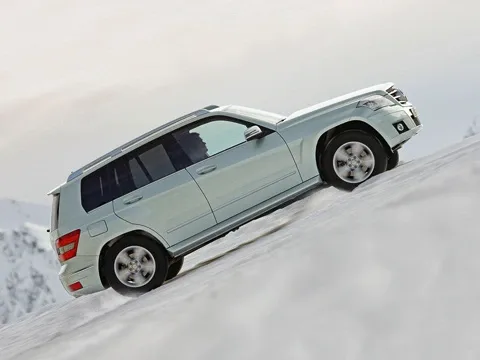
There's no doubt they can: Mercedes has everything necessary for this. And you can't fault the GLK — it gives exactly what you expect from it: comfort, safety, speed. But still, you really want it to give more. As the well-known revolutionary Che Guevara said: "Be realists — demand the impossible."
I went on a test drive of the new compact crossover Mercedes-Benz GLK in the Austrian Alps. The event took place in the town of Hochgurgl at an altitude of about 2000 meters above sea level. The organizers offered us to get from Innsbruck airport to the hotel ourselves, driving all-wheel-drive Mercedes-Benz models. The distance is 100 kilometers: half on the autobahn, half on a mountain road. On the way there, I got a huge R 500 4Matic, and on the way back — an equally huge G 500. The difference is colossal! If on the "R" the journey flew by unnoticed, then behind the wheel of the Gelandewagen I was simply exhausted — both on the mountain serpentine, where heavy steering and brakes prevented relaxation, and on the autobahn, where this "brick" also felt not very confident.