My colleague already had experience driving a fourth-generation Range Rover, but I didn't consider that an advantage. After all, what's the fundamental difference between the third and fourth generations? After so many years, the king is still naked — what has changed? Appearance, trim materials, comfort — that's not all. And then there are the new owners from India... Who really believes that they, having bought Land Rover, will strictly honor the contract for five years and not interfere in the brand's affairs?
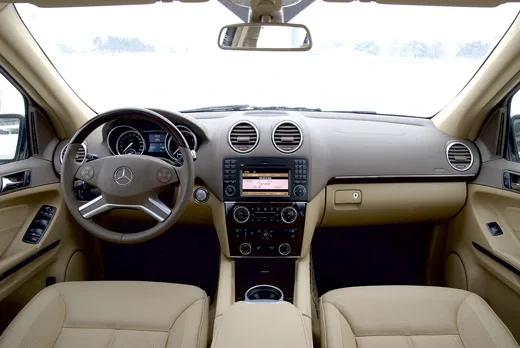
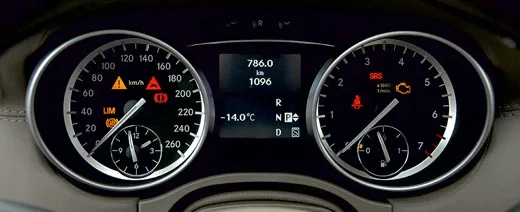
The Mercedes-Benz interior against the Range Rover looks gloomy, rough, and even military
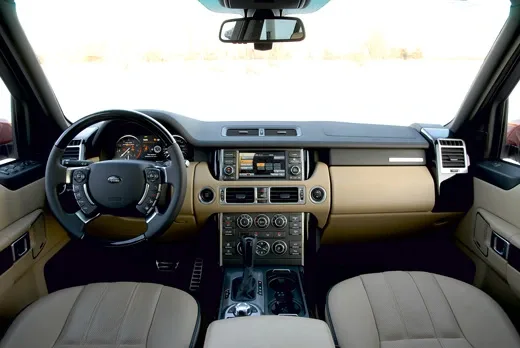
High seating position, like on a captain's bridge, light and comfortable steering wheel, fantastic sunset on the instrument panel — this is all Range Rover
ENGLISH HORSEPOWER
The previous Range Rover was clumsy, heavy, and overly comfortable, more like a bus, and too capricious for real off-road. I remember in a sand quarry near Moscow, I helplessly pressed all the buttons and pedals in the RR with the 4.2-liter Supercharged, but couldn't get it moving — I couldn't find the right sequence of actions. And nearby, a colleague was calmly driving a Lexus LX570...
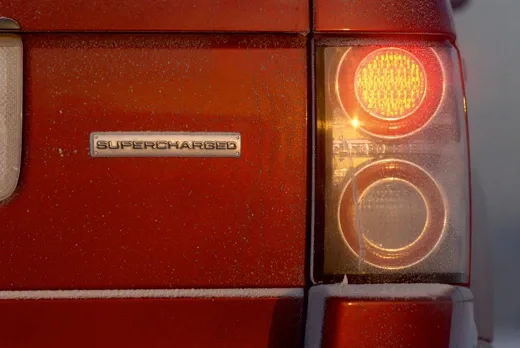
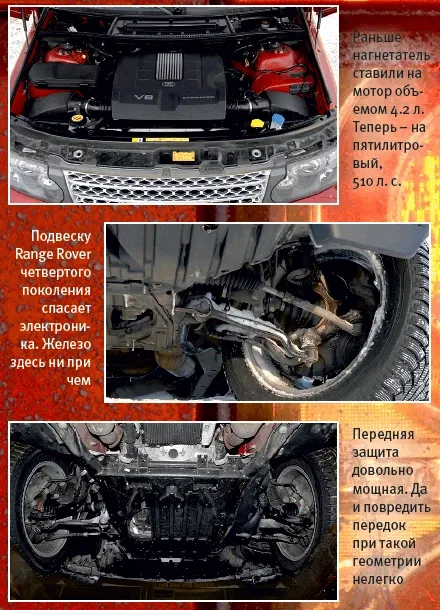
Now the situation has changed dramatically. In the fourth generation, the Range Rover's five-liter engine is supercharged. And it can overtake everyone. The huge displacement combined with the supercharger opens up limitless possibilities. There's so much power that the main problem is not overdoing the gas pedal. But even that isn't scary, because all this incredible English power is now under the control of smart electronics. Perhaps the new program for the traction control system was written by Indian programmers — after the Russians, they're considered the best in the world?
ALL IN THE PAST
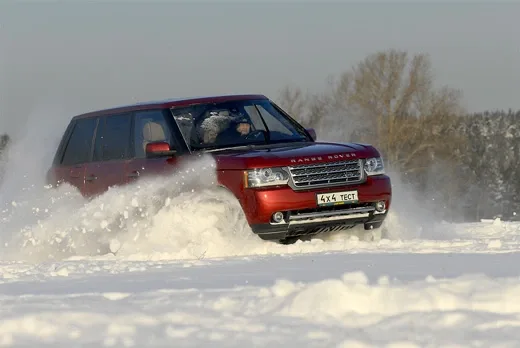
The five-liter supercharged RR is a machine capable of tunneling through rocks. The updated Terrain Response system is so smart that it prevents getting stuck in loose snow, even if the driver presses the gas against common sense. In sand, it definitely wouldn't lose to the Lexus. Innovations are impressive, but that's not enough to beat the Mercedes.
All doubts disappear when you try the Adaptive Dynamics mode in the suspension. It maintains comfort while keeping the suspension under control on any surface — asphalt, sand, snow, or mud. It works great.
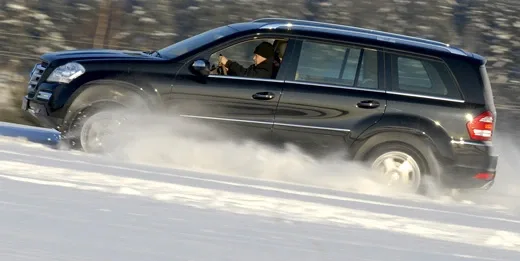
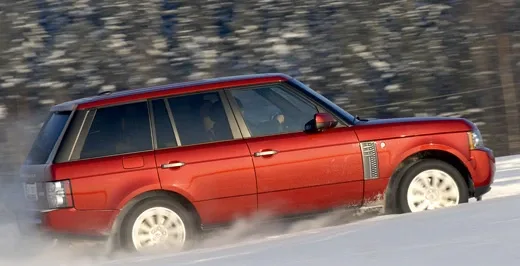
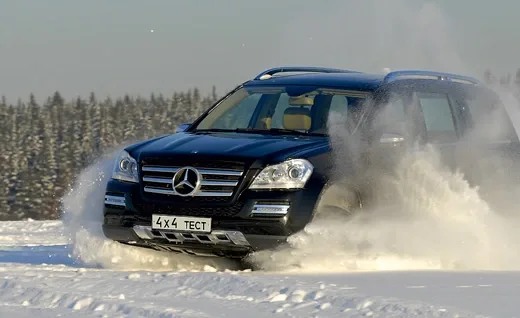
Now it's time to talk about the GL. But what is there to say? Before the test, I was sure of its superiority, but it turned out that the Range Rover is no worse. The German wasn't helped even by the AMG styling package (that's the car that came for the test) with wide wheels. Without it, the GL wasn't exactly shining in directional stability on rough roads, and with it, it outright loses to the Brit — you constantly have to correct the steering.
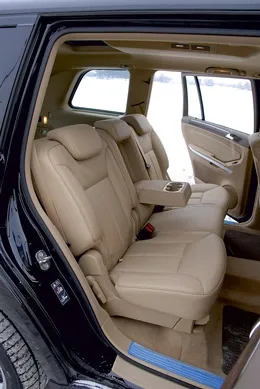
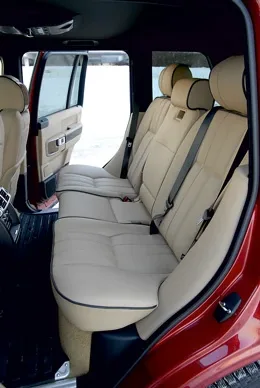
| In the Mercedes-Benz, as always, the rear seats are impeccable | They say the queen rides in a Range Rover. Judging by the rear seats, it's hard to believe |
PURELY GERMAN ARGUMENTS
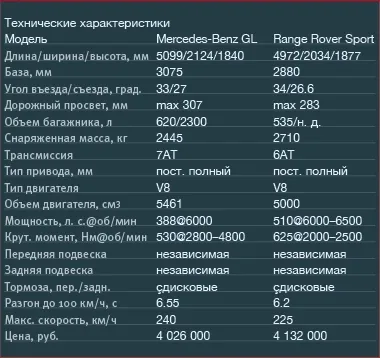
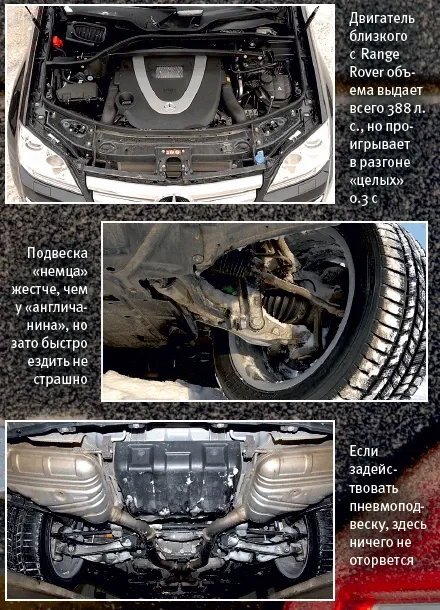
It seems there's nothing to hold against the fourth-generation RR. But if you look, you'll find something. For example, acceleration. The GL reaches 100 km/h in 6.5 seconds, while the Range Rover does it in 6.2. The German achieves the same dynamics with 388 horsepower. The Englishman needs all 510 for a 0.3-second advantage! Such a difference in effort can't go unnoticed. Moreover, the English "turkey" is heavy: the GL is 300 kg lighter. These are the "tasteless" but purely German arguments one has to use for the Mercedes-Benz, which once impressed everyone with its off-road capabilities in its first tests in Russia.
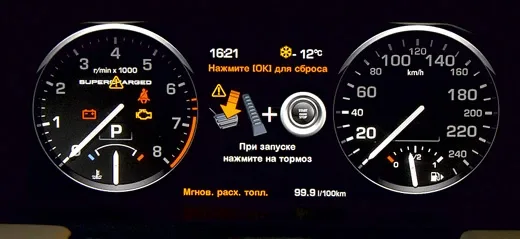
Now the RR is reaping the laurels. It greets the driver with a high seating position and excellent visibility over the edges of the massive square hood. Wraps you in a soft seat. Gives you a light steering wheel, especially pleasant off-road. Shows a Martian sunset on the instrument panel.
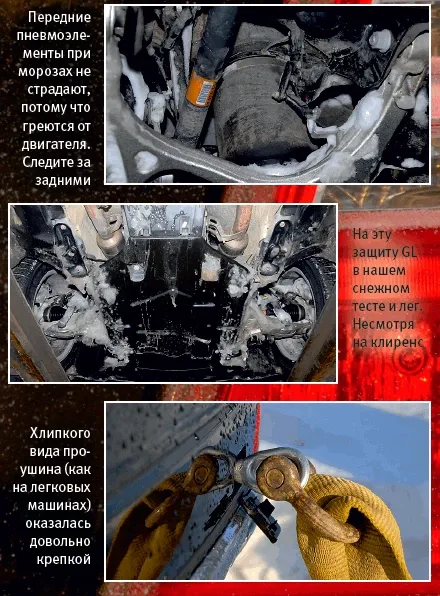
Quickly — in 20 seconds — raises the air suspension to maximum height and invites you to press the gas until the fuel runs out or all the snow under the wheels is gone.
The Mercedes-Benz GL tests you with hard seats. Checks how quickly you can turn the heavy, viscous steering wheel. Takes four and a half times longer to inflate the air springs. And mocks you if you forgot to think before using all the power of the five-liter engine. Despite less power, you need to press the gas pedal in the GL with utmost care. We drove in deep snow, and after a few mistakes, we found the right algorithm: lock second gear in the automatic transmission, engage the center and rear differential locks, turn off ESP. Then it goes. And the RR goes anyway. Just for fun, I tried all combinations...
IT WILL REMIND YOU OF ITSELF
And yet, the more time passed after the test, the more flaws of the RR I remembered. The charm of this sly one is so great that all the shortcomings during the acquaintance are quickly forgotten. How could I not mention that its brakes, compared to the GL, seem oiled? And the acceleration and power are unnecessary because driving faster than 140 km/h is already scary. A natural result for a car with a curb weight of about 2800 kg.

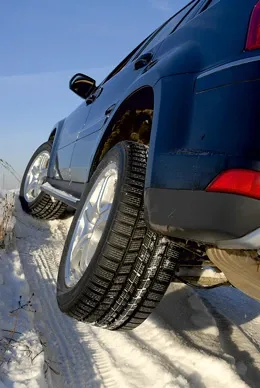
| The Range Rover Sport is hard to deprive of support — the suspension travel is large | The GL is also hard to hang, but because it spins its wheels |
There are also ergonomic misses. The main controls in the cabin are large, well-visible buttons. Trusting the designers, you start pressing them almost blindly without removing thick gloves. But when you need to lower the side window, the mirrors unexpectedly fold — the engineers didn't think that through. And traditional English reliability is a three-word joke. The RR's rear wiper, unable to bear the boredom of the first test day, told us that joke, chuckling.
This upsets me no more than the tomb-like Mercedes-Benz interior in the Reich Chancellery style. That mix of deadly gray, indifferent black, and murky brown. Imagine a gentleman in a black suit, brown shoes, and a gray shirt. Wild.
TECHNICAL DATA: RANGE ROVER
TECHNICAL DATA: MERCEDES-BENZ GL
AND IN THE CAR YOU CAN...
Similar but not quite. The Range Rover against the GL is like an artist of the royal troupe. The texture, color, and trim materials seem from a theatrical costume room. And the TFT screen that replaced the instrument panel displays speed, temperature, and the future. Looking at it, you realize: all disputes about backlighting, readability, size, and design of the speedometer will soon disappear. The driver will set all parameters himself. I, for example, prefer a green background and large numbers across the entire screen, like in a Citroen. Sold the car to a girl — she changed everything to pink and returned the dial-style indication. Everyone will get what they like. Especially if you replace all other functions of the front panel with a touchscreen display, making its mount adjustable. The driver will choose the height and angle convenient for themselves, getting rid of the endless current mistakes of designers and ergonomists. It's high time they decided among themselves what's more important — beauty, convenience, or safety.