Station wagons in Russia, as is well known, are not particularly popular. And the arrival of the new generation Mercedes-Benz C-Class is unlikely to radically change this situation. And that's a pity, because this newcomer from Stuttgart can confidently claim the title of "universal soldier," not only because of its body type, but also in its essence.
What can I say — stereotypes have become too deeply ingrained in us. Seven decades of struggle for a bright socialist future still make themselves felt. Even fifteen years after the collapse of the USSR, post-Soviet euphoria still firmly holds many Russians. How else to explain that, unlike Europe, our desire to show off defeats healthy pragmatism? That's why practical station wagons, which have long conquered half of Europe, are only fighting local battles here. But there is no doubt that with fighters like the new C-Class, the eastern campaign will someday be won. Already in January next year, Mercedes-Benz will bring five new petrol station wagons to the Russian market. These will be C-Class models with two supercharged engines of 1.8 liters and three naturally aspirated ones — 2.5, 3.0, and 3.5 liters. In reserve remain three diesel "soldiers" with volumes of 2148 and 2987 cm³, but they are not yet planned for delivery to us.
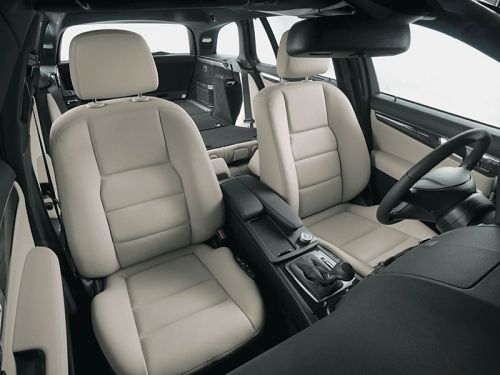
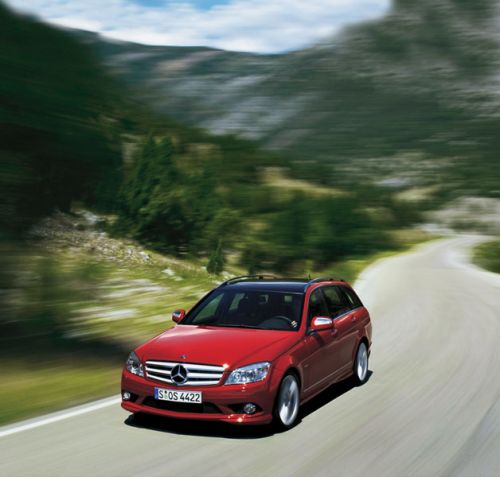
The most interesting of this five seemed to us the 3-liter C 280, which we took for a test in German Mainz. At first glance at the new C-Class, it's clear how seriously the designers worked on both the exterior and the interior. The car's appearance has changed beyond recognition. The new radiator grille, different headlights, fresh bumpers, and modified body shapes have made the "C" more squat, taut, and modern. Inside, it has become even more functional. For example, the navigation monitor is now retractable and has moved to the top of the central console. Elegant lines both inside and outside have noticeably rejuvenated the C-Class, adding aggression. At the same time, it's striking how filigree the engineers from Stuttgart have perfected every detail, achieving harmony of seemingly incompatible elements. Take, for instance, the aerodynamics of the rear: in Stuttgart, they killed two birds with one stone. On one hand, they completely eliminated vibrations typical of station wagons. On the other, they increased the trunk, which now varies from 485 to 1500 liters.
The mass of the towed trailer has increased to 1800 kg. But there is one nuance: the rear suspension of the station wagon, as expected, is noticeably stiffer than the front. So if you plan to frequently tow heavy trailers, it's better to order the "self-leveling suspension" option. Otherwise, it's hard to find fault with the suspension's work — it seems created to please the driver. Adaptive shock absorbers with electronics adjust themselves to the driving style, and depending on the style, the reaction to bumps noticeably changes. The base ground clearance of the C-Class compared to the previous version has even decreased by 15 mm — springs are shorter, torsion bars are thicker. But for our harsh realities, the station wagon will receive a reinforced suspension and increased ground clearance. There's no escape: fighting Russian roads without special preparation for European automotive intelligentsia is suicide. However, the "Russification" of the C-Class is unlikely to spoil its character.
The steering, especially in sport mode, has become slightly sharper than before. Given the traditionally academic nature of both station wagons and Mercedes-Benz as a whole, more is not needed. The wheelbase extended by 45 mm and the ideal 50:50 weight distribution across the axles have benefited handling. Behind the wheel of even the not-most-powerful 3-liter C-Class, I caught myself several times thinking: if you don't look in the mirrors, it's easy to forget you're driving a station wagon. No "wagon-like" aerodynamic vibrations, and the rear suspension doesn't seem overly stiff. The dynamics are also impressive: 231 "horses" accelerate the C 280 to 100 km/h in 7.5 seconds, while the more powerful 3.5-liter unit (272 hp) does it a second faster. Even during engine braking in comfort mode, the 7-speed automatic shifts without torque dips. Forced throttle blips, as on the sporty C 63 AMG, are, of course, absent here. But the C 280 is a universal soldier, not a sports car. Although it has enough sportiness, and at the same time it has a moderate appetite. If you take the entire line of eight new engines, fuel consumption on average decreased by 6%, while power increased by 13%. So, the most promising for Russia, the C 280 and C 350, consume 9.4 and 9.9 liters per hundred in the combined cycle. Agree, for a car of this class and character, that's quite little.
Now the main question: won't the new "universal soldier" from Mercedes-Benz be too expensive for the eastern front? In Europe, the C-Class starts at 37,366 euros. The Russian price has not yet been announced — it will be named closer to winter. But it's clear that redeployment to the east is never cheap.
A spoon is dear when lunchtime is near
Russia is slowly waking up from a long navigation-less sleep. And it's especially pleasant that the ban on GPS was lifted just before the arrival of the new C-Class. It would have been a shame to lose such an option. In 10 years of journalistic work, I've driven about 50,000 km across Europe in various cars with various electronic guides. Among them were real "misleaders" and systems that in accuracy can be compared to missile complexes. But, honestly, I have never encountered such a perfect automotive navigator. It's not even about accuracy or the abundance of options — from Bluetooth to a trainable voice control. The main thing is the ideal combination of all aspects: from a simple and convenient interface to stunning, down-to-the-meter accuracy and many small auxiliary functions. For example, special icons indicate which lane is best to drive in. The only fly in the ointment is the not-so-ideal placement of the control joystick: between the gearbox lever and the armrest.
To each his own
In Russia, as in Europe, the C-Class station wagon will be offered in three trim levels: Classic, Elegance, and Avantgarde. Avantgarde, with the brand's traditional huge three-pointed star in the center of the grille, emphasizes the aggressive character of the C-Class. The three-dimensional glossy grille of Elegance, on the contrary, emphasizes comfort and luxury. Classic is deliberately restrained and symbolizes loyalty to Mercedes-Benz traditions. Any of the modifications can be ordered with the AMG sport package, which includes 17-inch 6-spoke wheels, a three-spoke steering wheel, sport front seats, and an AMG rear body kit.
Driving
A very smart car that easily adapts to the driver's control style.
Interior
Having gotten rid of the baroque-style wooden inserts, the C-Class has noticeably rejuvenated, but has not changed in quality.
Comfort
Three-zone climate control, new seats, and excellent sound insulation allow us to confidently give the highest rating.
Safety
The body frame consists of almost 70% high-strength steel, the cabin has seven airbags and a whole arsenal of auxiliary electronics that have moved here directly from the brand's luxury models.
Price
Mercedes-Benz has never been a car for the masses, so it's hardly worth expecting the new C-Class to be cheaper than its main rivals.
2008 Mercedes-Benz estate C 280
© Photo: Mercedes-Benz
| Dimensions, mm | 4596/1770/1459 |
| Engine | petrol, 2996 cm3, 231 hp/6000 rpm |
| Transmission | automatic, 7-speed |
| Dynamics 0-100 km/h, s | 7.5 |
| Maximum speed, km/h | 240 |
| Competitors | BMW 3-series Touring, Audi A4 Avant |
Advantages and disadvantages
+ Fresh ContiSportContact 3 tires seem specially selected for this car.
- The accelerator pedal is not very informative — it will take time to get used to it.
Our opinion
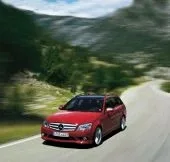
2008 Mercedes-Benz estate C 280
© Photo: Mercedes-Benz
This car is equally good in long trips and in calm city bustle. The strong but at the same time somewhat accommodating character of the C-Class breaks the usual stereotypes about station wagons. For Russia with its post-Soviet complexes, this is especially important. However, with all its advantages, this station wagon cannot yet count on bestseller status in the Russian market.
31 October 2007
Author: Vladimir Makkaveev
© 5 Koleso