
| The term C-class only caught on by 1993. That was when four trim options appeared: Classic, Elegance, Avantgarde, and Esprit, which did not survive to our days. Moreover, for the first time, the appearance of the C-class directly depends on the chosen version. The main feature of Avantgarde is the radiator grille with wide slats and a large three-pointed star in the center (like on the brand's sports models), plus the AMG package: suspension lowered by 15 mm, sports seats, aerodynamic body kit, aluminum pedals, and perforated brake discs. Elegance and Classic look more modest — a classic grille and no body kit even for an extra charge. The resemblance to the S-class is certainly discernible, but the younger model is, of course, not as massive. |
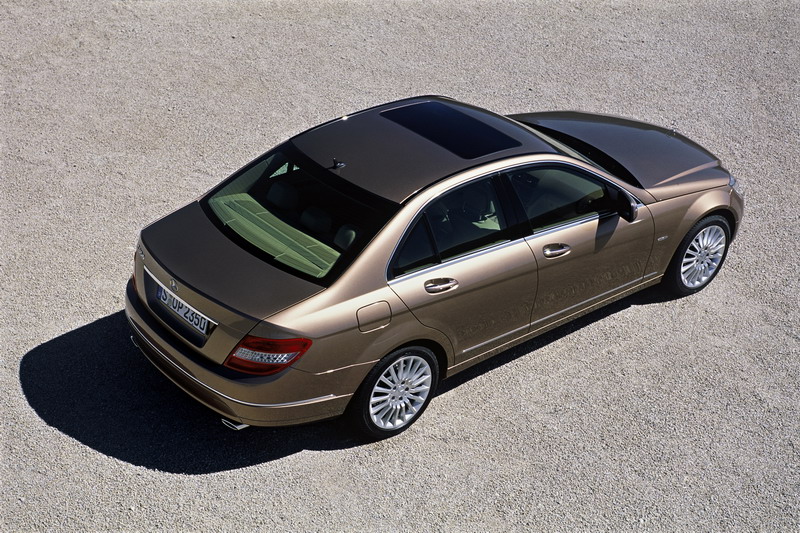 Compared to its predecessor W203, the new model is larger and has lost its former refinement. However, the proportions remain the same. Graceful lines have appeared on the sides, visually stretching the body. The front headlights have acquired more square contours, and the massive rear LED lights extend deep into the fenders, touching the side lines with their upper edge. Compared to its predecessor W203, the new model is larger and has lost its former refinement. However, the proportions remain the same. Graceful lines have appeared on the sides, visually stretching the body. The front headlights have acquired more square contours, and the massive rear LED lights extend deep into the fenders, touching the side lines with their upper edge. |
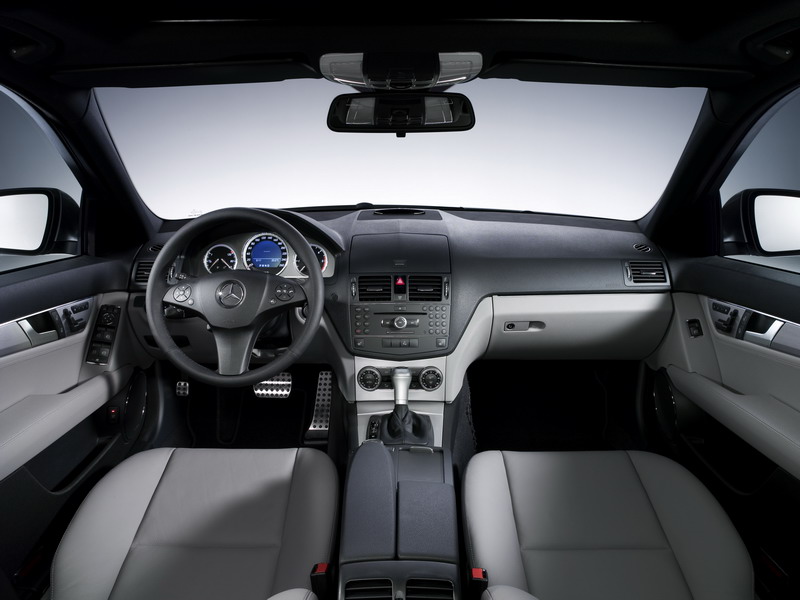 The interior greets you with a two-tone design that harmonizes perfectly with aluminum inserts in Avantgarde or wooden ones in Elegance and Classic. In the center of the front panel, behind a folding lid, hides a 4.9-inch color screen for the information system and navigation (in versions with Command APS multimedia — a 7-inch one, with voice control and a music server). Control is via a round joystick on the center tunnel or buttons on the left side of the steering wheel. The interior greets you with a two-tone design that harmonizes perfectly with aluminum inserts in Avantgarde or wooden ones in Elegance and Classic. In the center of the front panel, behind a folding lid, hides a 4.9-inch color screen for the information system and navigation (in versions with Command APS multimedia — a 7-inch one, with voice control and a music server). Control is via a round joystick on the center tunnel or buttons on the left side of the steering wheel. |
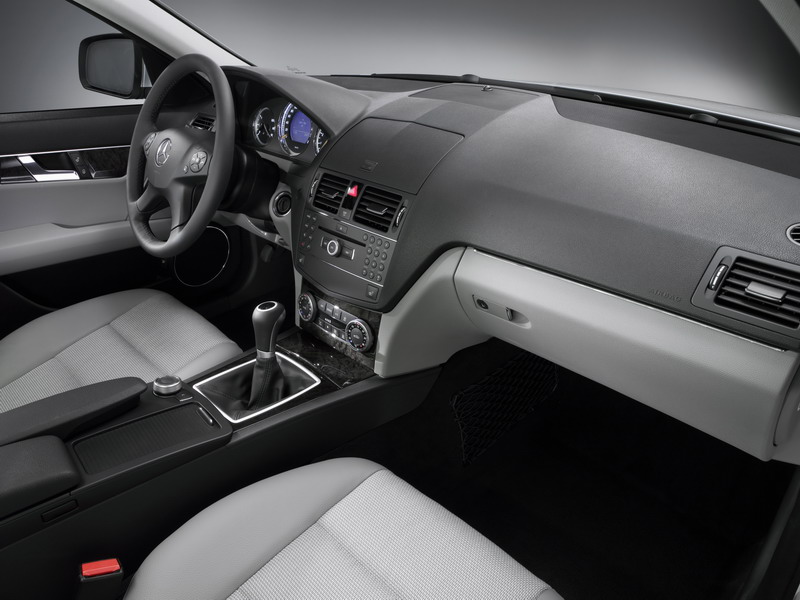 The ergonomics are exemplary. You sit in a German-comfortable seat, and everything seems familiar, as if you've driven this car all your life. The three-spoke leather multifunction steering wheel practically begs to be held. The round instruments, especially the large central speedometer, are perfectly readable. The floor-mounted gas pedal with a short travel — pressing it to kick-down is a breeze (unlike many modern cars). The build quality is impeccable. The ergonomics are exemplary. You sit in a German-comfortable seat, and everything seems familiar, as if you've driven this car all your life. The three-spoke leather multifunction steering wheel practically begs to be held. The round instruments, especially the large central speedometer, are perfectly readable. The floor-mounted gas pedal with a short travel — pressing it to kick-down is a breeze (unlike many modern cars). The build quality is impeccable. |
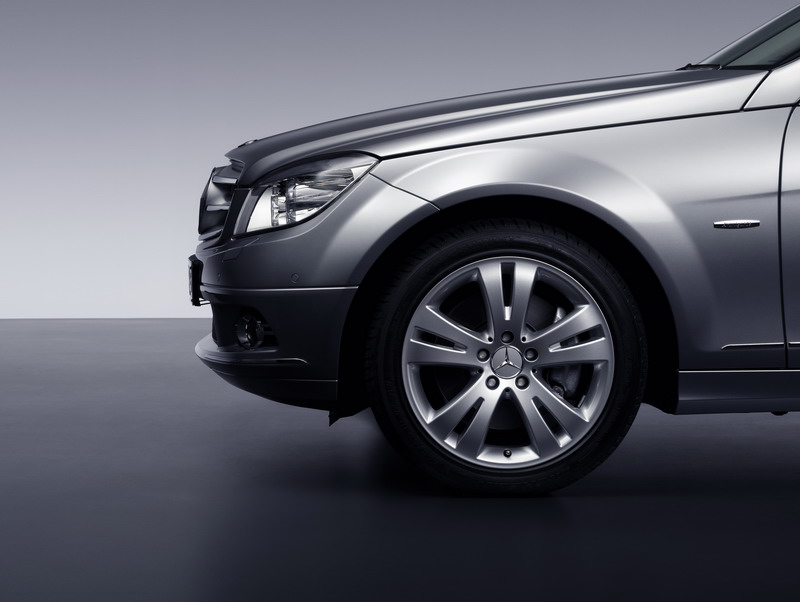 What has changed in road behavior? To find out, I went on a test drive organized by the DaimlerChrysler representative office. The route ran through the city and highway, and ended with a stage at the Dmitrov test track, where the sedan was to be tested in extreme modes. What has changed in road behavior? To find out, I went on a test drive organized by the DaimlerChrysler representative office. The route ran through the city and highway, and ended with a stage at the Dmitrov test track, where the sedan was to be tested in extreme modes. My choice — Mercedes C200 Kompressor in Elegance trim, the most affordable at the time (the less powerful C180 Kompressor was expected to appear at dealers in the fall). It was the 4-cylinder engines that changed noticeably, while the "sixes" (2.8 L and 3.5 L) remained unchanged. The C230 version (V6, 2.5 L, 204 hp, 245 Nm) was also expected in Russia by fall. The power of the 1.8-liter supercharged engine of the C200 increased by 20 hp — to 184 hp at 5500 rpm, torque — 250 Nm from 2800 rpm. The dynamics don't take your breath away, but allow you to feel confident on the road. Plus, there are obvious advantages: compared to the V6, less weight and fuel consumption. |
| The new C-class is like two cars in one. In calm mode, it carries you with the usual Mercedes smoothness, barely communicating the quality of the road surface. The 5-speed automatic meanwhile shifts gears leisurely and imperceptibly. But the "baby Benz" is also ready for mischief. A couple of movements of the automatic gearbox lever to the left — I drop a couple of gears, rev the engine to 6500 rpm, which the supercharger happily accompanies, and I fly up to the corner. A slight turn of the steering wheel (ratio 14.5:1, about 2.7 turns from lock to lock) — and the car enters the turn... astonishingly, how easily the C-class goes along the arc, almost without body roll! Thanks to the new Agility Control suspension, which changes the stiffness of the shock absorbers depending on the driving mode. Any overtaking or lane change in this Mercedes is a pleasure, the power reserve is quite sufficient. Previously, such "sportiness" was not inherent in the C-class, although comfort has not suffered much. The car has become stiffer and sharper in reactions, but in normal conditions — a familiar picture for Mercedes-Benz. |
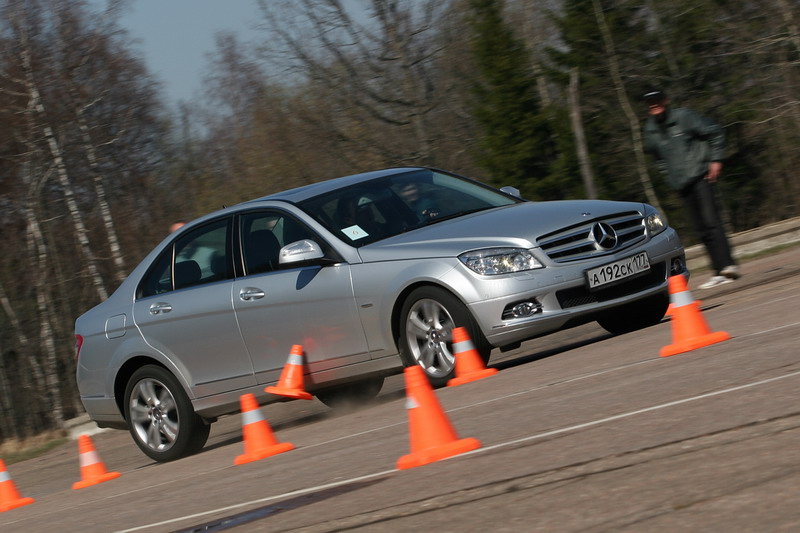 Finally, the test track, where I am to get acquainted with the 6-cylinder versions. It was raining, which, in my opinion, only helped to "understand" the car. The organizers prepared four exercises for journalists: the "moose" test, simulating an obstacle avoidance during braking (for example, when you don't have time to notice the tail of a "traffic jam"), driving a small "ring" with turns of varying steepness and a "slalom", as well as a separate "slalom" on "basalt" surface. Finally, the test track, where I am to get acquainted with the 6-cylinder versions. It was raining, which, in my opinion, only helped to "understand" the car. The organizers prepared four exercises for journalists: the "moose" test, simulating an obstacle avoidance during braking (for example, when you don't have time to notice the tail of a "traffic jam"), driving a small "ring" with turns of varying steepness and a "slalom", as well as a separate "slalom" on "basalt" surface. The obstacle avoidance was performed during braking from about 120 to 80 km/h. ABS, Adaptive Brake (the system pre-builds pressure in the brakes during sudden throttle release, "presses" the pedal for weak drivers, and dries the pads on wet roads) and ESP immediately came into play. The new model borrowed the electronics from the S-class, so it works flawlessly. The anti-lock braking system does not transmit vibration to the pedal, and deceleration on slippery surfaces is confident. |
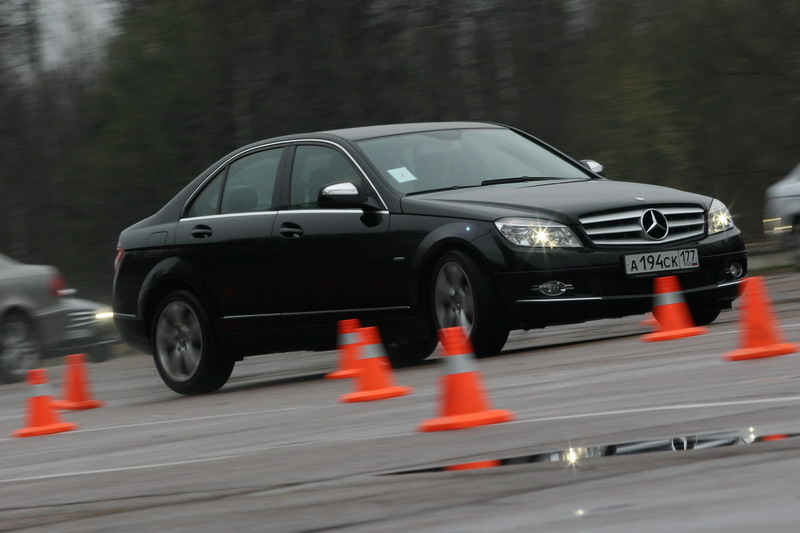 During emergency braking, the C-class responds sensitively to steering wheel turns. If you sharply press the brake pedal, the car will warn those behind by flashing the brake lights, and after stopping, it will automatically turn on the hazard lights. During emergency braking, the C-class responds sensitively to steering wheel turns. If you sharply press the brake pedal, the car will warn those behind by flashing the brake lights, and after stopping, it will automatically turn on the hazard lights. ESP works unobtrusively — sometimes it's impossible to understand whether the electronics intervened — but effectively, as confirmed by the "slalom" on "basalt". It's unlikely you'll be able to drive it faster with the system turned off: that requires the skills of a sports pilot. And with the stabilization system, even a novice can confidently perform such an exercise. |
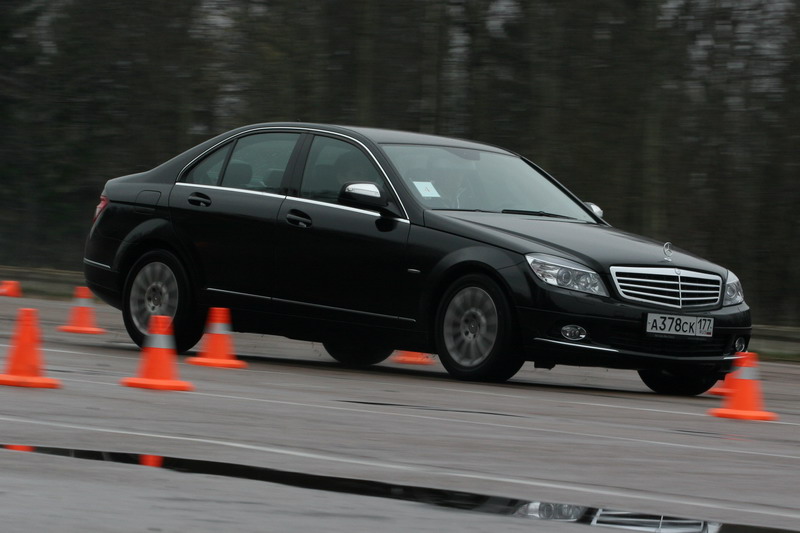 The "moose" test involved two tasks: to avoid the "moose" and to evaluate the operation of the Pre-Safe preventive safety system, which the C350 is equipped with as standard, and other versions — for an extra charge. When a potential emergency situation is detected, Pre-Safe "tightens" the seat belts, brings the passenger seat to an optimal position, and closes the windows and sunroof, leaving gaps for the gases released by the pyrotechnics of the airbags (there are seven of them). The "moose" test involved two tasks: to avoid the "moose" and to evaluate the operation of the Pre-Safe preventive safety system, which the C350 is equipped with as standard, and other versions — for an extra charge. When a potential emergency situation is detected, Pre-Safe "tightens" the seat belts, brings the passenger seat to an optimal position, and closes the windows and sunroof, leaving gaps for the gases released by the pyrotechnics of the airbags (there are seven of them). |
| After the runs on the small ring track, where I had the chance to accompany the C280 and C350, I was finally convinced: for the trip to Dmitrov, the C200 Kompressor was the ideal choice. If you need crystal-clear handling, the lighter C-class is exactly that. Of course, the six-cylinder cars have their own significant trump card — excellent dynamics. |
| Returning to Moscow with a charge of vigor and a load of positive emotions, I pondered who to prefer when choosing between the modern BMW 3 Series, Audi A4, and the new C-class. And I came to the conclusion that my favorite is the Mercedes. That is if comparing the 320i, C200, and A4 2.0. Of course, in the fall, all-wheel-drive versions will appear, as well as the Advanced Agility sport package with the option to choose sport or comfort modes for the electronics, gearbox, and suspension. That is, the C-class will appear in even more refined variants. But the competitors will be different then... |
| PRICES AND TRIM LEVELS Mercedes C-class offers buyers three gasoline engines: a supercharged 1.8-liter "four" producing 184 hp (C200 Kompressor), as well as two V-shaped "sixes" — 3.0 L with 231 hp (C280) and 3.5 L with 272 hp (C350). For the C200, a 6-speed manual gearbox and a 5-speed automatic are available; the C280 has the same manual or the 7G-Tronic automatic, while the C350 is equipped exclusively with a 7-speed automatic. The lineup of versions includes Classic, Elegance, and Avantgarde trims. The starting price for the C200 Kompressor in the base Classic is ?34,100, while the top C350 Avantgarde starts at ?47,800. The Elegance equipment includes 16-inch alloy wheels (Avantgarde has 17-inch), tires 205/55/R16 and 225/45/R17 respectively, aluminum side moldings, a central armrest for rear passengers, a leather-wrapped multifunction steering wheel, a 4.5-inch display in the instrument panel, a gray radiator grille with chrome inserts (Avantgarde has a matte silver one with chrome and the Mercedes star), special interior lighting, fog lights in a chrome frame with a double slat, a leather gear lever, protective overlays, chrome trim on the trunk lid, and wooden inserts in the interior (in Avantgarde they are replaced by aluminum). In the fall of 2007, modifications with 1.8 L engines producing 156 hp (C180 Kompressor) and 2.5 L with 204 hp (C230) are expected to appear on the Russian market, as well as all-wheel-drive 4-Matic versions and the Advanced Agility sport package. |
Vitamin C
Mercedes-Benz 190E came into existence a quarter of a century ago, in 1982. Thus, a new compact class was born in the Mercedes-Benz model lineup, which over time became the best-selling.
Test drive photos
Comments
No comments yet. Say the first word.