|
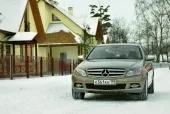 Owning a Mercedes is not just about having a car, but a whole social marker, a kind of ticket to a closed club of the chosen ones. People around react to the mention of this brand with reverent awe, comparable to how the heroes of the cult film "Kin-Dza-Dza" perceived a man in yellow pants — "ku" twice, and nothing else. It seems this aura of greatness weighs not only on the public, but also on the drivers themselves, so much so that, according to our editor-in-chief, most of them are deeply indifferent to the nuances of the car's behavior on the road — in their snobbery, they simply do not stoop to such trifles. Owning a Mercedes is not just about having a car, but a whole social marker, a kind of ticket to a closed club of the chosen ones. People around react to the mention of this brand with reverent awe, comparable to how the heroes of the cult film "Kin-Dza-Dza" perceived a man in yellow pants — "ku" twice, and nothing else. It seems this aura of greatness weighs not only on the public, but also on the drivers themselves, so much so that, according to our editor-in-chief, most of them are deeply indifferent to the nuances of the car's behavior on the road — in their snobbery, they simply do not stoop to such trifles. |
 It's hard to argue with that — most lucky ones behind the wheel of a Mercedes are quite content to observe the world through the iconic star on the hood, enjoying comfort, smoothness, and silence in the cabin. Their happiness does not depend on whether they understand the difference between understeer and oversteer. But, as usual, there are exceptions to every rule, and even in the most respectable circles, there are originals. It's worth remembering that Mercedes has had truly sporty models. It's hard to argue with that — most lucky ones behind the wheel of a Mercedes are quite content to observe the world through the iconic star on the hood, enjoying comfort, smoothness, and silence in the cabin. Their happiness does not depend on whether they understand the difference between understeer and oversteer. But, as usual, there are exceptions to every rule, and even in the most respectable circles, there are originals. It's worth remembering that Mercedes has had truly sporty models. |
 Without delving into history like the 300 SL, and limiting ourselves to classic sedans, let's recall the magnificent E500 in the W124 body — a fast, sharp, and obedient car. And as for the AMG versions, there's nothing to say — they compete on equal terms with BMW M and Audi RS. Among fans of the Stuttgart brand, of course, there are also active drivers — those who "understand" — most often these are relatively young people by Mercedes standards. And when the new generation of the C-Class came out last year, the Stuttgart folks, it seems to me, made a bow in their direction. They killed two birds with one stone: they created a car that became much more interesting both in design and handling, and gave those who previously hesitated to buy due to insufficient "liveliness" of the steering the opportunity to join the "Mercedes club" for quite reasonable money. Without delving into history like the 300 SL, and limiting ourselves to classic sedans, let's recall the magnificent E500 in the W124 body — a fast, sharp, and obedient car. And as for the AMG versions, there's nothing to say — they compete on equal terms with BMW M and Audi RS. Among fans of the Stuttgart brand, of course, there are also active drivers — those who "understand" — most often these are relatively young people by Mercedes standards. And when the new generation of the C-Class came out last year, the Stuttgart folks, it seems to me, made a bow in their direction. They killed two birds with one stone: they created a car that became much more interesting both in design and handling, and gave those who previously hesitated to buy due to insufficient "liveliness" of the steering the opportunity to join the "Mercedes club" for quite reasonable money. |
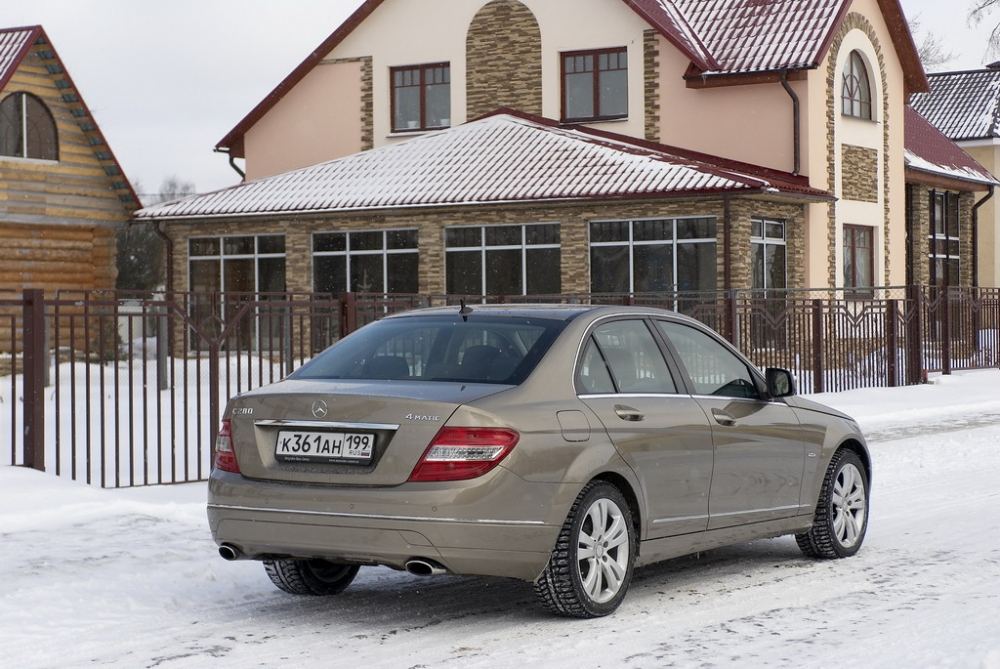
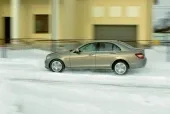 This spring, sales of all-wheel-drive versions of the C-Class started in Russia — the C280 and C350 modifications. They received the latest generation 4Matic system, which debuted a year earlier on the flagship S-Class. The transfer case here is combined with the 7G Tronic hydromechanical transmission in one housing and uses a common lubrication system — unlike the previous all-wheel-drive scheme that was installed on the "C" until 2006. As a result, the design became lighter and more compact: the all-wheel-drive C-Class is only 65 kg heavier than the rear-wheel-drive one. Mechanical losses and noise levels also decreased. Mercedes engineers claim that 4Matic can easily withstand a mileage of up to 300,000 km. The cylindrical center differential distributes torque in a 55:45 ratio favoring the rear axle, and the functions of free differentials are taken over by the 4ETS (Electronic Traction System), which brakes one or two wheels. This spring, sales of all-wheel-drive versions of the C-Class started in Russia — the C280 and C350 modifications. They received the latest generation 4Matic system, which debuted a year earlier on the flagship S-Class. The transfer case here is combined with the 7G Tronic hydromechanical transmission in one housing and uses a common lubrication system — unlike the previous all-wheel-drive scheme that was installed on the "C" until 2006. As a result, the design became lighter and more compact: the all-wheel-drive C-Class is only 65 kg heavier than the rear-wheel-drive one. Mechanical losses and noise levels also decreased. Mercedes engineers claim that 4Matic can easily withstand a mileage of up to 300,000 km. The cylindrical center differential distributes torque in a 55:45 ratio favoring the rear axle, and the functions of free differentials are taken over by the 4ETS (Electronic Traction System), which brakes one or two wheels. |
 How does all this behave on the road? How does all this behave on the road?
|
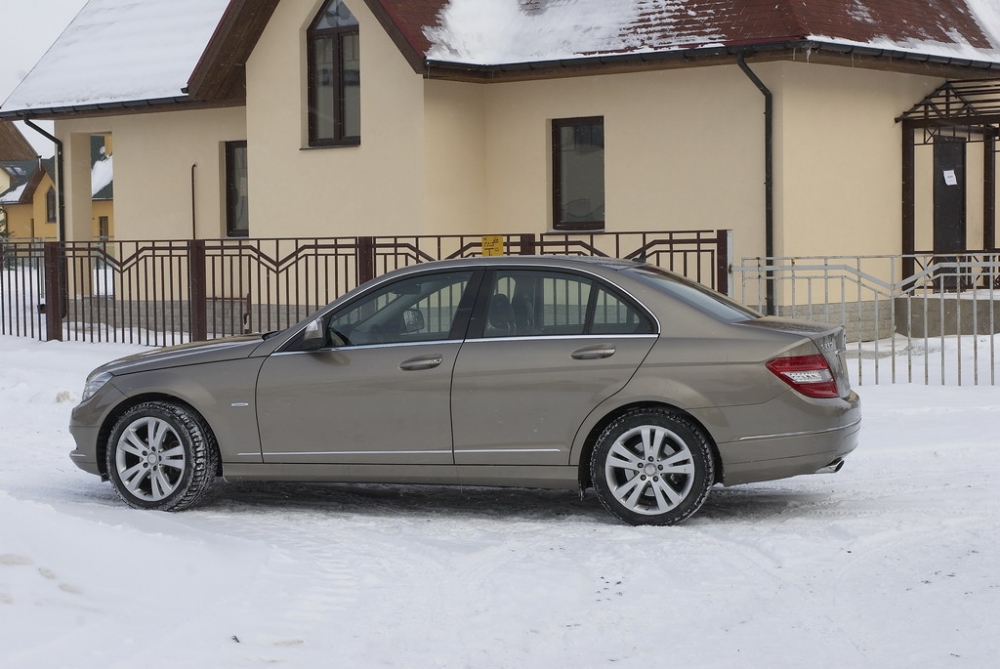
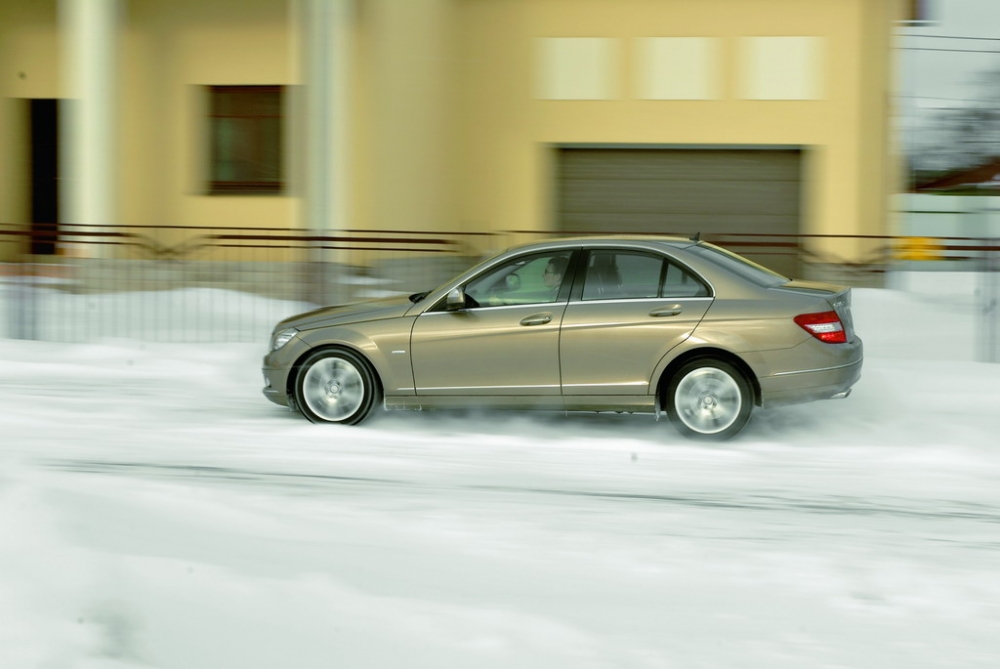
If the rear-wheel-drive C-Class seemed too lightweight and playful to someone, although in fact it only became more precise and sharper in reactions, then the 4Matic version looks like a much more classic "Mercedes" in the usual sense. On slippery and uneven roads, this car amazes with its calmness and stability. Where the rear-wheel-drive "C" tirelessly blinks the yellow ESP triangle on the dashboard, the all-wheel-drive version maintains astonishing composure. Nothing bothers it: neither the snowy-reagent slush on Moscow avenues, nor icy sections on suburban highways. It gives exactly that feeling of reliability for which cars from Stuttgart are valued.
Of course, the C280 4Matic starts off much more confidently. Whatever the surface under the wheels, this confidence turns into persistent straight-line acceleration that does not require steering corrections. But here's the trouble: more confident does not mean faster. Although according to the specs, acceleration to 100 km/h for the all-wheel-drive version is only a couple of tenths longer than for the regular rear-wheel-drive one, it feels much calmer. And it's not just about the increased mass. The compact transfer case is not designed for torque exceeding 700 Nm, so it was decided to limit it to this level already after the first gear. Moreover, it seemed to me that the engineers did not do without reflashing the "brains" of the 7G-Tronic automatic transmission. In any case, the shifts have become smoother, and neither sport nor manual modes provide the desired sharpness and speed. The gearbox works measuredly, without unnecessary fuss. In a word — Mercedes.
The front suspension of all-wheel-drive "C" models uses different arms and steering knuckles. To compensate for the weight of the front drive, stiffer springs and shock absorbers had to be installed. And to accommodate the front axle reduction gear, the steering rack was moved 7 centimeters forward. It seems like a trifle, but these changes noticeably affected the character of the C-Class. First of all, this concerns the cleanliness and transparency of the steering. Unfortunately, with the advent of 4Matic, that clarity and responsiveness of the steering wheel, which pleased so much a year ago during the test of rear-wheel-drive models at the Dmitrovsky test site, disappeared. At low speeds (up to about 40 km/h), there is no reactive force at all. It gets to the point that during slow maneuvers, you have to return the steering wheel to zero yourself.
With increasing speed, feedback appears, but it seems somehow artificial, not real. This again encourages calm, measured driving — you roll along to your dacha, not thinking about what is under the wheels: asphalt, snow, or water, and lazily turn the multimedia system knob. Could it be that with the release of all-wheel-drive versions of the C-Class, the Stuttgart folks themselves got scared of excessive sportiness and decided to tame the "C"? That was hardly their main goal. Most likely, this is simply an inevitable price for 4x4 drive. After all, the Agility Control suspension is still magnificent. Elastic and composed, with moderate body rolls in corners, it still maintains the comfort in the cabin that is expected of a car with a three-pointed star. Rarely do you find such a successful compromise. Moreover, the 4Matic itself can bring a lot of pleasure to an experienced driver.
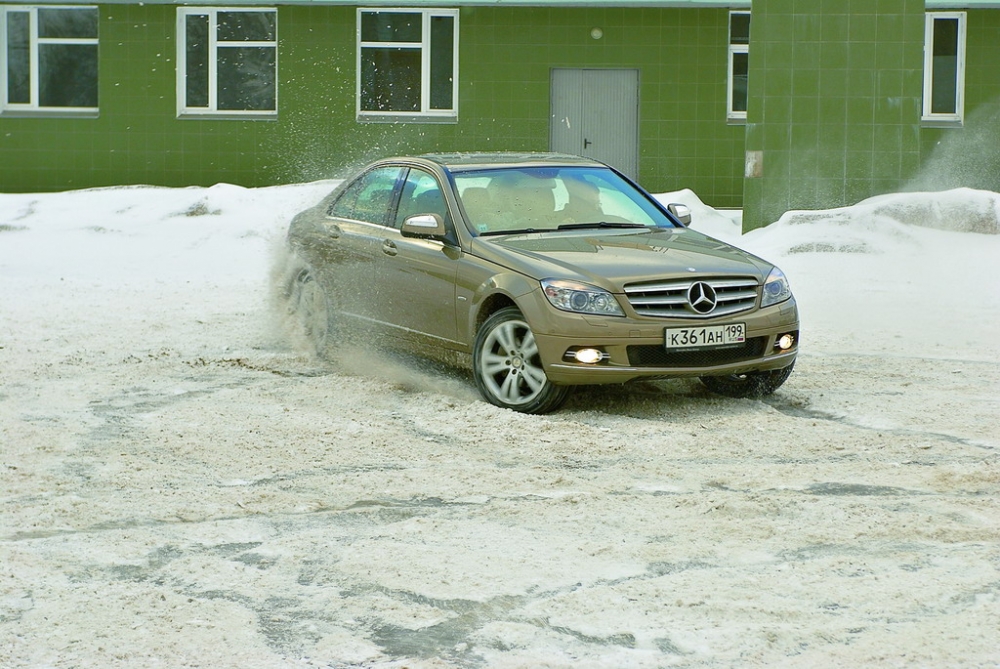
Forward, to the huge snowy area! I note that the ESP system is also borrowed from the senior S-Class. Its main features are the ability to intervene very correctly, almost imperceptibly, in the process of stabilizing the car at a critical moment (when it is enabled) and quite a lot of freedom of action in the partial shutdown mode. In practice, this means that the 4Matic with ESP off calmly allows you to drive in slides. If the situation gets out of control, ESP, of course, will pull the car back. But if you do everything right — slightly turn the steering wheel into the turn and slightly open the throttle — you can drive in a drift under power for a very long time. Surprisingly, without having a rear torque-vectoring differential (like on the Mitsubishi Evo or BMW with new xDrive), the 4Matic is also capable of accelerating out of a drift. The main thing is not to jerk the steering wheel and not to touch the brake, otherwise ESP will wake up and ruin all the fun.
But again a reasonable question arises: does the Mercedes owner need all this? Maybe he is satisfied with the confidence and safety that all-wheel drive provides on our nine months of terrible roads a year? But then why not take a comparable crossover? Or maybe what matters to him is what was mentioned at the beginning of the article — "reliability, quality, solidity, self-confidence, prestige"? No, perhaps, choosing the C-Class 4Matic, he gets both. Plus a touch of exclusivity — after all, not many all-wheel-drive "Mercedes" are sold here. And if the owner is also a bit "non-traditional" (in the sense of automotive preferences and driving skills, of course), then on a safe area or on snowy deserted winding roads, he will get a lot of joy precisely from driving this very "firmatik"…
The first all-wheel drive 4Matic appeared in Mercedes models E260, E300, and E300 D on the W124 platform in 1987. The transfer case worked on two hydraulically controlled clutches. In essence, it was that very principle of torque on demand, which today is familiar to every crossover owner. However, the mechanics worked differently: the transmission itself selected one of four modes, based on signals from ABS sensors and a steering angle sensor.
In the first mode, all 100% of the torque went to the rear axle, in the second — 65% remained at the rear, in the third — the torque was divided equally, 50:50, and in the fourth, the rear differential lock ASD was additionally engaged. If the ABS was activated, the all-wheel drive immediately turned off. During acceleration, the front wheels were always engaged, even if the rear ones were not slipping. The system was produced in two series — from 1987 to 1991 and from 1992 to 1997, and they differed in the way the front drive was disengaged. Neither version could boast reliability. Due to constant lockups and sharp redistribution of torque, the transmission experienced overloads, which required stronger, and therefore heavier and more expensive parts. As a result, in 1997, the system was abandoned.
The next generation of 4Matic debuted on the E-Class W210 in 1998. It was developed jointly with the Austrian company Steyr-Daimler-Puch. This was already a full-fledged permanent all-wheel drive: on passenger models (except C and S classes), the torque was divided in a 60:40 ratio in favor of the rear wheels, and on GL, ML, and R — equally, 50:50. The main feature of this version is the rejection of locks for the center and cross-axle differentials in favor of the 4ETS (Electronic Traction System) traction control system. It brakes the spinning wheels, simultaneously transferring torque to those that have better grip. The 4ETS itself is integrated into the ESP stability control system.
ESP collects data from ABS sensors, wheel angle sensors, the vehicle's yaw rate, and lateral acceleration, after which it distributes braking forces or adjusts torque, keeping the car in a stable position. After modernization in 2002 (version 4ETS+), this scheme is still used on most Mercedes models.
The test Mercedes C280 received the latest, newest version of 4Matic — the same one installed on the flagship S-Class. The principle remained the same, but the Austrians from Steyr-Daimler-Puch were no longer involved in the development. However, important changes appeared. Instead of a free center differential, a differential with partial locking via a multi-disc clutch is now installed, and the torque is distributed in a 55:45 ratio in favor of the rear axle. If in a turn or on uneven surfaces the difference in torque between the front and rear axles exceeds 50 Nm, the clutch begins to slip, and 4ETS comes into play.
Unlike the previous scheme, the transfer case is now combined with the gearbox into a single unit, and the front wheel drive shaft is pressed as close as possible to the gearbox housing. This made it possible not to touch the central tunnel of the body. To reduce noise, the transfer case gears were made with a more oblique tooth. Previously, an all-wheel-drive Mercedes was 105 kg heavier than a single-drive one; now the difference has been reduced to 65 kg. The difference in fuel consumption has also decreased — from 1.1 to 0.3 liters. In the near future, the new version of 4Matic is promised to be installed on the GLK crossover and the next-generation E-Class.

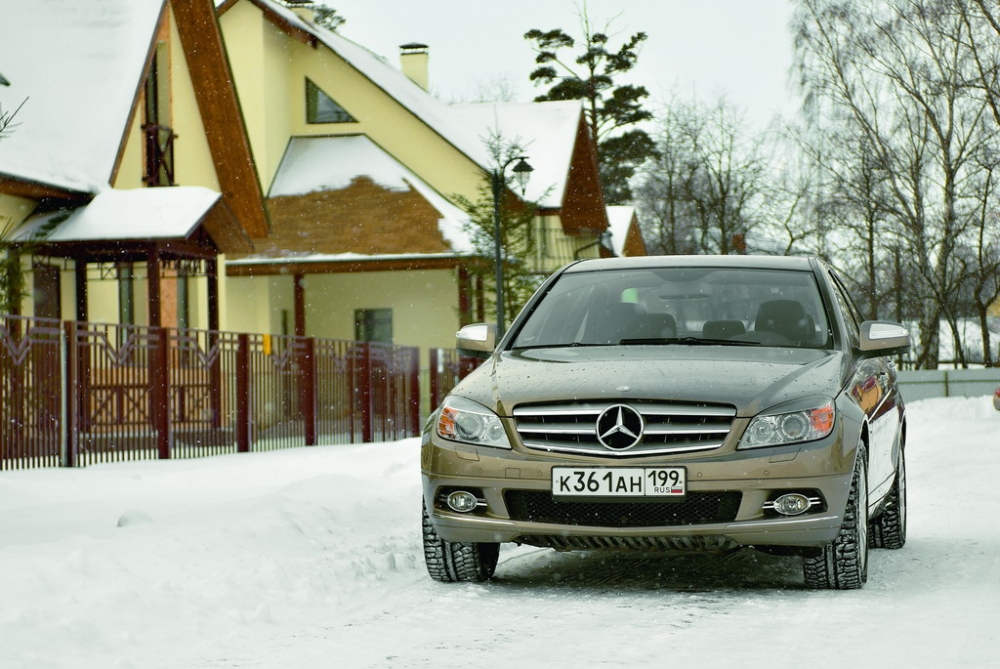 Owning a Mercedes is not just about having a car, but a whole social marker, a kind of ticket to a closed club of the chosen ones. People around react to the mention of this brand with reverent awe, comparable to how the heroes of the cult film "Kin-Dza-Dza" perceived a man in yellow pants — "ku" twice, and nothing else. It seems this aura of greatness weighs not only on the public, but also on the drivers themselves, so much so that, according to our editor-in-chief, most of them are deeply indifferent to the nuances of the car's behavior on the road — in their snobbery, they simply do not stoop to such trifles.
 It's hard to argue with that — most lucky ones behind the wheel of a Mercedes are quite content to observe the world through the iconic star on the hood, enjoying comfort, smoothness, and silence in the cabin. Their happiness does not depend on whether they understand the difference between understeer and oversteer. But, as usual, there are exceptions to every rule, and even in the most respectable circles, there are originals. It's worth remembering that Mercedes has had truly sporty models.
 Without delving into history like the 300 SL, and limiting ourselves to classic sedans, let's recall the magnificent E500 in the W124 body — a fast, sharp, and obedient car. And as for the AMG versions, there's nothing to say — they compete on equal terms with BMW M and Audi RS. Among fans of the Stuttgart brand, of course, there are also active drivers — those who "understand" — most often these are relatively young people by Mercedes standards. And when the new generation of the C-Class came out last year, the Stuttgart folks, it seems to me, made a bow in their direction. They killed two birds with one stone: they created a car that became much more interesting both in design and handling, and gave those who previously hesitated to buy due to insufficient "liveliness" of the steering the opportunity to join the "Mercedes club" for quite reasonable money.
 This spring, sales of all-wheel-drive versions of the C-Class started in Russia — the C280 and C350 modifications. They received the latest generation 4Matic system, which debuted a year earlier on the flagship S-Class. The transfer case here is combined with the 7G Tronic hydromechanical transmission in one housing and uses a common lubrication system — unlike the previous all-wheel-drive scheme that was installed on the "C" until 2006. As a result, the design became lighter and more compact: the all-wheel-drive C-Class is only 65 kg heavier than the rear-wheel-drive one. Mechanical losses and noise levels also decreased. Mercedes engineers claim that 4Matic can easily withstand a mileage of up to 300,000 km. The cylindrical center differential distributes torque in a 55:45 ratio favoring the rear axle, and the functions of free differentials are taken over by the 4ETS (Electronic Traction System), which brakes one or two wheels.
 How does all this behave on the road?