
First, it is also a German brand. Second, its build quality is traditionally considered exemplary. And third, the price list finally convinced us we made the right choice.
In terms of its concept, the one-box Golf Plus, based on the fifth-generation hatchback, is closest to the B-Class. However, we deliberately took the CrossGolf version with the "off-road" body kit — its price turned out to be closest to the Mercedes-Benz.
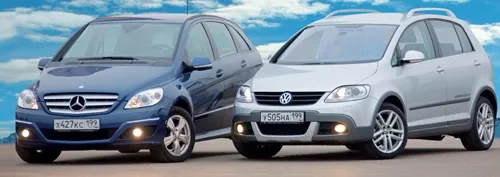 |
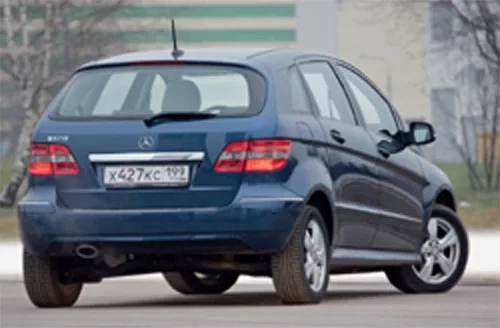
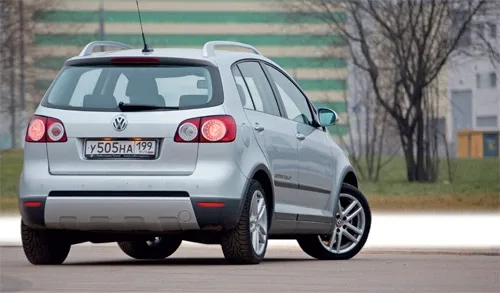
Despite similar concepts, the cars differ radically from each other. Let's start with the exterior. Mercedes-Benz bets on elegance: the sculpted hood, longitudinal lines on the sides, and chrome grille look like elements of an expensive suit, leaving no doubt about its aristocratic origin. Against this background, the Volkswagen looks simpler and rougher, but at the same time more masculine. The body lacks sharp edges and unnecessary details, and the plastic body kit around the perimeter creates a "macho" image.
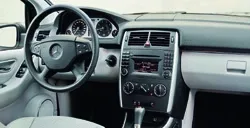
Inside, the cars are also different, primarily in the driver's seating position. In the CrossGolf, it is typical for this class — high and upright. Legs are slightly bent, and the hands hold a comfortable steering wheel with a fairly thick rim. The B-Class is different: legs and arms are extended, the steering wheel with a thin rim, which is not very comfortable in the palm, sits almost vertically, resembling a ship's wheel. At the same time, the driver sits high and sees the road far ahead thanks to the special platform layout with a raised floor.
As for the quality of materials, the cars are similar: both "Germans" feature solid materials, neat panel gaps, and pleasant design. There is enough free space in both cars. The front seats are comfortable in both the Volkswagen and the Mercedes-Benz. But the CrossGolf is slightly more comfortable thanks to the well-thought-out seat profile and dense padding. However, in the second row of the B-Class, passengers have a bit more shoulder room, and the central occupant is not bothered by a protruding tunnel.
 |  |
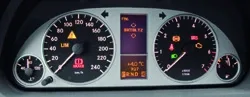 | EASY READING The instrument cluster on a silver background looks simple and is read without problems. |
| YOUR OWN CLIMATE The B-Class "special series" is equipped with a simple air conditioner – the driver controls the air distribution and fan speed. | 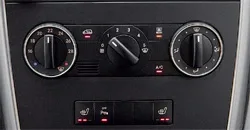 |
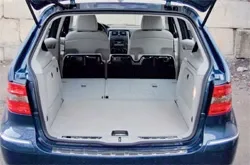
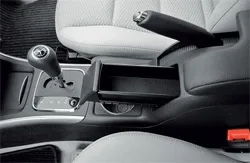 | SPENDTHRIFT In terms of "stashability," the Mercedes-Benz significantly loses to its rival – there wasn't even enough space between the seats for a full-fledged box. The most the driver can count on is a pull-out drawer of quite modest size. |
 |
CLOSE, BUT DIFFERENT
Our subjects are equipped with engines of similar displacement and power, but with a slight advantage for the Mercedes-Benz in horsepower. At the same time, the B-Class can also be bought with a different engine, while the CrossGolf buyer chooses only between manual and automatic transmissions. The B-Class also offers an "automatic," but in the form of a CVT.
These cars can't be called lively. The B-Class has a slight advantage in dynamics — it accelerates faster both from a standstill and on the move. Its transmission responds more nimbly to the driver's actions, and the engine sound is more pleasant than that of its rival. However, neither gives any reason to complain about a lack of power in city driving. There are also no complaints about road behavior. The Mercedes-Benz reports road irregularities in more detail, although there are no particular questions about ride smoothness — the suspension is more noisy than stiff. The CrossGolf's chassis is generally omnivorous: potholes, bumps, joints — it doesn't care, and all road defects are transmitted to the body in a muted form.
The steering effort of the Volkswagen noticeably changes depending on speed, but its mechanism is inferior to the Mercedes one in the transparency of reactive force and speed of response. The B-Class is more understandable to drive and follows commands more precisely, and the standard stability control makes it even safer: for the CrossGolf, it is only an option.
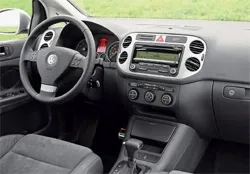 |  |
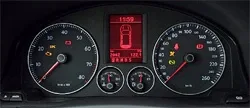 | FOLLOWING IN RELATIVES' FOOTSTEPS The CrossGolf's instrument panel is not very original, but pleasant to look at. Information perception is excellent |
| ANY WHIM... On request, the Volkswagen is equipped with dual-zone automatic climate control with automatic recirculation. | 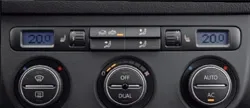 |
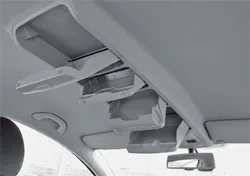 | PLAYING HIDE AND SEEK? The number of pockets and hideaways for small items on the CrossGolf is impressive – even in the ceiling there is room for boxes of various shapes and sizes. |
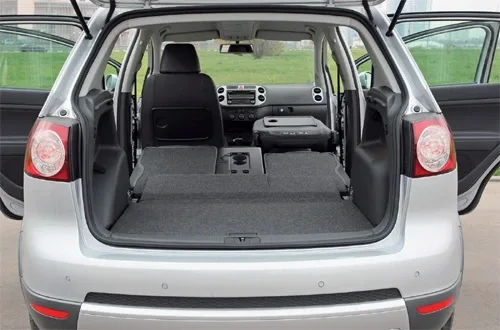
| OVERDID IT The spacious multifunctional box (option) is not so convenient – it takes up a lot of space in the trunk, and when used as a central armrest, it turned out to be too high. | 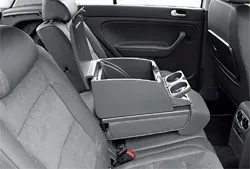 |
 |
THE QUESTION OF MONEY
It is difficult to give unconditional preference to one. The Volkswagen wins in functionality and practicality, while the Mercedes-Benz is more pleasant and dynamic on the road. Moreover, neither rival showed clear superiority in most disciplines, except one — price comparison. The B-Class will cost $38,881 (UAH 311,040), and for that money, you won't get dual-zone climate control or leather seats. For that amount, the CrossGolf (from $27,447 (UAH 219,573)) will offer everything you need and even more — from additional boxes in the cabin to an audio system with ten speakers and bi-xenon headlights. The choice depends on the buyer's mood: do they need a pass to the premium world, or is solid practicality enough?
| Manufacturer's data Mercedes-Benz B-Class ■ ENGINE 1699 cm3 petrol, 4 cylinders 116 hp at 5500 rpm, 155 Nm at 3500–4000 rpm ■ TRANSMISSION CVT, 7 ranges front-wheel drive ■ DYNAMICS max speed – 180 km/h 0-100 km/h acceleration time – 12 s ■ DIMENSIONS (mm) length – 4273 width – 1777 height – 1603 ■ ECONOMY average consumption – 7.1 l/100 km | Manufacturer's data VW CrossGolf ■ ENGINE 1595 cm3 petrol, 4 cylinders 102 hp at 5600 rpm, 148 Nm at 3800 rpm ■ TRANSMISSION Automatic, 6 ranges front-wheel drive ■ DYNAMICS max speed – 173 km/h 0-100 km/h acceleration time – 13.5 s ■ DIMENSIONS (mm) length – 4233 width – 1776 height – 1651 ■ ECONOMY average consumption – 8.6 l/100 km |