
Not Superfluous
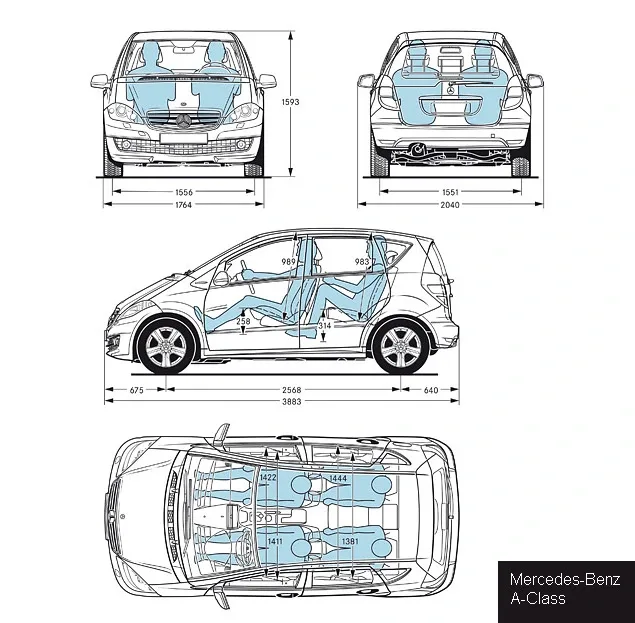
Eleven years ago, Mercedes-Benz took a bold step by releasing the "small Mercedes" — the A-Class model. By the brand's standards, it was a true dwarf: the length of the five-door hatchback barely exceeded 3.5 meters. For comparison, the then most compact "Mercedes" — the three-door C-Class Sport Coupe — was almost a meter longer.
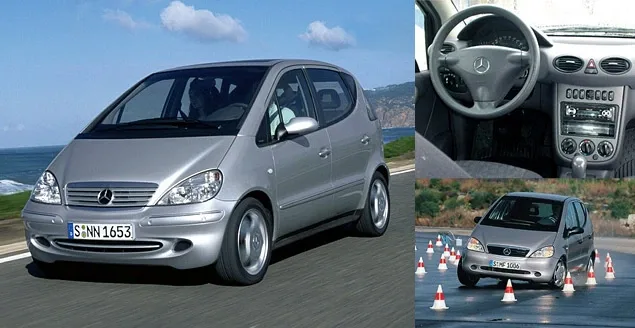 |
The A-Class was not just small — it resembled a mini-minivan (which did not add elegance) and became the first front-wheel-drive passenger car in the brand's history. The interior was Spartan, with hard and far from "premium" plastic, and the four-cylinder engines could not boast either displacement or power.
However, Mercedes-Benz invested enormous funds in this project — more than 900 million euros were spent on development and launch, and in 1999 the concern opened a second assembly plant in Brazil, spending another 840 million dollars on it. They had to design a front-wheel-drive platform from scratch, invent a unique chassis with a "sandwich" floor structure — in an accident, the engine went down without injuring people — and spend a long time refining handling. There was also a scandal: the A-Class showed a tendency to tip over in the "moose test." After that, the stability control system became standard for all versions.
Initially, the A-Class was conceived as the most affordable "Mercedes" — a kind of "entry ticket" to the premium class. And the idea worked: over 11 years, almost 1.4 million "small Mercedes" were sold worldwide. The success was so contagious that in 2004, BMW decided to break into the "compact premium" segment, creating the 1-Series family.
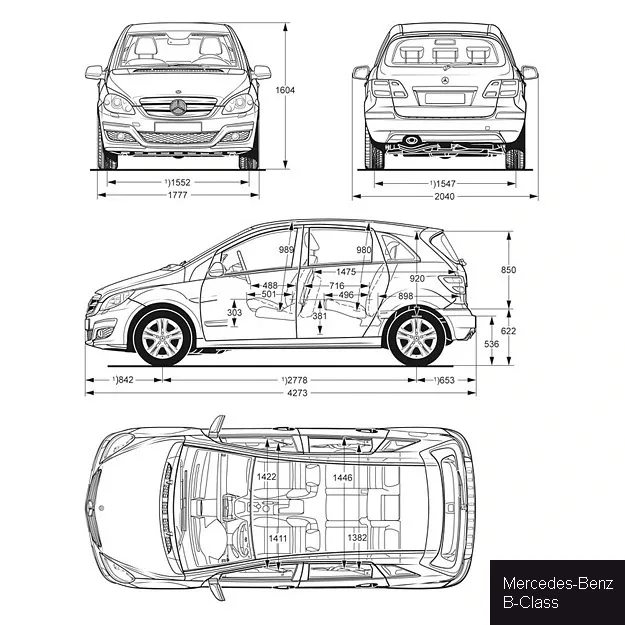
In 2004, Mercedes-Benz announced the second generation of the A-Class, and in March 2005, it presented another compact model on the same platform — the B-Class compact van. It turned out to be half a meter longer than the A-Class, looked more solid, had a spacious interior and a roomy trunk. Technically, the "small Mercedes" were almost identical, differing only in the set of engines.
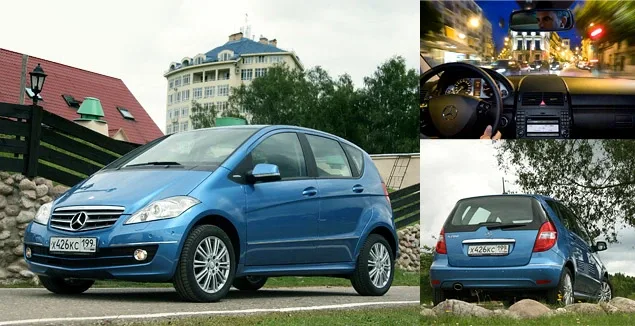
In June of this year, the A- and B-Class underwent a light restyling, and just a month after the world premiere, the updated cars reached Russia.
 |
"A" and "B"
The current A-Class has matured — it is no longer a frivolous hatchback with an unusual side window shape and streamlined body, but a serious and stylish car. After the latest update, it received "chopped" headlights in the spirit of the C- and S-Class and a new front bumper with a large air intake. Side mirrors, taillights, and bumper were also updated, and the wheel rims received a new lineup.
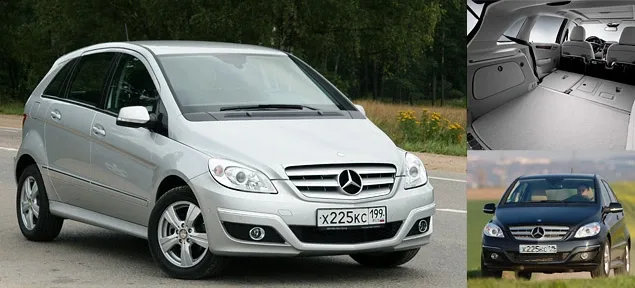 |
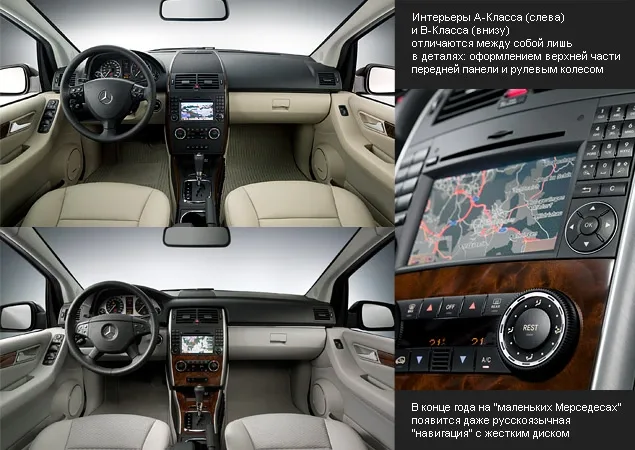
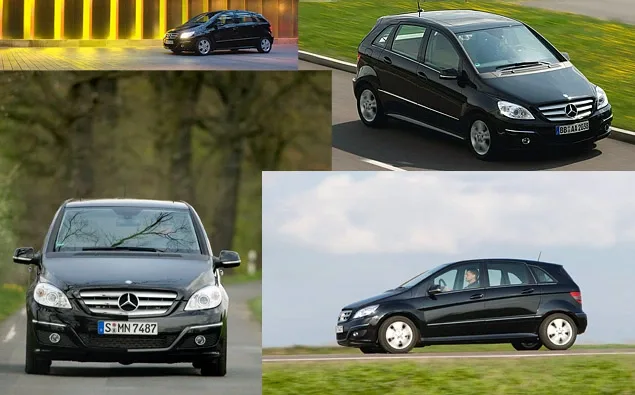
The B-Class changed even more — a new hood, a different radiator grille and headlights, modernized bumpers, and "crystal" taillights. Inside both models — fresh color schemes for upholstery, aluminum inserts (in some versions), and an advanced multimedia system COMAND APS with Russian-language navigation (it will appear in autumn as an option).
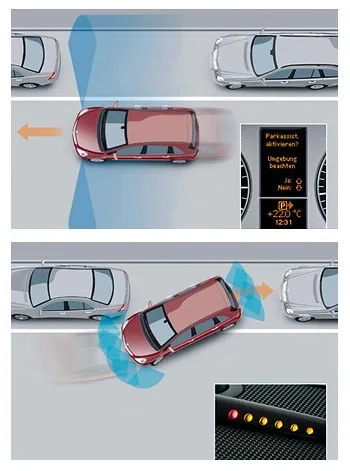 Parking "without hands" Parking "without hands" Updated A- and B-Class can be ordered with the "semi-automatic" parking system PARKTRONIC. It itself finds a suitable place and helps park in a limited space. The driver only needs to press the brake and gas, following the readings of the parking sensors, while the steering wheel will be turned by electronics. By default, the parking radar scans the space on the right: for the system to find a place, you need to drive along parked cars at a distance of no more than 1.5 meters and at a speed not exceeding 35 km/h. When the "parking assistant" detects a gap that is at least 1.3 meters longer than the car, the symbol "P" lights up on the instrument panel. Then, using the buttons on the steering wheel, automatic parking is activated, reverse gear is engaged, and you can take your hands off the wheel — the system itself will turn the wheels to the desired angle, and the driver only needs to smoothly move off, wait for the warning signal of the parking sensors, and brake. After that, first gear is engaged, the system again turns the steering wheel, and it remains to carefully move off and align the car. If the place is on the left, you need to turn on the left turn signal in advance and observe the same conditions — drive slowly and as close as possible to parked cars. Otherwise, the "left" parking algorithm is no different from "right" parking. |
The basic equipment of the updated A- and B-Class will include adaptive "flashing" brake lights that warn those behind about emergency braking, a modernized ESP stabilization system with hill-start assist, a steering column adjustable by height and reach, and emergency interior lighting (in an accident, all lighting turns on).
 |
The power of the "small Mercedes" engines has not changed, but the engines themselves have become more economical — on average by 7-8 percent. And in autumn, versions with a "start-stop" system will appear in Russia, which, by stopping the engine at traffic lights and in traffic jams, allows saving another nine percent of fuel. True, such a system will be available only on A 150 and A170 modifications with a manual gearbox.
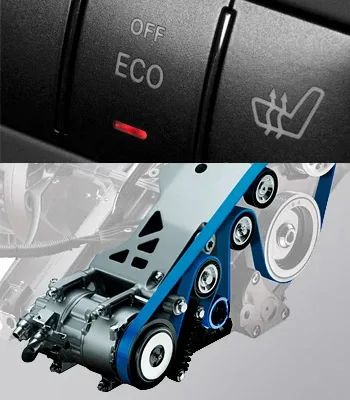 Economy mode Economy mode The "start-stop" system on the A- and B-Class saves fuel not only in traffic jams but also while driving. The secret is in the "smart" starter-generator, which begins to generate current and recharge the battery only during braking. During acceleration or coasting, the generator in most cases rotates freely, not loading the engine and not increasing consumption. The system works according to the traditional scheme: when the driver shifts the gear lever to "neutral" at low speed and presses the brake, the engine stalls, and the "ECO" symbol lights up on the instrument panel. As soon as the driver presses the clutch or fully releases the brake, the engine starts again. Thanks to the new starter-generator built into the belt drive, the process of stopping and starting takes very little time. |
While preparing this material, I came across an interesting fact — the A-Class is more compact than the Ford Fiesta or Opel Corsa. Surprisingly, in person it does not seem small at all! Due to the high roofline and "bus-like" seating position, this small hatchback is perceived more like a Ford C-Max or Opel Zafira. Moreover, the high floor in the cabin — in the A-Class you have to not "enter" but "climb in." I won't say it's inconvenient, but it's definitely unusual.
Inside, the A-Class is also not cramped — even tall passengers will have enough space both in front and in the back, and the trunk will easily hold a reasonable number of supermarket bags. If you want even more space, you can switch to the five-door B-Class. Thanks to the wheelbase extended by 20 centimeters, it has more space in the rear seats and trunk.
On the move, the B-Class seems bigger and more solid than it actually is: due to the high center of gravity, the car reluctantly changes direction and demonstrates pronounced understeer. Neither the stiff suspension nor the thick anti-roll bars save from "sluggishness" in reactions. Moreover, the B-Class passes small irregularities "silently," but on large bumps, passengers are shaken as in a sports car.
 |
As for dynamics, the five-door B170 with a 1.7-liter engine and 115 horsepower, paired with a continuously variable transmission, clearly does not claim the title of a sports car. According to the passport data, the hatchback accelerates to 100 km/h in 12 seconds, and it's easy to believe. The CVT seems too thoughtful, which is especially felt during overtaking on the highway. To achieve brisk acceleration from the car, you need to plan the maneuver in advance and take into account the time, leaving a decent distance margin to the oncoming car.
A completely different matter is the 136-horsepower B200. It accelerates noticeably more briskly, and it's hard to find fault with the CVT's operation here. Especially if before overtaking you switch to manual mode with seven virtual gears and drop a couple of steps down. Interestingly, even at maximum revs, the car does not stop accelerating — the CVT smoothly changes the gear ratio, and the car continues to gain speed.
The B200, however, seemed not only faster but also stiffer: on a broken road, it shakes more, and from the rear, unpleasant dull knocks are heard from time to time. To understand where the "small Mercedes" get such stiffness on bumps, we switch to the three-door A170... And here — a completely different picture! Despite the short wheelbase, this hatchback turned out to be much more comfortable than its older brothers: neither on a fine "comb" nor on an old highway with patches and potholes, there is no shaking as such.
After the presentation, it turned out that for the A- and B-Class hatchbacks, three types of suspension are provided: standard, sport, and comfort. So, if you want truly Mercedes-like comfort, you should choose the latter option.
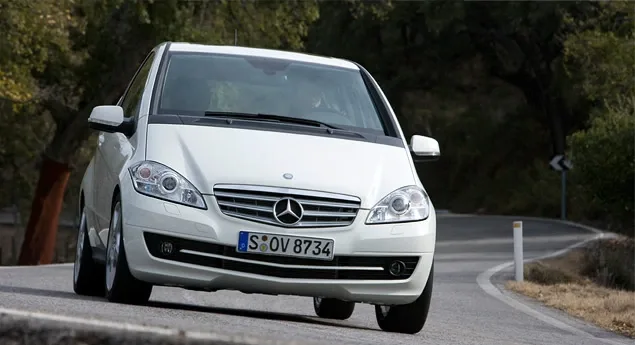 |
The three-door A170 generally made the impression of perhaps the most balanced car of all that we tried that day. Due to its lower weight (minus one hundred kilograms, by the way), it accelerates to 100 km/h almost two seconds faster than the B-Class with the same engine. At the same time, it is more comfortable and handles no worse. Plus, in my opinion, the power steering is tuned differently — that artificial increase in effort, as on the B-Class, is not present here. Instead, there is the signature emptiness in the near-zero zone, which is especially noticeable at low speeds.
Price
In Russia, the Mercedes-Benz A-Class is available in both three- and five-door versions. The base three-door A150 with a 95-horsepower engine costs 673,400 rubles, and the five-door version with the same engine is 26,000 more expensive. Traditionally, the A-Class also has a "Special Series" — cars with a fixed but rich set of equipment and a minimum number of options. The Mercedes-Benz A170 (116 hp) in the "Special Series" is equipped with a CVT, suspension with increased ground clearance, audio system, air conditioning, and electric windows; the price is 832,500 rubles. For "metallic" paint along with the PARKTRONIK parking radar, you will have to pay an additional 59,200 rubles. The most expensive A-Class of the "Special Series" — five-door, with a two-liter engine, parktronic, advanced radio, and "metallic" paint — is priced at 1,021 million rubles.
For almost the same money (1,006,400 rubles), you can get a Mercedes-Benz B-Class with a 115-horsepower B170 engine and the same set of equipment. The list of options includes only bi-xenon headlights for 63,000 rubles and chrome body trim for 11,100 rubles. The more powerful B200 with a two-liter engine will cost 52,000 more. If you want to expand the base configuration, you can add bi-xenon or a sport package for 59,200 rubles — for this money, the buyer gets a modified suspension (sport or comfort to choose from), larger alloy wheels, and artificial leather interior trim.
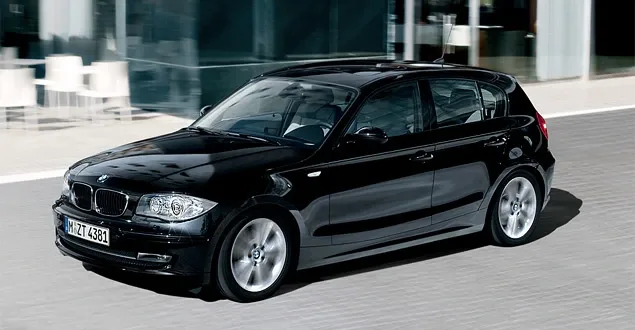 |
Competitors are slightly cheaper. For example, the three-door BMW 118i "Special Series" with a 136-horsepower two-liter engine and rich equipment is sold for 813,600 rubles, and the five-door 120i "Special Series" with a 156-horsepower engine can be purchased for 990,000 rubles. The surcharge for an automatic transmission is 56,000 rubles.
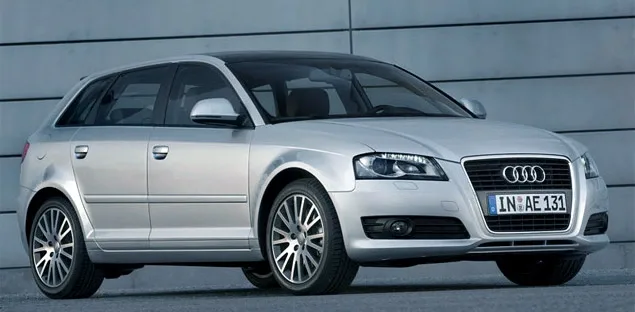 |
The Audi A3 1.6 with an automatic transmission in a rich base configuration can be bought for 854,000 rubles, and the version with a 1.8 TSI engine and DSG gearbox — for 927,000 rubles.
 |
 |
Mikhail Tsymbal