
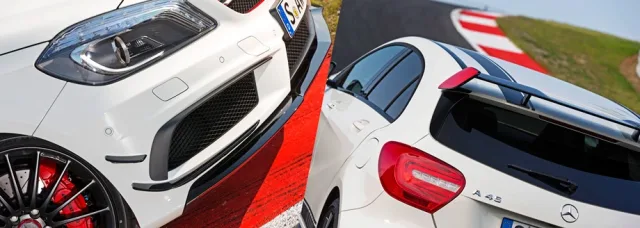
Twenty thousand cars sold a year — is that a lot or a little? On the scale of Mercedes-Benz, it's a drop in the ocean, but for its court atelier AMG, it's the maximum achieved in nearly half a century of the company's history. And now tuners claim that in the next four years they want to increase sales of AMG-Mercedes by one and a half times: to 30 thousand cars a year. And as arguments, they roll out new weapons from the boxes of the Bilster Berg race track — the Mercedes-Benz A 45 AMG hatchback and the CLA 45 AMG sedan.
The AMG outfit is modesty itself: signature alloy wheels and slightly different plastic body kit. The potential of the 360-horsepower hatchback is hinted at only by the air intakes in the front bumper, behind which hide additional cooling radiators.
Until now, AMG has not produced Mercedes of such compact dimensions. So the A 45 and CLA 45 are not only a small-format AMG revolution, but also the first production models in the company's history equipped with four-cylinder engines. 360 hp from two liters of displacement?! The first thought that comes to mind after comparing these figures: how reliable is such an engine? The second is that the thermal load of the engine must be such that it could easily be used as a kitchen stove, especially since, opening the hood, you actually see the "stove."
The creators emphasize that the 360 hp and 450 N•m extracted from two liters of displacement give the M133 engine the title of the most powerful production four-cylinder engine on the planet. As with higher-ranking AMG models, the engine is assembled from start to finish by a single master. In this case, it's a certain Lothar Damke.
Ensuring the necessary heat exchange for the inline "four" M133 became the main task of the engine builders. The result of their work: an extensive cooling system network whose circuit covers not only the turbocharger but also the seven-speed preselective "robot" gearbox, which has its own cooling radiator. And to prevent such a complex system from stalling due to vapor locks, an additional electric pump is embedded in it, and another expansion tank is installed at the highest point of the cooling line. Truly racing technologies!
Base wheels are 18 inches, but wheels one inch larger are offered as an option. Ground clearance is reduced by 20 mm compared to civilian models.
Your attention is invited to the official video of the CLA 45 AMG sedan and the A 45 AMG hatchback.
However, at first, there's no hint of racing. Clad in sporty armor, the A45 AMG looks, of course, aggressive: 350-millimeter brake discs fill the insides of 19-inch wheels with a cold gleam, carbon fiber strokes on the body. And in the cabin, you're greeted by aluminum, leather panels with red stitching, and strict anatomical seats marked AMG. A fighting mood is guaranteed! Even the suspension, which from the regular A-Class retains perhaps only the front subframe, promises to shake my insides considerably even before leaving the parking lot.
The interiors of AMG models have enough differences from civilian cars. There's a new steering wheel with aluminum paddle shifters, an original instrument cluster, and leather trim on the dashboard and door panels. But the most obvious is the lever of the seven-speed "robot" gearbox, located on the center tunnel, regardless of body type. Recall that in "A-class" cars with "automatics," the transmission selector is located on the steering column.
Standard seats with dense padding and moderate lateral support are good, but if you intend to go to the track, you definitely need to order the optional Performance seats with developed anatomy and adjustable lateral support.
But the first serious start from a traffic light casts doubt on the claimed 4.6 seconds to 100 km/h. The "hot" hatchback, even at full throttle, pulls away emphatically smoothly. It's the electronics protecting the friction linings of the robotic transmission, and the engineers protecting the environment. "The M133 engine meets future Euro-6 standards, and the cars themselves consume an average of seven liters of gasoline per hundred kilometers," they say. Ecology is now more important than technology! Perhaps that's why, to achieve the promised acceleration seconds, a whole ritual is required, taking at least ten seconds: set the stability system to Race mode, the gearbox to Manual, and also pull both paddle shifters and wait for the message about the readiness of all systems. And only then the gas... Complicated, to say the least. And on a race track, such a system is completely useless, because the lap time is taken on the fly.
The driver has three modes at their disposal: normal, sport, and race, which sharpen the operation of the gearbox, accelerator drive, and steering. The difference between them is quite noticeable, but only Race mode can rid the "robot" of delays.
By the way, during driving, the "robot" continues to be sluggish in both normal and sport modes, preferring after a downshift to first create a slight pre-tension and only then provide full acceleration. Of course, after all transient processes are left behind, both "juniors" from AMG become very fast. Suffice it to say that the maximum 450 N•m is achievable at 2250 rpm. And the faster you drive, the faster the mechatronics of the cars work. They seem to hint: don't stroke the accelerator — press it with all your might! I press... and get a deafening volley from the exhaust cannons. It turns out it's all about the electronic flap that opens as the accelerator is pressed and turns the exhaust system into a straight-through one. But... passersby look around, cyclists get scared, and I have the feeling that I've fallen into an orchestra pit during a percussion part. Firstly, it's awkward in front of others, and secondly, it's very loud.
With the same set of sporty attributes, the CLA 45 looks less aggressive than the hatchback. But the sedan better matches the traditions of AMG.
The suspension also doesn't let you relax. Even on smooth German roads, the A 45 AMG finds flaws and transmits them into the cabin. Why such stiffness? The engineer sitting opposite raises his eyebrows in bewilderment: "Our customers are used to such settings. Oh, so you're from Russia! To your buyers, I can only advise not to get carried away with large wheels. On standard 18-inch tires, the car's ride is somewhat softer." Interestingly, the CLA 45 AMG on the same roads rides noticeably more comfortably. Its gait has fewer sharp vertical accelerations, and the energy intensity of the suspension even allows it to fight medium-sized potholes. And the four-door sounds less impudent: at medium throttle, a quality baritone caresses the ear, and the cannonade familiar from the hatchback covers only under full throttle. As a result, on public roads, I liked the CLA 45 AMG more. But the A 45 AMG is incomparable on the track!
The chassis of the A 45 AMG and CLA 45 AMG is identical. And the differences in ride smoothness are explained by engineers by the slightly greater weight of the sedan. In curb weight, it weighs 1510 kg — 30 kilograms more than the hatchback.
The flat track diagram hanging on the box wall cannot convey all the charm of Bilster Berg. It's not for nothing that it's called the "little Nürburgring"! Nineteen corners are twisted over a distance of 4200 meters with a total elevation change of 70 (!) meters. Yes, in winter you can really go sledding here! Moreover, there are a couple of places from which not every daredevil would decide to descend. The track configuration, by the way, was designed by the court architect of F1, Hermann Tilke, but the track is unsuitable for traditional auto racing — too few boxes. This circuit is for track days. What a coincidence! After all, the Mercedes A 45 AMG in the Edition 1 version, which differs from the regular A 45 with a modified suspension and aerodynamic package, was created precisely for racing weekends.
The Edition 1 package includes a 20% stiffer suspension front and rear, a sport exhaust system, and aerodynamic elements (bottom row of photos) providing additional downforce. For example, the rear wing at high speeds loads the rear axle by 40 kg.
True, the organizers played it safe — they sent the column of journalists behind the lead car. Well, the safety car turned out to be no slouch either — a Mercedes SLS AMG. The guy in the nearly 600-horsepower coupe drove, of course, with a margin, but in places he didn't deny himself anything. Following behind, I saw how his supercar rose on its toes at corner exits, balancing on the edge of slides. And I in the same place simply pressed the accelerator to the floor, not fearing a rear-axle drift, and shortened the distance to the leader. After all, all-wheel drive is a very useful thing, even on dry, sun-warmed asphalt. And the stiff suspension, which on regular roads shook the soul out of me, now helps. You can safely attack the curbs.
Both the driver of the regular A 45 AMG and the pilot of the A 45 AMG Edition 1 are provided with sufficient information about the position of the steered wheels through a constant flow of feedback through the steering wheel. And this is very useful on a track with such a complex landscape. In addition, the engineers tuned the chassis of the "hot babies" for neutral handling, prioritizing control reliability. The car is indeed ready to forgive small mistakes in choosing speed and trajectories.
By the way, the seven-speed preselective gearbox, which annoyed with its sluggishness in everyday driving, works just brilliantly in racing modes. I tried shifting manually, but quickly realized that the electronics do the same thing more accurately and delicately. The right gear is engaged before entering a corner, and on exit all you have to do is press the gas again. However, I couldn't get used to the racing brake settings for a long time. No, both deceleration and feedback are perfectly fine here. But compared to road cars, the AMG hatchback's pedal is frankly heavy, and it takes a few laps to understand their true capabilities.
"Brothers," but not twins. This applies not only to appearance but also to driving character. And even though the differences in the behavior of the AMG cars are not as significant as one might wish, it's safe to say that the creators killed two birds with one stone.
"With the A 45 AMG and CLA 45 AMG, we hope to attract more young buyers," say the marketers. "Essentially, these are entry-level AMG packages that provide membership in an exclusive club for a moderate fee." However, the price tags themselves can hardly be called moderate: the A 45 AMG in base trim starts at 1,990,000 rubles, and if the owner intends to race on the track, it's advisable to equip the car with the Edition 1 package, which adds another 422 thousand to the price. The CLA 45 AMG is even more expensive — from 2,290,000 rubles. "We deliberately positioned the sedan and hatchback in different niches. Because despite technical similarity, these are still different cars. The A 45 AMG was created with amateur racers in mind, while the CLA 45 AMG is simply a fast city car." In the end, everyone will benefit: young buyers get a choice, and the manufacturer gets the prospect of increasing sales to the planned 30,000 cars by 2017. By the way, it's in that year that AMG will celebrate its 50th anniversary!
Specifications
| Mercedes | A 45 AMG | CLA 45 AMG |
|---|---|---|
| Body | ||
| Body type | hatchback | sedan |
| Number of doors/seats | 5/5 | 4/5 |
| Length, mm | 4359 | 4691 |
| Width, mm | 1780 | 1777 |
| Height, mm | 1417 | 1416 |
| Wheelbase, mm | 2699 | 2699 |
| Track front/rear, mm | 1557/1561 | 1557/1561 |
| Curb weight, kg | 1480 | 1510 |
| Gross weight, kg | 2050 | 2075 |
| Trunk volume, l | 341 | 470 |
| Engine | ||
| Type | petrol with direct fuel injection and turbocharging | petrol with direct fuel injection and turbocharging |
| Location | front, transverse | front, transverse |
| Number and arrangement of cylinders | 4, in-line | 4, in-line |
| Number of valves | 16 | 16 |
| Displacement, cm³ | 1991 | 1991 |
| Max power, hp/rpm | 360/6000 | 360/6000 |
| Max torque, N•m/rpm | 450/2250–5000 | 450/2250–5000 |
| Transmission | ||
| Gearbox | robotic seven-speed | robotic seven-speed |
| Drive | all-wheel drive | all-wheel drive |
| Chassis | ||
| Front suspension | independent, coil spring, McPherson | independent, coil spring, McPherson |
| Rear suspension | independent, coil spring, multi-link | independent, coil spring, multi-link |
| Front brakes | ventilated disc | ventilated disc |
| Rear brakes | ventilated disc | ventilated disc |
| Tires | 235/40 R18 | 235/40 R18 |
| Performance characteristics | ||
| Maximum speed, km/h | 250* | 250* |
| Acceleration time 0–100 km/h, s | 4.6 | 4.6 |
| Fuel consumption, l/100 km | ||
| — combined cycle | 6.9–7.1 | 6.9–7.1 |
| Toxicity standard | Euro-6 | Euro-6 |
| Fuel tank capacity, l | 56 | 56 |
| Fuel | AI-98 | AI-98 |
| * Electronically limited. | ||
Technology
The all-aluminum M133 AMG engine features direct fuel injection with an operating pressure of 200 bar and a twin-scroll turbocharger capable of providing 1.8 bar of boost pressure. Additionally, up to five fuel injections are delivered per working cycle synchronously with spark generation. All this allowed achieving a record 181 hp per liter of displacement. To provide the turbocharged four-cylinder with the necessary heat exchange, the cooling system circuit includes a second expansion tank and an additional electric pump that ensures fluid circulation even after the engine is stopped, preventing local overheating of the turbine.
The chassis of the A 45 AMG and CLA 45 AMG, although based on the road-going prototypes (pictured is the Mercedes A-Class hatchback), has been reworked by more than 80%. The front subframe and the rear multi-link beam, which is now attached to the body without silent blocks, have been reinforced. Stiffer front suspension knuckles and rear hubs were made anew. The hub bearings have become more powerful, while the arm silent blocks, on the contrary, have lost an extra layer of rubber. The characteristics of the shock absorbers, springs, and anti-roll bars have also been revised towards stiffening. The ground clearance of the AMG cars is 20 mm lower than that of standard models. Finally, the engineers changed the wheel alignment angles to negative: –1.8