
SPRATS IN TOMATO SAUCE
When doubts overwhelm me, I usually turn to Ivan Evdokimov for advice, but this time his answer didn't satisfy me.
– Ivan, what on earth is such a huge crossover for?
– To drive to the hypermarket for groceries.
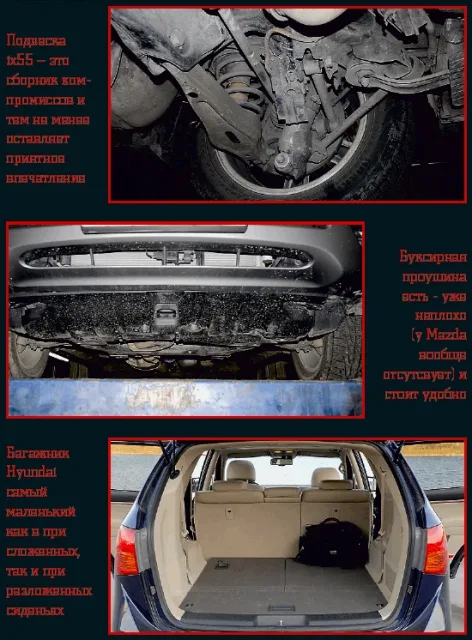
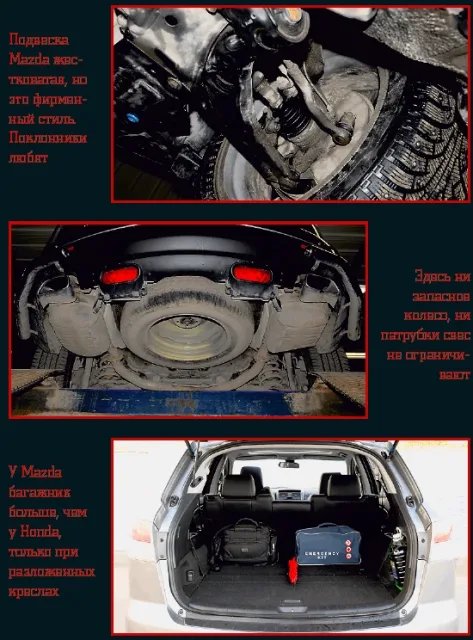
Ivan, you're wrong there. I popped into Auchan and loaded up seven huge bags of groceries and other household bits. I wheeled the cart to the rear of the Mazda CX-9, tossed everything into the trunk, but couldn't drive off: I couldn't shake the thought that at the first traffic light, the sprats would fly into the tomatoes from the launch, and the cream would soak the laundry detergent. Seven big bags are too little for such a volume. They'd rattle around the trunk from side to side, each jolt destroying my supplies, the upholstery, my wife's nerves, and a lovely spring evening. What to do? I couldn't buy another fifteen bags to pack the cargo area solid. I had to unload everything and place the purchases on the second row, right on the floor. Such mega-crossovers aren't even suited for basic shopping. Maybe for moving furniture.
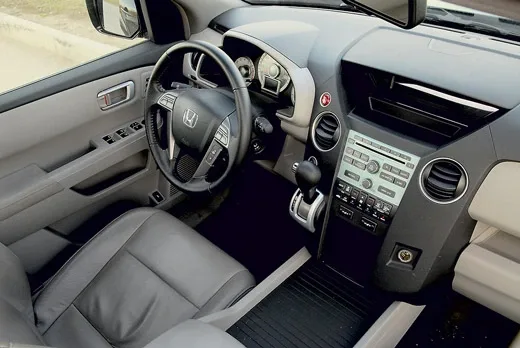
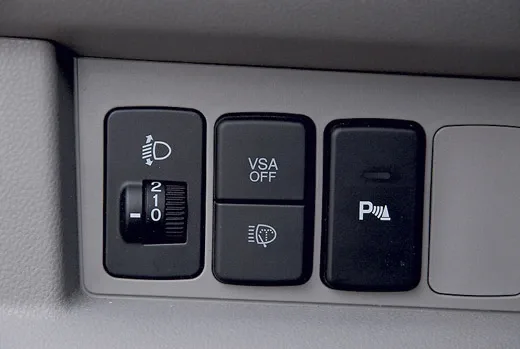
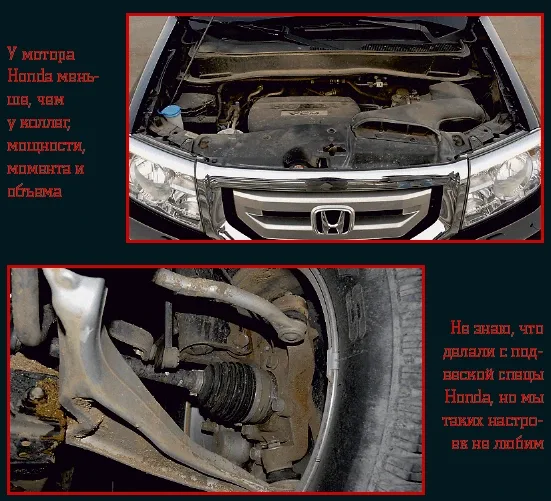
Honda disables the electronic "collar" in manual mode of the automatic transmission
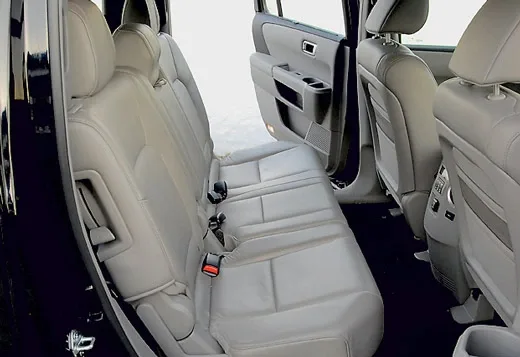
Let's look for another use for these cars. Perhaps on a long "liner" it's much more pleasant to devour highway miles than to rattle in a short sedan? Let's check. We headed to Volokolamsk — about 120 kilometers. The Mazda CX-9 covered the entire route as predictably as possible. The suspension is a bit stiff for potholes in the asphalt, and in ruts the car might wiggle a little, but no surprises. Sit down and go, no need to get used to it. You don't even remember the car is five meters long.
The Honda Pilot is like a freight elevator darting between floors. What remains in memory after the trip? Only heavy vertical pitching. Up and down. Very tiring.
The Hyundai ix55 behaved more decently. No asphalt irregularities rocked it or knocked it off course. If you need transport for bad roads, it's unrivaled.
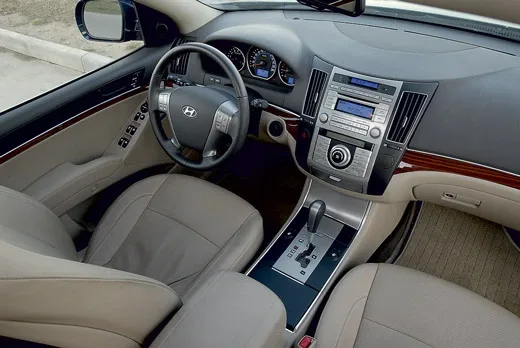
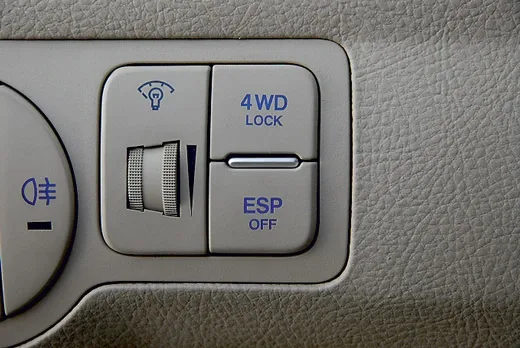
The Hyundai has everything a crossover needs: a coupling lock and ESP shutdown (though not complete)
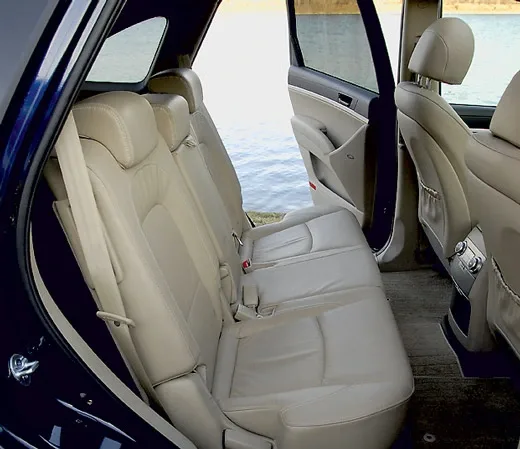
On the highway, the Honda lost. Assign first and second places yourself. The CX-9 is the favorite for those who like to keep the car under control. The ix55 is for those who trust the car to find the right trajectory on its own.
TO TOPPLE THE LAND CRUISER
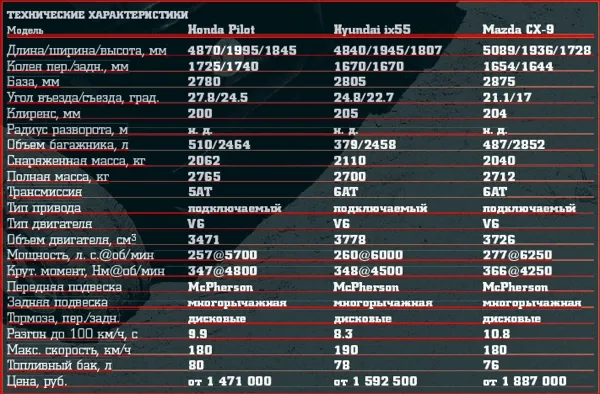
The crossovers are powerful but heavy. Their acceleration and braking are like a plane's takeoff and landing. The Honda confidently reaches 150–160 km/h. Its speedometer is needlessly marked to 200. The maximum it can do is 180, and that's on nerves; and crucially, it brakes vaguely. The Mazda stretches to 190 km/h, then, despite the red backlighting of the instruments, drops revs. Only the Hyundai deserves the "rocket" title. The liveliest acceleration, and it confidently goes to 200 km/h or more. But the Korean brakes oddly: a long pedal travel, and at the end — mush. If you want to brake, do it in the Mazda, and it'll be transparent and predictable.
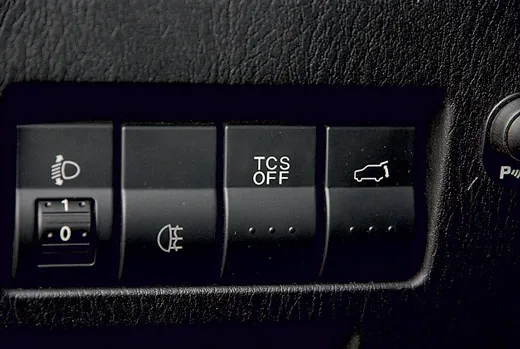
The Mazda lacks a coupling lock for the all-wheel drive. This somewhat hinders in critical situations, but it's not fatal
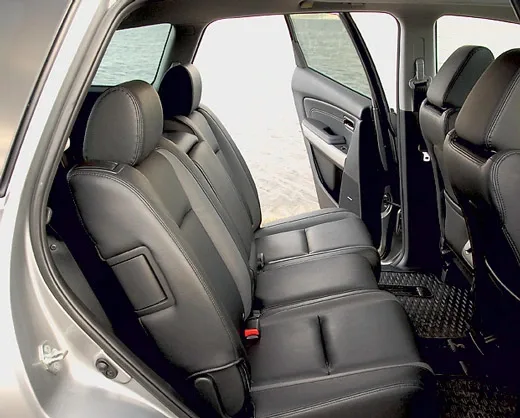
The Pilot loses again. We urgently need to find some merits in it to avoid programming the final result. Maybe it'll make up ground in design and interior trim? Honda's designers worked hard. I even know with what goal. They wanted to topple the Toyota Land Cruiser. And they didn't hide it. How to take down the "two-hundredth" Toyota? A good off-roader knows: with diff locks in the axles, a beastly low range, better geometry. But showing a menacing face is a trick for the ladies. Just for show. Dust in the eyes. A long hood, wide seats, a "Hummer-like" meter-long "glovebox" between the front seats. Winning moves. Brutality in its purest form, if you don't count the glass front panel resembling an office table. And who did you want to fool? Plus that gray hard plastic and the crossword of buttons for climate and multimedia controls, which are easier to punch with a fist than to poke with a finger: maybe the right one will turn on.
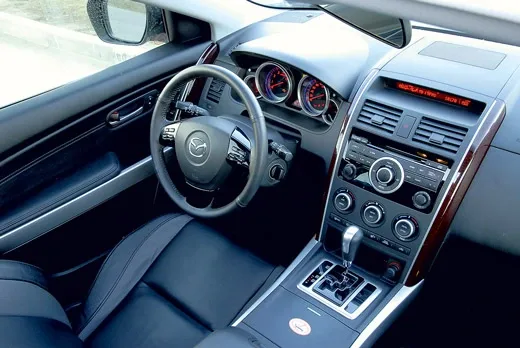
Once inside the Honda, you can identify the car's brand only by the badge and the gear lever with too short a throw — it definitely overshoots Drive. In the Mazda, it's different. The family resemblance is obvious, no guessing needed. The reddened instruments, the large round climate knobs, and the convenient automatic selector give it away. Even if you're indifferent to the "zoom-zoom" ideology, it's more pleasant here. And the Korean truly surprised. Soft plastic, stylish interior, plus build quality. If it loses in the simplicity of the climate control algorithm, it's far ahead in materials. See, I honestly tried to side with the Pilot, but it's behind again.
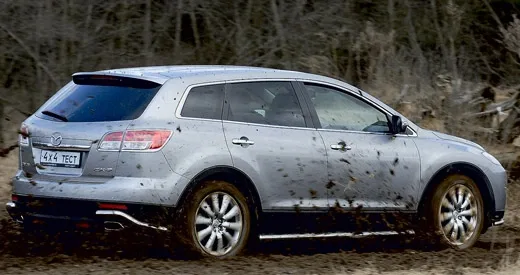
DEVOURED THE BUMPS
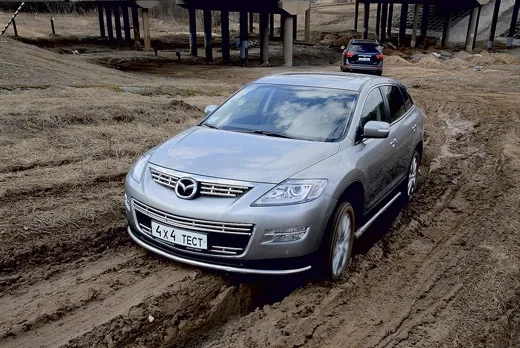
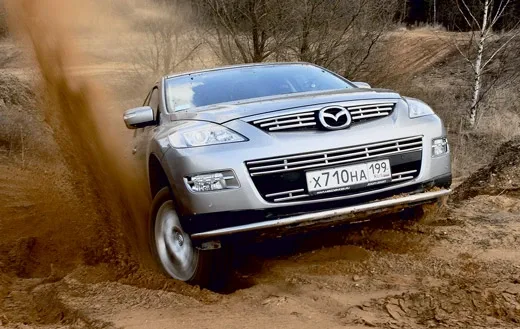
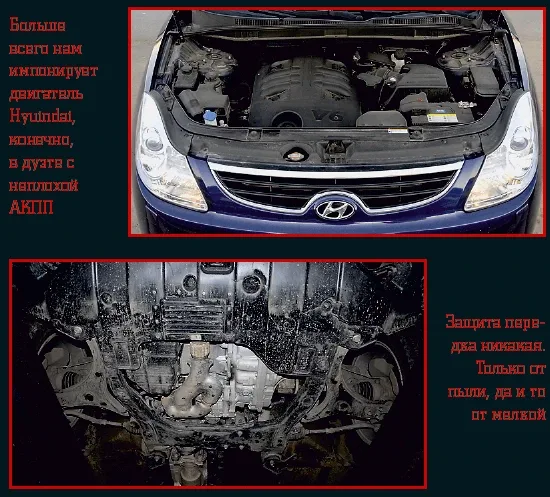
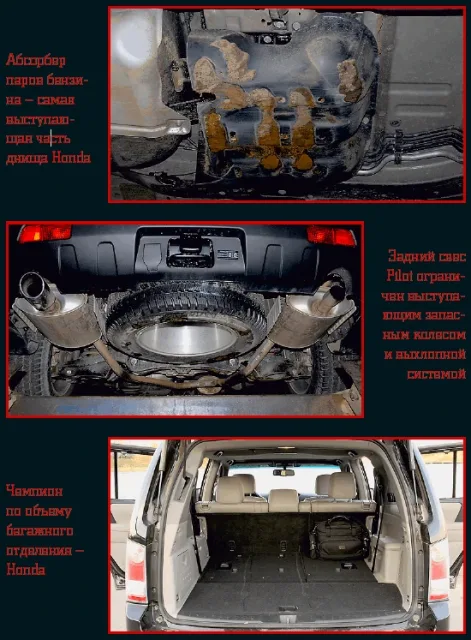
Off-road will settle the debate once and for all. First, we play "king of the hill." The hill is covered in slippery mud and cut by ruts. The Honda immediately sat on its belly. Despite the most impressive approach angle among rivals (27.8 degrees), it has the least ground clearance (200 mm) and, which is especially unpleasant, a relief underbody. A bulky fuel vapor absorber hangs down, fuel tanks protrude, and the spare wheel hangs low. Honda's engineers overdid it: they wanted to level the cabin floor but grew stalactites under the belly.
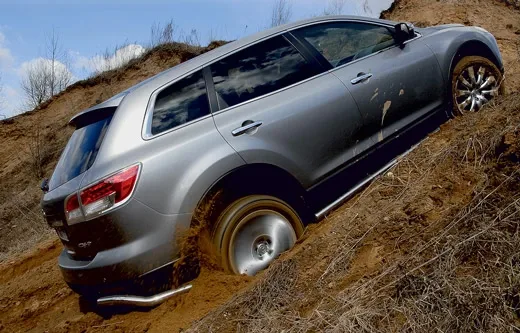
The Mazda has the most modest approach angle — 21 degrees, but it has 204 mm of ground clearance and a flat bottom, so it climbed higher. The Hyundai also scrambled more confidently than the Pilot and, if not for the weak front protection, would have reached the very top.


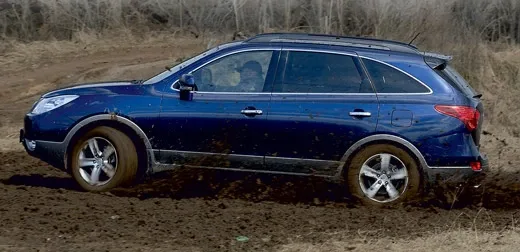
Next came uneven dirt road. The Pilot, despite looking like an SUV, didn't let us speed up on the country road. In potholes, it dipped its nose so much that we had to slow down. Again that vertical pitching. How tiring it is both on the highway and off-road! The CX-9 covered the section in a car-like way, too jolty. It was a pity to abuse it, but we had to. Only the ix55 didn't notice the bumps at all, devouring them in one go. The impressions from meeting the Hyundai last year in Korea were fully confirmed. It likes village life.
All test participants are equipped with a stability control off button. The Honda turns off both ESP and traction control completely. In the Mazda, the traction control will re-engage at 16 km/h in any case. You can't have fun in a controlled slide. In the Hyundai, when electronic aids are turned off, their activation threshold is simply pushed back. At what speed they'll kick in again, the manufacturer doesn't specify, because many factors are involved — not just acceleration. Be that as it may, the ix55 allowed plenty of rally-style fun. The rivals' drive was lackluster. All three crossovers handle diagonal wheel hanging. So the traction control, though not ideal for off-road, works fine.
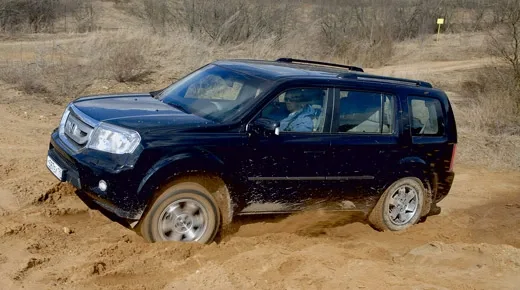
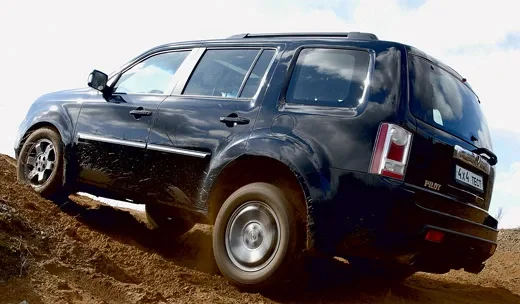
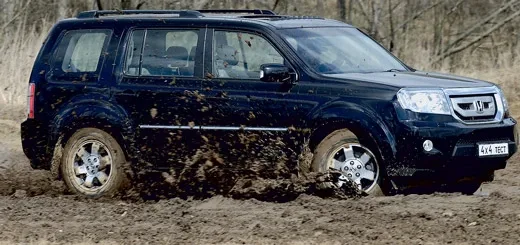
Both the Pilot and the ix55 have a coupling lock for the all-wheel drive, while the CX-9 does without it. That's why the Mazda made so many extra movements and dug its wheels into the ground. We tested it on a sandy incline with a turn near the top. Although all rivals took this obstacle, the issue wasn't the technical content but the driving. So the lack of a lock in the Mazda isn't a hindrance in experienced hands. One problem — it has no front tow hook. Nothing to pull it out by. So learn to be careful.
SPECS: HYUNDAI IX55

TECH SPECS: MAZDA CX-9


TECH SPECS: HONDA PILOT

After completing the off-road part of the tests, Hyundai was ahead in almost every parameter. I almost finished the material, and, as promised, I learn the name of the winner together with you, right in the process of writing. The question arises: why couldn't I calculate everything in advance? The thing is, throughout the entire test, one thought didn't let me go: why create seven-seat crossovers with such a strange and contradictory set of qualities that are unlikely to be useful outside the States? An off-road wagon — that I can still understand. An all-wheel-drive minivan — that also doesn't raise questions. But a seven-seat "parketnik"? True, colleagues quickly explained to me how things really are. "You just have few children," they said. "Have three. Then you'll immediately understand why a seven-seat crossover is better than a minivan!" Of course, both are capable of fitting a stroller, bags of groceries for three days for five people, and a case of beer into the huge trunk. Both allow you to seat grandma or a nanny in the third row if needed. But a crossover, at the same time, gives you, a fully family man, at least some opportunity to feel like a man. And for a woman behind the wheel, unlike a minivan, it gives a sense of security."
Thus, the victory in the test goes to the ix55 — a car with a magnificent interior finish, which handles broken roads well, cheerfully goes into a drift, is equipped with an excellent engine that easily accelerates it to speeds over 200 km/h, and pleases with a five-year warranty. The only drawback is that it's not too friendly to tall passengers: the seat adjustment range is small.
In second place is the CX-9. It's a somewhat stiff but obedient car, which in character is closer to a passenger car and doesn't forget about the brand's style. And the consolation prize goes to the Pilot — a car that resembles heavy swings that unsuccessfully aimed for the place of the Land Cruiser.
During the test, radio communication was used
from the company "Argut", www.argut.net
from the company "Argut", www.argut.net