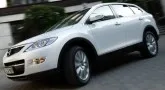
In cramped Europe, clogged with cars and suffering from insane fuel prices, people long ago stopped sacrificing parking comfort for the sake of car size — they calmly drive compact small cars and don't complain. A huge SUV on the streets of the Old World is a real rarity. But in America, such cars have been loved for a long time and seriously: there it's more spacious, gasoline is cheaper, and prices are not at all like ours. Russia, as always, goes its own way. Fuel seems to be getting more expensive almost to European levels, and traffic jams haven't gone anywhere, but the love for big cars hasn't disappeared. Everyone lives by the principle "the bigger, the better." That very mentality and public opinion decide everything: the larger a person's car, the more solid they look in the eyes of others.
So it's no surprise that Russia made it onto the short list of countries where the CX-9 is officially supplied (besides North America, these are South America, Australia, Saudi Arabia, and Ukraine). Sales here start in September this year. It's pleasant to realize your exclusivity, and I understood this right away: when I flew to Stockholm for the CX-9 driving presentation, a whole army of journalists from different European countries gathered there — and they all came to drive the three-door Mazda2. But they weren't allowed near the CX-9. Just as we weren't allowed behind the wheel of the Mazda2.
In America, the big Mazda has been sold since 2007. Just in March this year, 42,500 people bought it. Experts across the Atlantic also appreciated the model, awarding it the Truck Of The Year 2008 title. To understand why Americans loved the CX-9 so much, my colleagues and I headed to the roads around the Swedish capital. The new model's appearance was no surprise. The "Nine" strongly resembles the younger model — the CX-7 — in its shapes. The signature style is, of course, good, but will a future buyer want their huge crossover, positioned in the same class as monsters like the Q7, Land Cruiser, and X5, to be hard to distinguish from the younger model at a distance? Moreover, the sleek forms of the CX-9 noticeably hide what many buy such cars for — size.
But as soon as you get inside, you understand — things are serious with size here. Over five meters from nose to tail allowed for three rows of seats. Officially, on the Russian market, the SUV is positioned as a six-seater. In the American specification, there are seven seats. In fact, seating a third passenger in the middle row is quite realistic, but no seatbelt is provided for them. By the way, it's quite comfortable to settle in the back row! I, with my height of 183 cm, conducted such an experiment: I tried to sit behind myself in all three rows, especially since the middle row also adjusts longitudinally (by 26 cm). I managed to do this without problems — all seats are truly full-fledged, although our compatriots, not used to traveling in a large company, are unlikely to appreciate it.
The leather front seats are equipped with a minimum of electric adjustments (longitudinal, backrest tilt, and lumbar support), but this doesn't stop them from being very comfortable. A good balance between firmness and comfort, and they hold the body well. The architecture of the front panel resembles that of the CX-7, but looks more monumental, as befits a car of this class. The instrument panel with wells and the three-spoke steering wheel are in a unified corporate style. The center console has become wider, but the climate and music controls are the same. At the top is the same narrow display for the onboard computer and radio — in Russia, there will again be no navigation, and therefore no large multimedia screen.
This is strange, because for most classmates this has long been the norm! And the interior of American versions (they, of course, have such a screen) looks richer, and no one denies the benefits of navigation. But installing this equipment would significantly increase the car's price, and Mazda needs to keep it at a fairly low level compared to competitors.
The next victim of cost reduction was the quality of trim materials. Undoubtedly, it's the best among all Mazda models, but it doesn't yet reach premium — the somewhat hard plastic and imitation wood don't allow it.
To be honest, I didn't expect such obedience and responsiveness from this behemoth. The CX-9 really allows you to drive fast, with pleasure, and at the same time with comfort. Now I'm not talking about acceleration — the 3.7-liter V6 has quite ordinary power of 273 hp (but nevertheless, a compression ratio of 10.3 doesn't allow using gasoline with an octane rating below 95). And acceleration to 100 km/h in 10.1 seconds doesn't seem to impress the imagination, although for two tons of weight, this is a good result.
The CX-9 is distinguished by the coordinated operation of all units and systems that affect the car's movement in space. The gearbox perfectly complements the engine, shifting smoothly but quite briskly, without interrupting the power flow. During kick-down, it willingly drops a couple or even three gears down; in manual mode, it holds at maximum revs, and in manual, it allows very fast shifting.
The baton of drive is willingly supported by the excellently tuned suspension and steering. An excellent balance between sportiness and ride smoothness! There are few five-meter crossovers capable of attacking corners so confidently or rushing in a straight line at high speed. The CX-9 is very stable, with minimal body roll and pitching. But comfort hardly suffers from this sharpness — passengers won't have a clue how fast they're moving unless they glance at the speedometer. The brakes don't lose effectiveness even after a series of intense stops.
Advice to future CX-9 owners. Don't expect miracles off-road from this car. Yes, the Active Torque Split all-wheel drive system can transfer up to 50% of torque to the rear axle. But this is primarily for slippery surfaces. Not for serious off-road obstacles. Due to the short-travel car-like suspension, the car hangs diagonally very early. But to the CX-9's credit, it continues to move forward even in this position — the non-switchable stability system helps (albeit with a noticeable delay) by braking the necessary wheel.
Still, no matter what you say, no matter how you look for possible competitors for the CX-9, Mazda's flagship crossover stands apart. Its essence lies in combining things that are poorly compatible at first glance. Although cautiously, it can crawl off-road. The interior is so spacious that associations with minivans come to mind. And sharp handling will allow it to outdo not only sluggish competitors but also representatives of the passenger car tribe! Well, and if there is a car capable of matching the CX-9 in the number of combined capabilities, then Mazda has a joker up its sleeve for this case too — a moderate price of one and a half million rubles! What, are your hands already itching, reaching for your wallet or credit card? Don't rush, Russian sales start only in September — after the local presentation at the Moscow Auto Show.
FOR YOUR INFORMATION
The MZI V6 engine with a volume of 3.7 liters and a cylinder bank angle of 60° became Mazda's first V-shaped "six" in the last five years — before that, the company didn't produce such units. The brand's first V6, with a volume of only 1.6 liters, was installed on the Mazda MX-3 coupe, and for the American market there was a version with turbocharging and a displacement of 2.3 liters, which operated on the Miller cycle. The same technology is used in Demio and Mazda2 engines for Japan. In addition, Mazda also made J-series V6s, which were installed on the first Mazda MPV and the 929 model. The new MZI 3.7 received a Sequential Valve Timing (S-VT) system, thanks to which torque is available in a wide range of revs. This engine is assembled on the same line in Ujine where Mazda's inline "fours" are also produced.
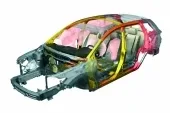
The CX-9's good handling was largely made possible by the rigid unibody, which uses elements made of high-strength steel. Power components of increased cross-section form a strong safety cage. The front subframe was made longer so that in a frontal collision, the oncoming car doesn't "climb" onto the hood. The Mazda CX-9 earned five stars for frontal and side crash tests according to the American NHTSA agency's methodology, and four stars for rollover protection.
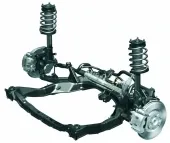
The suspension layout of the CX-9 is the same as that of the younger CX-7: MacPherson struts at the front, and a multi-link design with one trailing arm and two transverse arms per wheel at the rear. The front suspension rests on a subframe attached to the body at six points. The rear subframe is connected to the body by four mounts. The trailing arms are mounted higher, which increases the car's stability during braking.
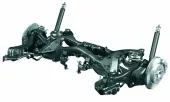
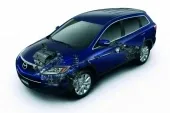
The all-wheel drive with active torque distribution (Active Torque Split) is built on the basis of a similar system from the CX-7. ATS automatically transfers torque between axles in a range from 100:1 in favor of the front wheels to 50:50, and can also switch to winter or sport mode. In the only trim level available on the Russian market, the CX-9 is equipped with ABS, DSC stability control, RSC rollover protection, EBA emergency braking assist, and EBD brake force distribution.