
Universal Option
The Russian market is almost as attractive for Mazda Motor as the North American one, and perhaps even more so. Sales are growing rapidly: in the first nine months of 2008, the company's turnover increased by 81 percent. The crisis will, of course, cool buyers' ardor somewhat, but Mazda is confident that even under such conditions the momentum will be maintained.
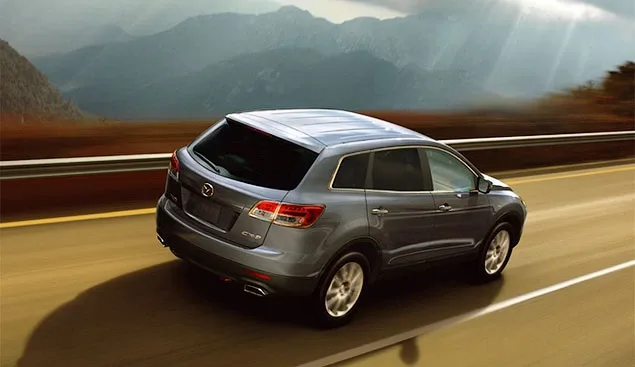 |
Moreover, our buyers adore large all-wheel-drive vehicles, paying no attention to their price or appetite. That is why Russia became the first country in Europe where sales of the Mazda CX-7 crossover started a little over a year ago, a model originally designed for the American market.
This year, inspired by the success of the "CX-seven," Mazda decided to bring another model from across the ocean — the CX-9. This six-seat SUV is based on the CD3 platform, familiar from the Ford Edge, Lincoln MKX, and Mazda6. In America, the CX-9 temporarily replaced the MPV minivan, gaining the status of a family car. Some overseas journalists even dubbed it a "modern station wagon" — a universal of the new era.
Unification
Seven models are built on the Ford CD3 platform, and at its core lies the Mazda6 chassis.
The 3.5-liter Duratec 35 engine first appeared on the Ford Edge and Lincoln MKX, and Ward's publication recognized it as one of the ten best engines in the world. Its modification — Duratec 37 — is installed on the Mazda CX-9, though in the Japanese version it is called MZI. |
In Russia, the positioning of the CX-9 is different. Marketers are betting on the upper part of the middle class and expect that thanks to a rich standard equipment list and impressive dimensions, the newcomer will lure away some buyers from premium crossovers.
Where Zoroastrian Roots Grow From
The presentation of the Russian CX-9 took place… in Uzbekistan. Mazda PR specialists explain this unusual choice by the brand's history. The company's name comes not only from the surname of founder Yujiro Matsuda but also from the name of the Zoroastrian god of the Sun — Ahura Mazda. According to some legends, the prophet Zoroaster, the founder of Mazdaism, was born in Uzbekistan, not in Iran, as is commonly believed. Hence the idea arose to hold the test drive here. But Mazda has no plans to sell the large SUV in this country.
And how could they? With an average salary of $50–60 a month, a new Japanese car is an unaffordable luxury for an Uzbek. Everyone here drives Daewoo. These Korean cars are assembled at the country's only plant, "UzDaewoo Auto," and thanks to import duties (up to 100 percent), they are incredibly popular. For example, you have to wait four (!) years in line for a Matiz.
Besides Korean cars, donkeys, bicycles, and old Soviet cars passed down from generation to generation are often found on Uzbekistan's roads. And if fresh flatbreads from a tandyr — a local oven resembling a concrete pit in the ground — need to be delivered a couple of blocks away, they are simply placed on a wooden tray about a meter in diameter, which the porter holds on his head.
In such surroundings, behind the wheel of a CX-9, you feel like the pilot of a flying saucer that has crashed on a planet unprepared for contact with the Japanese auto industry. All eyes are fixed on the driver, and even factory tinting doesn't help hide. The only way out is to quickly get off the busy streets.
Now a Pothole, Now a Ditch
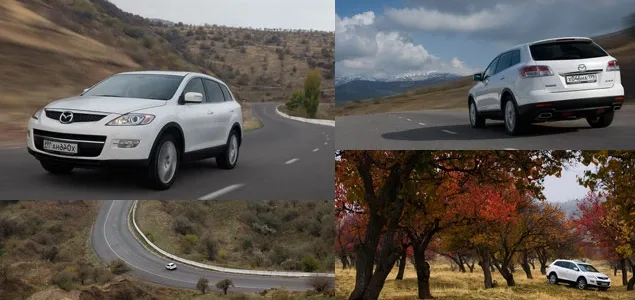
And we had the opportunity to escape from onlookers — part of the test took place on the 340-kilometer Samarkand–Tashkent highway. This road can only be called high-speed on the approach to the capital. Otherwise, it is in terrible condition, and everywhere differently. For instance, we came across potholes scattered across the asphalt in a checkerboard pattern, where a wheel on a 20-inch rim could sink entirely. And sometimes the road turned into a concrete slab track, reminiscent of the road to Moscow-region dachas paved with slabs.
But our "Mazda" was unfazed by such trials. Thanks to the almost sporty suspension settings of the two-ton car. Yes, the ride is a bit stiff, but the shaking on bumps is forgotten when you feel that all four wheels are constantly pressed to the asphalt, keeping the car on course. No wobbling or rocking typical of large American SUVs. At first, the steering wheel seemed a bit empty, but that feeling quickly disappeared, and no complaints remained about the handling.
 |
The CX-9's directional stability is ensured not only by the suspension (MacPherson struts up front and a multi-link setup at the rear) but also by a rigid body. Engineers from Hiroshima added reinforcing elements to the floor and roof, and made the middle pillars from high-strength steel. Otherwise, it's impossible — at a length of 5074 millimeters, the frame experiences serious torsional and bending loads.
Inside, even on concrete slabs, it's quiet and calm. Low-profile tires transmit shaking, but vibrations are damped before reaching the body — in the rubber mounts on which the subframes are attached. There are six at the front and four at the rear.
Engine of Progress
Acoustic comfort has a downside. Because of the almost complete silence in the cabin (we didn't like the local radio) and the close attention of passersby, we felt like fish in an aquarium after just twenty kilometers. Moreover, our CX-9 came to Uzbekistan from Moscow and had Russian license plates. With local plates, we would have been quickly left alone — expensive cars here are driven mainly by security forces and officials. But Russian plates don't command respect, and some drivers get fired up like a bull seeing a red rag. So our CX-9 was constantly cut off by dashing "kopeykas" and "Moskvichs" from shaggy years, overtaking across double solid lines.
And we… we observed the speed limit. Uzbek traffic cops happily pull over both locals and visitors for exceeding by just a few kilometers. And that's dangerous — your license can be taken away for any violation, for example, to force you to pay a fine. So the V-shaped gasoline "six" under the hood of the CX-9 calmly "growled" almost the entire way.
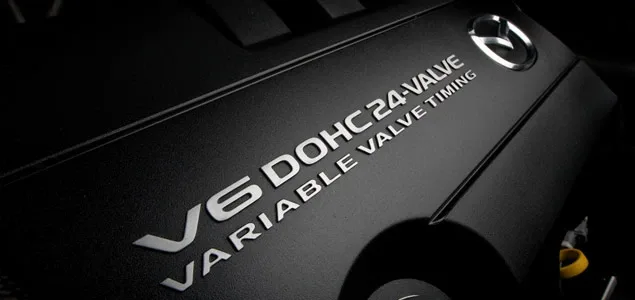 |
But safe sections did exist to test the engine's dynamics. Of course, for a heavy car, 277 horsepower isn't that much. The CX-9 accelerates to 100 km/h in 10.1 seconds, but with 366 Newton-meters of torque, the V6 engine pulls confidently from low revs, and as revs rise, it becomes even more spirited. A new six-speed automatic gearbox from Aisin helps realize the potential — it's smart and fast, but it loves to downshift at the slightest touch of the brake, helping to "brake with the engine."
But the SUV can't be called economical. The new MZI V6 with a displacement of 3.7 liters is based on Ford's Cyclone V6 and is therefore American-style voracious. On the highway (at an average speed of 100 km/h), the car consumed about 15 liters per 100 km instead of the claimed 9.9 liters. But that's less than what the CX-7 with its 2.3-liter turbo engine consumes under the same conditions. Moreover, buyers of expensive cars rarely think about fuel costs. What matters more to them is the tank volume, and the CX-9 has 76 liters.
Choice Without Choice
Inside, the car pleased with its spaciousness. The cabin is truly six-seat — in the third row, not only children but also adults can sit comfortably. At the same time, the trunk still has enough room for bags — 267 liters, almost like a Peugeot 207, for instance.
|
Interior Secondly, I was pleased with what the cabin was assembled from. There is an abundance of soft plastic here, and the interior is done in a pleasant "sand" shade. Some may find the front panel and center console a bit plain, but personally, their strictness seems solid and executed in the best German traditions. True, there is a nuance: the leather, which looks expensive, feels more like vinyl and is quite slippery. However, there's no choice — the leather interior is part of the standard equipment, so you'll have to pay for it anyway. For the Russian market, the flagship crossover is offered in a single, maximally equipped version. The price of this modification is 1 million 713 thousand rubles. In America, this variant is called Grand Touring, but here it got the name Sport. The equipment list includes a six-seat leather interior, alloy wheels with 245/50 R20 tires, front seats with memory function, three-zone climate control, a Bose audio system with ten speakers, keyless entry, and all-wheel drive with active torque distribution ATS (Active Torque-Split). If you want to pay extra, the only available option will be a sunroof, for which they will ask 28 thousand rubles. But xenon headlights are not provided for the CX-9 at all — neither in the base nor for an extra charge. They simply don't exist. For now. The company promises that xenon will appear later, possibly paired with a navigation system.
|
 <\/td> <\/tr> <\/tbody><\/table> <\/div> <\/div>
 <\/td>
  <\/td>
  <\/td> <\/tr>