

When Honda Pilot and Mazda CX-9 were just preparing to enter the Russian market, their creators counted on a cloudless future in a country where oil revenues flowed like a river, and loans were issued faster than TV commercial casts change. They didn't send their "offspring" to us right away — first, they were sent to gain experience in North America, where they were to undergo a baptism of fire in the fight for customers' wallets. And so, after such an "internship," the Honda Pilot and Mazda CX-9, having already mastered English, finally reached us.
 ANGULAR OR STREAMLINED?
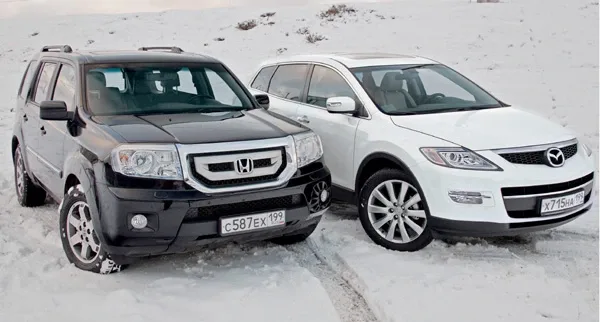
Both cars are large, with powerful engines and multi-seat cabins. But at the same time, they are complete opposites, which even someone far from the intricacies of automotive design will notice.
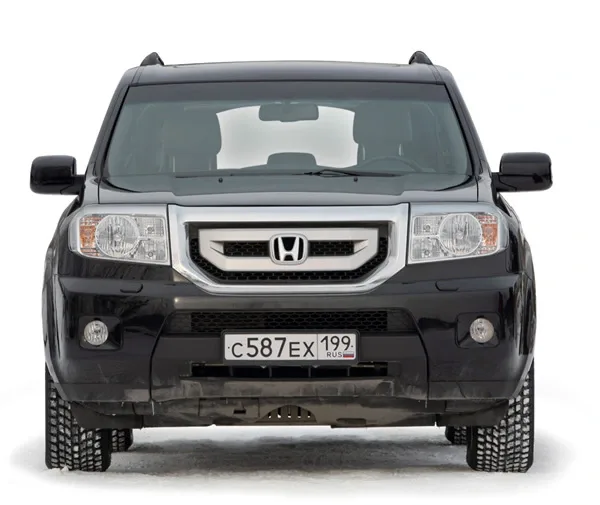
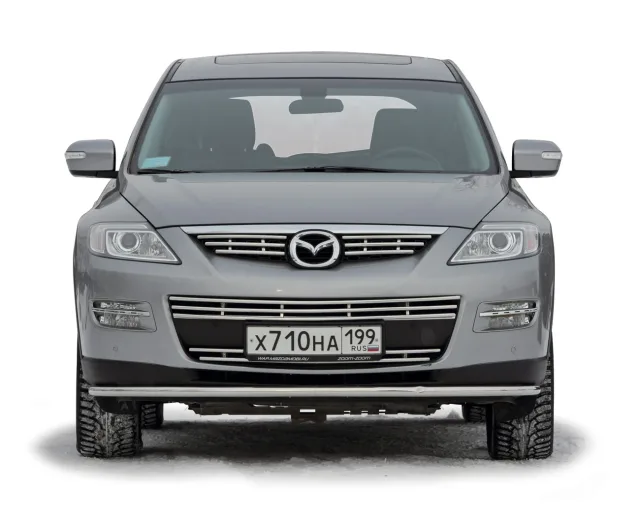
Pilot, especially in black, resembles a low-flying grand piano — chopped and stern. The senior Mazda model, on the contrary, flaunts streamlined shapes and signature features in the spirit of the mysterious "zoom-zoom" philosophy.
Mazda's designers certainly had an easier time: they essentially adapted the concept of the younger CX-7 to new dimensions. But the competitors from Honda sweated more — Pilot was created from scratch. It inherited nothing from its predecessor except, perhaps, impressive external power. The headlights are huge, and the radiator grille is the size of a writing desk.
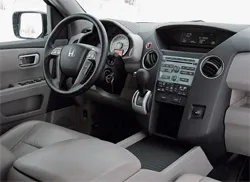
A similar situation is inside. If the CX-9's interior has absorbed the best from the entire Mazda lineup, then Honda has almost no single part that would be found on other brand models.
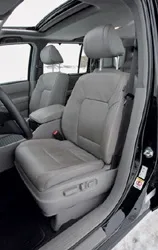
The "pilot's cabin" is angular, with a peculiar character, but very practical, especially for those who love long trips or are used to stowing all sorts of little things in niches. This is a real paradise for those who never throw anything away. One box alone at the bottom of the center console can swallow the contents of a small travel bag, and there are plenty of such containers here.
ANGULAR OR STREAMLINED?
Both cars are large, with powerful engines and multi-seat cabins. But at the same time, they are complete opposites, which even someone far from the intricacies of automotive design will notice.
Pilot, especially in black, resembles a low-flying grand piano — chopped and stern. The senior Mazda model, on the contrary, flaunts streamlined shapes and signature features in the spirit of the mysterious "zoom-zoom" philosophy.
Mazda's designers certainly had an easier time: they essentially adapted the concept of the younger CX-7 to new dimensions. But the competitors from Honda sweated more — Pilot was created from scratch. It inherited nothing from its predecessor except, perhaps, impressive external power. The headlights are huge, and the radiator grille is the size of a writing desk.
A similar situation is inside. If the CX-9's interior has absorbed the best from the entire Mazda lineup, then Honda has almost no single part that would be found on other brand models.
The "pilot's cabin" is angular, with a peculiar character, but very practical, especially for those who love long trips or are used to stowing all sorts of little things in niches. This is a real paradise for those who never throw anything away. One box alone at the bottom of the center console can swallow the contents of a small travel bag, and there are plenty of such containers here.
Mazda cannot boast of an abundance of compartments. The glove box is small, the box between the seats quickly fills with discs and stops performing its functions. Overall, like the CX-7, the big "zoom-zoom" does not favor hoarders, as the trunk clearly hints, which, given such body dimensions, seems quite tiny, especially in depth.
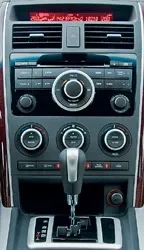
But the main person in the car is still the driver, and here everyone chooses for themselves. The sporty cockpit of the CX-9 will appeal to those who seek a spark of driving pleasure even in a two-ton SUV, while Pilot, as its complete opposite, is made for men who are alien to infantilism and design frills. But there is one detail that introduces dissonance into this stern picture: light turquoise instrument dials and the same insert on the audio system panel. It feels like the interior designers at some point realized they had overdone it with masculine monumentality.
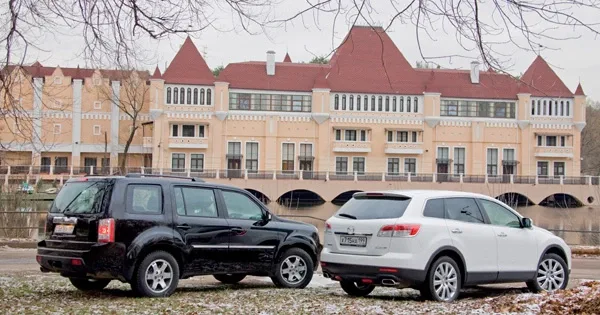
There is another important difference between them — recognizability. The CX-9, especially from the front, can easily be confused with the younger CX-7, but Pilot is fine in this regard. Its huge "big-eyed" face is visible from a mile away, as is its completely inexpressive rear.
JAPAN OR AMERICA?
The three-and-a-half-liter engines in both heroes are large and torquey, which is not surprising: for the American market, powerful torque is almost the main argument after a favorable loan rate.
 Mazda is noticeably more powerful — an advantage of 20 hp, but in the mandatory race to a hundred, the rivals arrive almost simultaneously, and even with a slight advantage for the big "Pilot." Honda engineers equipped their engine with Variable Cylinder Management, which can deactivate up to three cylinders out of six — for fuel economy and reduced emissions. True, in a stop-and-go city rhythm, serious savings don't work out, and the fuel gauge needle inexorably creeps toward zero. However, the CX-9's engine has an even bigger appetite.
The characters of the cars are opposite. Honda smoothly sways on the road and carefully smooths out all bumps. Minimal vibrations penetrate the cabin, and the engine barely purrs under the huge hood. In tune with this philosophy, the steering is set up, allowing itself some relaxation, and the automatic transmission lacks a manual mode. Sit down — and just float along leisurely. Of course, if you need to overtake sharply, the engine will wake up almost instantly, all six cylinders will engage, and the huge angular mass, growling menacingly, will lunge forward. But this is not a favorite activity for the "Pilot" — it is, oddly enough, a purebred "American." Not so with Mazda, whose creators never hid that their main priority is handling and driving pleasure.
Like its younger "brother," the CX-9 can't be called a crossover. The short-travel, elastic suspension, sharp steering, and responsive gas pedal turn a conventional SUV into a huge all-wheel-drive hatchback with sports car habits. You can forget about measured "floating" over asphalt expanses — Mazda was not created for that.
And what about off-road talents? Honestly, they don't impress. No matter how hard we tried to find arguments in favor of the fact that these are not just soft-roaders, it was all in vain. Even the advanced all-wheel-drive system of the Pilot didn't save it, whose geometric off-road capability doesn't allow it to overcome even a harmless pit without prior reconnaissance. What can we say about the CX-9 with its 20-inch wheels on low-profile tires and a simple all-wheel-drive scheme.
Mazda is noticeably more powerful — an advantage of 20 hp, but in the mandatory race to a hundred, the rivals arrive almost simultaneously, and even with a slight advantage for the big "Pilot." Honda engineers equipped their engine with Variable Cylinder Management, which can deactivate up to three cylinders out of six — for fuel economy and reduced emissions. True, in a stop-and-go city rhythm, serious savings don't work out, and the fuel gauge needle inexorably creeps toward zero. However, the CX-9's engine has an even bigger appetite.
The characters of the cars are opposite. Honda smoothly sways on the road and carefully smooths out all bumps. Minimal vibrations penetrate the cabin, and the engine barely purrs under the huge hood. In tune with this philosophy, the steering is set up, allowing itself some relaxation, and the automatic transmission lacks a manual mode. Sit down — and just float along leisurely. Of course, if you need to overtake sharply, the engine will wake up almost instantly, all six cylinders will engage, and the huge angular mass, growling menacingly, will lunge forward. But this is not a favorite activity for the "Pilot" — it is, oddly enough, a purebred "American." Not so with Mazda, whose creators never hid that their main priority is handling and driving pleasure.
Like its younger "brother," the CX-9 can't be called a crossover. The short-travel, elastic suspension, sharp steering, and responsive gas pedal turn a conventional SUV into a huge all-wheel-drive hatchback with sports car habits. You can forget about measured "floating" over asphalt expanses — Mazda was not created for that.
And what about off-road talents? Honestly, they don't impress. No matter how hard we tried to find arguments in favor of the fact that these are not just soft-roaders, it was all in vain. Even the advanced all-wheel-drive system of the Pilot didn't save it, whose geometric off-road capability doesn't allow it to overcome even a harmless pit without prior reconnaissance. What can we say about the CX-9 with its 20-inch wheels on low-profile tires and a simple all-wheel-drive scheme.
 WAITING FOR BETTER TIMES
What the heroes of this test were really unlucky with is timing. They appeared here almost at the height of the financial storm. Buyers who just yesterday were calling dealers non-stop are now storming exchange offices, buying up currency, and banks, in a time crunch, are rewriting loan rates upward. It's a shame.
WAITING FOR BETTER TIMES
What the heroes of this test were really unlucky with is timing. They appeared here almost at the height of the financial storm. Buyers who just yesterday were calling dealers non-stop are now storming exchange offices, buying up currency, and banks, in a time crunch, are rewriting loan rates upward. It's a shame.
ANGULAR OR STREAMLINED?
Both cars are large, with powerful engines and multi-seat cabins. But at the same time, they are complete opposites, which even someone far from the intricacies of automotive design will notice.
Pilot, especially in black, resembles a low-flying grand piano — chopped and stern. The senior Mazda model, on the contrary, flaunts streamlined shapes and signature features in the spirit of the mysterious "zoom-zoom" philosophy.
Mazda's designers certainly had an easier time: they essentially adapted the concept of the younger CX-7 to new dimensions. But the competitors from Honda sweated more — Pilot was created from scratch. It inherited nothing from its predecessor except, perhaps, impressive external power. The headlights are huge, and the radiator grille is the size of a writing desk.
A similar situation is inside. If the CX-9's interior has absorbed the best from the entire Mazda lineup, then Honda has almost no single part that would be found on other brand models.
The "pilot's cabin" is angular, with a peculiar character, but very practical, especially for those who love long trips or are used to stowing all sorts of little things in niches. This is a real paradise for those who never throw anything away. One box alone at the bottom of the center console can swallow the contents of a small travel bag, and there are plenty of such containers here.
 |  |
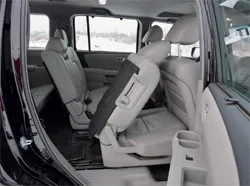 | WELCOME ON BOARD The Honda cabin comfortably seats up to eight passengers. And there will still be room for modest luggage. Isn't that a personal plane? |
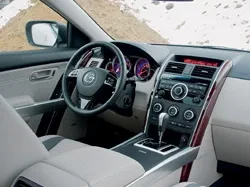 |  |
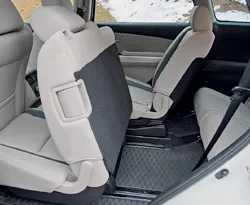 | FAMILY ZOOM-ZOOM Kids and grandparents will also appreciate Mazda's philosophy — the CX-9 is designed for seven, and there's enough "zoom-zoom" for everyone. For individualists, there's a styling package with grille overlays and roof rails (below). |
Mazda is noticeably more powerful — an advantage of 20 hp, but in the mandatory race to a hundred, the rivals arrive almost simultaneously, and even with a slight advantage for the big "Pilot." Honda engineers equipped their engine with Variable Cylinder Management, which can deactivate up to three cylinders out of six — for fuel economy and reduced emissions. True, in a stop-and-go city rhythm, serious savings don't work out, and the fuel gauge needle inexorably creeps toward zero. However, the CX-9's engine has an even bigger appetite.
The characters of the cars are opposite. Honda smoothly sways on the road and carefully smooths out all bumps. Minimal vibrations penetrate the cabin, and the engine barely purrs under the huge hood. In tune with this philosophy, the steering is set up, allowing itself some relaxation, and the automatic transmission lacks a manual mode. Sit down — and just float along leisurely. Of course, if you need to overtake sharply, the engine will wake up almost instantly, all six cylinders will engage, and the huge angular mass, growling menacingly, will lunge forward. But this is not a favorite activity for the "Pilot" — it is, oddly enough, a purebred "American." Not so with Mazda, whose creators never hid that their main priority is handling and driving pleasure.
Like its younger "brother," the CX-9 can't be called a crossover. The short-travel, elastic suspension, sharp steering, and responsive gas pedal turn a conventional SUV into a huge all-wheel-drive hatchback with sports car habits. You can forget about measured "floating" over asphalt expanses — Mazda was not created for that.
And what about off-road talents? Honestly, they don't impress. No matter how hard we tried to find arguments in favor of the fact that these are not just soft-roaders, it was all in vain. Even the advanced all-wheel-drive system of the Pilot didn't save it, whose geometric off-road capability doesn't allow it to overcome even a harmless pit without prior reconnaissance. What can we say about the CX-9 with its 20-inch wheels on low-profile tires and a simple all-wheel-drive scheme.
WAITING FOR BETTER TIMES
What the heroes of this test were really unlucky with is timing. They appeared here almost at the height of the financial storm. Buyers who just yesterday were calling dealers non-stop are now storming exchange offices, buying up currency, and banks, in a time crunch, are rewriting loan rates upward. It's a shame.
| Manufacturer data
Mazda CX-9
■ ENGINE 3726 cm3 petrol, V6 273 hp at 6250 rpm, 366 Nm at 4250 rpm ■ TRANSMISSION Automatic, 6 speeds, all-wheel drive ■ PERFORMANCE max speed – 181 km/h 0-100 km/h – 10.1 s ■ DIMENSIONS (mm) length – 5074 width – 1936 height – 1728 ■ ECONOMY average consumption – 13 l/100 km | Manufacturer data
Honda Pilot
■ ENGINE 3471 cm3 petrol, V6 257 hp at 5700 rpm 347 Nm at 4800 rpm ■ TRANSMISSION Automatic, 6 speeds, all-wheel drive ■ PERFORMANCE max speed – 180 km/h 0-100 km/h – 9.9 s ■ DIMENSIONS (mm) length – 4870 width – 1995 height – 1845 ■ ECONOMY average consumption – 11.8 l/100 km |