The domestic auto industry is unlikely to ever decide to create such an impractical car, which also has no utilitarian purpose, for example, for the military enlistment office. Therefore, it is not surprising that the fashion for crossovers was brought to us from Japan, and the pioneers were Toyota RAV4 and Honda CR-V.
However, the situation has changed now: one after another, crossovers are being designed with an eye on the United States. And soon, perhaps, models created specifically for Russia will appear — after all, in terms of sales volumes of such cars, we have already become leaders in Europe.
SHE DOES EVERYTHING BETTER...
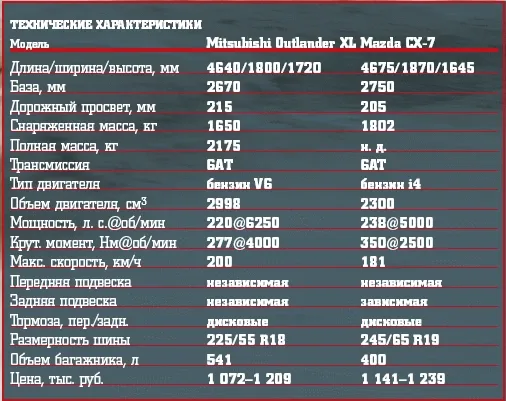
The American origin of the Mazda CX-7 is visible to the naked eye — it is the largest representative of its segment, its body stretches to 4675 mm. In addition, it has a daring, persistent, and frankly demonstrative appearance that applies to both the exterior and the interior. Fortunately, the American traits end there.
Before the debut of the CX-7, the largest in the class of mid-size crossovers was considered the Hyundai Santa Fe with its 4650 mm, and the Mitsubishi Outlander XL, 4640 mm long, was slightly inferior to it. It was the Mitsubishi that we took as a rival — both are Japanese, both recently appeared at our dealers.
For the shooting, we drove out onto an icy track that was cleared on the territory of a still unfinished park. We had to endlessly shuttle back and forth in front of the lens. For about ten minutes, I was circling on this patch, which was noticeably narrower than a regular lane, behind the wheel of the CX-7. Then, after switching to the XL, I, as they say, changed my expression. Moving at the same speed and at the same relaxed pace was no longer possible. All my long-standing sympathy for the Outlander evaporated in a matter of seconds. It turns out that Mazda really does everything better.
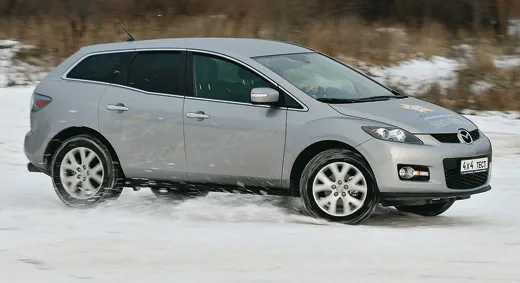
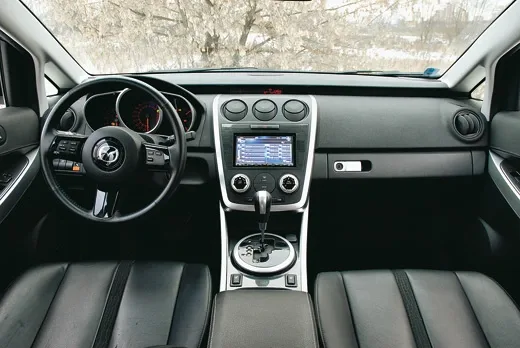
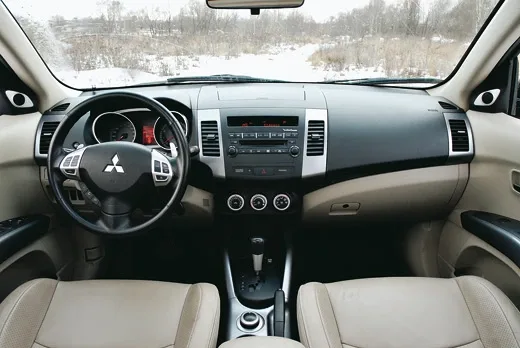
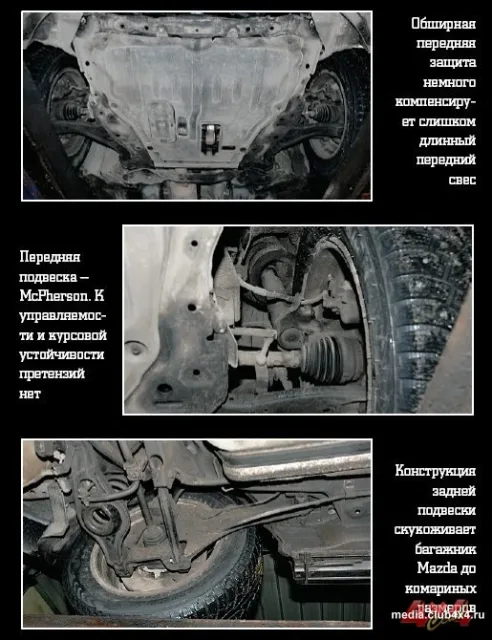
It holds the course more confidently, its steering wheel is more precise and informative. In addition, it has a lower center of gravity, and the wheelbase and track are wider.
Here is the zoom-zoom philosophy in action. Let me remind you that this slogan means nothing more than the childish "vzhik-vzhik" — the sound that kids use to imitate a moving car. It turned out to be more pleasant and reliable to buzz behind the wheel of a Mazda.
SPECS: MAZDA CX-7
SPECS: MITSUBISHI OUTLANDER XL

WHO'S FIRST AT THE START?
The excitement did not let us go, and we arranged traditional standing-start races. And in vain! From the starting line, the Mitsubishi XL effortlessly pulled away from the Mazda CX-7 by a full car length, and this gap did not shrink until the 100 km/h mark.
Is the atmospheric three-liter Outlander engine really more powerful than the turbocharged 2.3-liter unit of the CX-7? The official data says the opposite. The Mitsubishi has 220 hp, the Mazda has 238 hp. The XL reaches peak power at 6250 rpm, while the CX-7 does so already at 5000 rpm. The torque situation is similar: the Mazda has 350 Nm at 2500 rpm, the Mitsubishi has 277 Nm at 4000 rpm. According to the documents, the CX-7 reaches 100 km/h in 8.3 seconds, and the XL in 9.7.
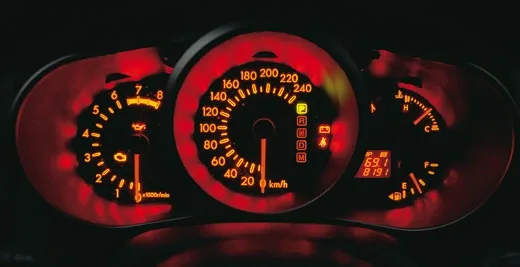
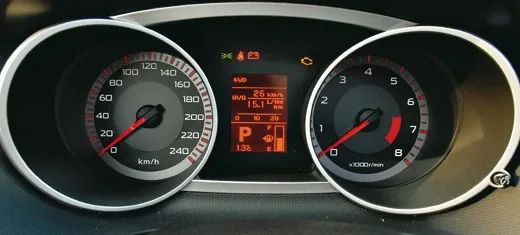
The official acceleration figures cannot be trusted! It has been proven more than once that they diverge from reality. Did Mazda simply add an extra one and a half to two seconds to itself?
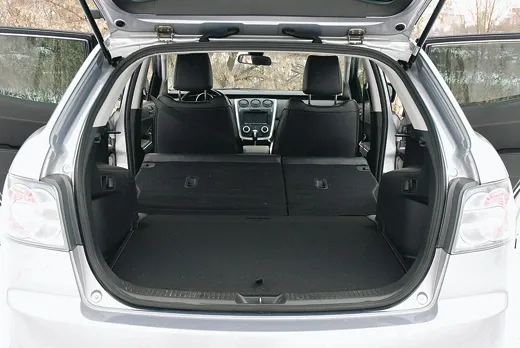
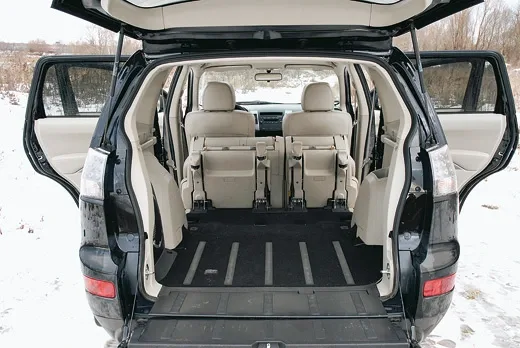
However, let's return to our tests. Dynamics are not important to everyone. Some want seating comfort, trunk volume, and interior transformation. And here, despite the spacious interior of the Mazda, it is more comfortable to sit in the second row in the Outlander. The XL's trunk is both larger and better organized: 510 liters versus 400 for the Mazda. But the CX-7 has rear seat backs that fold down with one motion.
If you consider each of these crossovers separately, both are capable of bringing joy from driving and are suitable for both family and business trips. But still, the big "American" from Mazda is perceived as more cohesive. And not only on asphalt.
ACCIDENTALLY SMART
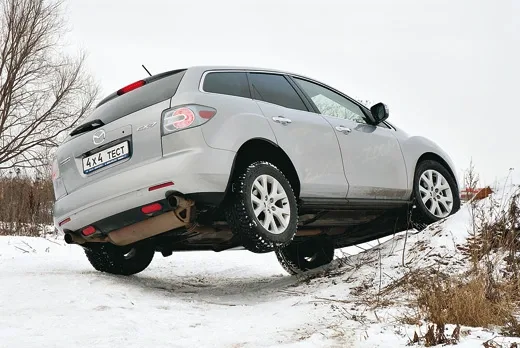
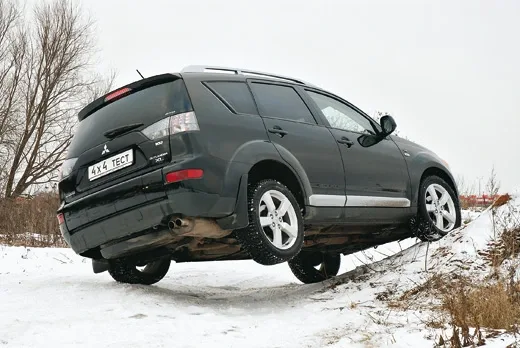
After the highway duels, we turned onto a dirt road, or rather, onto frozen bumps covered with snow and ice. The task was classic — to hang one, and if lucky, two wheels, to evaluate the work of electronic assistants. The Mitsubishi spun hopelessly, storming obstacles, but did it painfully slowly. It required a serious run-up and really frayed the driver's nerves.
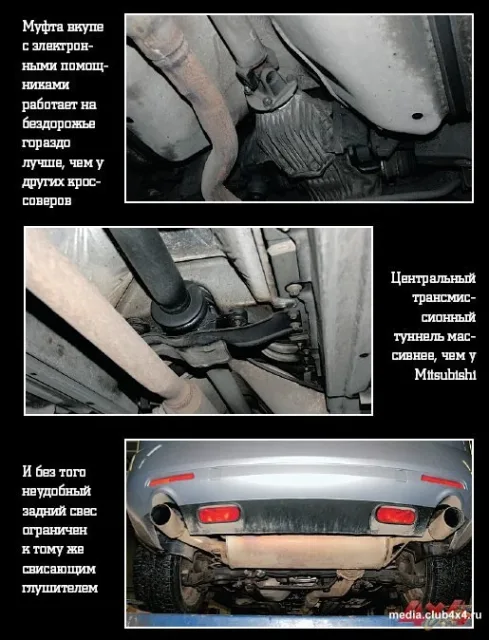
The Mazda, on the other hand, obeyed the pilot's commands unquestioningly, without delays or arguments. This is truly sensible electronics for a crossover. Unfortunately, in most crossovers, except perhaps the Land Rover Freelander, the electronic systems are tuned not for off-road, but for maintaining trajectory on asphalt. The CX-7 was not specially prepared for off-road. But its ESP on dirt turned out to be very useful. Plus, the limited-slip differential on the rear axle contributed its share.
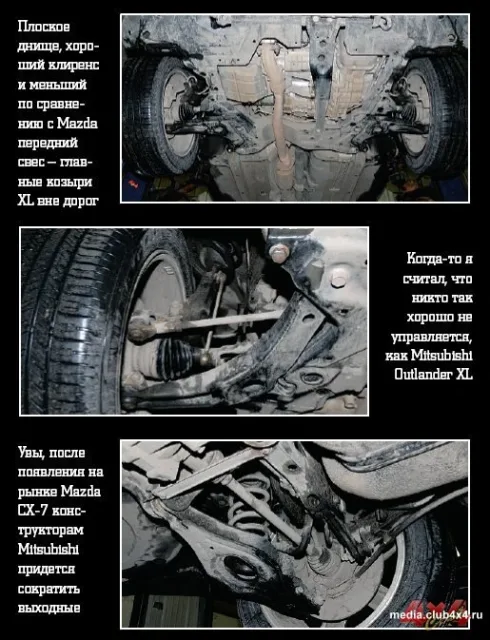
The CX-7 system works like this: when a wheel hangs in the air, the electronics choke the engine, but if the driver is persistent and continues to press the gas, after a couple of moments it releases the revs and, gently braking the spinning wheels, lets the car crawl further. As a result, the Mazda did not even require a slight run-up on the icy incline when one of the wheels was hanging. Yes, the XL also managed the off-road route, but it was a pitiful sight, accompanied by desperate wheelspin and nervous efforts. The Mitsubishi was saved only by its greater ground clearance (215 mm versus 205 mm for the Mazda) and, of course, the increased approach angle.
So, we found out which of them is the main one. It seems that... Although, if you don't pit them against each other in a head-on attack, both cars are good in their own way.