
A familiar smile
Last summer, Moscow frayed nerves considerably: first heat of nearly forty degrees, then almost a month of smog from burning peat bogs. So Mazda's offer to spend a couple of days in Moldova testing the updated CX-7 crossover became a real breath of fresh air — both to take a break from the metropolis and to give the lungs a workout.
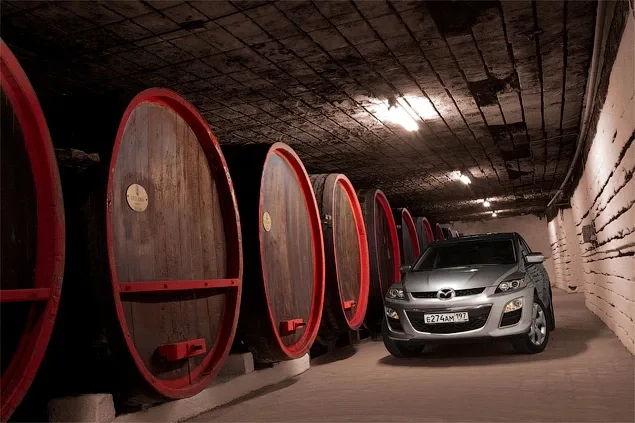
After the scorching Moscow asphalt, Chisinau — one of the greenest cities in Europe — seems almost like paradise. Parks, squares, streets — everything is immersed in greenery. In the shade of trees, you can leisurely examine all the changes in the design of the Japanese crossover. And honestly, there aren't that many of them…
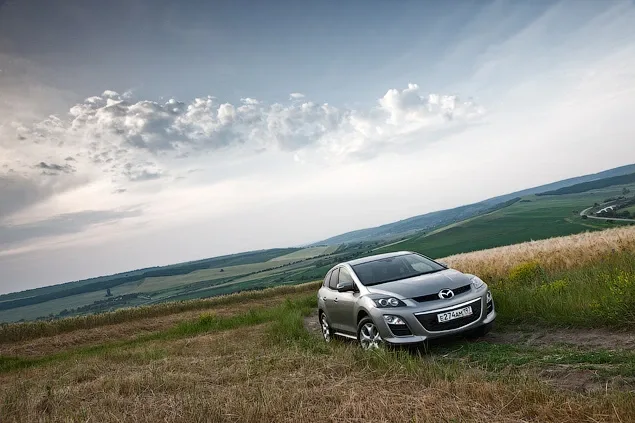
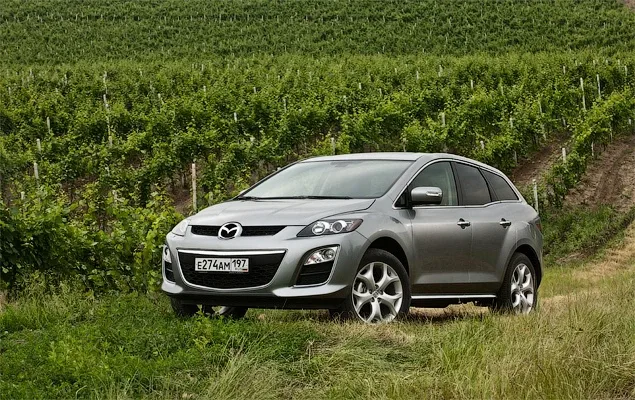
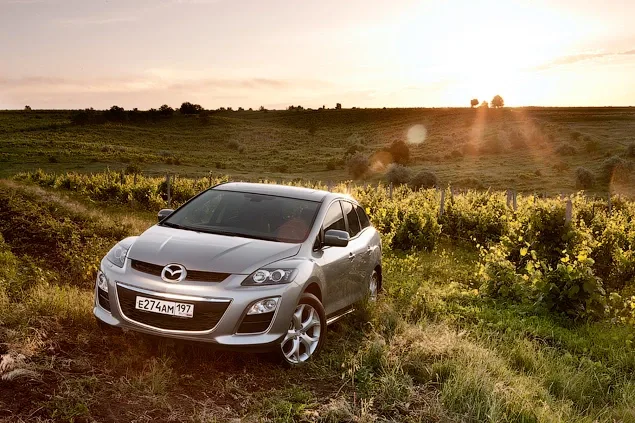
The previous CX-7 was beautiful in its own way and even aggressive — muscular wheel arches, a large air intake, longitudinal stampings on the hood. But after the restyling, the car became even angrier: the "mouth" of the radiator grille enlarged, large vertical niches for fog lights and two spoiler skirts appeared on the sides of the front bumper, the rear bumper changed, and there's more chrome. It turned out well — the crossover didn't lose its style, but acquired bright details that allow it to be unmistakably distinguished from its predecessor and refresh interest in the model. Which, in fact, was needed.
Moving to the interior… The first serious change is the new center console. The narrow display, which previously showed all information — from fuel range to climate and audio settings — has disappeared.
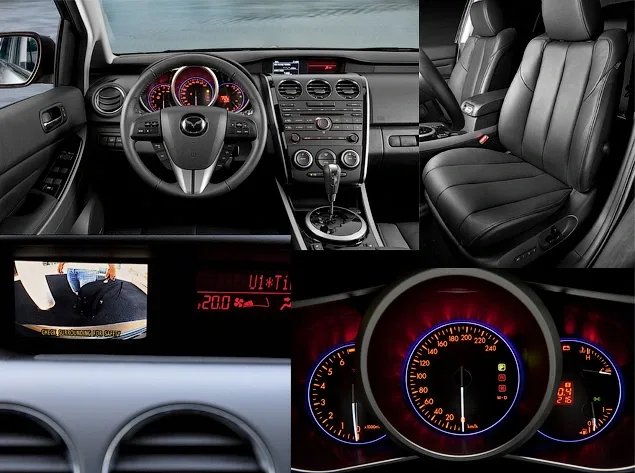
Instead, two screens appeared, "à la" Mazda3. On the right — a regular display in black and red with climate control and audio system readings. And closer to the driver — a color one, which, in addition to onboard computer data, also shows (attention!) the image from the rearview camera. However, the simplest audible parking sensors are still not in the CX-7 equipment list. And that's bad, because the display is too small for comfortable parking, is located too far from the driver, and the image on it is not of the best quality, and there are no guide lines showing the trajectory.
Moreover, the camera is "standard" only in the top Sport version, and for the more affordable "Touring" it's offered in an options package that increases the crossover's price by 20 thousand rubles. Continuing the theme of new additional equipment: leather seats now have memory settings, the interior mirror can now automatically dim, and mirrors fold electrically. However, multi-stage seat heating is not even in the options list.
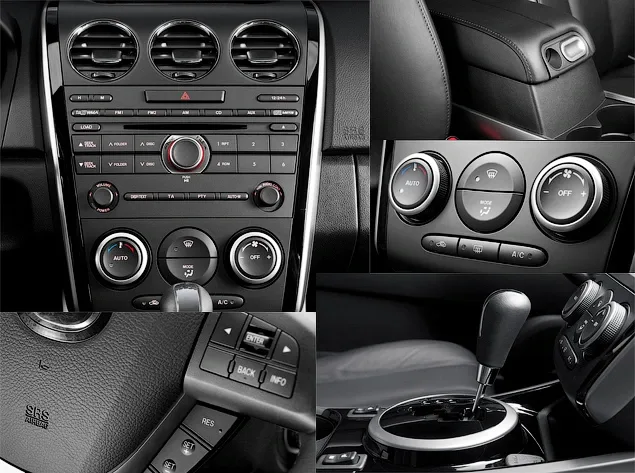
The updated CX-7 also got the "all-Mazda" three-spoke steering wheel, like on the "three" and "six", which now adjusts not only for height but also for reach. The design of door panels, central armrest, and air ducts changed slightly, new instrument scales appeared, and the center tunnel and other interior elements are now finished with glossy black plastic with chrome trims.
Having finished the inspection, we receive final instructions from Mazda representatives — according to them, Moldovan traffic inspectors are lenient about minor traffic violations, but strictly punish speeding — and we head out of Chisinau onto the country's roads.
And if with beautiful nature and the amount of greenery in Moldova everything is in order, then the roads here are only a name. The only highway with decent pavement, according to locals, was built by the former president of the country from his official residence to his dacha. But the bad roads, which we had to cover more than two hundred kilometers on, provided an excellent opportunity to test the suspension.
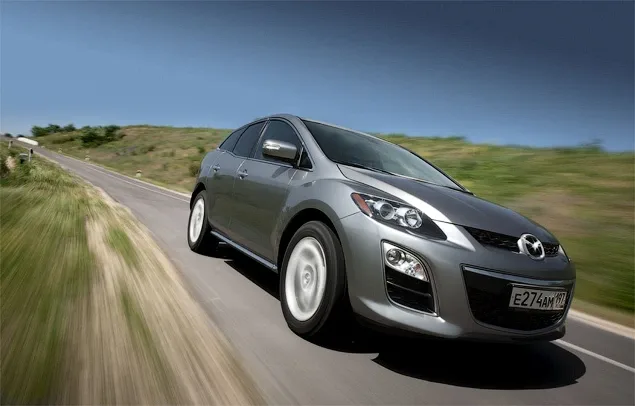
Its design hasn't fundamentally changed: in front it's still MacPherson, and in the rear — a retuned multi-link from the "three". Engineers assure that on the restyled CX-7, the damping characteristics of the shock absorbers were changed, but in reality, it wasn't possible to feel the difference. The Mazda indeed rides quietly and softly over small irregularities and small potholes, but the crossover doesn't like serious potholes, and on really bad asphalt with many holes and cracks, after a few minutes of driving, the suspension starts to "thump".
By the way, we encountered extraneous sounds in the suspension that occur after a few kilometers of driving on "killed" asphalt even on the pre-restyling car, during a long test in 2008. Then we decided that the shock absorbers overheat and stop holding on rebound, because after a minute of "rest" everything returned to normal. However, it's worth noting that only a very, very bad road can "loosen up" the CX-7's suspension…
But even on such a road, the CX-7 handles excellently. At least for a crossover. Perhaps some credit goes to the increased torsional rigidity of the body. Moreover, to avoid installing additional reinforcing structures, Mazda engineers modernized the very technology of joining body panels, which combines spot welding with adhesive.
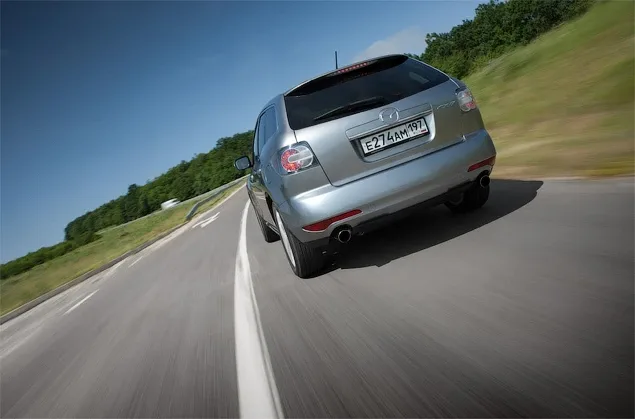
The restyled "C-X" clings perfectly to a winding road, passing turns with minimal body roll, and pleasing with a pleasant heaviness of the informative steering wheel. But you still shouldn't overdo speed in corners, because the high center of gravity hasn't been canceled. However, even in extreme modes, the car behaves predictably, sliding outward with all four wheels, and in an emergency, the stability control system will back you up. It just intervenes quite sharply and roughly — to such an extent that the car stops responding to the accelerator for a couple of seconds.
The updated crossover, like its predecessor, is equipped with an all-wheel drive system with a clutch in front of the rear wheels, redistributing torque between the front and rear axles in a ratio from 100:0 to 50:50. And the power unit — a turbocharged 238-horsepower 2.3-liter engine and a six-speed automatic transmission — the Japanese engineers also decided to keep without any modifications.
And probably, that's right. After all, the engine is good — it has a huge torque reserve and a spirited character, and if you don't let the revs drop below 2.5 thousand, where the maximum torque of 350 Nm is achieved, you even get the feeling that you're driving not a two-ton car, but a nimble "hot" hatchback. And thanks to the reconfiguration of the engine control unit, which allowed to slightly reduce the turbo lag effect and sharpen the response to pressing the gas pedal, acceleration in the CX-7 is perceived as more "linear".
Another thing is that for powerful acceleration and extra newton-meters of torque, the CX-7 owner has to pay with considerable fuel consumption. According to the "passport", in the urban cycle, the updated crossover consumes 15.3 liters per hundred kilometers, and in combined — 11.5 liters. But in reality, during the trip through Moldova, the average consumption of our car was just over 18 liters of 95-octane gasoline per "hundred".
And if we recall how the previous CX-7 behaved, it is quite possible to expect that in city traffic jams the appetite of this crossover will easily exceed the 20-liter mark. Therefore, it is especially disappointing that Russian buyers will not be offered either the relatively affordable version with a 2.5-liter naturally aspirated engine producing 161 horsepower, which Americans have, or the 2.2-liter turbodiesel delivering 173 horsepower and 400 newton-meters. True, in Europe this diesel is paired exclusively with a manual gearbox, and in our country cars of this class with a manual transmission are traditionally not favored. Sad.
What else has changed in the updated CX-7? First of all, it is noticeable that the cabin has become noticeably quieter — the sound insulation has clearly been improved. But as soon as the car drives over gravel, the rattle of stones on the wheel arches reminds of itself with the same persistence. Also, the manufacturer has closed some gaps in terms of safety. Now the crossover's arsenal includes a system that automatically turns on the hazard lights during hard braking, and an assistant that monitors blind spots. If someone in the adjacent lane is hiding from the driver's view, a special pictogram lights up in the mirror. This function works starting from 55 km/h and can detect cars at a distance of up to 50 meters.
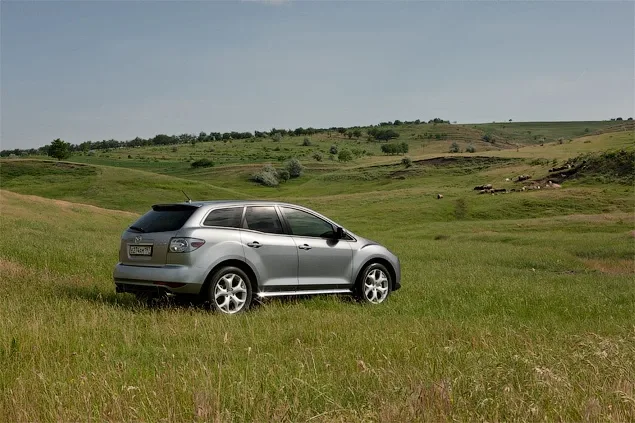
It is pleasant that, despite all the innovations, prices for the crossover have not increased significantly. The initial Touring trim, which includes climate control, cruise control, heated front seats, a radio with MP3 support and four speakers, six airbags, and 18-inch wheels, is priced at 1 million 229 thousand rubles.
For the top Sport version, which can boast xenon headlights, a rear-view camera, a rain sensor, keyless entry, and leather seats with memory settings, you will have to pay 1 million 374 thousand rubles. But the electric folding mirrors and the blind spot monitoring system are the prerogative of only this maximum version.
If you look at classmates, the CX-7 does not look expensive at all. For example, the Volkswagen Tiguan with a 170-horsepower two-liter engine starts from 1 million 197 thousand rubles. The Toyota RAV4 with a 2.4-liter engine of the same power and an automatic transmission starts from 1 million 260 thousand. And the Nissan X-Trail with a 169-horsepower unit and a CVT costs at least 1 million 171 thousand 400 rubles.
However, Mazda is not embarrassed by such figures and looks to the future with optimism. They are confident that the restyling will boost interest in the model. Moreover, the company says that in some regions there is already a six-month waiting list for the new crossover. There are also those willing in the capital, but they will have to wait much less.
The updated cars are already driving around Moscow streets. And it is not difficult to distinguish them from previous versions — just look carefully at the predatory smile of the radiator grille. Auto.Lenta
Technical characteristics of Mazda CX-7
| 2,3 MZR DISI Turbo | ||
| Length, mm | 4700 | |
| Width, mm | 2055 | |
| Height, mm | 1645 | |
| Wheelbase, mm | 2750 | |
| Curb weight, kg | 1831 | |
| Engine displacement, cm3 | 2261 | |
| Power, hp/rpm | 238/5000 | |
| Torque, Nm/rpm | 350/2500 | |
| Maximum speed, km/h | 181 | |
| Acceleration from 0 to 100 km/h, s | 8,3 | |