
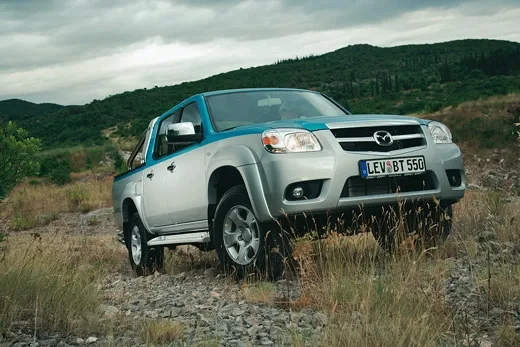
Asking owners and fans is a waste of time. They look at the car through rose-colored glasses, and no arguments will convince them. Any unbiased person will ask a logical question: "Why can't the driver's seat be adjusted for height? There's plenty of room above your head."
Almost all pickups in this segment, except for the SsangYong Actyon Sports, suffer from the same problem — a driver slightly above average height has to sit with knees raised almost to the chin. However, we were never the target audience for such cars. The main sales market is Southeast Asia, where people are generally short. So we can only be glad for the new radiator grille, leather steering wheel, and updated instrument panel — the latter is truly successful: the numbers are large and easy to read. True, for this set you will have to pay from 7 to 14 thousand rubles depending on the trim level. The base version with metallic paint costs 644 thousand, the top version — 869 thousand.
But Mitsubishi recently took a different path and cut the price of the L200 by 7%. Mazda is still cheaper, but the difference in marketing approaches is obvious. And why is the L200 selling 2.5 times better in Russia? It's all about the magical combination of "automatic transmission," which hypnotizes buyers, plus permanent all-wheel drive, allowing you to drive in 4x4 mode all year round.
When journalists at the presentation of the updated BT-50 asked the Japanese about the automatic transmission, they answered evasively. In Australia — please, even tomorrow, but for Russia — someday, maybe. But buyers are not used to waiting. The BT-50 would not have been hurt by an "automatic" if only because the standard 2.5-liter diesel lacks low-end torque. A torque converter would add elasticity, especially since the car, as the Russian Mazda marketer admitted, is designed for off-road.
The remaining questions at the presentation concerned service and the terrible work of dealers. And here owners have reason to be sad: the oil in the diesel BT-50 needs to be changed every 5 thousand km (for the Mitsubishi L200 — 15 thousand, for the Nissan NP-300 — 10 thousand). You save on fuel — you overpay on maintenance. Our diesel fuel has a lot of sulfur, it gets into the oil, forms acid, and corrodes the engine. The Japanese are powerless here. But they could influence dealers. I have not dealt with Russian Mazda dealers, but the stories of owners are impressive. It seems that they have a program to drive away regular customers. And it's strange that journalists complained about this only to Russian managers, but were shy to ask the Japanese directly. And in vain — in such matters, modesty is unnecessary.
For those who have been offended by sellers, let me remind you: the concept of "official dealer" does not exist in Russian legislation. If you are not satisfied with prices and service, you can contact any licensed workshop. And if "official dealers" then refuse warranty — this is a direct violation of the law "On Protection of Consumer Rights" and the Civil Code, for which a serious penalty is due. And there is nothing to be ashamed of.
But enough about the sad stuff. Despite the low seat and strange dealers, the BT-50, in my opinion, remains the best truck in its class on the Russian market.