
Facelift
Do you know how to make a Moscow journalist drop everything for a test or presentation? Just utter the magic word "facelift" in his presence — and he's ready to fly to the ends of the earth, stuffing his backpack with cameras, and patiently endure a multi-hour layover at the airport.
It was this very magic word, mentioned in Mazda's invitation, that lured me, along with a small group of colleagues from Russia and Europe, to distant Croatia to get acquainted with the updated Mazda BT-50 pickup. Facelift…
Imagination, of course, immediately painted something incredibly "zoom-zoom": with elongated headlights, a sharp-angled grille, and sculpted fenders. Something so futuristic that the current Mitsubishi L200 would seem utterly mundane next to it. So, upon receiving the press kit about the new "BT" at the airport, I first opened the spread with a large photo… and stared at the image for several minutes, trying to understand: what, exactly, had changed? No use — I had to look into the press release.
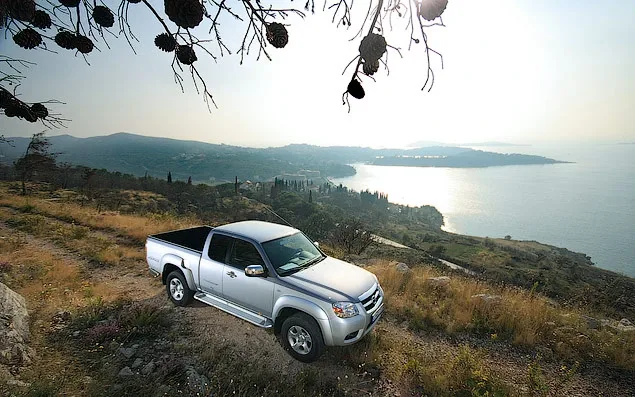
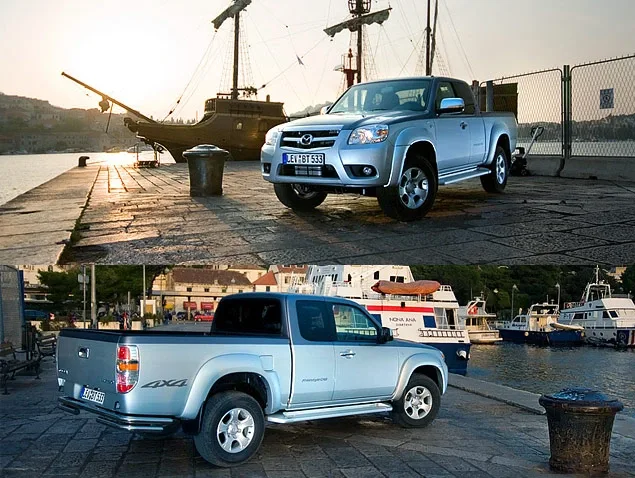
It turned out that the "facelifted" Mazda BT-50 had only one exterior change — the front bumper, made together with the grille. The grille itself became pentagonal and acquired a chrome checkmark strip at the bottom, while the large air intake in the bumper was made trapezoidal and more "aggressive" by the Japanese (or Malaysian?) designers. That's all.
Facelift? Why not… Lately, we've seen many times how differently automakers understand this term. Some, like Ford with the Focus, change all body panels except the roof during an update. Others — for example, Peugeot in the case of the "407" — call a car a facelift when only the number of cells in the fake grille has changed.
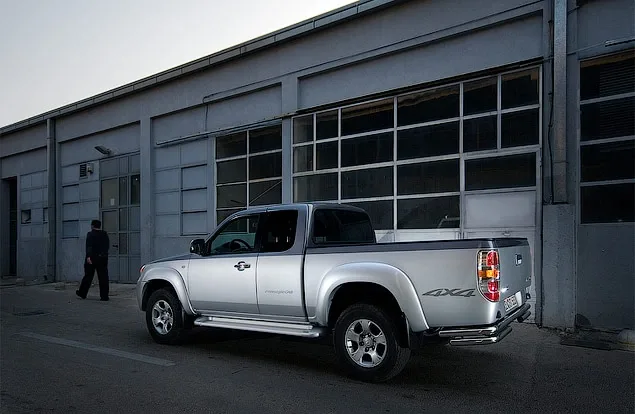
But the BT-50, besides the bumper, also had the internal structure of the headlights refined and the design of the wheel rims updated! And if you carefully study the press materials, you'll learn that the "BT" will now be offered in five new colors, including glamorous turquoise and rich blue, with a total of 11 body shades available for this pickup. Plus three new two-tone paint options: silver "bottom" and dark gray, turquoise, or black "top." It looks nice, but the surcharge for the unusual color is 18 thousand rubles.
In the accessories list for the BT-50, a branded hardtop for the bed appeared (previously Mazda dealers offered the same one but from the Ford Ranger) and an original trunk that attaches in the cargo area and is equipped with two key-lockable lids.
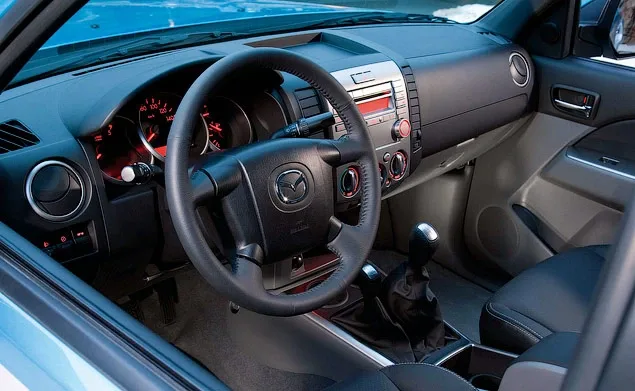
Inside the Mazda BT-50, everything is the same, except for the red instrument lighting instead of the dull green (though some colleagues assured me that green bulbs seem incredibly cozy to them) and the addition of a separate connector for connecting an mp3 player. In base versions, a new fabric is used for seat upholstery, while expensive modifications now include a leather interior. However, leather-wrapped steering wheel and gear lever can be ordered on simpler versions, as can electric adjustment of side mirrors with heating.
But technically, the BT-50 hasn't changed at all — it still comes with the torquey 2.5-liter turbodiesel, a proper all-wheel-drive transmission with a rigidly engaged front axle and a self-locking differential at the rear. The "BT" also has purely rear-wheel-drive modifications, but they are not sold here.
During the presentation in Dubrovnik, we were allowed to drive all modifications of the updated Mazda BT-50 — with single, extended (where the rear side door panels open against the direction of travel), and double cabs. But in Russia, as before, only the "double cab" version will be sold — true cargo modifications of pickups are hardly in demand in our country.
We also won't see (at least in the foreseeable future) a version of the "BT" with an automatic transmission. Despite all the pleas from the Russian Mazda office and dealers, the head office still hasn't decided to start supplying "automatic pickups" to our market. And that's strange, because pickups with "automatics" are already produced — for Australia, but only with right-hand drive. And without the "hydromechanics," the BT-50 in Russia has no chance in the fight for the title of best-selling pickup against the popular Mitsubishi L200.
On the other hand, the Japanese can also be understood: Russia, although it is the largest sales market for "BTs" in Europe, significantly ahead of Greece, the UK, and Germany, still sells only 3-4 thousand cars a year — that's too little to bother with producing a special version for our country. Our "Mazda" will have to keep increasing sales, if the crisis doesn't interfere…
Meanwhile, the new Mazda BT-50 is already on sale in Russia — live cars began arriving at dealers in early October. Prices increased by 7-15 thousand rubles depending on the modification: the "bare" pickup (even without air conditioning) in the Direct version now sells for 626 thousand rubles.
The most popular "BT" in the Touring trim with body-colored bumpers and fender flares, air conditioning, power windows, leather-wrapped steering wheel and gear lever, heated mirrors, a full set of airbags, an mp3 stereo, and alloy wheels will cost 741 thousand rubles.
And the most expensive Active trim with a leather interior and the fullest list of additional equipment will now sell for 851 thousand rubles.
P.S. Don't be surprised that there are no driving impressions in the text. The fact is that the new "BT" in this regard is no different from the "old" model. The pickup, as before, seems very comfortable on dirt roads, has good directional stability on good asphalt, and on a long journey pleases the driver and passengers with decent sound insulation and comfortable seats.
Therefore, read all other "driving" details about the Mazda pickup below, in the material of my colleague, who drove the pre-facelift "BT" several thousand kilometers during his trip to Karelia.
Karelian Difficulties Sergey Belousov
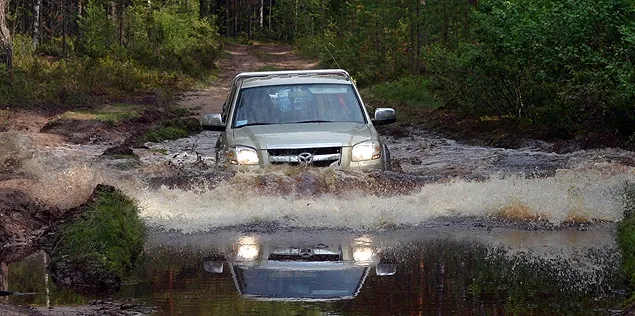
In the summer, I bought a rubber boat and a motor for it, got a license for "operating small vessels," and decided to head to Lake Onega in Karelia to test my new watercraft. In principle, the motor along with the inflatable boat fits in my station wagon, but for that, I have to fold down the rear seat, and there's no room left for other things. So, for the trip, I needed larger transport. Or a trailer. But without a tow hitch, a trailer and my car are incompatible, so as "transport" I chose a Mazda BT-50 pickup, still pre-facelift. How much worse (or better) it looks compared to the new model — let's leave that to connoisseurs of visual aesthetics. What matters to me in pickups is not how they look, but what they can do. The Mazda BT-50, as it turned out, can do a lot, but if it gets into trouble, helping it will be very difficult. We've already written about the all-wheel-drive system of the BT-50 clone — the Ford Ranger, whose technical component fully replicates the Japanese pickup. I see no point in talking about it again. However, unlike the Tver expedition, my Karelian trip had to be done without the support of two SUVs, without winches, and without "toothy" BFGoodrich tires. All that was in our "BT's" arsenal for overcoming Karelian forests was a large jack (also known as a "hi-lift") and a couple of strong tow ropes. The first thing I felt an acute need for was a hardtop. On the test car, as luck would have it, there wasn't one, so all the gear in the bed had to be carefully tied down with ropes and cables. But even that didn't help — on the way, I still lost something. 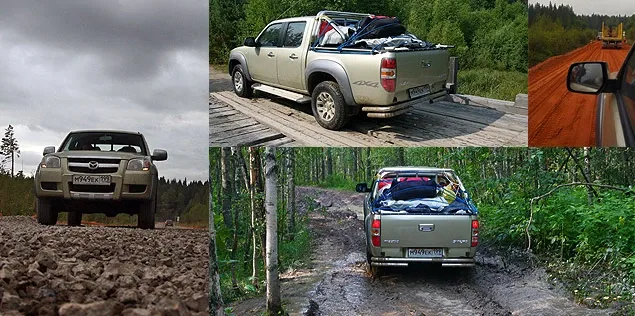 |
Mazda BT-50 Specifications
| Length, mm | 5075 |
| Width, mm | 1805 |
| Height, mm | 1760 |
| Wheelbase, mm | 3000 |
| Curb weight, kg | 1800 |
| Engine displacement, cm3 | 2499 |
| Power, hp/rpm | 143/3500 |
| Torque, Nm/rpm | 330/1800 |
| Acceleration 0-100 km/h, s | 12.5 |
| Top speed, km/h | 158 |
| Fuel consumption (combined), l/100 km | 8.9 |