
| The Ligurian coast of sunny Italy... A beautiful city with a name as sonorous as an effectively tuned exhaust system, Rappalo... Early spring, warm sun... Hot Pyrenean beauties... And the Mazda6. |
 "Mazda6 again?" – you'll surely be surprised. "That model we've already seen a hundred times?" But no, not quite. Or rather, the same, but different. Now we're talking about five-door versions – the hatchback and wagon, as well as a new two-liter turbodiesel. It's clear that all these updates are primarily aimed at the European market. Sales statistics for the previous generation of the "six" show that in Europe, the wagon was the most in demand (40% of sales), the hatchback took second place (34%), and the sedan, which is so loved in Russia, had to settle for only 26% – that is, about a quarter of the total volume. "Mazda6 again?" – you'll surely be surprised. "That model we've already seen a hundred times?" But no, not quite. Or rather, the same, but different. Now we're talking about five-door versions – the hatchback and wagon, as well as a new two-liter turbodiesel. It's clear that all these updates are primarily aimed at the European market. Sales statistics for the previous generation of the "six" show that in Europe, the wagon was the most in demand (40% of sales), the hatchback took second place (34%), and the sedan, which is so loved in Russia, had to settle for only 26% – that is, about a quarter of the total volume. |
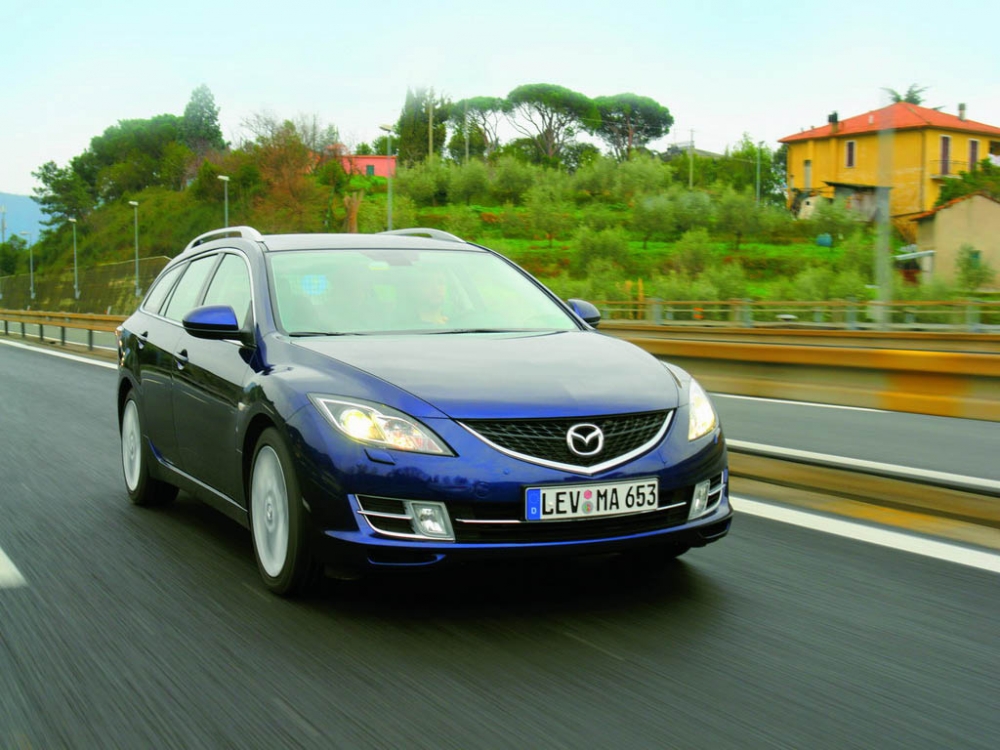 Europeans have long appreciated all the advantages of five-door cars. Their practicality with almost the same external dimensions as a sedan is an obvious advantage. "Shed"? In Europe (and even in the US), such a word wouldn't even cross anyone's mind – "wagon" sounds much nicer. Ugly? Look at today's wagons: they often look even sportier, more dynamic, and more elegant than sedans. More fuel? That's a myth. Stiff suspension? Usually the difference is minimal. Poor visibility? Again, just self-suggestion. So, is a wagon all pluses? Maybe not entirely, but they clearly outweigh all those imagined minuses. Europeans have long appreciated all the advantages of five-door cars. Their practicality with almost the same external dimensions as a sedan is an obvious advantage. "Shed"? In Europe (and even in the US), such a word wouldn't even cross anyone's mind – "wagon" sounds much nicer. Ugly? Look at today's wagons: they often look even sportier, more dynamic, and more elegant than sedans. More fuel? That's a myth. Stiff suspension? Usually the difference is minimal. Poor visibility? Again, just self-suggestion. So, is a wagon all pluses? Maybe not entirely, but they clearly outweigh all those imagined minuses. |
 It's a pity that the stubbornness of our compatriots in their love for sedans and distrust of wagons and hatchbacks resembles that very stiff, unyielding suspension. The same goes for diesel engines. Mazda understands this perfectly well, and also knows about the quality of our fuel, so they decided not to supply the "six" with the two-liter turbodiesel to Russia. Demand is too low. And it's a shame. The engine isn't bad – torquey, fairly quiet, and with moderate vibration. The torque is high, and in low gears it works real wonders. But the working range is a bit narrow, which forces you to constantly work the lever of the "shortened" gearbox. And in high gears, the car isn't too peppy either. So, maybe there's not much to be upset about... It's a pity that the stubbornness of our compatriots in their love for sedans and distrust of wagons and hatchbacks resembles that very stiff, unyielding suspension. The same goes for diesel engines. Mazda understands this perfectly well, and also knows about the quality of our fuel, so they decided not to supply the "six" with the two-liter turbodiesel to Russia. Demand is too low. And it's a shame. The engine isn't bad – torquey, fairly quiet, and with moderate vibration. The torque is high, and in low gears it works real wonders. But the working range is a bit narrow, which forces you to constantly work the lever of the "shortened" gearbox. And in high gears, the car isn't too peppy either. So, maybe there's not much to be upset about... |
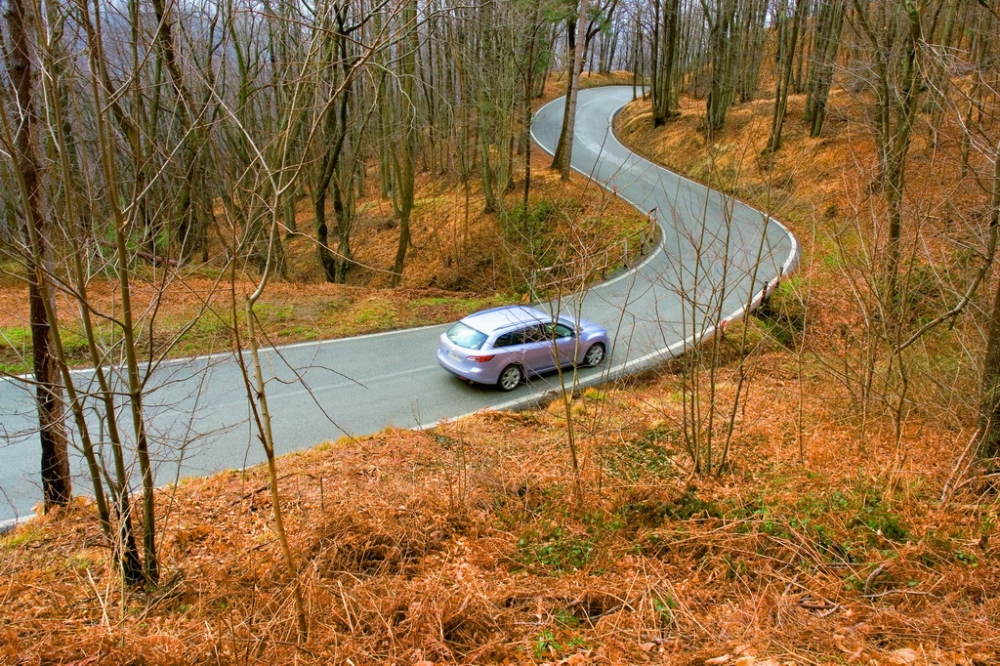 As for body styles, why shouldn't Mazda – one of the fastest-growing brands on the Russian market – try to break the established stereotype about the prestige of sedans and the "shedness" of wagons? Especially since the new Mazda wagon is just a sight to behold, it's so beautiful! As for body styles, why shouldn't Mazda – one of the fastest-growing brands on the Russian market – try to break the established stereotype about the prestige of sedans and the "shedness" of wagons? Especially since the new Mazda wagon is just a sight to behold, it's so beautiful! |
The first thing that comes to mind after returning from Italy is, of course, beauty. No, I'm not talking about the picturesque landscapes and local beauties, although there are plenty of both. I'm talking about the magnificent Mazda6 wagon – it's simply stunning!
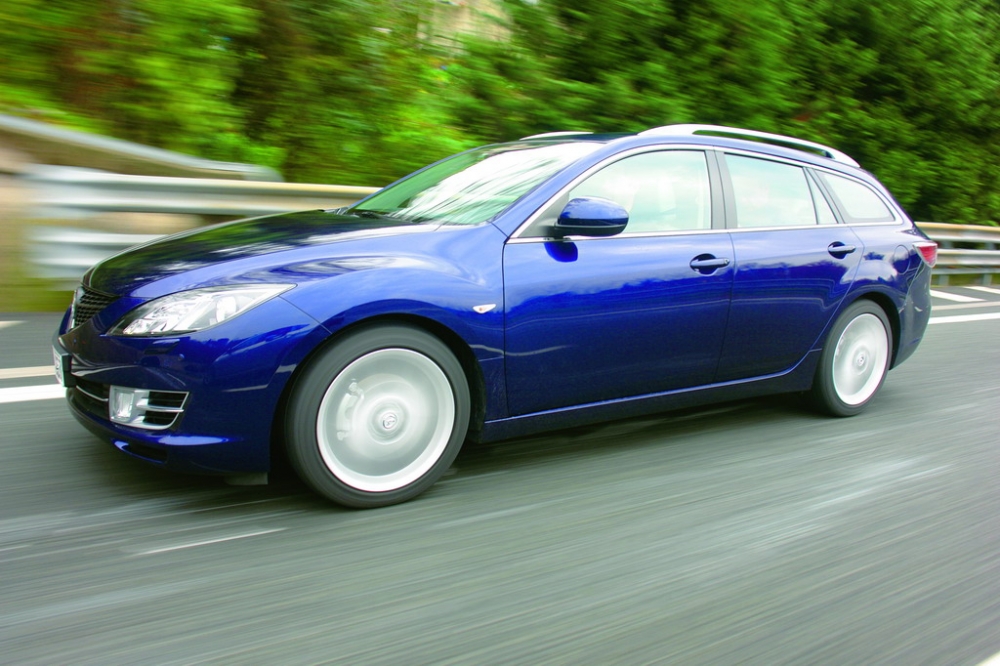
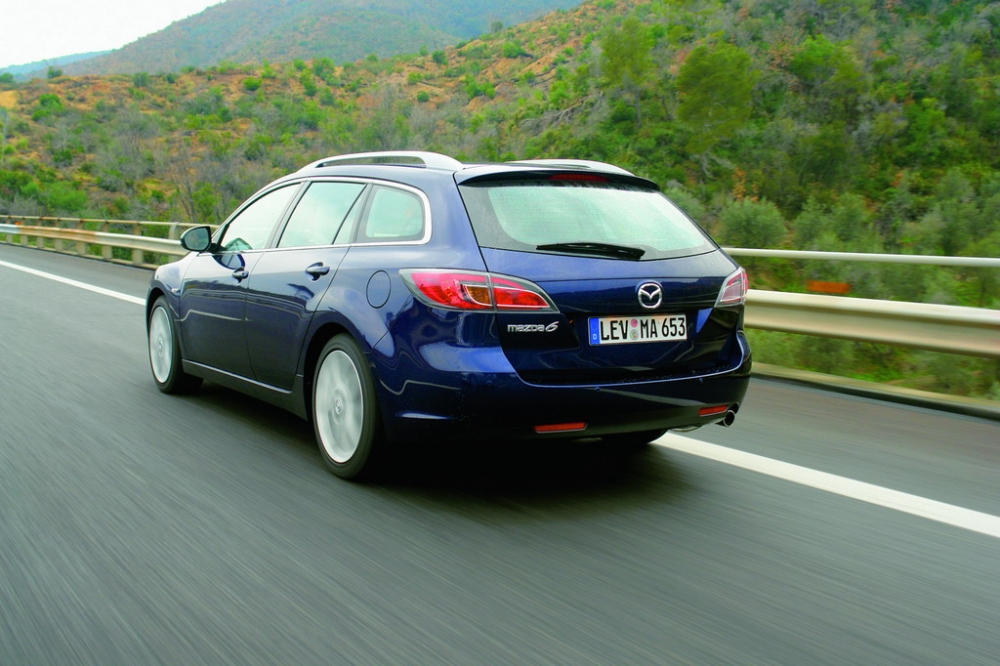
Of the three body styles created by designer Yoichi Sato, this one seems to me the most successful. The beltline, which on the sedan breaks off somewhat illogically, here continues its rise behind the rear doors, ending in an elegant and, I'm not afraid to say, very attractive curve on the pillars. Along the lower part of the doors runs a stylish stamping parallel to this line. The sedan is certainly handsome, but the wagon looks more refined and dynamic. The rear with the heavily raked tailgate glass also looks great. And it's no "shed" at all!
The hatchback, in my opinion, turned out less successful. It's certainly not bad, but it lacks the lightness that the sedan and wagon have. Perhaps it's the somewhat heavy rear end. Besides the looks, it's worth noting the excellent aerodynamics. The drag coefficient for the hatchback and sedan is just 0.27, and for the wagon – one "tenth" more. That's an excellent figure! Moreover, good aerodynamics contributes to cabin quietness (which, by the way, is completely identical to the sedan's). Together with the noticeably improved sound insulation of the new-generation Mazda6, this allows you to speak in a low voice even at high speeds. And the Mazda6 loves fast driving, as we've already noted in our previous tests in October 2007 and February 2008.
The wagon is three centimeters longer than its siblings, and its rear suspension was slightly recalibrated and became a bit stiffer. However, this barely affected handling. Hundreds of kilometers along the mountain serpentines of San Colombano and Chiavari showed that the car hasn't lost any precision in steering or smoothness of ride. It remains dynamic and comfortable, and its responses to the steering wheel and brake pedals are precise and predictable. The difference in dynamics, in essence, depends only on the chosen engine. It's a pity I didn't get to load the enlarged trunk to the full – to transport some cargo or family items. Perhaps then the different suspension would have shown itself more clearly. But as it is, I repeat, the difference from the sedan is barely noticeable, and this was repeatedly confirmed by numerous ascents and descents in a ragged rhythm – sometimes braking before a steep 270-degree turn, sometimes accelerating on the exit.
If there is any difference, it's almost imperceptible. Much more discomfort was caused by the 18-inch wheels. On perfectly smooth highways and country roads of the Ligurian coast near Genoa, there were no problems at all – the car handled great, but on mountain rural roads or cobblestones of small towns like Recco or Portofino, it shook considerably, fatigue quickly accumulated, and a desire arose to change the wheels and tires. Given that in Russia almost all roads outside the near Moscow region resemble cobblestones, I wouldn't advise future owners to chase a larger diameter. But 16-inch wheels in the huge arches of the Mazda6 look quite small, so 17-inch diameter seems to me that very golden mean.
Now about the trunk – after all, it's supposedly the wagon's main trump card. Despite the sloping rear glass, it's huge. One or two movements – and before you opens an immense space. The maximum volume with the second-row seats folded is 1751 liters! The rear door opening is also wide – 1066 mm. You can easily load a small sofa or refrigerator, not to mention all sorts of little things for the garden, repairs, and so on. And a dog will feel great there. True, to transport a four-legged friend, you'll have to remove that miracle shelf of the luggage compartment.
The mechanically retractable translucent curtain is a true pride of Mazda! A real "gimmick"! They say they thought about it for a whole 4 years. They even wanted to install a servo drive, but they figured – that's extra weight and extra cost. In the end, they settled on ordinary mechanics. And, probably, for the better – it's more reliable. But from the experiments with the curtain, apparently, unnecessary electric motors remained. They found a use for them – hatchbacks in standard trim got a power tailgate closer. That's how carefully they treat things in a country that has practically no natural resources of its own.
As for engines for the Russian market, there are still three – 1.8, 2.0, and 2.5 liters. With any of them, you can choose a sedan or hatchback, with the first two engines able to work in conjunction with an automatic transmission. Wagons, however, will be available only with 1.8 and 2.0-liter engines. In my opinion, the optimal option is the two-liter engine with a five-speed automatic – it's a true golden mean in terms of power, price, and comfort.
And still, it's a pity... It's a pity that we don't like wagons and don't appreciate all their advantages. There would be more beautiful cars on the roads, and many people's problems with transporting all sorts of things would be solved, and they'd take up the same amount of road space. But our fellow citizens just don't want to become more European. Eh, mentality...