
Princess-Frog
In Paris, Berlin, and London, the new Mazda6 is not yet on the streets. But in Russia, there are already plenty of these cars. Several hundred have been delivered to customers, primarily in the capital, and another 10 are currently driving around Siberia between Surgut and Khanty-Mansiysk. There, in December, the Russian presentation of the Mazda6 for journalists is taking place.
The new generation of the "six" was long awaited, but any official information about it "surfaced" only at the end of August. It was about ten photographs that caused a real stir in the Russian-speaking internet. Everyone was talking about this car, wanting to know the specs and prices, to look, to price it, to touch it.
 |  |
The next wave of excitement following the photos came at the Frankfurt Motor Show. Then the car was officially presented to the public, and the first technical information appeared. For example, it became known that Mazda had abandoned the platform of the new Ford Mondeo - it would have been more expensive and would have required more development time.
From the appearance of the first photos of the "six" until the end of the Frankfurt Motor Show, the Auto.Lenta.Ru website recorded about 150 thousand visits to materials dedicated to it. In the entire history of our resource, such interest was generated only by the Lada C concept car, the new BMW X5, and the latest Ford novelties - the facelifted Focus and Kuga.
Mazda perfectly understood that the car was awaited in Russia. And already in early October, two months before sales began, it organized another presentation, letting journalists get behind the wheel. However, the driving part consisted only of a few laps around the test track, but we learned almost everything about the car's design.
Now we've managed to fill the gap in driving impressions. After driving plenty across the Siberian expanses, we'll tell you what the new "six" is like "in the wild." And if you're interested in the "hardware," refer to the October article. There it's written how the chassis changed, what equipment appeared, what grades of steel the body is made of, how they achieved a drag coefficient of 0.27, and much more.
Fairy-tale transformations
Before flying from Moscow, and then in Surgut, we were given several brochures with information about the new Mazda6. All of them show the same picture: a car with a crown on its roof, driving on snow and pulling a skier behind it. The skier didn't interest any of my colleagues, but the crown made us recall two fairy tales at once. The first is about the Snow Queen, and the second is about the Frog Princess. It's clear that the artist was hinting at the Snow Queen, but we also remembered the Frog Princess for a reason. Why?
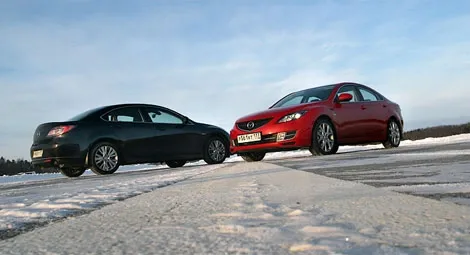 |  |
For the old-generation "six," such duality was quite characteristic. On one hand, there were bright advantages: attractive appearance, decent handling, and a relatively low price.
But on the other hand, there was still a bit of the "frog": in terms of cabin comfort, finish quality, and equipment set, the Mazda6 completely lost to any European classmate. And over time, when most competitors underwent a generational change, this gap became even more noticeable: for a large family car, no trim level offered parking sensors, no adaptive headlights, no MP3 stereo...
Despite all this, right up to the end of the old "six's" production life, Russians continued to vote for it with their wallets and hearts, and it remained among the sales leaders all that time.
The new "Mazda-six" is also likely destined for bestseller status. But it wasn't allowed to show its "frog skin" under any circumstances: even the cheapest version comes with alloy wheels and an MP3 stereo. And expensive modifications boast 18-inch wheels, combined or leather interiors, parking sensors, auto-dimming rearview mirror, and adaptive bi-xenon headlights.
Interestingly, almost specially for Russia, a Sport version with a two-liter engine and an automatic transmission appeared. Its content, of course, is not sporty at all - acceleration to 100 km/h takes 11 seconds. But it looks very good both outside and inside. And that's what most buyers actually need.
Top model
In Moscow, for several years now, winter has been associated not with snow, but with a gray-brown slush, washing which off the windows uses up five liters of "anti-freeze" a day. But in Surgut, winter is real.
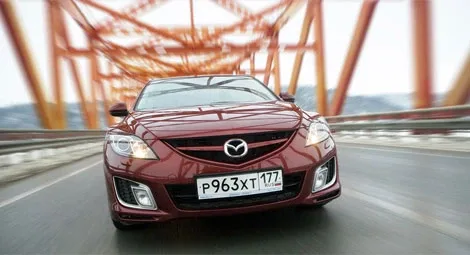
True, we didn't initially notice the thin transparent film of ice on the asphalt. And being confident that roads in Siberia are dry and clean, we asked the organizers for the most powerful version of the Mazda6 - with a 170-horsepower 2.5-liter engine and a six-speed manual.
Due to the ice, this car couldn't realize its potential, generally speaking. You press the gas, the wheels start scratching the ice with studs, and the traction control system immediately "chokes" the engine. So, that's how we drove the first part of the route - to Nefteyugansk.
 |  |
On the other hand, it's clear that on good pavement, the dynamics of the 2.5-liter "six" are fine. Its predecessor with the old 2.3 engine accelerated quite well. Now four more "horses" and 19 newton-meters have been added, and the car itself has "lost weight" by over 30 kilograms.
The six-speed manual is essentially the same as that installed on the first "six," but it works much better - gears engage clearly and almost effortlessly, and no vibrations are transmitted to the lever. The designers achieved this in a fairly simple way: the shift mechanism was moved to a new location and recalibrated, synchronizers were changed, and a dual-mass flywheel was used. It makes shifts much smoother.
However, engines and gearbox are not the main changes. The powertrains, except for the 2.5-liter, were inherited from the previous generation. But everything related to comfort has been thoroughly reworked.
Firstly, good sound insulation appeared: the engine became quieter, the suspension quieted down, snow, water, and sand no longer rustle in the wheel arches, and at high speeds, wind noise is no longer audible. Even the hum of studded tires, quite loud outside, barely penetrates the cabin.
The concept of "ride smoothness" in relation to a Japanese car can now be used without quotation marks - its suspension has been taught to handle "typical Russian" asphalt defects softly and silently.
Finally, and this is perhaps the most important for the buyer, the "six," like in the famous TV intro, doesn't miss the opportunity to tell its owner "feel our love." When he gets behind the wheel, it lights up the instruments and displays one by one, and in response to turning the ignition key, it greets the owner with a "bell" sound and the inscription "Zoom-Zoom."
If the owner decides to change the audio system volume or retune the radio, blue light stripes will start "running" across the center console. All this creates the feeling that the car is alive.
The Mazda6 also knows how to say goodbye. When the engine is turned off, the display shows "Goodbye," and the instruments smoothly go out.
Test site
The intermediate point of our route was a test site on the territory of a "semi-operational" airport in Nefteyugansk. There, on a cleared and almost ice-free runway, we had the opportunity to drive different "sixes" between cones and test the car in a braking corridor.
Even on the way to Nefteyugansk, I noted that on slippery roads, the stability control system works very well. On one hand, it prevents the driver from making serious mistakes, and on the other, it intervenes in control very softly and almost imperceptibly. As far as I remember, the old "six's" electronics acted much more harshly.
At the test site, on the third lap around the cones, I decided to turn off the stability control and accelerate harder. Somewhere in the middle of the "slalom," I turned the steering wheel too sharply, and a skid began. To correct it, I had to quickly turn the wheel in the other direction, and then I realized: oh miracle - thanks to replacing the hydraulic power steering with an electric one, the steering wheel no longer "bites." And with old "sixes," this was a family disease. Very unpleasant, I must admit.
Bestseller
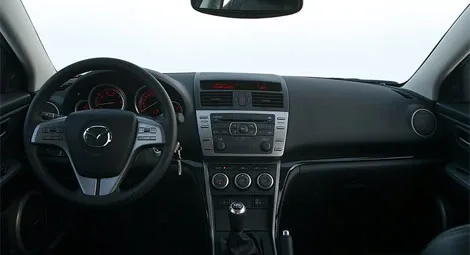
After the test site, my colleagues and I swapped cars, and we got a Mazda6 Touring with a two-liter engine and an automatic transmission. According to marketers' expectations, this car will be the most popular in Russia. The Touring trim differs from the expensive Sport and Luxury versions by having a fabric interior, 17-inch wheels instead of 18-inch, a simpler instrument panel design, and halogen headlights instead of bi-xenon.
 |  |
All the positive things we said above about the top-of-the-line "six" also apply to the two-liter "Touring": a comfortable, quiet, well-built car that can win you over at first sight.
The five-speed automatic can certainly be praised for its smoothness and predictability of shifts, but it lacks a bit of "intelligence." More precisely, adaptability. Unlike many modern gearboxes that adapt to driving style, this transmission operates on a very simple algorithm: you release the gas - it shifts up, you press it - it waits a bit and drops one or two gears. Just like in the old "six."
But the manual mode here is absolutely honest: when you hit the rev limiter, it doesn't allow an automatic upshift, and with a sharp press of the gas, it doesn't downshift. So before overtaking, you can manually shift down and accelerate instantly when a gap appears in oncoming traffic.
The two-liter engine with 150 horsepower paired with such a gearbox, of course, cannot endow the "Mazda" with breathtaking dynamics. On the other hand, it accelerates quite confidently up to 120-140 kilometers per hour. And you don't need to go faster - remember what speeding fines come into effect from the New Year.
The engine's character, as with the 2.5-liter unit, is very smooth. No dips, no surges - you press the gas, and the tachometer needle steadily climbs. On almost any gear and at any speed.
Grumbling
The second part of our route turned out to be almost three times longer than the first - about 300 kilometers from Nefteyugansk to Khanty-Mansiysk. And here, the Mazda6, which we had "judged by its cover," tried hard to earn a good "send-off for its brains." But then we had to remember the Frog Princess again...
The plastic of the dashboard is something that both buyers and journalists pay attention to. In the opinion of both, it should be soft.
By the way, soft dashboards were originally made solely for safety reasons. In the pre-airbag era, it was the only way to protect the front passenger from injury. But now that almost all cars are equipped with airbags, designers choose the dashboard material purely for decorative and practical reasons.
Nevertheless, almost the first thing a buyer does when entering a showroom is touch the dashboard. And based on that, they often draw conclusions about the quality of the entire car. Mazda understood this perfectly, and on the new "six" they used expensive and pleasant-to-the-touch materials. But... only on the passenger side. In front of the driver - cheap hard plastic... I wonder why such "penny-pinching" economy was needed?
The second disappointment is the system with the tricky name CF-Net (Cross Function Network). The creators of the Mazda6 unanimously claim that this is a "revolutionary technology" that speeds up the control of all secondary vehicle functions (climate control, onboard computer, and audio system) and thereby increases the level of active safety.
But that's on paper. In reality, what hides behind the CF-Net abbreviation clearly doesn't qualify as a "revolutionary technology." The interface of this system consists of five buttons on the steering wheel and a narrow display on the center console. Almost the same screen is on all other "Mazdas" - from the "three" to the CX-7, only in the new six it is even less informative.
How CF-Net works can't be explained on your fingers - watch the video...
The Mazda6 designers claim that controlling the climate system has become faster than that of European competitors. Well, that's possible. But wouldn't it be better to spend an extra half a second adjusting the climate control (especially since it happens once a week) than to switch radio stations with at least two presses, and the onboard computer readings with five (!)?
Another unpleasant surprise came from the MP3 stereo. As it turned out, it can't read files in WMA format... We couldn't find any rational explanation for this. Maybe they skimped on the codec, or maybe they just forgot.
Bottom Line
Despite six paragraphs of "grumbling," the new Mazda6 is a huge leap forward compared to the previous generation. The designers fixed its main drawbacks, gave it an interesting appearance, and didn't raise the price too much.
The result is an ideal product for car enthusiasts who value "kizuna" highly but are not ready to pay double for it or sacrifice comfort.
Don't know what "kizuna" is? It's second-generation "zoom-zoom" enhanced with "rin," "seiti," and "yusen." Still not clear? Then click here.