
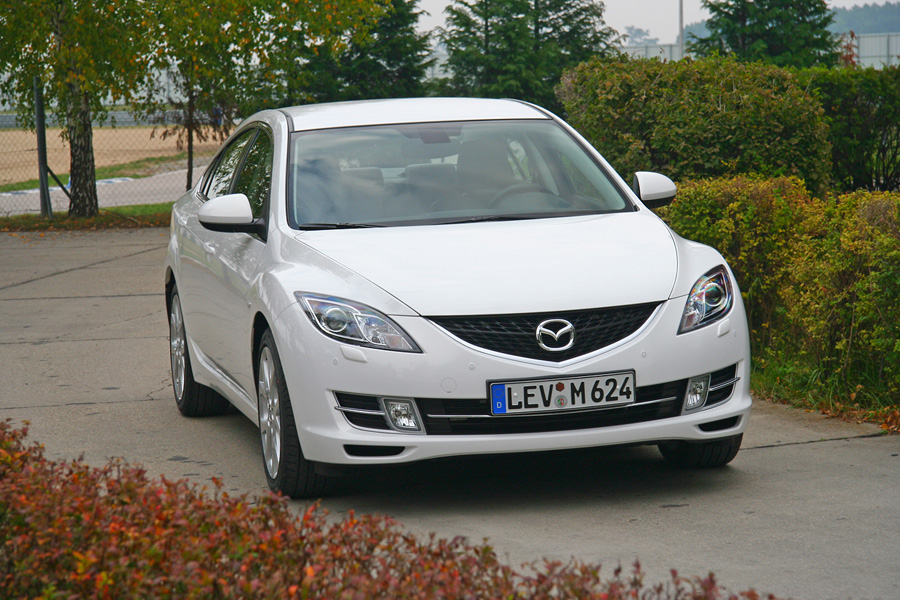
 Despite its increased dimensions, the new Mazda6 has become 30 kilograms lighter than its predecessor.Comments (1)
The "Six" for Mazda is a landmark model. It was with its appearance that the Japanese concern's affairs sharply went uphill. It also became the first bearer of the zoom-zoom style, which is so much talked about today. But no matter how stylish, no matter how attractive the first-generation Mazda6 was, its days are now numbered. From December 2007, sales of the "all new" Mazda6 start. Has the car become fundamentally different?
Photos of the new model, first presented at the Frankfurt Motor Show, have already managed to circulate through all print and online publications. It is enough to glance at them to understand: the style has remained the same. Except that the current design has added a touch of solidity and significance to the "Six", but overall the car still looks sporty and fit. Some of its elements are designed to emphasize the dynamic appearance: for example, the hood has become more convex and wedge-shaped, the headlights and taillights have "flowed" onto the fenders.
The model has also grown slightly in all three dimensions – the wagon has even been lengthened by a full 75 mm. Despite this, the car's mass has become 30 kg less, although the new filling should, on the contrary, have increased it by almost a hundredweight. Such "slimming" became possible through the use of high-strength steels in the body frame. In the spirit of the times, the engines have also become more economical – their appetites have been reduced by about 10%. By the way, about the engines: there will still be three of them, but the 2.3-liter will be replaced by a 2.5-liter, obtained, in essence, by refining its predecessor. The gain in "horses" turned out to be barely noticeable – only four more.
On the eve of the official showing, there were rumors that the new "Six" is built on the platform of the 2007 Ford Mondeo. In fact, this is not so – the chassis is a thoroughly reworked version of the first-generation model. As the engineers of the Japanese concern assure, they aimed to make the car more comfortable and at the same time improve handling. Determining the "comfort" of the suspension at the Hungarian test site, where the first official presentation of the Mazda6 was held, turned out to be somewhat difficult – there were simply no special sections for such testing, and we were not allowed to leave the racing track. But the driver qualities were studied thoroughly. The "Six" has indeed become better suited to the image of a car with a sporty character. In corners, it holds excellently, its behavior is typical for a front-wheel-drive model. It is pleasing that at any moment the Mazda6 remains under the driver's control. All its reactions are easily predictable – even a not very experienced driver can find the critical edge beyond which a drift or skid threatens. Fears that the steering wheel would become less informative after replacing the hydraulic power steering with an electric one, fortunately, were not justified. The reactive force is still present to a proper degree. The brakes also turned out to be good.
However, carried away by the sporty theme, the Mazda people did not forget that many buy the "Six" as a trivial family car. And if so, the car simply must be practical. Here we will note only a few solutions that appeared only in the second generation.
On the left spoke of the steering wheel, a joystick for the CF-Net system has appeared. In essence, this is also a step towards computer technology – of course, not as radical as BMW with its iDrive or Audi with MMI, but still. By controlling the keys of this joystick, you can change almost any parameter displayed on the screen in the upper part of the central console, and these are the settings for climate control, audio system, and trip computer readings. Navigating the menu is quite convenient, since the "picture" on the display is, in essence, static, and therefore there are no problems with navigation.
A very interesting solution, called Karakuri, is now implemented in the wagon. Nothing supernatural – just the curtain covering the trunk is now also attached to the fifth door. Thus, access to the cargo compartment is significantly simplified: the curtain rises together with the door, facilitating the loading process. For transporting large items, of course, you can fold the backrest of the sofa in parts – now it is enough to pull the corresponding lever on the side of the trunk trim. Such is Karakuri.
The first new "Sixes" should appear in Moscow this year. So far, only approximate prices have been announced – the most budget version with a 1.8-liter engine and manual transmission will cost its owner $24,000. Well – excellent. Apparently, the Mazda6 will still remain one of the most affordable offers in its class. I wonder how long the queues for purchase will stretch?
Text: Alexey Tikhonov