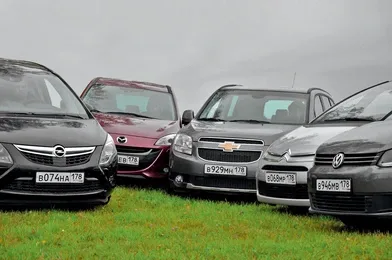
Test participants
Opel Zafira tourer from 799,000 RUB
Mazda5 from 985,000 RUB
Chevrolet Orlando from 719,000 RUB
Citroen C4 Picasso from 755,000 RUB
Volkswagen Touran from 845,000 RUB
Comparison of 5 minivans
Photo: Igor Kuznetsov
And if so, why not gather the most prominent representatives of this automotive family and go on a traditional editorial run through Karelia, where, as is known, it is not only beautiful but also very indicative, because on a small territory there are almost all types of roads that can be found in Russia, from broken gravel roads to ideal highways. It is there that you can truly appreciate what a particular family car is good for, because who else but minivans are designed for long trips with the whole family.
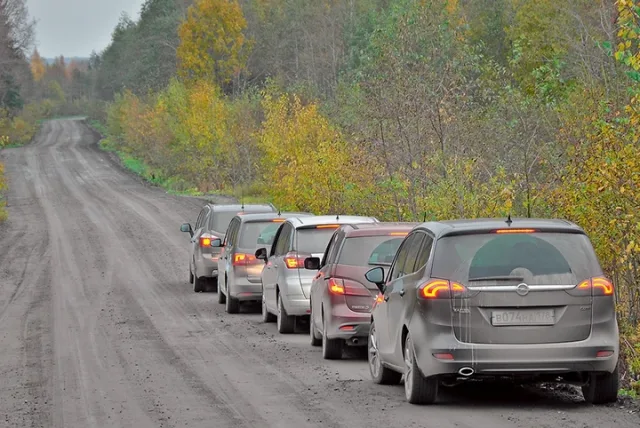
This time the list of contenders, though not very large (there are incomparably more sedans or crossovers), was sufficient for a choice. Given the relative popularity and novelty of the cars, it was decided to take the following vehicles on the run: VW Touran - because it is already a classic; Citroen C4 Picasso - because it is not like the others; Mazda 5, which looks least like a minivan; the expressive Chevrolet Orlando and, of course, the new product - Opel Zafira Tourer, literally packed with innovations. As a result, on one of the fine autumn days, a column of five minivans set off towards the city of Sortavala.
Mazda 5
Tikhon Sikuler, art director, 30 years old, driving experience: 12 years, personal car Ford C-max
I was looking forward to this comparison: it's my size, I love minivans. Especially if, in addition to the universal qualities of a "small bus", it can also bring pleasure behind the wheel. Mazda 5 is just one of those. There is plenty of space behind the wheel, but the seating position is not minivan-like low. The sharp and informative steering wheel, combined with a moderately stiff suspension, allows you to have some fun in corners. In terms of dynamic characteristics, the Mazda justified the number 5 in its name and turned out to be the slowest of our quintet. But thanks to the responsive gas pedal, this was practically not felt, although I would have liked more agility from the automatic transmission.
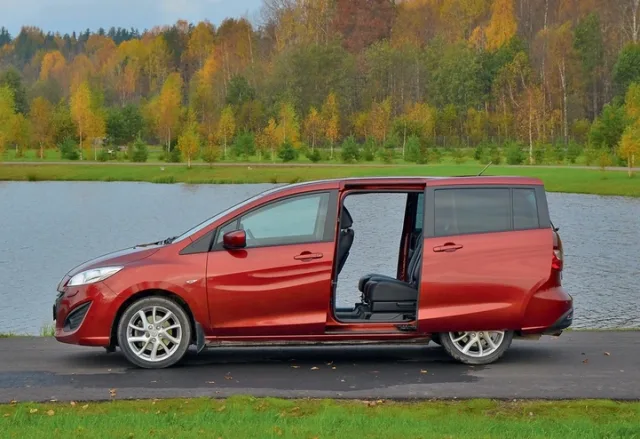
Mazda5
Photo: Igor Kuznetsov
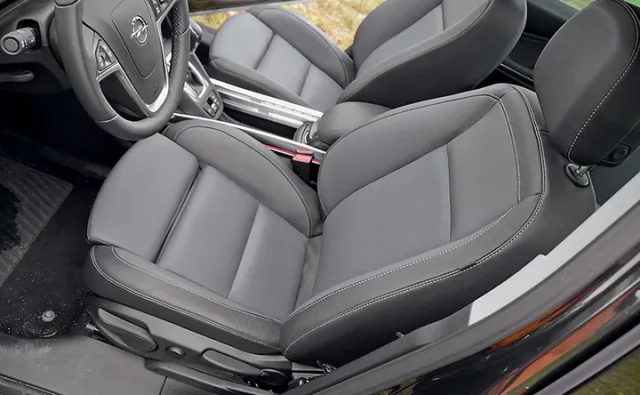
The car dealership employee who gave me the keys to the Mazda5, upon learning that we were going to Karelia, exclaimed: "You won't get through there. And the five doesn't even have a spare tire!" Fortunately, the manager was wrong both times. Despite the small ground clearance and long front overhang with a low-hanging bumper skirt, the Mazda 5 easily overcame broken dirt sections. And the spare tire was found: despite the presence of a third row of seats, the designers managed to hide a space-saver under the trunk floor, placing a niche for small items on top. The leather seats seemed soft, with poor support. The middle row is more for two - sitting in the central part is uncomfortable. But the most interesting thing in this Mazda is the sliding doors. In addition to the electric drive, they also stand out for the ability to lower the windows, which is rare for this type of door, and children will like it.
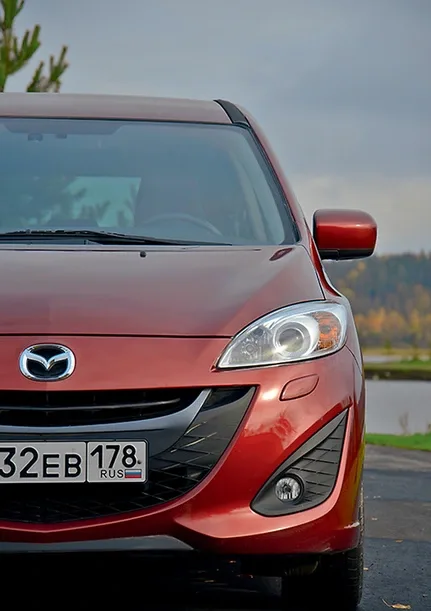
Mazda5
Photo: Igor Kuznetsov
Driving
The engine power is sufficient for dynamic driving. The handling matches. Brakes are quite effective.
Interior
Spacious, but somewhat old-fashioned. The transformation is original but not difficult.
Comfort
Sound insulation could clearly be better.
Safety
6 airbags, stability control system, ABS.
Price
Comparable to the price of competitors.
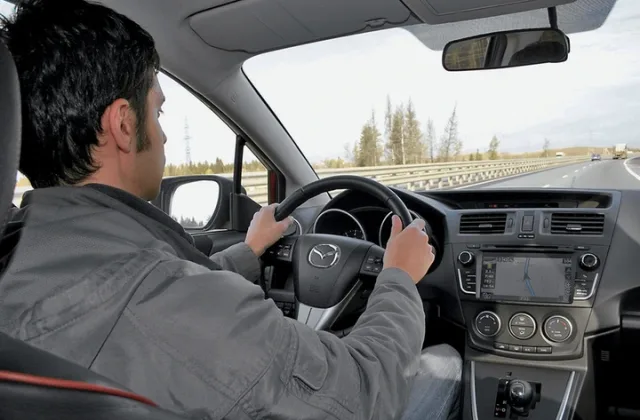
Mazda5
Photo: Igor Kuznetsov
How sometimes classification ruins a car's life! Judge for yourself: the Mazda 5, according to "NATO terminology," belongs to minivans, but if you don't know that, no one would think of putting this car in the same league as those that are consciously bought in most cases when you have at least a third of your life behind you and seven on benches. Externally, the Mazda 5 is too swift and squat to be a joy for the whole family. It is more of a dynamic station wagon than a family minivan. And yet it is so. At least, you stop doubting this when you find yourself in the car's interior. By the way, unlike the other participants in the run, only the Mazda has access to the second row not through swing doors, but through sliding doors. They are electrically operated and can be opened remotely from the key fob. As it turned out during the test, this action can still bring wild delight not only to a resident of a remote farm. The advantages of sliding doors over swing doors are simply undeniable. Firstly, it is a wide opening, and secondly, the ability to board and alight passengers in cramped conditions.
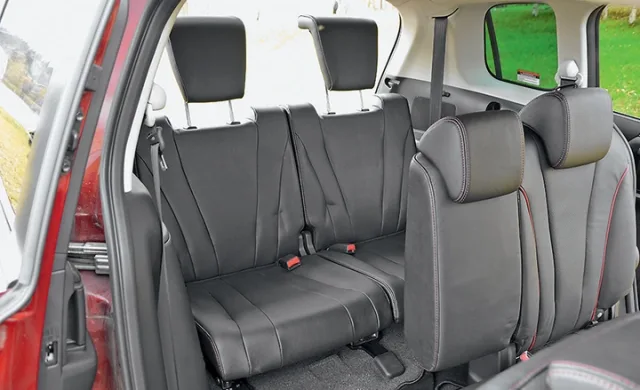
Getting in is easy, but sitting is not very
Photo: Igor Kuznetsov
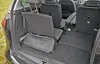
But this is not all that the Mazda 5 interior can surprise with. For example, the second row can be either three-seat or two-seat. If you don't need the middle seat, you fold the right seat and stow it into the resulting niche, then return the seat to its place. Want a spacious mesh pocket between the seats? No problem: fold the left seat forward and pull out from under it something like a playpen for small items. Or you can simply leave a passage to the third row. By the way, the rear seats are easy to access both from the second row and from the trunk. However, sitting on them, as in other cars, is not very comfortable. Even the fact that you can move the second-row passengers forward, albeit slightly, to free up legroom doesn't help. As for the trunk, in the seven-seat configuration, it is practically nonexistent.
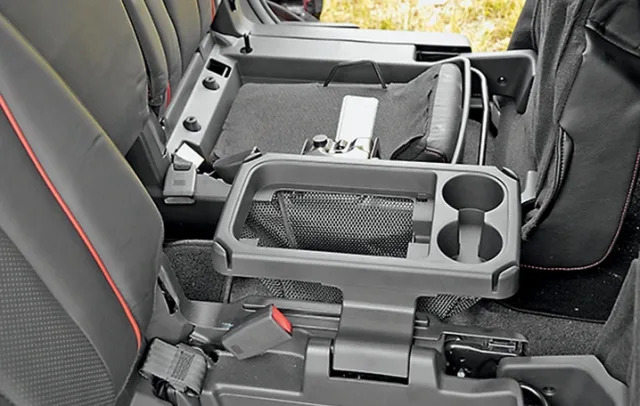
The middle seat can also appear in this form
Photo: Igor Kuznetsov
Despite the abundance of various features and gadgets, the interior of this "Japanese" still looks rather old-fashioned. It feels like the Japanese were haunted by nostalgia for the 2000s when designing the interior. Even the fancy multimedia system doesn't save the situation. However, as it turned out later, it is not standard equipment and does not belong to the original elements, so we won't focus on it.
Being a car with a dynamic appearance, the "five" turned out to be just that in practice. At least, what it could demonstrate on the road is quite commendable. Even the automatic transmission practically did not interfere with the car realizing what the driver wanted from it. The steering was also responsive. Sometimes even very responsive, because the reaction even to a slight turn of the steering wheel was almost instantaneous. The car also behaved decently on the gravel road. Contrary to expectations, it didn't shake the driver's soul out. On the highway, it was even good. The only thing to complain about was insufficient sound insulation. On a smooth highway, you can still put up with it, but as soon as you hit a rough surface, you can forget about a heartfelt conversation with a passenger. At elevated tones, what kind of heartfelt conversation is there! However, insufficient sound insulation is characteristic of almost all cars of this brand.
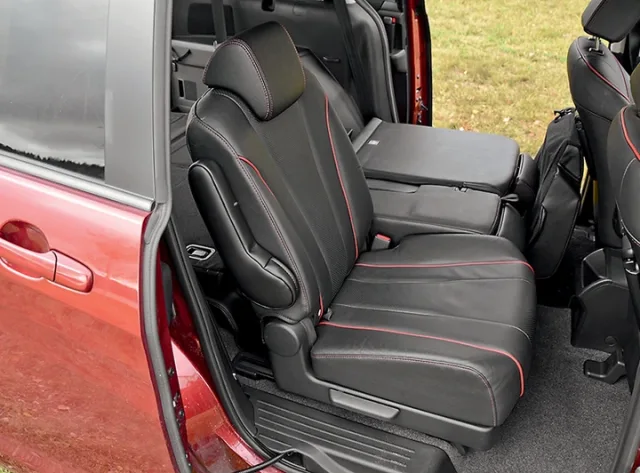
Mazda5
Photo: Igor Kuznetsov
Chevrolet Orlando
Andrey Mashnin, deputy editor-in-chief, 49 years old, driving experience 13 years, personal car Mitsubishi Galant
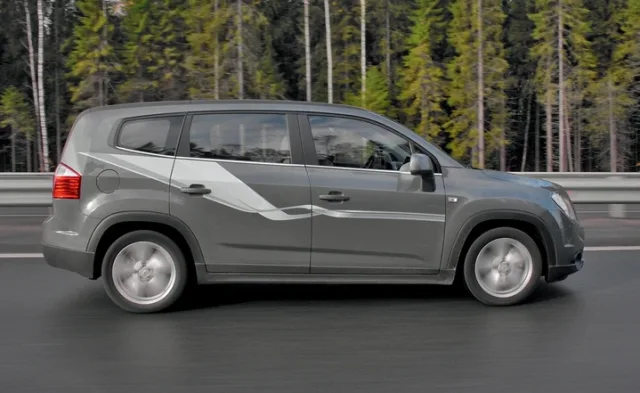
Chevrolet Orlando
Photo: Igor Kuznetsov
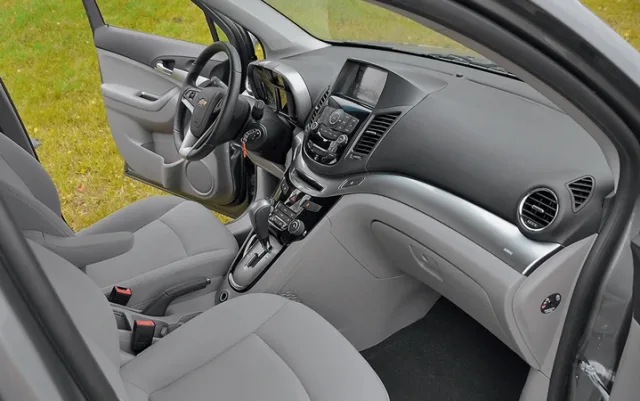
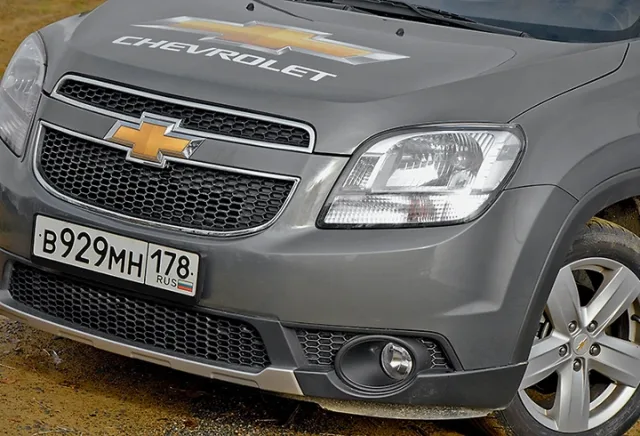
Previously, I didn't pay much attention to this car. By its image, it seemed somewhat "official," service-like, almost like a minibus. But now a face-to-face meeting took place, and the impression changed. After getting the car from the dealer, I walked around it, sat in all seats, examined the trunk, and came to the conclusion that this is an ideal car for family life, and in different variants of its character. Those who are younger can go out of town in a large company, those who are older can carry, besides children and relatives, a bunch of luggage on long trips. Neither avid gardeners, nor outdoor enthusiasts, nor hunters and fishermen will leave offended. I liked the layout of the driver's seat, everything is clear and convenient, without surprises. It's a pity that the built-in navigator glares in the sun so that nothing is visible on the screen. Among the bright features, I note the strong engine noise during intense acceleration. During overtaking on a two-lane highway in the oncoming lane, this, of course, mobilizes, but such a sound still resembles hysteria. But when driving at a cruising speed of about 110 km/h, there is complete silence and grace in the cabin. I personally have no complaints about handling, I adapted quickly. The suspension is also normal, without extremes. Good visibility, sufficient ground clearance, spacious interior, transformation wonders - an excellent car.
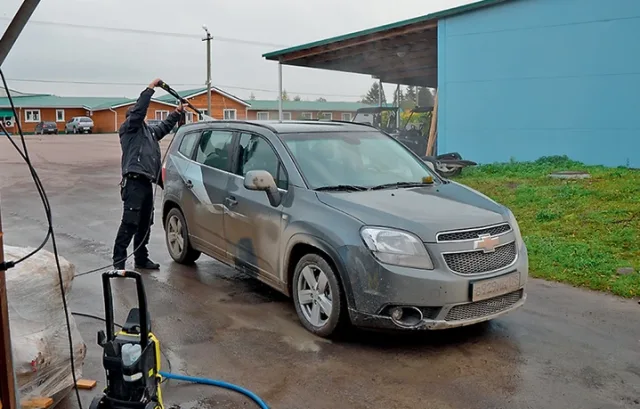
The height of the car allows you not to strain too much when washing
Photo: Igor Kuznetsov
Driving
Despite the fairly powerful engine, the dynamics are mediocre. Sometimes the gearbox is sluggish.
Interior
Spacious and quite cozy. Transformations are not extensive, but well thought out.
Comfort
A fairly comfortable car. Disadvantages include insufficient sound insulation of the engine compartment.
Safety
Base includes 4 airbags and ABS.
Price
Affordable.
Chevrolet Orlando
Photo: Igor Kuznetsov
Even if you remove the huge cross from the radiator grille, there will be no doubt where this car comes from. And even though it has long been "European," Americanisms permeate every element of the exterior. The interior is no less star-spangled. Everything here is deliberately large. It's immediately clear: the country producing such cars has no shortage of resources and cannot have one. The materials also match the overall style.
The driver's seat is quite comfortable, but some interior details look very specific, and some even present surprises. For example, the instrument cluster looks very much like a diving mask. Or take, for instance, the center console. The upper part is occupied by an impressive active display. In addition to displaying the audio system functions, this same monitor shows navigation system information. By the way, the manufacturer preferred "Navitel" as the navigation program. The latter is quite justified, as it is best adapted for travel; at least, the roads along which the run took place are well known to "Navitel." Below are the audio system controls, and even lower, climate control, and everything seems usual, but... besides the main functions, the audio system control unit has another function: it also serves as the lid of a hidden glove box. By folding it down, you will find a fairly spacious box that can rival the size of a glove compartment in other cars. In this same glove box, there is also a bunch of "tails" for connecting audio devices.
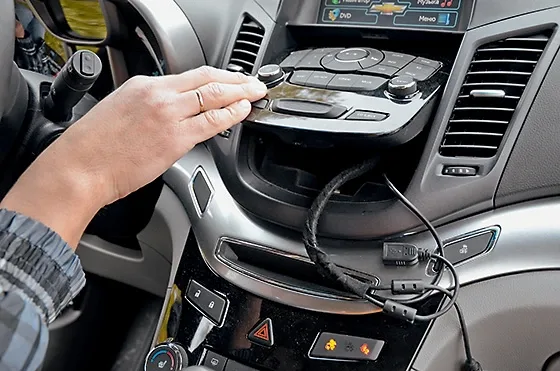
Hidden compartment behind the audio system control unit
Photo: Igor Kuznetsov
Being a minivan, the Orlando is offered in a 7-seat version, but like any other minivan of such dimensions, it cannot offer a full-fledged third row of seats. Even one person can hardly fit there, not to mention two. Nevertheless, if you need to go out not far with a large company, it will be possible. Especially since transforming the interior from five-seat to three-seat here is surprisingly simple. No unnecessary movements are needed: press the button on the top end of the second-row backrest, and not only does the seat move slightly forward, but the backrest also folds down. Just as easily, the seat folds forward, turning the car's floor into a spacious van. But there is one problem: this is where all the transformation ends. No little features like appearing armrests or anything else interesting. And the trunk floor itself turns out to be quite high. But it is flat, which means you can even spend the night in such a car comfortably, since the length allows, and you can transport large glass, for example, without breaking it.
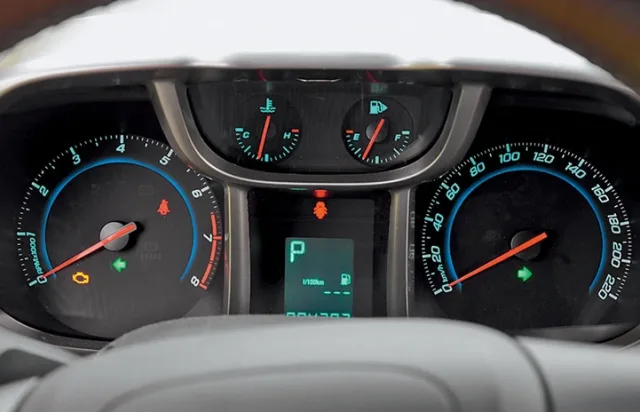
The instrument cluster is original but not very convenient to use
Photo: Igor Kuznetsov
The 1.8-liter engine installed in this car is not bad. At least, it is not deprived of power and torque. But the automatic transmission is clearly not from this car. And if during calm driving you can put up with its work, then as soon as you spur it on, disappointment sets in. Gears shift reluctantly. The engine begins to reach peak revs, but besides noise, it gives nothing. The manual mode doesn't help much in this case either. You can, of course, fiddle with the lever, but if you take a car with an automatic, you mainly rely on it, and here... In general, if you think about dynamics, it's better to take a car with a manual.
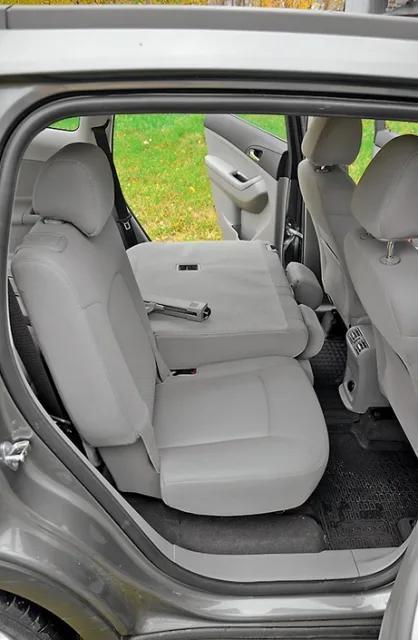
There are not many transformation options, but they are very simple and convenient
Photo: Igor Kuznetsov
But the steering, unfortunately, cannot be chosen. And how I wanted, oh how I wanted the steering wheel to be a bit heavier. But no: put your left hand "at nine," relaxed, and the car goes into the oncoming lane. This is especially noticeable at high speed, when even a slight deviation from zero is enough for the car to move a couple of meters from the straight-line trajectory in a second.
And yet, the Orlando can drive fast, even on bad roads - the suspension's energy intensity is quite sufficient. At least, no problems arose on the gravel road.
Chevrolet Orlando
Photo: Igor Kuznetsov
Volkswagen Touran
Igor Kuznetsov, photo editor, 50 years old, driving experience: 30 years, personal car Skoda Yeti
Volkswagen Touran
Photo: Igor Kuznetsov
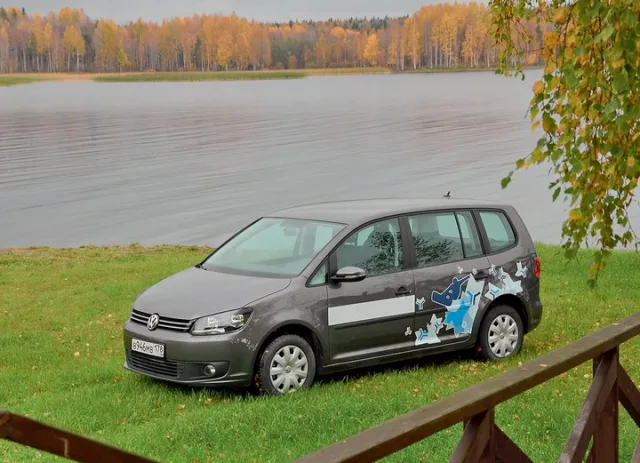
Touran is from the Volkswagen clan, and that already says a lot. The essence of the model can be expressed with the popular "chocolate" slogan: "Square. Practical. Good." At the same time, the Wolfsburg minivan is not alien to aesthetics. Moreover, I believe that a person of conservative taste will find Touran not only attractive but also stylish. Like any other car, Touran is for enthusiasts. For example, I like it. And in a comprehensive way. Because I like not only its exterior but also its interior content. And, looking ahead, its driving habits too. The Touran's cabin is a model of a balanced approach to design. It is convenient to use in any circumstances: for passenger transport and for cargo transportation. No wonder, because the transformations of the Touran's cabin could be envied by a transformer. It is also pleasant to contemplate and feel the "living area." The ergonomics of the laconic controls and the nobility of the finishing materials are at a proper level. The car drives quite spiritedly even with a 1.2-liter engine. The microscopic gasoline engine is stimulated by turbocharging. As a result, sitting behind the wheel, you are an equal member of the automotive community. The chassis is also well done. Touran steers clearly and understandably. The suspension is elastic. The brakes are tenacious. There is nothing to complain about. Only the "biting" price is confusing. However, undoubtedly, it is worth paying for Volkswagen quality.
Volkswagen Touran
Photo: Igor Kuznetsov
Driving
The engine cannot be called powerful, but the car's dynamics do not suffer from this. Handling is excellent on any surface.
Interior
Spacious and comfortable, although it looks rather simple. The removable second-row seats significantly increase cargo capacity.
Comfort
No complaints in this regard.
Safety
Standard equipment includes 6 airbags, ABS, ESP.
Price
In the base trim, it is not very expensive, but in the top trim...
Volkswagen Touran
Photo: Igor Kuznetsov
Classics, they say, are always in price. Well, that is a quite justified statement, and it fits Touran perfectly. Looking at it from the outside, you have no doubt that you are looking at a minivan. A small hood, a high roof, almost vertical rear pillars - all these are signs of class affiliation. However, this does not mean that the VW looks archaic. On the contrary, it seems timeless, and the modern trends that have captured the minds of designers today manifest here like a well-chosen high-tech cufflink on a classic suit. The rear lights alone are worth it: unobtrusive during the day, but how effectively they look at dusk and at night!
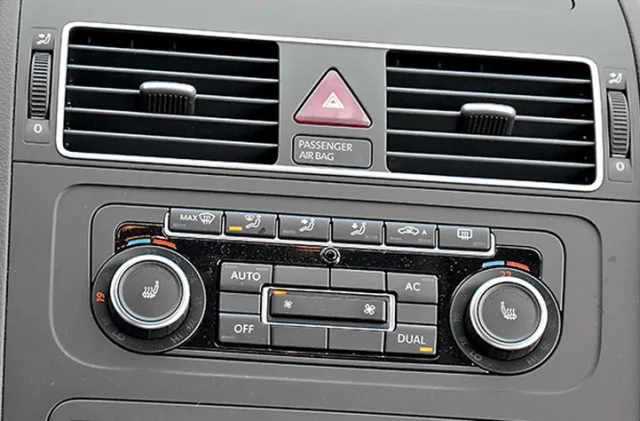
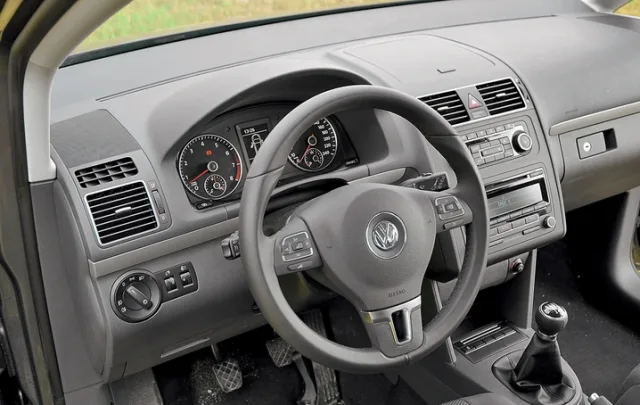
The climate control unit is extremely simple and therefore well understood
Photo: Igor Kuznetsov
The car looks no less classic from the inside. One might say, even too classic. However, as they say, "do you want checkers or to go?" And driving when everything is simple and clear is much calmer and safer than when you have to get used to everything. In a VW, you don't need to get used to anything. The set of design frills is minimal, but the ergonomics are refined to the smallest detail, so as soon as you sit behind the wheel, you understand that you are in your element. Even the gas pedal invites a long and pleasant trip because it is floor-mounted. And what a convenient central armrest - wide, adjustable in height and longitudinally! In general, on a long journey, driving in such an environment is a pleasure. The engineers took no less care of the passengers. Firstly, in the second row, each of the three has a full-fledged separate seat; secondly, any of them can adjust the backrest tilt and move longitudinally. And thirdly, if necessary, the second row can be easily removed. Moreover, the seats can be taken out in any order. Unfortunately, the car we got for the test did not have a third row of seats, and we cannot reliably say how passengers feel there. But given that the trunk volume here is about the same as that of competitors, we can assume that full-fledged seats are only a dream here too. However, as it seems to us, the owner's dreams and regrets will end there.
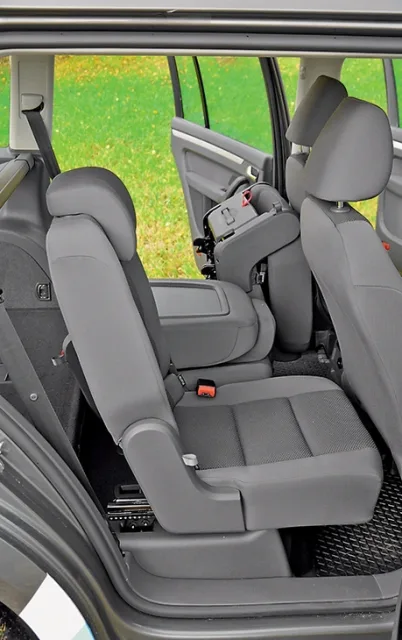
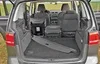
Each of these seats can be removed separately
Photo: Igor Kuznetsov
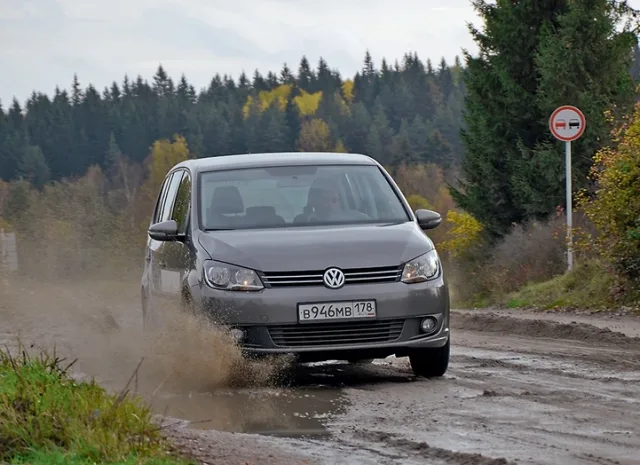
By and large, he will not even regret that at the time he was a bit stingy and did not take a car with an engine larger than 1.2 liters. This little one surprisingly well pulls a rather heavy car and is not at all voracious. At least, without lagging behind, and sometimes setting the pace for the whole column, the Touran consumed almost a quarter less fuel than its gasoline rivals. Quite pleasant impressions also remained from the suspension: even on a broken grader, the car was quite comfortable. As soon as we drove onto good asphalt, the trip literally turned into a flight phase. The steering also deserved flattering reviews. Its qualities especially manifested on serpentines. The effort on the steering wheel is optimal, and the gear ratio is equally optimal. Even in the sharpest turns, there was no need to cross the steering wheel. The brakes also turned out to be intelligible. And yet, one fly in the ointment was found - the absence of parking sensors. It is even somewhat strange that a car that even has fog lights, which, if not turned on, perform the function of cornering lights, does not have parking sensors. In our opinion, on such cars, it should be a priori, given the dimensions and the contingent of drivers.
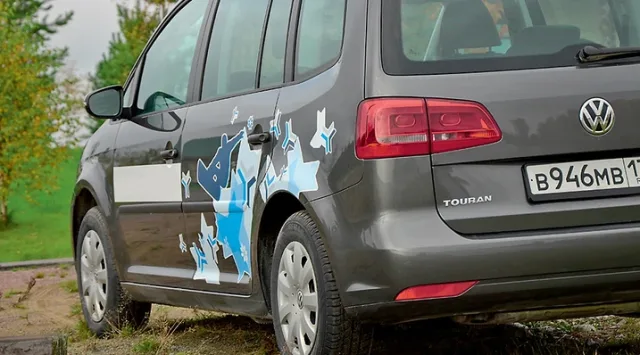
Volkswagen Touran
Photo: Igor Kuznetsov
Citroen C4 Picasso
Alexey Smirnov, designer, 40 years old, driving experience 10 years, personal cars - Volvo 940, Renault Logan
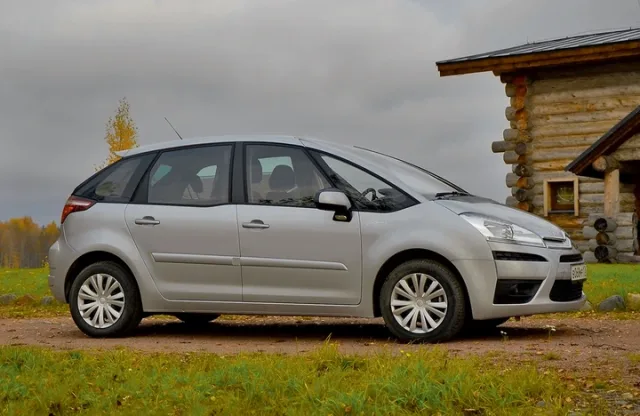
Citroen C4 Picasso
Photo: Igor Kuznetsov
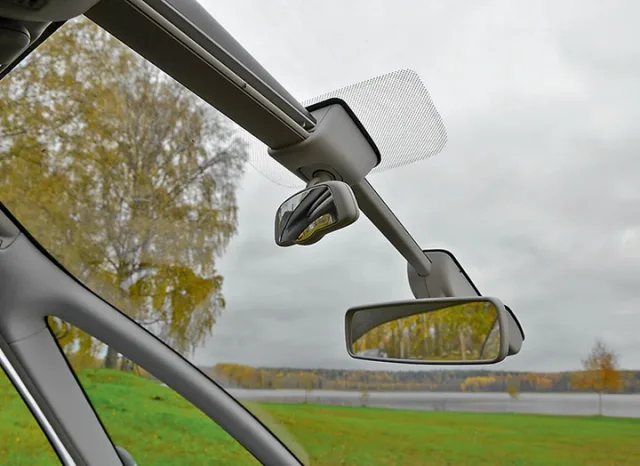
At first, having settled into the belly of this car, I felt like a fish. Not an ordinary small fry at a pet market, but some kind of collectible jawed species in a single aquarium. And this despite the fact that the Picasso did not have a sunroof. Sliding sun visors that increase the glazing area of the windshield to indecency, huge light openings at the front pillars, deliberately rounded body shapes, thin airy lines of interior elements - all this gave a feeling of airiness and lightness. Having touched the quite friendly controls, I decided that it would be more logical to imagine myself as a researcher of a deep-sea bathyscaphe.
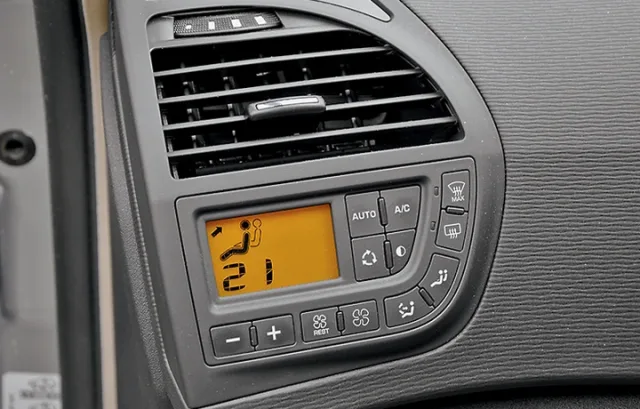
The front passenger also has such a control unit
Photo: Igor Kuznetsov
There are even too many places where you can put various small things - it is easy to forget what you stuffed where. Not all control buttons located on the fixed hub of the steering wheel are easy to reach right away, especially in turns. The bright, well-readable display is quite informative, though somewhat simple. I expected rolls due to the high center of gravity, but during high-speed maneuvers the car is stable, the suspension is moderately stiff. At first, the thoughtful "robot" annoyed me, but after making friends with the paddle shifter for forced downshifting, I found that the car became much more responsive. In general, a pleasant device. You just need to get used to some things and be able to extract maximum benefit from them.
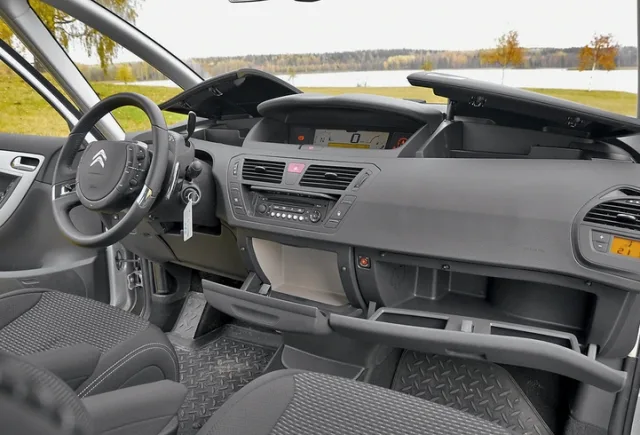
And these are not all the boxes that can be found in the car
Photo: Igor Kuznetsov
Driving
The engine is not bad, but the operation of the robotic gearbox in automatic mode spoils everything.
Interior
Visually overloaded. However, this does not prevent it from being comfortable and spacious.
Comfort
If not for the suspension, the car could be considered quite comfortable.
Safety
Standard equipment includes 7 airbags, ABS, ESP.
Price
A reasonable price for a well-equipped car.
Citroen C4 Picasso
Photo: Igor Kuznetsov
It would, of course, have been more correct to take a Grand Picasso for the test drive, but by chance there was no free car available at the dealership at the start, so we had to make do with what we had. As a result, the place in the column was taken not by a 7-seater, but by a 5-seater. Which, however, was not so critical, because apart from a slightly different shape of the rear body and the absence of a third row of seats, the five-seater is in principle no different from the seven-seater.
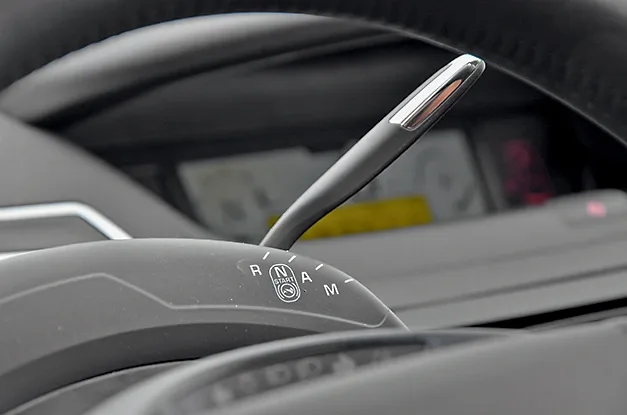
You don't get used to this gear selector for the robotic gearbox quickly
Photo: Igor Kuznetsov
And since we're talking about the exterior, let's say this: those who like it and those who don't are actually split evenly. The interior caused no less debate over its design and functionality. The abundance of buttons, displays, and handles scattered almost throughout the cabin can baffle even a person experienced in cars. For someone who finds themselves in the cabin for the first time, it's simply staggering. And if you also open all the compartments that only the front panel is equipped with, you'll have to take a pen and write down where you put what, otherwise you'll forget. Fortunately, at least the second row of seats folds down more or less intuitively. You pull the corresponding strap, and the seat cushion immediately falls to the floor, with the backrest folding on top of it. All three seats here are separate and can be folded either all together or individually. The trunk floor, with the seats fully folded, becomes flat and quite low. The fifth door is equipped with an opening window, which simplifies loading small items in tight conditions.
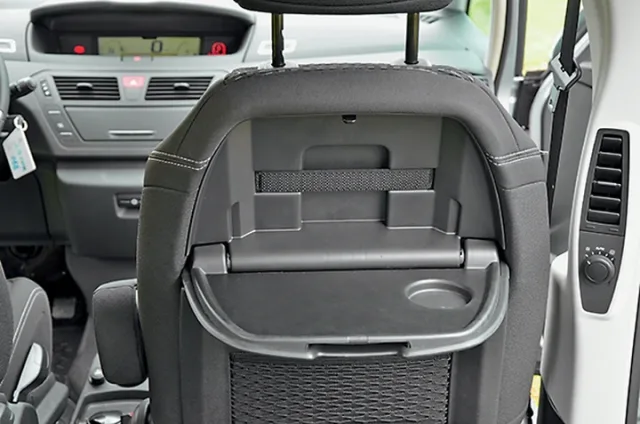
The table in the seat back is a small thing, but pleasant
Photo: Igor Kuznetsov
To be honest, we expected the most comfortable ride from Citroen, but from the first meters of the journey our expectations were not met. Firstly, everyone who got behind the wheel of this car was very annoyed by the lever for selecting the operation of the robotic gearbox. It had a very unconventional shifting algorithm compared to a regular automatic. As they say, never mind that, but the robot's operating algorithm itself was not up to par. Almost all shifts were accompanied by strong nods, which, as you understand, did not add comfort. In addition, the robot did not always select the right gear, which was especially noticeable on serpentines: you need traction, but there is none, the car sags and only then, as if coming to its senses, shifts down a gear and, with the engine roaring, begins to pull uphill. In general, after some time, everyone decided to drive this car exclusively in manual mode, and a miracle happened: the car seemed to be replaced, it runs well, pulls uphill excellently, and the dynamics are quite decent. The main thing is to pull either the left or right paddle shifter in time. And what a view! The huge windshield that transitions into the roof is exactly what you need when traveling through Karelia. With regular glazing, you wouldn't see half of what is revealed to your eyes behind the wheel of a Citroen. You just need to get used to the two additional pillars at the front. Because of them, on a serpentine you literally have to lean out to properly assess the road situation. Being a car with legendary suspension, the Citroen presented no surprises on asphalt—the car was indeed very comfortable. But as soon as we drove onto a gravel road, something unimaginable began. Blow after blow literally shook the body, and it wasn't about bottoming out. It's just that the too-stiff shock absorbers didn't allow the springs to react adequately to bumps. As a result, to avoid destroying the car, we had to reduce speed. However, that was on the way there, and the return trip was on a repaired gravel road, and the speed of the column no longer depended on the Citroen—the C4 Picasso flew along the dirt road on par with everyone else.
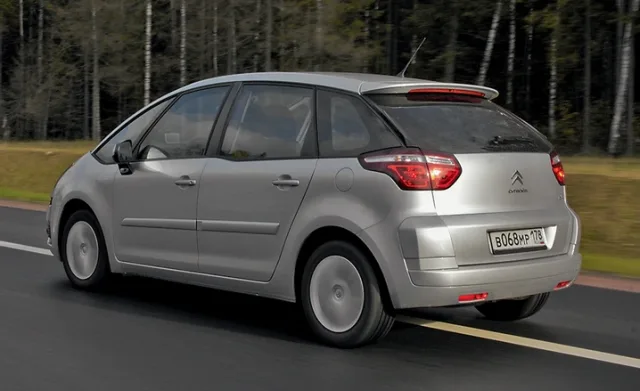
Citroen C4 Picasso
Photo: Igor Kuznetsov
Opel Zafira Tourer
Maxim Fedorov, journalist, 34 years old, driving experience 8 years, personal car Ford Focus
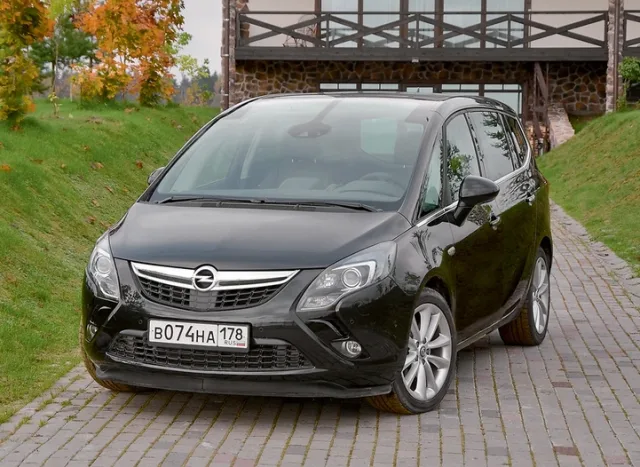
Opel Zafira tourer
Photo: Igor Kuznetsov
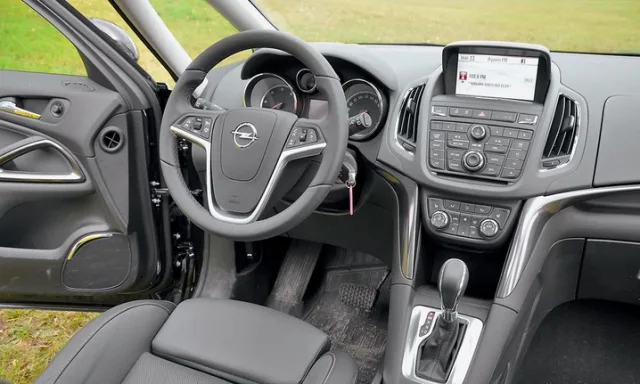
The king is made by his retinue, and the car by its engine. The brutal torque of the two-liter turbodiesel of the Zafira, soaring like a candle almost from idle, turns a family minivan into a real rocket! But, unlike the dynamics, the price of this version is not pleasing: in standard trim it will cost 1,135,000 rubles. Due to a bunch of additional options, the test car cost even more, and many of the "extras" here are clearly superfluous. For example, a navigator with a low-resolution screen and poor knowledge of the roads of the Leningrad region and Karelia, or a lane departure warning system. But the radar cruise control came in handy: it's very comfortable to drive on the highway with it. The Zafira's interior, against the background of competitors, looks the most stylish and modern, but at the same time it is far from the most convenient. The "proprietary" Flex7 transformation system turned out to be too complicated. To fold the middle row seats, you need to apply force and ingenuity, although in the platform-sharing Chevrolet Orlando there are no such problems. The third row in the Zafira is just for show: the seat cushions are so low that even a child is uncomfortable sitting there. Among other design miscalculations are the overloaded central console with buttons and a large area on the right side of the windshield that the wiper blades don't reach. Nevertheless, despite the shortcomings, among the tested minivans, the Zafira pleased me the most.
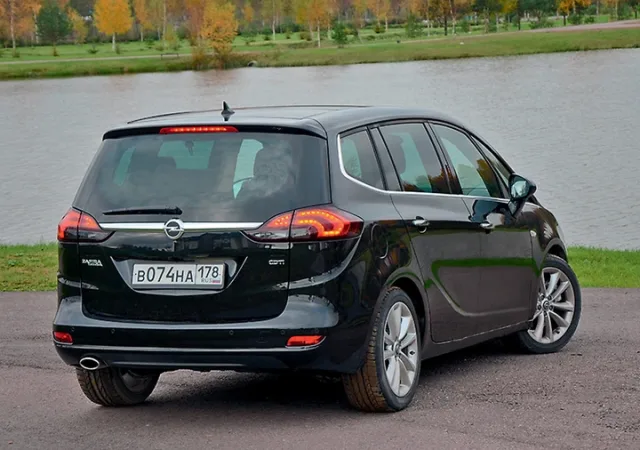
Opel Zafira tourer
Photo: Igor Kuznetsov
Driving
The car is well balanced. It steers excellently, brakes superbly, and the diesel is beyond all praise.
Interior
Interesting not only visually, but also in terms of transformation.
Comfort
Comfortable on roads with any surface. Sound insulation is also good.
Safety
In the base trim: 4 airbags, ABS, ESP.
Price
Quite explainable and justified.
Opel Zafira tourer
Photo: Igor Kuznetsov
We don't know about you, but for us the design of this car is associated exclusively with a high-speed train. Agree, there is something locomotive-like in the Zafira. And how much dynamics is added to its image by the headlights combined in the shape of a boomerang! Or take the huge windshield that transitions into the roof. And the color in which the Zafira appeared before us on the run, ordinary black metallic, suits it very well. The car also looks impressive from the rear, especially if instead of regular taillights there are modernized LED ones, as in our version. The fact is that we got the car for the test in maximum trim, that is, with all the delights that this minivan can be stuffed with, starting with a huge glass roof and ending with an active cruise control radar. And at the same time with an inactive display. The latter is very inconvenient, especially given the fact that navigation is provided in the car. And managing "Navitel", as you know, is easier with an active screen. In general, there are also plenty of buttons and keys on the central panel and the "beard" here, but there is no such stupor as in the Citroen. Everything is more or less intuitive, and much can be figured out even while driving, that is, practically without being distracted from the road. But the interior transformation system requires a thoughtful approach. Unlike the platform-sharing Orlando, where everything is simple as one-two-three, here you'll still have to "furrow your brow". What can I say, if only the front armrest has three levels and can be transformed into any shape convenient for the driver. And in general, the Zafira can be either 7-seater or 1-seater. That is, if necessary, you can fold the front seat as well, thereby getting the opportunity to transport long items. The transformation of the second row is no less interesting. It can be either three-seater or two-seater. In this case, the middle optional seat turns into two separate luxurious armrests, and the side seats move to the center of the car. At the same time, the seats can also move in the longitudinal direction, freeing up legroom. It's just that the passengers of the third row are unlikely to be happy about this, even despite the fact that the Zafira Tourer was the largest car among those that took part in the run.
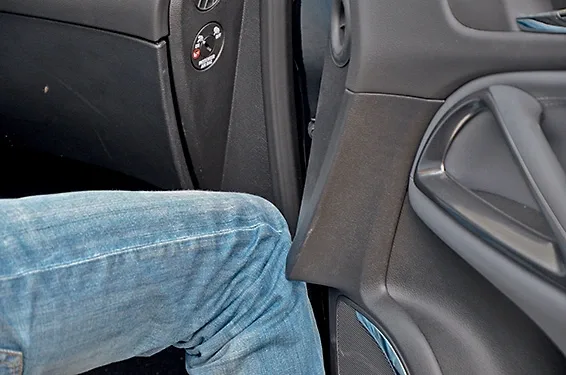
You can hit this protrusion quite painfully
Photo: Igor Kuznetsov
This car had one more difference from the rest. Opel turned out to be the only one that consumed diesel instead of high-octane gasoline. This, however, did not prevent it from being on par with everyone else in both dynamics and comfort. The noise from the two-liter diesel was not much more than from gasoline cars, and 130 horsepower and 300 Nm of torque were quite enough not only to avoid disappointment, but on the contrary, to admire the dynamics. And, of course, one could not help but appreciate the efficiency of this car. With a 58-liter tank, it has a significantly greater range than, say, the same Orlando. Involuntarily comparing the Zafira with its platform sibling, we also noted that these cars handle completely differently. The German holds the trajectory more clearly, and there is less looseness in the suspension, while it cannot be called stiff, and even on a broken road it holds up well. In addition, the suspension can be adjusted, just press the corresponding button on the center console. By the way, in "sport" mode, the instrument panel immediately turns red. Among the active assistants, it is also worth noting the blind spot warning system and active cruise control. The latter is very convenient, especially when driving in a convoy.
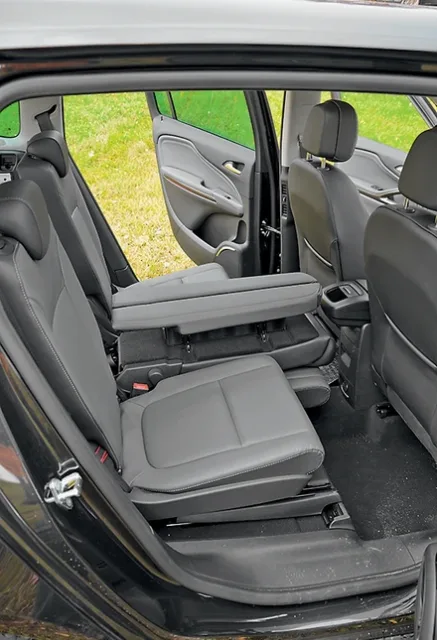
Such a huge armrest can turn into the middle seat of the second row
Photo: Igor Kuznetsov
Opel Zafira tourer
Photo: Igor Kuznetsov
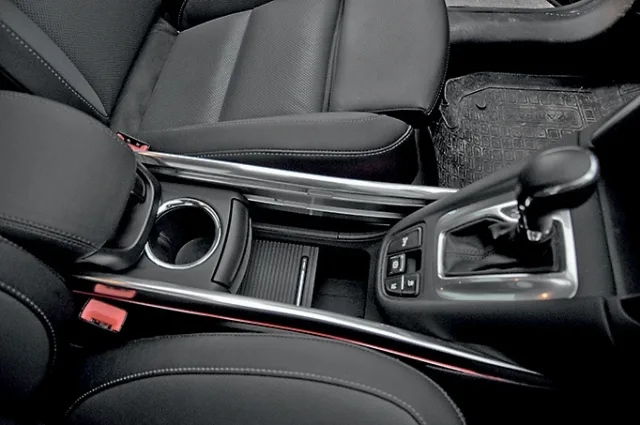
The multi-level armrest is not only interesting but also convenient
Photo: Igor Kuznetsov
our verdict
As in previous times, the big test allowed us to fully evaluate each of the cars presented in this material. There were discoveries, and there were outright disappointments, but one thing we are sure of: minivans, as before, are among the most versatile cars, and if you need a car for all occasions, then you should take a closer look at this class of cars. Especially since they are in the production program of almost all manufacturers.