
Shifts for the better
The Mazda5 compact van is not as overwhelmingly popular in Russia as other models of the Japanese brand. The facelift may not have turned the "five" into an undeniable bestseller, but it definitely made the car more attractive.
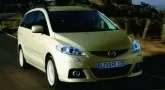
In some market segments, original solutions seem to scare off buyers rather than attract them. Take the Mazda5, for example: none of its direct competitors in the compact MPV class can boast sliding rear doors, yet in Russia, the more traditional Opel Zafira and Ford C-Max sell more confidently. However, figuring out the nuances of consumer demand is a task for marketers, and we headed to Sicily to get acquainted with the updated Mazda5 to understand what new things this compact MPV can offer the buyer.
Although the restyling of the "five" is officially called a facelift, it's worth starting not with the exterior but with the technical part — that's where the key changes occurred. The main news: the Mazda5 has for the first time an automatic transmission. The five-speed "automatic" and the new six-speed "manual" are offered only in conjunction with the two-liter gasoline engine. Its power increased slightly (by one horsepower, to 146 hp), but the engine became noticeably more elastic — already from 2000 rpm the torque approaches the peak of 185 Nm, which is available at 4000 rpm. The electronic gas pedal also added responsiveness. The 1.8-liter unit (115 hp, 165 Nm) remains in the lineup, untouched by modernization — it is still paired only with the five-speed "stick."
For diesel Europe, versions with diesel are provided, but such cars are not planned for delivery to Russia. On Sicily, from the many offered diesel Mazda5s, my colleagues and I struggled to find the most relevant modification for us — a gasoline one with an "automatic." For this, we had to travel three together, which, however, gave us the opportunity to test the "five" as a family car, including from the back seat. By the way, getting into the second or third row is now easier: the options list includes an electric drive for the sliding doors, which can even be controlled from the key fob.
Automatic sliding doors are perhaps the most noticeable external difference of the updated Mazda5 from the 2005 model. The rest is pure cosmetics: new bumpers, modified headlights, a more expressive pentagonal grille in the style of the latest Mazda novelties, and seven fresh body colors. For those wanting more, the Sport Appearance Package (SAP) is offered: a sport body kit with sill overlays, an aggressive front bumper, a different grille, a rear spoiler, and, unexpectedly, LED rear lights. SAP adds a bit of swiftness to the rather bland appearance of the Mazda5, but it's far from the aggression of the Opel Zafira OPC.
In the cabin, there was less glossy black plastic, which so readily collects dust, as well as the appearance of leather upholstery as an option. Opening the spacious trunk, it's hard to believe that two more seats are hidden under its floor — this is part of the proprietary "karakuri" transformation system. Traditionally for Mazda, the two-liter version is richly equipped even in the base: climate control, heated seats and mirrors, audio controls on the steering wheel (by the way, with leather trim), a stability control system, and a full set of airbags, including curtains. Even the most affordable Family version with the 1.8-liter engine and five seats can boast this.
I drove the first kilometers in the updated Mazda5 from the back seat. Individual seats with adjustments and armrests on both sides allow you to sit there no worse than in the driver's seat. There is no rocking, which rear passengers of family cars often complain about, even on uneven asphalt. The sound insulation has been seriously improved, so at a speed of 150 km/h you can calmly listen to the radio while sitting "in the rear." In general, an excellent option for traveling with a large company — it will be comfortable for everyone.
Moving to the driver's seat, I noticed that it's even a bit noisier here than in the back: at high speed, the massive side mirrors hum noticeably. However, the visibility they provide came in handy when I had to pass an excavator on a narrow rural highway. The situation was complicated by a stone wall on one side and a dug ditch on the other. It was a matter of millimeters, but the Mazda5 didn't deceive in the sense of its dimensions. Later, the car also performed excellently on the narrow streets of Sicilian towns, never making me feel like the driver of a cumbersome bus. There's almost no "bus-like" feel in the Mazda5 at all — including thanks to the low seating position behind the wheel, which has always been one of this model's strengths.
But the combination of the modernized two-liter engine and the five-speed "automatic" made a mixed impression. On one hand, there are clear responses to pressing the gas pedal and smooth shifts, including in the pseudo-manual mode. On the other hand, there's too frequent gear changing (due to the lack of a kickdown click in the pedal travel) and a noticeable lack of traction on any serious incline. Still, 1475 kg is a bit much for a 146-hp engine. However, the heaviness is felt mainly when driving uphill, and on the highway, the refined suspension, even with a full load, provides confident and quite engaging handling without a hint of "bus-like" behavior. The only thing is that the steering wheel, due to the overly active power assist, is a bit confusing, but here the winding Sicilian roads are more to blame, where many turns have to be taken at almost "parking" speed. On the highway, though, the "wheel" holds "zero" perfectly, not requiring correction even on rough pavement joints.
Overall, when it comes to driving sensations, you'll have to accept that the "five's" handling clearly exceeds its dynamics. Perhaps with a manual gearbox, the two-liter Mazda5 would be more interesting to drive, but it's the "automatic" that highlighted the main advantages of this compact MPV — practicality, comfort, and moderate sportiness on the move, which will please the driver and not make six passengers carsick.
So the improvements to this already good car are obvious. And speaking of shifts, don't forget the sliding doors: some may find their practicality questionable, but they undoubtedly give the "five" that very individuality for which Mazda has always been famous. And it doesn't matter that the updated Mazda5 is unlikely to flood the streets like the Ford C-Max. But those who pay 775 thousand rubles for the base two-liter version with an "automatic" will get an extra reason to be proud of their car's uniqueness.
Test drive photos
Comments
No comments yet. Say the first word.