
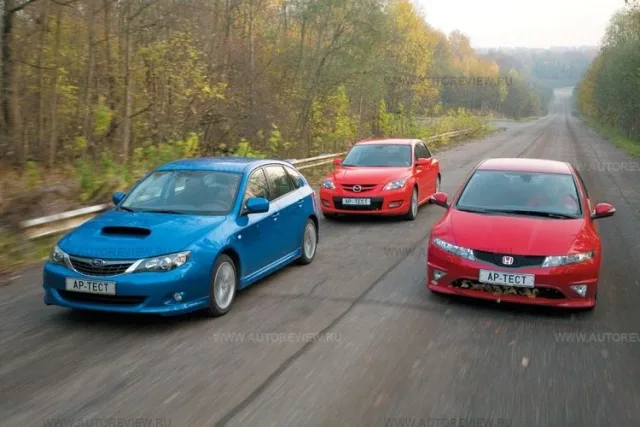
Fight-fight-fighters, the executioners have swooped in!
Whoever doesn't come to the fight, will get it worse.
Choose one of three — oak, nut, or millet?
The counting rhyme about oak, nut, or millet preceded brawls even in pre-revolutionary gymnasiums. We also expect a scuffle: at the Dmitrov test site — three "hot" golf-class hatches: Subaru Impreza WRX, Mazda 3 MPS, and Honda Civic Type R. Who will beat whom?
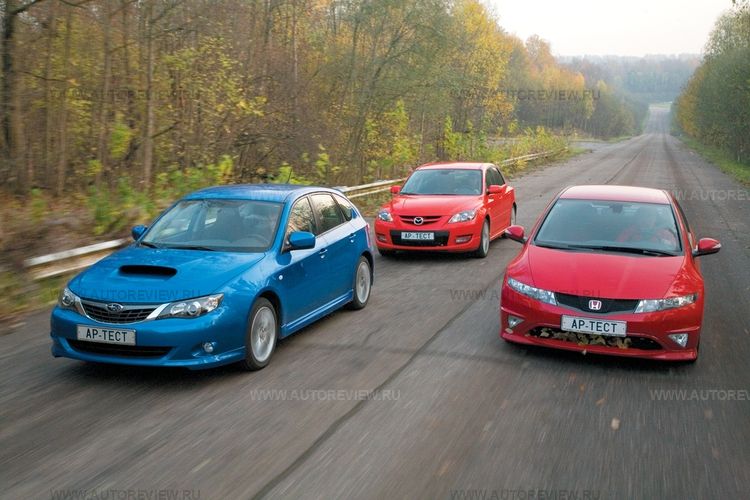
"Hot" hatchback Subaru Impreza WRX? This phrase grates on the ears of Subaru fans: after all, Impreza has always been either a sedan or a wagon! But now — a hatchback. Regular doors with frames, ordinary Korean-Chinese looks... And even the WRX version differs externally from the regular "atmospheric" Impreza 2.0R Sport only by the air scoop on the hood. So once again we understand those who look at the new Impreza — and are in no hurry to part with the old one.
Maybe it will grow on you?
| Honda Civic Type R | Mazda 3 MPS | Subaru Impreza WRX |
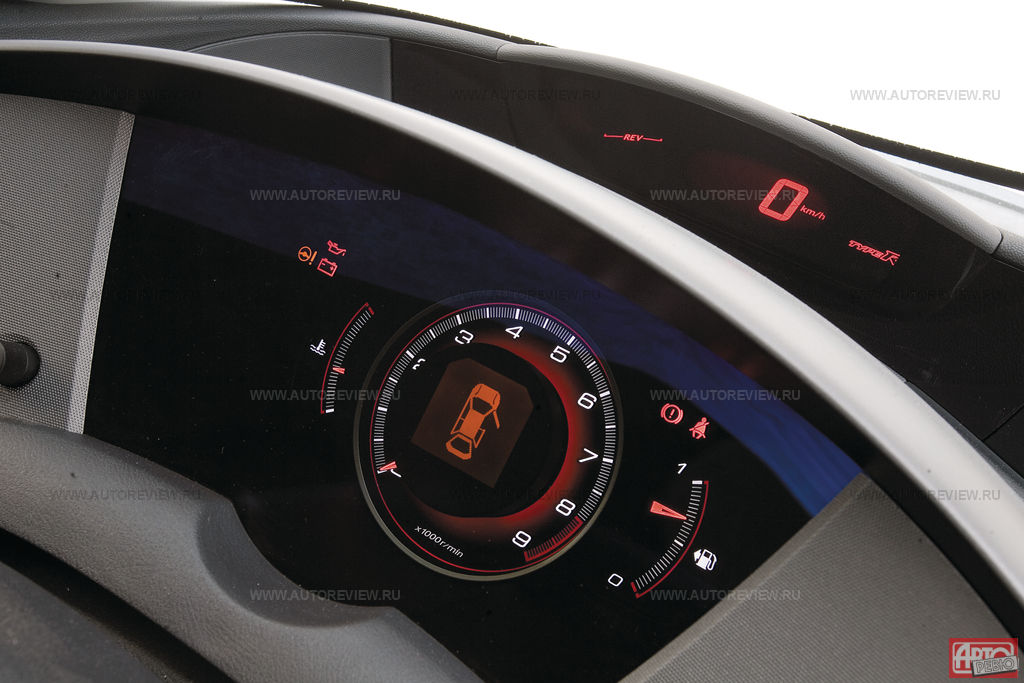 | 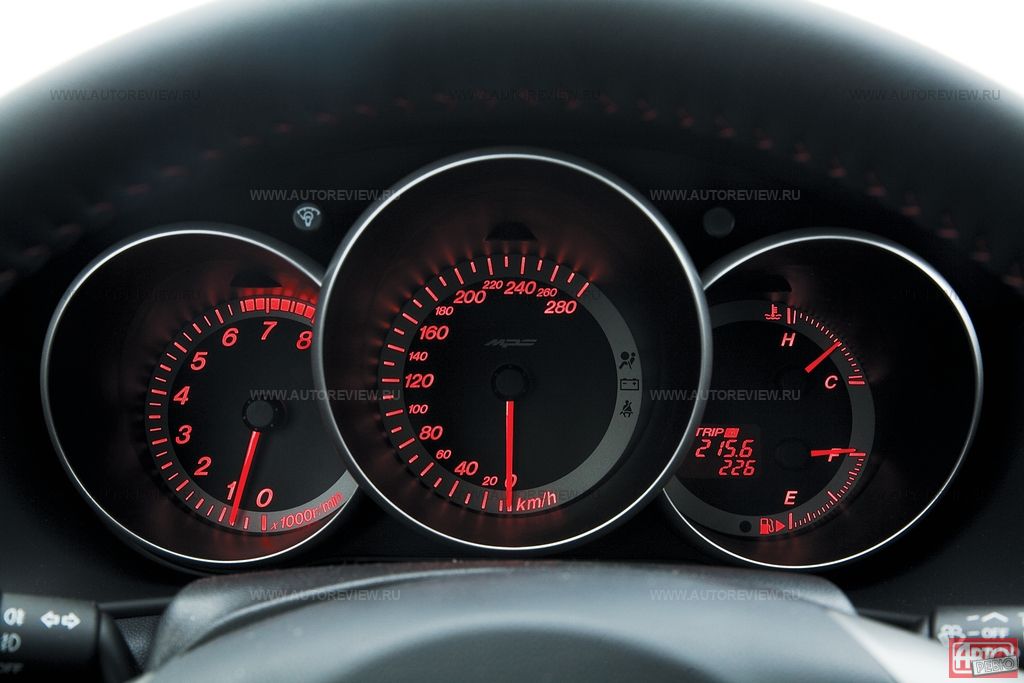 | 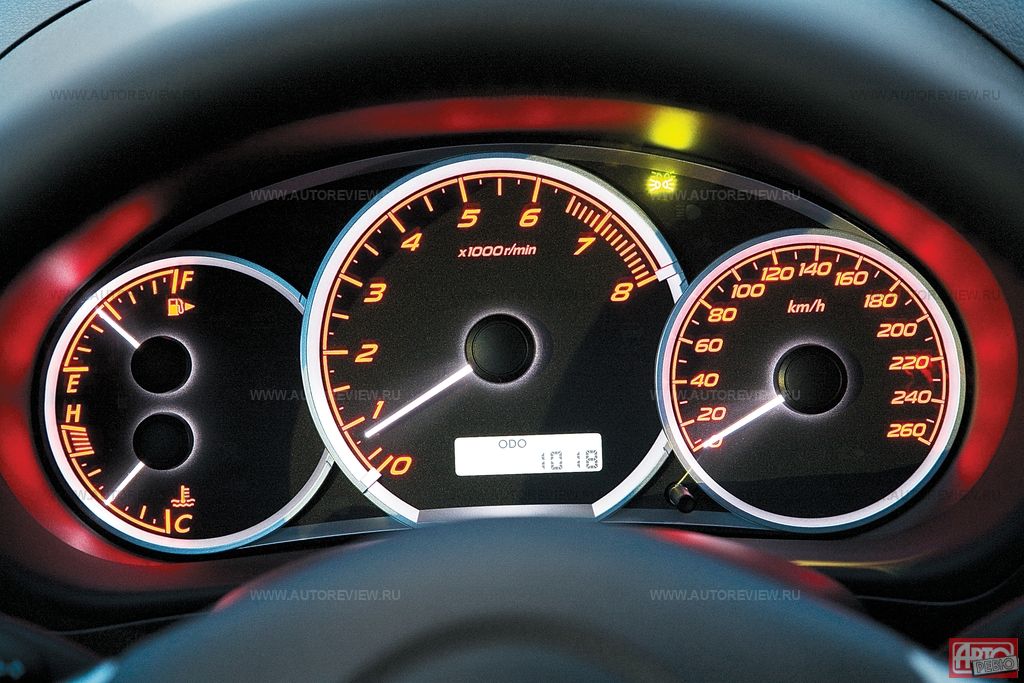 |
| The instruments in all three cars are informative, but the "vertical" needles in the Mazda's pods and the Subaru's central tachometer pale against the functional beauty of the Honda's instrumentation | ||
Inside, the new Impreza resembles more a family minivan: a monumental, well-built dashboard, modern ergonomics. The seating position is low but "civilian" — the bucket seat lacks firmness and lumbar support. The chunky steering wheel is comfortable, though it could be smaller, and the pedal box is too spacious — moving the foot from gas to brake sometimes requires lifting the heel off the floor. So the sport here is only in the centrally located tachometer and in the news broadcast on the radio.
The Mazda 3 MPS is also modest: you can recognize the MPS version only by placing it next to a regular "three". But the Mazda is beautiful in itself, as is the interior with Alfa Romeo-style instruments. And even though the center of the instrument cluster is a speedometer, not a tachometer, the seat, steering wheel, and pedals are more comfortable here.
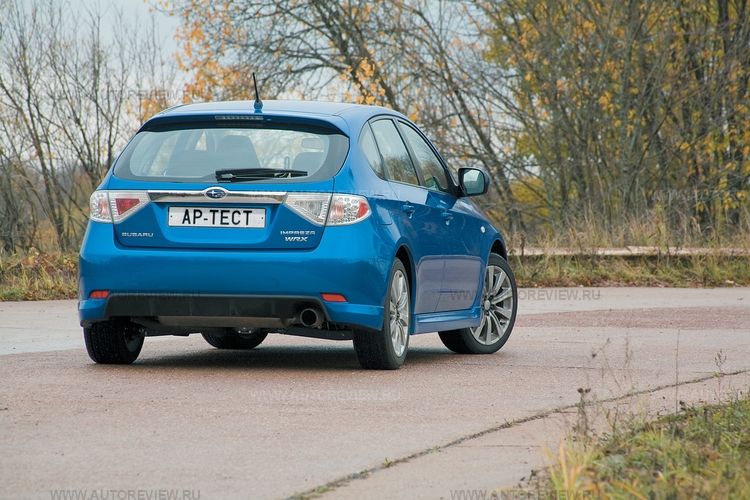
The one who is alien to modesty is Honda. That it is a Type R, the Civic shouts at the top of its lungs with the wide air intake in the front bumper. Cosmic design, futuristic interior. In the center of the two-tier instrument cluster is an analog tachometer flooded with red glow, the steering wheel and seats are stitched with red thread. It sets the mood! But the spoiler that obstructs rear visibility is disappointing. And also — minor ergonomic flaws like the climate control unit hidden behind the steering wheel.
The "charge" in our cars is different. The Impreza WRX has a 2.5-liter boxer turbo engine with 230 hp, plus permanent all-wheel drive. The Mazda 3 MPS, though front-wheel drive, has a self-locking differential, and the 2.3 DISI turbo engine develops as much as 260 hp! What can the Civic Type R with its naturally aspirated two-liter 200-hp engine and regular front-wheel drive oppose to them?
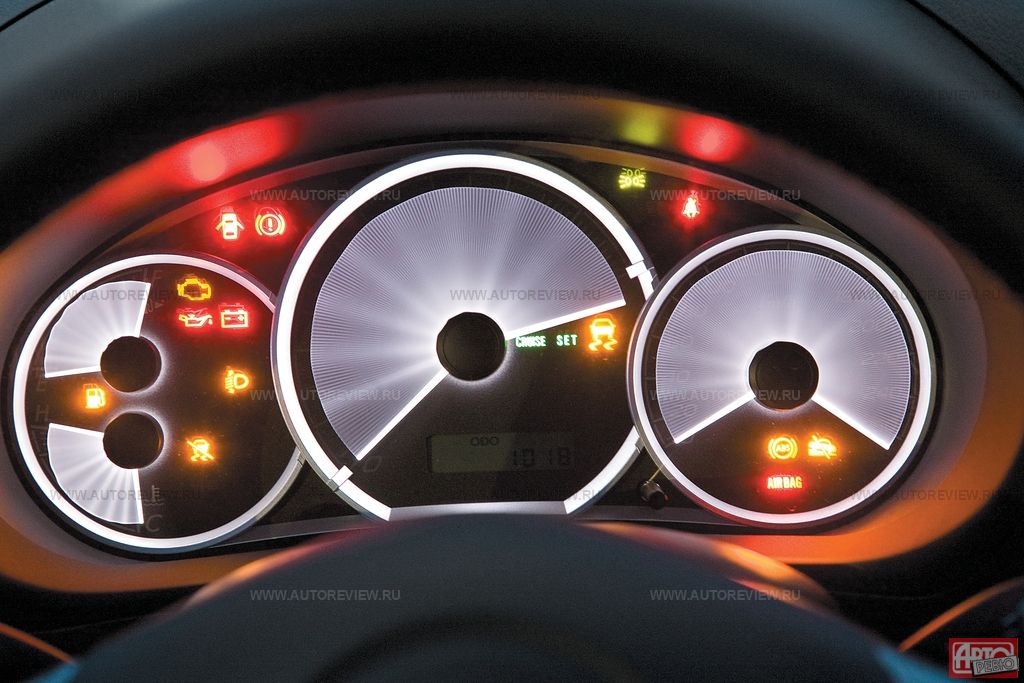 | 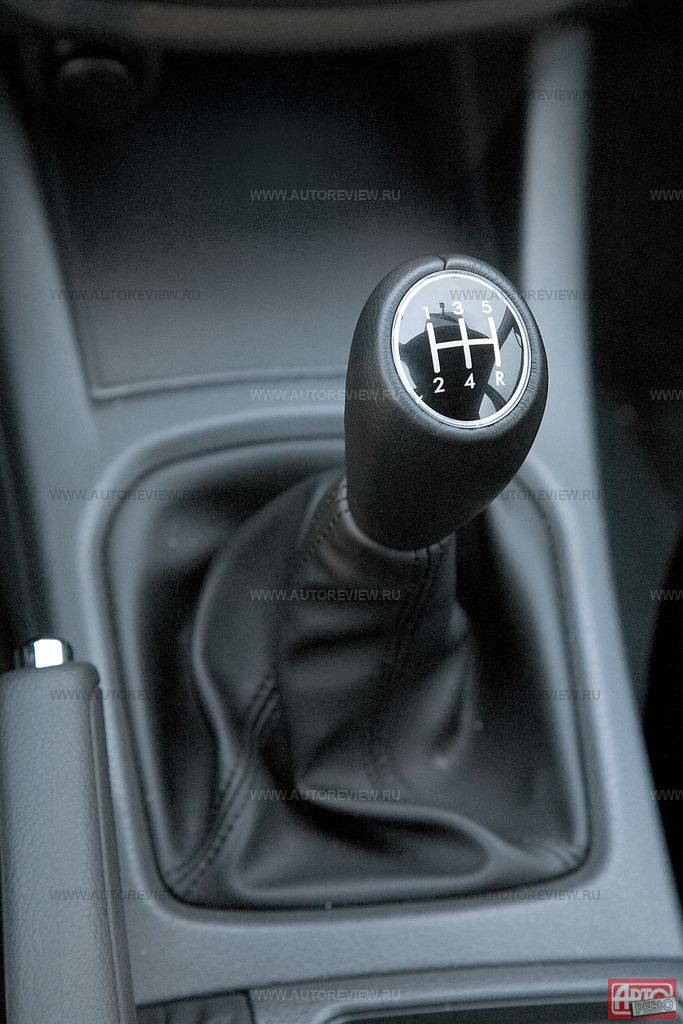 | 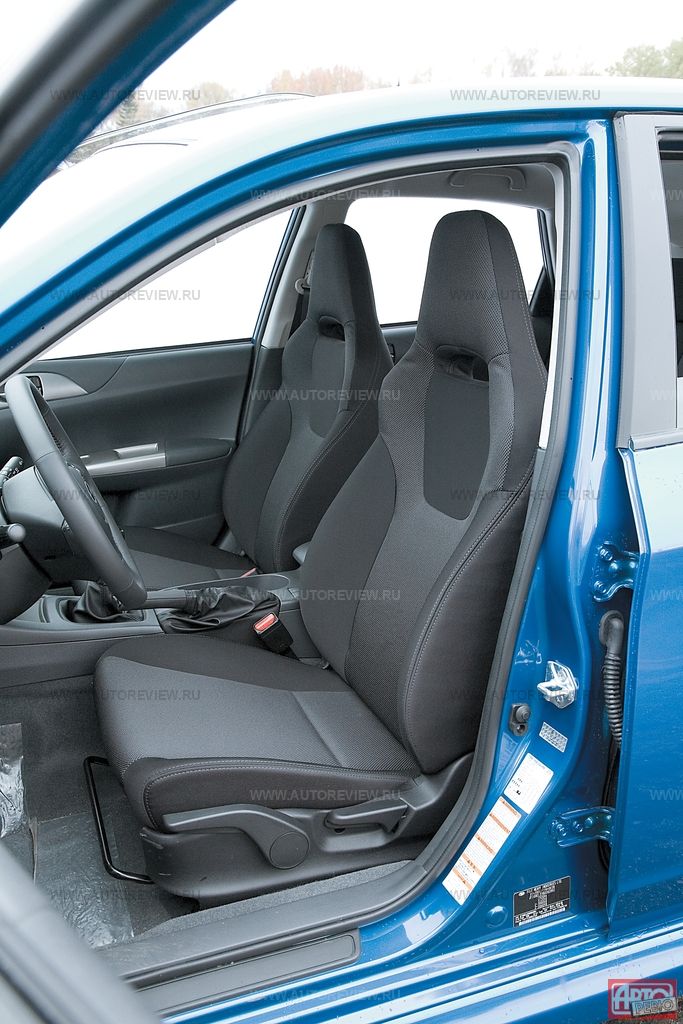 |
| When the ignition is turned on, the Subaru's instruments warm up, sweeping the needles | The Impreza WRX's gears engage flawlessly, though without sporty firmness | The Subaru's front seats are a bit soft, and they also lack lumbar support |
First, lightness: the Civic Type R weighs a good hundred kilograms less than its rivals. Second, Honda is still Honda: with a feisty roar, the naturally aspirated "four" instantly revs to the limit of 8300 rpm. Third, it has the "shortest" transmission: second gear "spins" only up to 86 km/h, and third up to 121 km/h. Out of habit, you keep hitting the limiter, and the short-throw shift mechanism sometimes provokes mistakes. At 5200 rpm, when the engine switches to "high-lift" cam lobes (signaled by the flashing "i-VTEC" symbol on the instrument panel), a gentle surge of acceleration is felt, the engine delivers a jubilant crescendo, and throttle response becomes simply magnificent!
But... No matter how you spin it, even up to the limit, this is not the old Honda "dual-motor" feel — rather a tribute to its memory. And in "traffic light brawls" with its turbo rivals, the Civic Type R is doomed to lose: the Mazda 3 MPS reaches 100 km/h half a second faster (6.6 s vs 7.1 s), and the difference in acceleration time to 150 km/h approaches three seconds. That's an eternity.
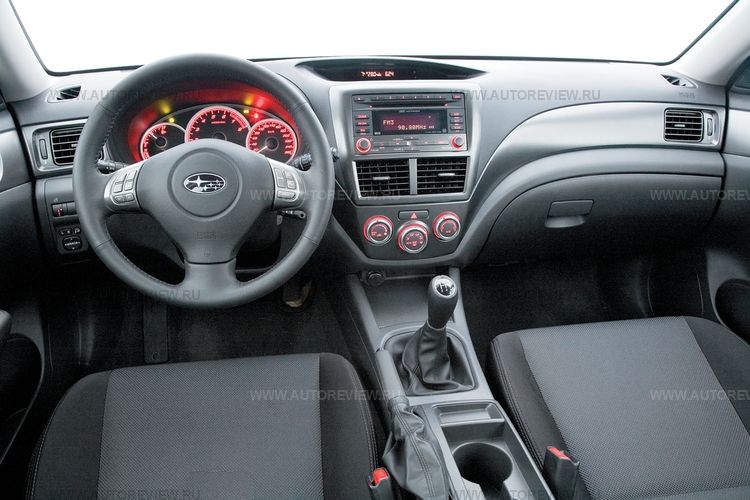
The Impreza's interior is well-assembled, but the minivan-like monumental front panel clashes with the WRX name
Yes, in the sprint, the Mazda 3 MPS covers everyone, including the Subaru! The transition to the turbo zone (2000—7000 rpm) stirs the nerves and presses you into the seatback — you just have time to shift. The engine growls bassily, throttle response is spot-on, and torque is abundant. And the top speed is over 240 km/h, while the Civic reaches 226.9 km/h.
And what about the Impreza WRX?
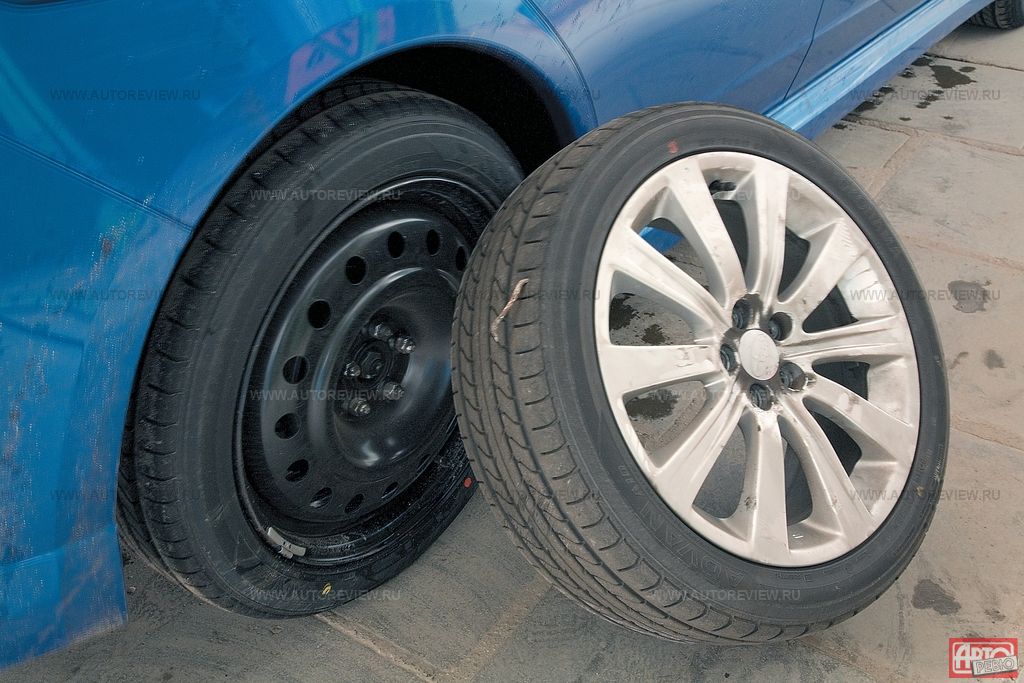 | |
| We "caught" a metal bracket and learned that the Subaru's spare wheel is steel. But in this test, it's the only full-size one: the Mazda relies on a space-saver, and the Honda on a repair kit with sealant | The wiper zone is heated |
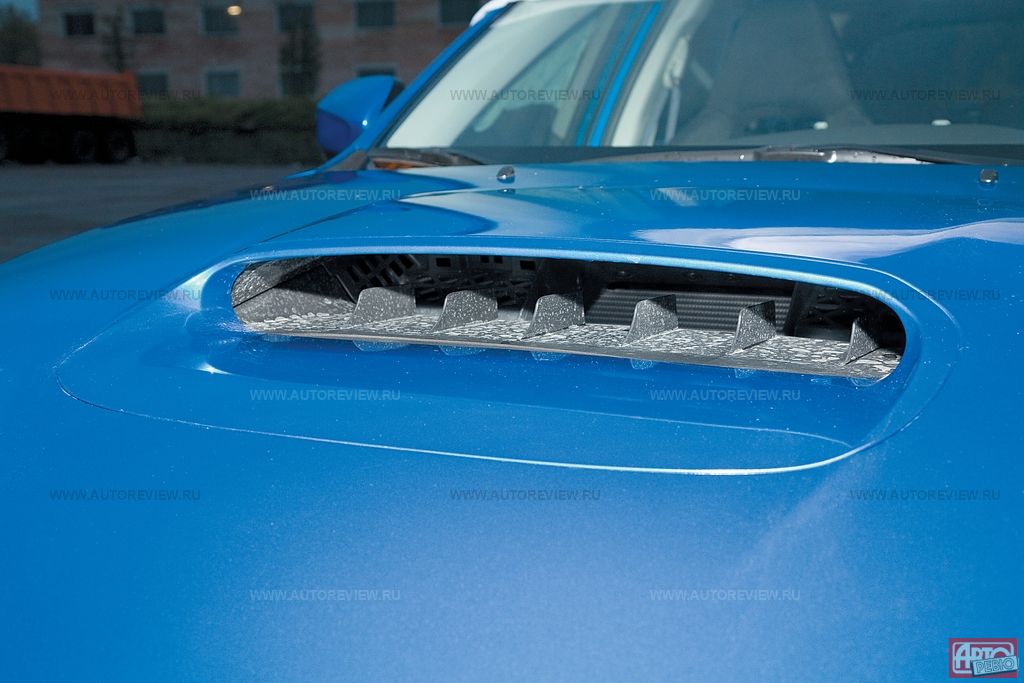 | 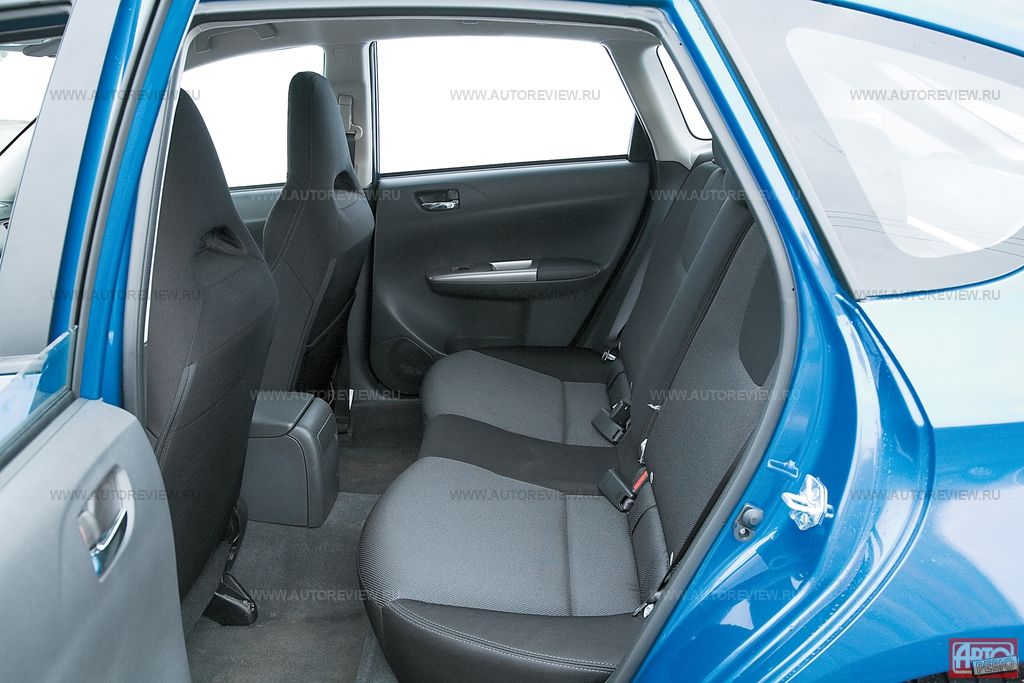 |
| The intercooler visible through the hood scoop has become lighter and more efficient than before | In rear space, the Subaru is beyond competition |
It starts even faster than the Mazda — after all, all-wheel drive! The acceleration is powerful, the turbo engine baritones with a hoarseness "at the top"... But as speed increases, the Impreza begins to lag behind the Mazda: if the Subaru reaches fifty almost a second earlier than the MPS, then to a hundred the WRX accelerates 0.2 s slower than the "three". And at the mark of 208.4 km/h, acceleration... gently stops — although there is still reserve under the pedal.
A speed limiter! And this is an Impreza WRX?
On the one hand, why not? After all, it's forbidden to exceed 110 km/h on the roads of the Russian Federation anyway. But on the other hand... The Impreza WRX is the heir to the glory of the first Impreza GT, the "people's supercar" for which there were simply no limits. And supercars are needed... No, not to break rules. But to know: you can always do more than others. The new Impreza WRX is not one of those: 209 km/h is its official "top speed".
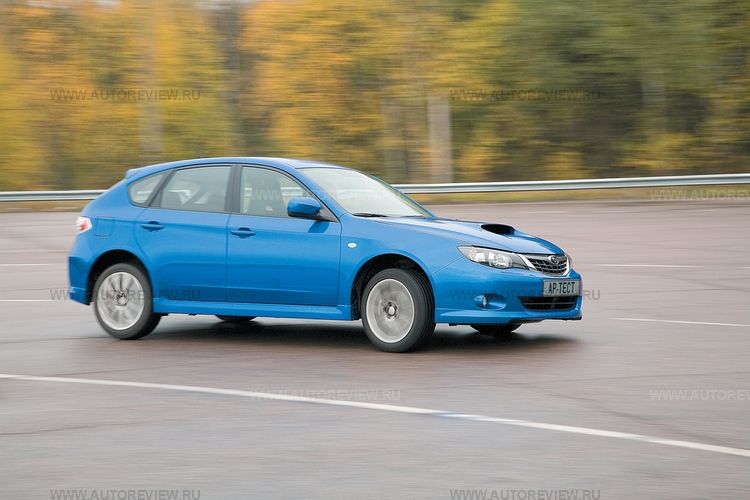
In motion, the Impreza WRX conquers primarily... with comfort! Active driving is hindered by sluggish responses and large body rolls
And if only the acceleration were emotional! But no — even the turbo surge here is somehow "atmospheric", smoothed out, like in a Honda. The sense of dynamics is also dulled by the over-damped accelerator — the Impreza responds to the driver's requests with a half-second delay. In addition, the high inertia of the all-wheel-drive transmission, coupled with a stiff and uninformative clutch pedal, prevents quick and smooth shifting with minimal interruption of power flow: on each gear change, the occupants nod their heads like Chinese bobbleheads.
And yet the Impreza will overtake the Mazda. Provided that there is no dry asphalt under the wheels.
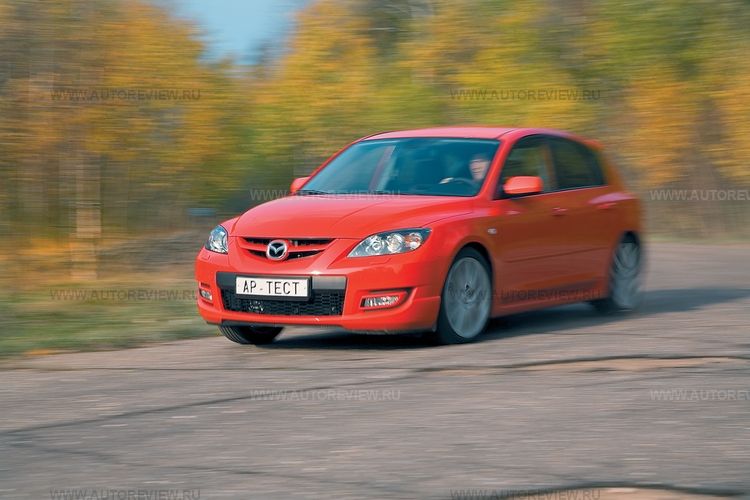
The Mazda 3 MPS is meaner, nimbler, and faster than its rivals
We deliberately conducted a series of launches on mixed surfaces, where under the right wheels of the cars there was dry asphalt, and under the left ones — basalt tiles slippery as ice. The Honda, devoid of a limited-slip differential, lags behind: either the stability control excessively strangles the engine, or (if VSA is turned off) one of the front wheels helplessly polishes the basalt. The Mazda 3 MPS is faster — the differential lock transfers part of the torque to the "asphalt" wheel, more effectively realizing traction. But the Impreza leaves no chance for both front-wheel-drive cars: all-wheel drive!
Brakes are fine on all. The leader is Honda: the shortest braking distance (40.1 m from 100 km/h) and instant reactions during emergency obstacle avoidance with ABS working. Next is Mazda: deceleration is dosed with jewel-like precision, ABS sportingly allows a brief wheel lock. But the braking distance is longer (41.6 m), and ABS adds nervousness to steering. And finally, Subaru — the braking distance is slightly shorter than Mazda's (41.1 m), but the pedal "sinks", the WRX noticeably dives on its nose and steers reluctantly during emergency braking. Somehow unsporty.
By the way, about sport: at different times we tested all three cars on the ring track in Myachkovo near Moscow. So: only the Mazda 3 MPS had no brake problems. And the Civic Type R and Impreza WRX made you experience "brake fade" already after the third lap.
 <\/a><\/td> <\/a><\/td> |  <\/a><\/td><\/tr> <\/a><\/td><\/tr> |
<\/td> Mazda's gears engage short and precise<\/tr>